As a business owner, your reputation is being shaped by online reviews every single day. Customers are talking about your brand and leaving reviews on Google, Yelp, Facebook, and other platforms, thus influencing the decisions of many others.
And as businesses, it is important for you to track these customer conversations to know what they are saying and how their reviews are impacting your visibility and credibility. If this is something you relate to, you’re in the right place.
In this blog, we will discuss online customer review data and insights to help businesses like yours understand the social media landscape, monitor your brand mentions, and effectively manage your online reputation.
Whether you’re a small local business or a large enterprise, this data can be your breakthrough to effectively manage your online reputation.
General Online Review Statistics
Online reviews are more than just customer feedback; they can largely shape consumer behavior and business success. Additionally, online review management can help businesses build trust, drive sales, and maintain a strong reputation.
Let’s dive into the numbers to see just how influential these online reviews can be.
- 97% of consumers read online reviews for local businesses. Of those, 41% say they “always” read reviews when researching a business, up sharply from 29% in 2025. [BrightLocal 2026]
- 97% of the consumers said that reviews and ratings were the most influential factors in their purchase decisions. [PowerReviews]
- 80% of consumers search online for local businesses at least once a week, while 32% of people search every day (or multiple times a day). [Soci.ai]
- 80% of consumers say they are less likely to buy a product that has no ratings or reviews. [PowerReviews 2025]
- 90% of consumers regularly consider how recently a review was written when deciding whether to buy from a business. [PowerReviews 2025]
- 77% of consumers expect the reviews available for a product to be no older than three months. [PowerReviews 2025]
- 60% of consumers prefer products with fewer but more recent reviews over those with higher volumes of older feedback. [PowerReviews 2025]
- 68% of consumers now require a minimum 4-star rating before they’ll consider using a business, up from 37% in 2025. And 31% now require at least 4.5 stars, nearly double the 17% who set that bar in 2025. [BrightLocal 2026]
- While reviews still continue to influence people, there is a decline in the influence of “user reviews on retailer websites” from 47% in 2024 to 35% in 2025. [PowerReviews]
- 80% of consumers say they are more likely to use a business that responds to all of its reviews, positive and negative. [BrightLocal 2026]
- Only 4% of consumers claim to never read online reviews. [BrightLocal 2025]
- 19% of consumers now expect same-day responses to their reviews, up from just 6% in 2025. And 81% expect a response within one week. [BrightLocal 2026]
- 36% of the customers are more likely to leave reviews for a business in exchange for a discount. [BrightLocal 2025]
- Consumers now use an average of 6 different review platforms when researching a local business. [BrightLocal 2026]
- 45% of consumers used AI tools like ChatGPT for local business recommendations in 2026, up from just 6% in 2025, making AI the third most popular recommendation source behind only Google and Facebook. [BrightLocal 2026]
- Email remains one of the top formats to ask for reviews. Nearly 40% of consumers are more likely to leave an online review when asked via email. [BrightLocal 2025]
- 81% of consumers say they write reviews of local businesses at least occasionally. [BrightLocal 2025]
- Trustpilot removed 4.5 million fake reviews in 2024, up 53% from 2023. Of those, 90% were caught automatically by AI and neural network models before any human ever saw them, making it the platform’s largest automated takedown on record. [Trustpilot Trust Report 2025]
Positive Online Review Statistics
While online feedback can be a double-edged sword, focusing on the positive reviews can yield significant benefits. These not only boost your online reputation but also drive sales and customer loyalty.
Let’s explore some key online review stats that highlight the power of positive feedback:
- 53% of the people say that a positive experience written about a business makes them feel positive about using a business. [PowerReviews]
- 42% of consumers say that they trust positive reviews as much as the personal recommendations made by their friends and family. [BrightLocal 2025]
- 71% of buyers only purchase from a business that has an average star rating of 3-star or above. [BrightLocal 2025]
The below graph shows some factors that make customers feel positive about a written review.

- A high volume of reviews directly impacts conversions. There’s a 292.6% lift in conversions if shoppers are exposed to 5,000 or more reviews. [PowerReviews 2025]
- 47% of consumers won’t use a business with fewer than 20 reviews. [BrightLocal 2026]
- Also, displaying positive reviews impacts conversions. Products that display at least one review show a 76.7% increase in conversions. [PowerReviews]
- 38% of consumers write about their positive experiences online, while 25% of them write about both their positive and negative experiences in reviews. [BrightLocal 2025]
Yelp Review Statistics
Yelp has solidified its position as a major player in the online review landscape. It’s a platform where consumers share their experiences, and businesses strive to maintain a strong online reputation.
To understand the true impact, let’s delve into some key Yelp review statistics that highlight its significance in today’s digital age.
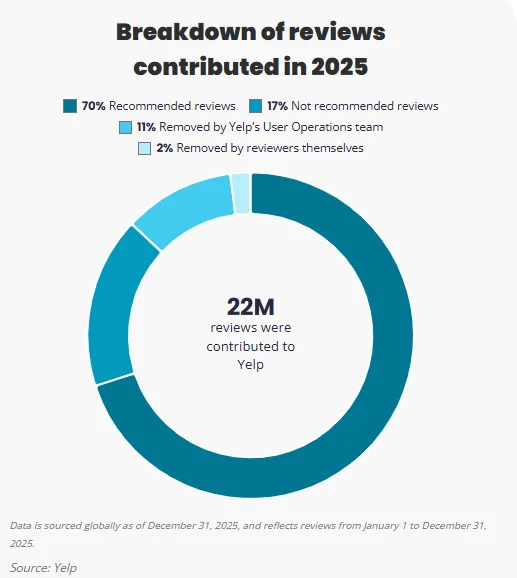
- Yelp had approximately 22 million new reviews in 2024. The graph below shows the breakdown of Yelp reviews during the same year. [Yelp Trust & Safety Report 2025]
- Approximately 44% of consumers in the US use Yelp to read online reviews about a business. [BrightLocal 2025]
- Yelp had approximately 330 million cumulative reviews as of 2025 and 76 million visitors on desktop and mobile. [Yelp Trust & Safety Report 2025]
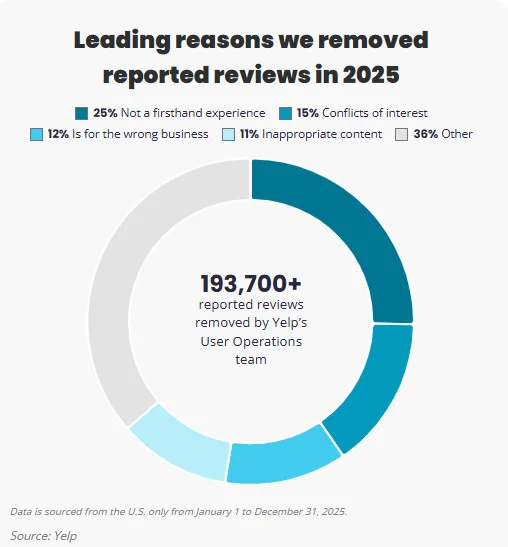
- In 2025, Yelp removed over 193,700 reviews for policy violations and blocked more than 39,000 spam-linked business listings from being published. 46,200+ reviews containing inappropriate content removed. The graph below shows the distribution of reported reviews removed by Yelp. [Yelp Trust & Safety Report 2025]
- Yelp closed more than 551,200 user accounts for violating its terms of service. [Yelp Trust & Safety Report 2025]
- Their user operations team rejected more than 39,200 new business pages that showed spammy behaviors and removed 1,040 existing business accounts linked to deceitful practices. [Yelp Trust & Safety Report 2025]
- In 2025, approximately 70% of Yelp reviews were “recommended” by Yelp’s automated recommendation software, down from 78% in 2024. [Yelp Trust & Safety Report 2025]
- According to Yelp’s 2025 YouGov survey, 88% of review readers believe AI-generated reviews shouldn’t be allowed on review platforms. [Yelp Trust & Safety Report 2025]
- 72% of review readers on Yelp say that they now read more online reviews than ever before, making purchase decisions. [Yelp Trust & Safety Report 2025]
- 88% of Yelp users said that they are more likely to trust a review that has a written review and not just a star rating. 71% of the readers said that they don’t even consider reviews that have just the star rating. [Yelp Trust & Safety Report 2025]
- Research from FTC Economist Devesh Raval found that only 2% of Yelp reviews had less than 100 characters, and as of December 2024, the average length of reviews on Yelp is 447 characters. [FTC Research Paper]
- 83% of review readers said that they are very likely to avoid a business that has fake or compensated reviews. [Yelp Trust & Safety Report 2025]
Google My Business Review Statistics
Most consumers check online reviews when they want to learn about a business. This helps them learn more about the quality of products and services it offers. Undoubtedly, customer reviews have become the most important factor in consumers’ decision-making.
Google reviews, in particular, extend beyond simply reflecting service quality; they play a pivotal role in shaping a business’s success in the competitive digital marketplace.
Here are some important Google review stats:
- 92% of consumers are likely to research products on Google or other equivalent search engines before making a purchase. [BrightLocal 2025]
- Google Reviews is a top business review platform, and 83% of consumers are likely to check Google when looking for reviews about a business. [BrightLocal 2025]
- BrightLocal notes Google use dipped from 87% (2023) to 81% (2024) for finding reviews then climbed again to 83% in 2025. [BrightLocal 2025]
- In 2026, the share of consumers using Google to find local business reviews dropped from 83% to 71%, a 12-point decline in a single year, the steepest single-year drop BrightLocal has recorded. AI tools and social platforms are absorbing the shift. [BrightLocal 2026]
- The following graph shows the online share of Google reviews for different industries.

- Google has nearly 80.8% of the total online reviews. Its dominance in reviews stems from its unmatched visibility in searches and Google Maps. [BrightLocal]
- The median number of reviews on Google cumulatively across all categories is 14, and approximately 17% of listed businesses have zero reviews. [BrightLocal]
- Google uses advanced machine learning algorithms to identify fake reviews. In 2024, they blocked or removed more than 240 million policy-violating reviews. [Google Blog]
- Additionally, Google blocked or removed more than 12 million fake business profiles and placed posting restrictions on over 900,000 accounts for repeated violation of their policies. [Google Blog]
Facebook Review Statistics
Facebook, being an interactive platform, has a massive user base, and both online and offline purchase decisions are greatly influenced by Facebook reviews (now Facebook Recommendations).
Let’s explore how this social giant impacts small and big enterprises and why your brand can’t afford to ignore it.
- Nearly 40% of people around the world use Facebook to find business reviews. However, this number has gone down from 48% in 2022 to 40% in 2025. [BrightLocal 2025]
- 34% of consumers in the USA named Facebook as their most trusted review platform. [BrightLocal 2025]
- Consumers rate online profiles on platforms like Google Maps and Facebook as helpful; nearly 99% of people say these tools are at least “moderately satisfactory.” [BrightLocal 2025]
- About 35% of people choose Facebook to write reviews about a local business. [BrightLocal 2025]
Reputation Management Statistics
Reputation management is not just about keeping customers happy but also ensuring that your online reviews work for you.
Let’s explore some review statistics that highlight the power of customer feedback and its influence on consumer behavior:
- In 2020, 79% of consumers trusted online reviews as much as personal recommendations, but in 2025, that number had significantly dropped to 42%. [BrightLocal 2025]
- Nearly 63% of people are likely to lose trust in a business if they see negative written reviews about it. [BrightLocal 2025]
- 60% of consumers say that negative reviews would discourage them from using a business. [BrightLocal 2025]
- The value of a positive online reputation cannot be forgotten. About 91% of consumers say that online reviews impact their perception of a business. [BrightLocal 2025]
- 89% of consumers expect business owners to respond to their reviews, up from 81% in 2025. [BrightLocal 2026]
- The online reputation management software market is projected to grow from $6.88 billion in 2025 to $14.01 billion by 2031, at a CAGR of 12.59%. [Mordor Intelligence]
- Consumers read an average of 7 reviews before trusting a business. [BrightLocal 2025]
- About 38% of consumers would consider using a business with a minimum rating of 4 stars. [BrightLocal 2025]
- 7% of the consumers say that reading long and detailed reviews makes them feel positive about using a business. [PowerReviews]
Industry-Specific Online Review Statistics
Let us now talk about industry-specific review stats for some popular industries like healthcare, hospitality, retail, and more.
The understanding of these trends can help businesses leverage reviews to attract more customers, improve services, and outshine competitors.
Let’s dive into how customer reviews shape success across various industries:
Review Statistics for Healthcare Businesses
- 77% of patients read online reviews before choosing a provider, and 69% say positive online reviews are extremely or very important. [Tebra 2025 Patient Perspectives Report]
- 84% of patients check online reviews before choosing a new healthcare provider. [rater8 2025 Report]
- 40% of patients say reviews have caused them to stop a care plan or change course. [rater8 2025 Report]
- 55% of patients have canceled or avoided booking with a provider because of online reviews. [rater8 2025 Report]
- 73% of patient expect a healthcare provider to have at least a 4-star rating before they’ll consider engaging. [Healthgrades]
Review Statistics for Hospitality Businesses
- About 72% of travelers frequently or always read reviews before deciding where to stay or what to do, according to a global Tripadvisor/Ipsos MORI survey of more than 23,000 travelers across 12 markets. [Tripadvisor – Ipsos MORI]
- 92% of hotel guests read reviews before booking a hotel, according to Alchemer’s 2026 Hotel Research Report, which analyzed approximately 1,400 guest reviews across Hyatt, Hilton, and IHG. [Alchemer 2026 Hotel Research Report]
- 77% of travelers are more likely to book when business owners respond to reviews, according to a Tripadvisor study conducted with Ipsos MORI polling more than 23,000 travelers and diners across 12 markets. [Tripadvisor – Ipsos MORI]
- A 1-point improvement on a 5-point hotel rating scale allows hotels to raise room rates by up to 11.2% without losing market share. Additionally, a 1% increase in a hotel’s online reputation score drives an average 1.42% increase in RevPAR at midscale properties. [Cornell Center for Hospitality Research]
- 76.6% of travellers read hotel reviews on Google, followed by Expedia, Booking.com, and Trustpilot. [BrightLocal 2025]

Review Statistics for Restaurant
- 46% of consumers turn to Google Reviews for restaurant ratings, making it the most-used platform, followed by Yelp (23%), TripAdvisor (9%), and OpenTable (6%). [Toast Restaurant Survey]
- Nearly 1 in 5 people (18%) admit they don’t usually check reviews before choosing where to eat. [Toast Restaurant Survey]
- Only 10% of customers said that they write reviews for restaurants after their visit. [Toast Restaurant Survey]
- 43% of people won’t go to a restaurant if its rating is below 3–3.5 stars (26% draw the line below 3 stars, 17% below 3.5 stars). [Toast Restaurant Survey]
- 46% of consumers say they would not dine at a restaurant without reading reviews. [Toast Restaurant Survey]
- 30% of people said that they read restaurant reviews or look at photos while at the table deciding what to order. [Toast Restaurant Survey]
- 65% of diners say food quality is the #1 thing they look for in restaurant reviews. [Toast Restaurant Survey]
Review Statistics for Software Products and B2B Services
- 77% of buyers looked at user reviews when making a software purchase. [TrustRadius 2024]
- 31% of buyers say public product review websites are the most consulted information source when planning to purchase goods/services for their company. [G2 2024 Buyer Behavior Report]
- 58% of software buyers read user reviews on third-party review sites, while 46% read user reviews on vendor’s site. [TrustRadius 2024]
- 51% of buyers say independent software/service review sites are more valuable than analyst firms at the discovery stage. [TrustRadius 2024]
- 22% of people watch video reviews when buying a software product. [TrustRadius 2024]
- 54% of buyers speak with a user before they themselves purchase a SaaS tool. However, vendors estimate this number to be lower, at 38%. [TrustRadius 2024]
- Approximately 17% of buyers use Gen AI chatbots and approximately 15% of buyers use software review sites to shortlist vendors. [G2 2024 Buyer Behavior Report]
- 73% of software buyers say they regularly or sometimes see fake reviews online, which is exactly why trusted review platforms matter in software decisions. [G2 2024 Buyer Behavior Report]
- When evaluating a software product on a review site, buyers prioritize review content (19%) and self-serve info like pricing/demos (19%) as the top decision factors. [G2 2024 Buyer Behavior Report]
Emerging Trends in Online Reviews
Online reviews greatly help people discover, evaluate, and choose brands they want to interact with, but how these reviews are created and consumed is changing rapidly.
Let us now discuss emerging trends transforming online reviews into powerful tools for connection and business success.
- Reviews are becoming multi-platform by default. 36% of consumers use two review sites, and 41% use three or more when deciding on local businesses. [BrightLocal 2025]
- Social platforms are increasingly being used as “review platforms.” 37% of consumers now use Instagram and 29% use TikTok as alternative local business review platforms, up from 34% and 23% in 2025. [BrightLocal 2026]
- Apple Maps nearly doubled as a local review discovery source, growing from 14% of consumers in 2025 to 27% in 2026, driven by iPhone users shifting away from Google for local business discovery. [BrightLocal 2026]
- Photos/videos inside reviews materially lift purchase likelihood. 61% of consumers are “very likely” to purchase when reviews include user-generated photos/videos. [PowerReviews]
- AI is also entering the “review response” workflow. 58% of consumers preferred an AI-written review response when shown one written by a human vs. one generated with AI. [Yelp Trust & Safety Report 2025]
- Platforms are explicitly filtering out “low-quality / AI-ish” reviews, not just removing “fake” ones. Approximately 17% of submitted reviews on Yelp were “not recommended” by its automated recommendation software in 2025. [Yelp Trust & Safety Report 2025]
- Employee incentive programs are now a major review integrity problem. Tripadvisor removed 360,000 reviews in 2024 that were linked to employee incentive programs. [Tripadvisor Transparency Report]
- Amazon blocked more than 275 million fake reviews in 2024, including reviews tied to paid review brokers operating across multiple countries. Amazon has now filed more than 150 lawsuits against fake review brokers since 2015, targeting operations in China, Europe, and North America. [Amazon]
Why You Can’t Ignore Online Reviews
Customer reviews are essential because they greatly impact the success of your business. Reviews act like the digital word-of-mouth that helps customers gain deeper insights into a company.
The way you respond to or choose not to reply influences your online reputation. So, here are 5 reasons why you shouldn’t ignore any consumer review about your business.
- Building Trust and Credibility: Positive reviews build trust and credibility. They reassure potential customers that your business is reliable and delivers on its promises.
- Improve Search Engine Rankings: Search engines like Google often consider online reviews as a ranking factor. More positive reviews can improve your search engine visibility, attracting more organic traffic.
- Driving Sales and Conversions: Positive reviews can significantly impact your sales. Customers are more likely to choose a business with a strong online reputation.
- Identifying Areas for Improvement: Negative reviews can provide valuable insights into areas where your business needs to improve. By addressing these issues, you can enhance customer satisfaction and loyalty.
- Engaging with Your Customers: Engaging with your customers by responding to both positive and negative reviews demonstrates that you value their feedback and are actively involved in the conversation. In fact, 36% of consumers said a business could stand out by responding publicly to reviews, indicating they look for these interactions.
Why Online Reviews Are So Powerful
Online reviews have become a cornerstone of consumer decision-making, holding the power to build or break trust in an instant. This is why businesses must recognize the importance of customer reviews in shaping their reputation and long-term success.
Let’s explore four reasons why online reviews hold such immense power and how they shape the success of businesses.
Consumers trust reviews and want to buy from businesses that have good customer feedback. These reviews are your biggest source of social proof, and they have a clear impact on the buying decisions of your consumers.
2. Give you Visibility
Many shoppers read reviews on social media and platforms like Google, Facebook, Yelp, etc, to make better buying decisions. These review platforms have their own specific algorithms for ranking and displaying content. They prioritize original and unique content.
Positive reviews on these sites can help fuel these algorithms, making your brand more visible in search results and boosting its overall online presence.
3. Enhance your Trustworthiness
A stream of positive reviews will build people’s trust and credibility in your brand. Many buyers will hesitate to buy from you if you have negative reviews and ratings below three stars. This is a narrow window of opportunity for your competitors who have better reviews than you.
By consistently delivering excellent customer experiences and encouraging positive reviews, you can enhance your brand reputation and increase customer trust.
4. It Impacts Your Sales
Positive reviews are powerful drivers of revenue. They enhance your brand’s credibility, attract more customers, and boost repeat business. Even small improvements in ratings can positively impact your sales.
Simply put, when people like what they see, they’re more likely to choose your business.
What These Online Review Stats Mean for Your Business
Whether you are a small local shop or a global enterprise, your reviews determine how much trust people place in your brand and the sales you generate.
But managing these reviews manually across all platforms can be challenging. This is where tools like SocialPilot Reviews can help you collect, manage, and market your reviews and take charge of your business’s online reputation.
By managing these reviews well, you will also get an edge over your competitors, which is quite important in today’s competitive world.
Still in doubt? Try out the free plan of SocialPilot Reviews and experience the ease of review management.