

If you already post on Bluesky for your business or another brand, you’ve probably searched for the best time to post on Bluesky and landed on five different answers. One site says Saturday evening. Another says Wednesday morning. A third gives you a regional breakdown with no source behind a single number in it.
That’s the actual problem with this topic right now. You’re not short on advice. You’re short on advice you can trust enough to act on, especially when you’re the one who has to explain the posting schedule to a client or a boss.
At this point, you don’t need one more Bluesky best time to post calculator that spits out a single hour with nothing behind it.
If you only take one thing away on when to post on Bluesky, this guide gives you a straight answer, built by comparing and analyzing the posting times of 5000 accounts and more than 1 million posts. This guide also explains why the when to post question on Bluesky doesn’t work the same way it does on Instagram or TikTok, and what that change means for you.
How do we identify the best time to post on Bluesky?
Our data analysis team reviewed more than 1 million Bluesky posts published from 5,000 Bluesky accounts connected to SocialPilot. Rather than a one-time analysis, this runs on an AI-driven system built into SocialPilot that continuously tracks engagement, by hour and by day, on every connected Bluesky account. The list refreshes at regular intervals, so you’re always seeing best-time suggestions based on an account’s most recent posts and its actual engagement, not a static figure that goes stale. In this analysis, we have shared universal patterns from that analysis that hold up across most accounts, industries, and regions.
Why “Best Time to Post” Means Something Different on Bluesky
Before you touch a posting schedule, it helps to know what you’re actually optimizing for. On most platforms, “best time to post” is a bet on an algorithm. On Bluesky, part of it isn’t a bet at all.
The Chronological Following Feed
Bluesky’s default Following feed shows posts from the accounts you follow in the order they were published, nothing more. There’s no ranking model deciding what you see first. So, the first post you see would not be more than a few hours old, as shown in the image below.

Bluesky’s team has described this in one of their 2023 blog titled “Algorithmic Choice” where they talk about a purely time-ordered feed as “an algorithm (albeit a very simple one),” which is their way of saying: this isn’t personalization, it’s just a clock.
That single fact is why timing matters more here than it does elsewhere. On an algorithmic feed, a strong post can get pulled back into view hours or days later. On Bluesky’s Following feed, if your followers aren’t scrolling when you post, your post just moves down and out of sight as newer posts stack on top of it.
It’s the timing that determines whether your existing followers will see the post at all. For the fuller picture of how Bluesky’s feeds and setup work beyond just timing, SocialPilot’s guide to how Bluesky works covers that in detail.
Where Algorithms Do Show Up: Discover and Custom Feeds
The Following feed isn’t the only way people use Bluesky, though. The Discover feed does use engagement and relevance signals, mixing “a global view of what’s trending” with posts from your network and people close to it. The image below shows what a Discover feed looks like.
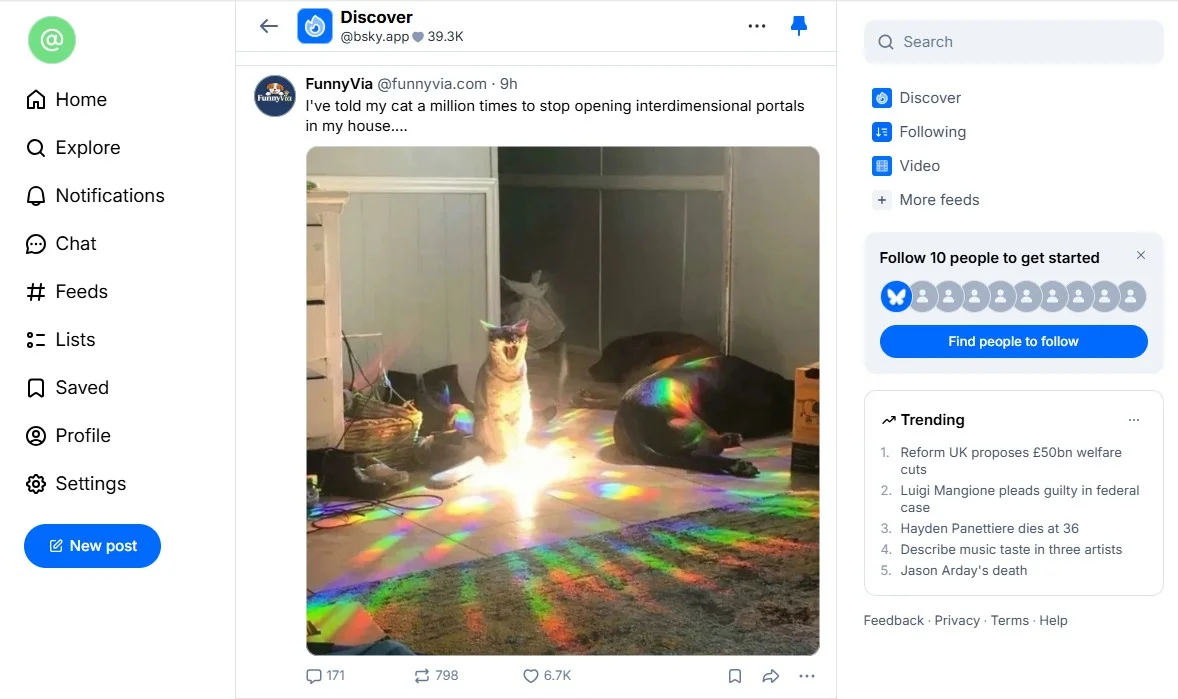
On top of that, anyone can build or install a custom feed, tuned to a topic, a hashtag, or even engagement volume, and plenty of active Bluesky users live inside those feeds more than the default one.
Getting picked up by one of these feeds comes down to what that feed is actually tracking, replies, keywords, engagement volume, none of which care what time you posted. Discover and custom feeds run on their own logic, not a publish timestamp.
If you’re chasing broader reach beyond your follower count, that’s a discovery and content problem, not a scheduling one. Getting into an active Starter Pack moves that needle far more than timing does, so it’s worth keeping the two goals separate in your head.
The Best Times to Post on Bluesky, Based on Real Data
SocialPilot’s own AI Suggested Time engine has analyzed 5,000 connected Bluesky accounts and more than 1 million posts, learning what actually drives replies and reposts on the platform. The windows below reflect that analysis.
Best Time to Post on Bluesky on Weekdays
Weekday mornings consistently outperform weekends on Bluesky, especially Tuesday and Wednesday. If you’re deciding on the single best day to post on Bluesky, a weekday morning is the honest answer, not a Saturday.
| Tag | Best Morning Window | Best Evening Window |
| Montag | 9-11 UHR | 6-8 UHR |
| Dienstag | 9–11 AM (most posted time slot of the week) | 6-8 UHR |
| Mittwoch | 9–10 AM (best time of the week) | 6-8 UHR |
| Donnerstag | 9-11 UHR | 7-9 PM |
| Freitag | 9-11 UHR | 5–7 PM (least posted evening window of the week) |
Best Time to Post on Bluesky on Weekends
Weekends don’t disappear from the picture; they just shift later and get less precise. Saturday recommendations cluster around late morning into early afternoon, and Sunday shifts slightly later into the early afternoon. The table below mentions the best posting times on weekends on Bluesky.
| Tag | Best Morning Window | Best Evening Window |
| Samstag | 11 AM–2 PM | 7-9 PM |
| Sonntag | 12 PM–3 PM | 7-9 PM |
The Weakest Posting Window on Bluesky: Late Night Into Early Morning
Our analysis shows that late night through very early morning is the dead zone, when you shouldn’t be posting at all. This rule applies to every day of the week, not just on specific days.
| Tag | Weakest Window |
| Monday–Sunday | 12 AM–7 AM |
One honest caveat before you lock in a schedule: the windows above are general averages across time zones, not a guarantee for your specific account. As some Bluesky users have mentioned on Reddit, their peak times vary a lot depending on who they follow across time zones.
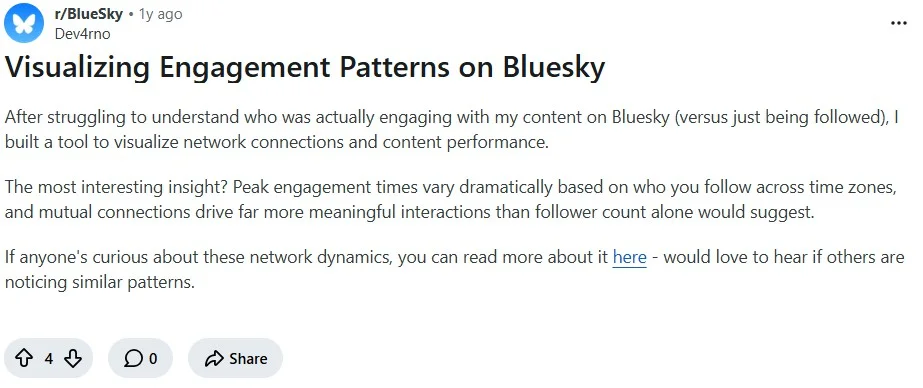
We completely agree with this and advice you to treat the above tables as your starting point and then let your own account’s activity tell you where to adjust from there.
Why a Single Global Time Doesn’t Really Work
Every number above is an average across thousands of posts and, almost certainly, hundreds of different time zones. That matters more on Bluesky than you might expect.
Where Bluesky’s Users Actually Are
Bluesky closed out 2025 with 41.41 million registered users, up nearly 60% from 25.94 million at the start of the year, nach Bluesky’s own 2025 Transparency Report. That’s real growth, and it’s also spread across a genuinely global user base. As of July 2026, the United States accounts for roughly 48% of traffic to Bluesky’s site, with the UK, Germany, Japan, and Canada rounding out the next largest markets, each in the 5 to 10% range, according to SimilarWeb’s traffic analytics for bsky.app.
If you’re trying to profile your own audience against the wider platform, keep in mind that Bluesky user demographics are still being mapped out. Reported estimates on age and gender split vary enough between sources, so treating any single figure as settled would be premature.
Daily active user estimates have the same problem, ranging anywhere from 1.5 million to 4.5 million depending on who you ask. Bluesky doesn’t publish daily or monthly active users on a regular basis, so treat any specific Bluesky growth statistics you see, including the ones in this guide, as directional rather than exact.
Here’s what that spread actually means for your posting schedule: a “best time” built on a US-heavy dataset is going to under-serve an account with a meaningful UK, Japanese, or German following. A single global clock time was never going to fully hold up against that kind of spread.
Finding Your Own Best Time Instead of a Universal One
Rather than trying to find one universal best time to post on Bluesky, figure out where your specific followers actually are. If you already run other social accounts, your existing audience demographics are a reasonable starting point, since a lot of overlap tends to exist between platforms for the same brand or creator.
From there, the consensus windows above become a starting hypothesis you test against your own account, not a rule you follow blindly.
How to Actually Use This Best Posting Time on Bluesky
You’ve got the data and the reason it isn’t one-size-fits-all. Here’s what to actually do with both.
Post for Your Followers’ Time Zone, Not a Universal Clock
Start with the Tuesday or Wednesday morning window if your audience skews US-based, since that’s where the consensus above is strongest. If a meaningful share of your following sits in the UK, Japan, or elsewhere, shift your primary posting slot toward their morning or evening hours instead of defaulting to Eastern or Pacific time.
That’s a small adjustment, but it can have a significant impact on your Bluesky engagement.
Schedule Ahead Instead of Chasing a Perfect Hour
Bluesky still doesn’t support native post scheduling, so hitting a specific window consistently means using a third-party tool rather than remembering to open the app at exactly 5 p.m. every Saturday. SocialPilot’s Bluesky Scheduler lets you queue and manage your Bluesky posts in advance, right alongside every other platform you’re already running from the same dashboard. It also has an AI Suggested Time feature that reads your own account’s engagement history and recommends specific posting slots for the days ahead.
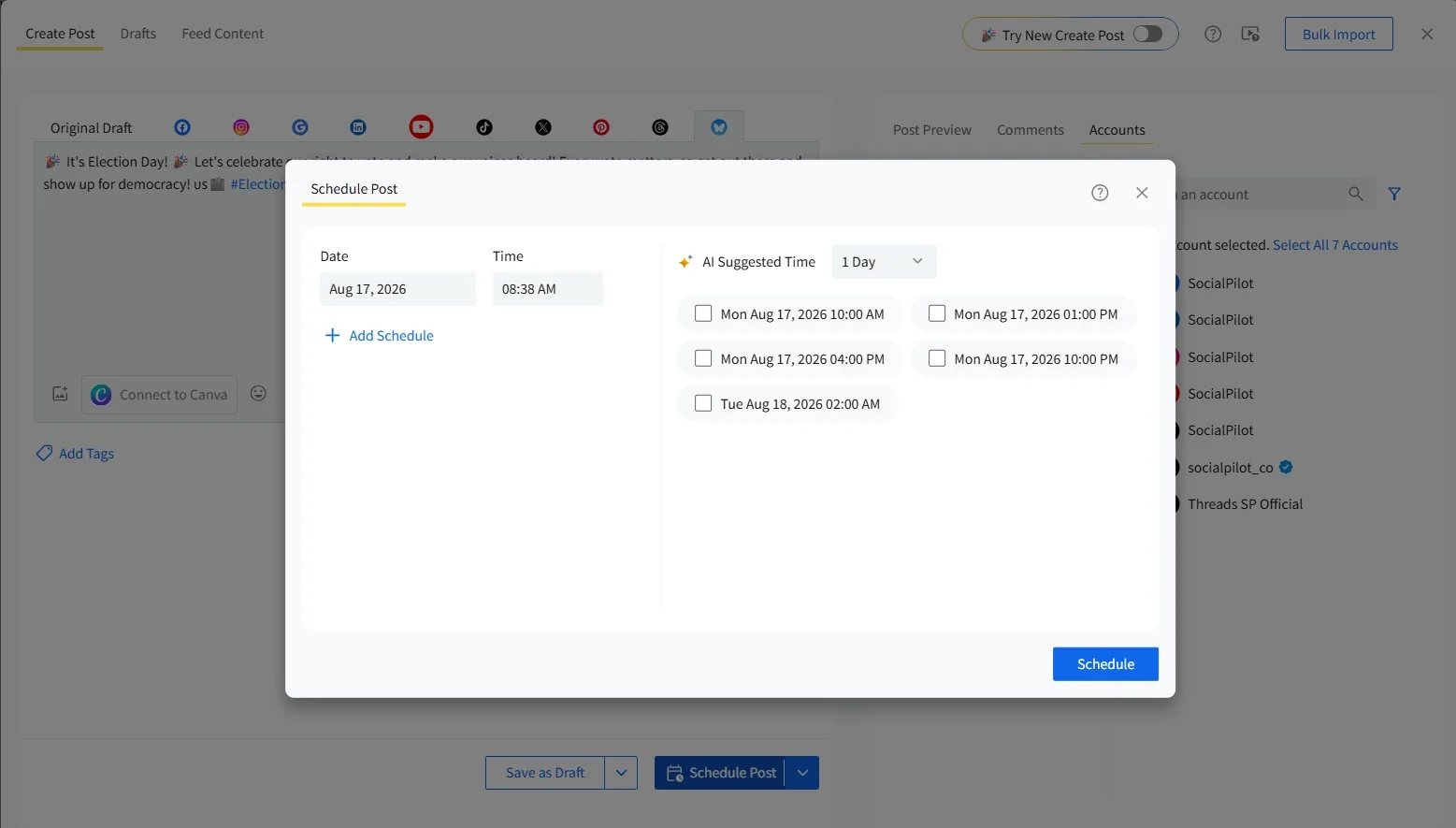
For a complete process walkthrough, you can read this SocialPilot’s guide to scheduling Bluesky posts that talks about scheduling, editing and managing Bluesky posts using SocialPilot, so that you can manage this account the same way you manage other accounts on social media.
This matters more if you’re managing Bluesky alongside four or five other accounts already. A recurring slot removes one more thing you have to remember every day.
Let Your Own Analytics Override Generic Advice
Once you’ve picked a starting window and run it for a couple of weeks, check what actually happened. Use a dependable Social-Media-Analysetool and look at which posts got replies and reposts fastest, since early engagement is what determines whether a post gets picked up more broadly at all.
If your own numbers consistently point somewhere different than the consensus tables above, trust your numbers. They describe your actual followers and not the generic Bluesky audience.
Timing is just one piece of the puzzle, though. Once you’ve settled into a rhythm, SocialPilot’s Bluesky marketing strategy guide is worth a look next. This guide covers the posting cadence and content mix that go alongside timing.
Where This Data Comes From
Being honest about sourcing matters more on a topic this thin, so here’s exactly what this guide is built on.
What We Used
- SocialPilot’s own AI Suggested Time feature, which continuously reads each account’s post engagement, likes, replies, and reposts, across 5,000 connected Bluesky accounts and more than 1 million posts, to generate real-time best-time suggestions for every account.
- Our data analysis team studied the patterns the AI surfaced across those accounts to identify the times that hold up consistently across the board, the universal findings shared in this blog.
- Bluesky’s own official 2025 Transparency Report for user growth figures
- Bluesky’s official blog posts on how the Following, Discover, and custom feed systems work.
What We Couldn’t Verify
- Bluesky doesn’t provide a standardized engagement-rate metric the way older platforms do, so “engagement” here reflects replies, reposts, and likes taken together, not one universal percentage.
- Our dataset reflects Bluesky accounts connected to SocialPilot, which may not perfectly mirror the makeup of Bluesky’s entire user base.
- These findings reflect recent patterns, and this behavior can shift with time on a fast-growing platform like Bluesky.
- Individual accounts still vary from the aggregate, which is exactly why the AI Suggested Time feature exists on SocialPilot, to catch the account-specific patterns.
Turning the Right Time into a Routine
Getting the timing right on Bluesky comes down to a few things. Post during the weekday morning windows where engagement holds up best, especially Tuesday and Wednesday, treat the weekend slots as a solid backup, and stay out of the late-night dead zone. Beyond that, consistency matters more than chasing a perfect hour every single day.
That consistency is exactly where Bluesky gets harder than it needs to be, since the platform still has no scheduler built into it. SocialPilot fills that gap, letting you queue your Bluesky posts for the windows that work for your account, right alongside every other platform you manage, with AI Suggested Time doing more of the work as your own data builds up.
If you’re serious about growing on Bluesky and want a system that handles the scheduling for you, take a look at Die Preispläne von SocialPilot and see which one fits how you post.





 Schließen Sie sich 55.000+ Social Media Managern an