
Search Buffer pricing and the first number you meet is $6 a month. The next page says $5. A third says $120, and a fourth is still explaining Buffer’s Agency plan, which no longer exists.
Every one of those numbers except the last is real. They just answer different questions.
Buffer doesn’t charge per plan. It charges per channel, so $6 is a rate, not a bill. Connect ten channels and you pay ten times that. And since November 2025, the rate itself changes as you grow: your eleventh channel costs a third of what your tenth cost. Buffer’s own help centre states the principle: pricing is designed to scale with you, and the cost per channel decreases as you add more. Most write-ups multiply the headline figure by a channel count and stop there, which overstates the cost at scale by a wide margin.
Every figure below comes from Buffer’s own pricing page and the FAQ published on it, read at both billing settings. Where Buffer doesn’t publish something, this page says so instead of estimating.
Here is what Buffer costs at every channel count that matters, what changed in November 2025, and where a flat per-tier model comes out cheaper.
Buffer's Current Plans, Verified Directly from the Source
One word has to land before the numbers make sense: channel.
A channel is one connected social media account. One Instagram profile, one Facebook page, one LinkedIn page, one TikTok account. Buffer’s own wording: if you run five brands with an Instagram and a Facebook page each, that’s ten channels.
Buffer doesn’t charge per user on its entry plan and doesn’t charge per brand at all. It charges per channel, and that single fact drives almost every surprise on a Buffer invoice.
There are three plans. Free, Essentials, and Team. Here is what each costs at one channel, in both billing periods, as Buffer’s pricing page currently shows it:
| Piano | Channels at this price | Monthly billing (per channel) | Annual billing (per channel) | Utenti |
| Gratis | Up to 3 | $0 | $0 | 1 |
| Essentials | 1 | $6/month | $5/month ($60 billed yearly) | 1 |
| Squadra | 1 | $12/month | $10/month ($120 billed yearly) | Illimitato |
Two things to hold onto. Every paid figure above is per channel per month, not a plan price, and the rate falls once you pass ten channels. Both of those are covered in detail in the next section.
There is a wrinkle in how Buffer describes the annual saving. The plan cards say annual billing saves you two months, which is 16.7%. The FAQ on the same page says you receive a 20% discount. The published totals match the plan cards: $60 a year against $72 paid monthly. The FAQ overstates it by about three points.
Free, $0 a Month for Up to Three Channels
Buffer’s free plan has no time limit, and it is more generous than most free tiers in this category. You get three channels, one user, unlimited AI Assistant use, the community inbox, and API access with one key and 3,000 requests a month.
The limit people misread is the posting cap. Buffer allows ten scheduled posts per channel, and the slot frees up as soon as a post publishes. It’s a queue depth, not a monthly quota. Three channels means thirty posts queued at once, and you can refill continuously. Plenty of write-ups, including an earlier version of this page, describe it as ten posts per month. That is wrong, and it makes the free plan sound far more restrictive than it is.
What you give up is depth rather than volume:
- Insights carries 30 days of history instead of unlimited
- Saved ideas cap at 100 and tags at three, against unlimited ideas and 250 tags on paid
- AI replies drop to five suggestions a week, and you get one saved reply
- Reports, custom analytics, and custom UTM parameters are paid-only
- So are hashtag manager, first comment scheduling, and channel groups
Who it works for: one person on three platforms who posts a handful of times a week and wants to see whether the analytics justify paying. If you need a fourth channel, the free plan ends there, and upgrading means paying for all four.
Essentials, From $6 a Month Per Channel
Essentials removes the caps. What you get for the money:
- 1 channel at $6 a month, or $5 a month billed annually
- Unlimited scheduled posts per channel and unlimited saved ideas
- Unlimited analytics history, advanced analytics, and reports with custom UTM parameters
- Hashtag manager, channel groups, and custom video covers
- First comment scheduling for Instagram and LinkedIn
- Three API keys with 7,500 requests a month
Buffer describes the posting allowance as unlimited and then says openly what unlimited means: a fair use cap of 5,000 posts per channel, which the company notes nobody has ever hit.
The constraint that matters on Essentials is the seat count. Essentials includes exactly one user account. Not a small team, not a limited number, one. No approval workflows, no access levels, no branded reports. If a second person needs to log in, draft, or approve anything, Essentials stops being an option at any channel count.
Team, From $12 a Month Per Channel
Team is everything in Essentials, plus the layer that makes more than one person workable:
- 1 channel at $12 a month, or $10 a month billed annually
- Membri del team illimitati
- Flussi di lavoro per l'approvazione dei contenuti
- Access levels controlling which channels each person can touch
- Branded reports for client-facing work
- Five API keys with 15,000 requests a month
At a single channel, Team costs double. That ratio does not hold as you scale, and the next section explains why.
The Real Per-Channel Math, Buffer's Volume Discount Above 10 Channels
Buffer’s pricing page has a channel slider, so you can find the total at any count by dragging it. What the slider gives you is the total, never the rate behind it. The rule underneath is set out in the FAQ on the same page.
Work the totals back and the structure comes out in full.
How the Volume Discount Curve Actually Works
Buffer prices channels in bands, and the bands are marginal. Each channel is charged at the rate for the band it falls into, the way income tax brackets work, rather than one rate being applied to your whole count.
| Channel | Essentials rate | Team rate |
| 1st to 10th | $6/month each | $12/month each |
| 11th to 25th | $4/month each | $4/month each |
| 26th to 50th | $3/month each | $3/month each |
| 51st onward | $1/month each | $2/month each |
The second row is the one that changes the arithmetic. From the eleventh channel on, Essentials and Team cost exactly the same per channel. Your eleventh channel on Team costs $4. Your tenth cost $12.
Those rates produce the following totals. Figures at 1, 3, 5, 10, 25, and 50 channels are published by Buffer directly. The 15 and 20 channel rows are calculated from Buffer’s own band rates and match what the live pricing slider returns at those counts.
| Channels | Essentials monthly | Essentials annual | Team monthly | Team annual |
| 1 | $6 | $5 | $12 | $10 |
| 3 | $18 | $15 | $36 | $30 |
| 5 | $30 | $25 | $60 | $50 |
| 10 | $60 | $50 | $120 | $100 |
| 15 | $80 | ~$67 | $140 | ~$117 |
| 20 | $100 | ~$83 | $160 | ~$133 |
| 25 | $120 | $100 | $180 | $150 |
| 50 | $195 | $163 | $255 | $213 |
All totals are the monthly bill for that channel count. Annual figures are the per-month equivalent when billed yearly.
The effective rate per channel falls steadily. On Essentials it goes from $6 at ten channels to $5.33 at fifteen, $5 at twenty, $4.80 at twenty-five, and $3.90 at fifty. On Team it falls much harder, from $12 to $9.33, $8, $7.20, and $5.10.
Where the Discount Starts Saving You Real Money
Against flat linear pricing, the gap gets large quickly.
Twenty-five channels on Essentials would cost $150 a month at the headline $6 rate. The real bill is $120, so the discount is worth $30 a month. At fifty channels, linear math says $300 and the real bill is $195, a saving of $105 a month or $1,260 a year. Any write-up multiplying $6 by your channel count is overstating your bill by that much.
On Team the effect is larger still, because the drop at channel eleven goes from $12 to $4 instead of $6 to $4. Twenty-five channels would be $300 linear against a real $180. Fifty would be $600 against $255.
So here is the fact worth carrying away from this page. Between 11 and 50 channels, upgrading from Essentials to Team costs exactly $60 a month more on monthly billing, or $50 on annual, no matter how many channels you have.
The entire Team premium is charged on your first ten channels. After that the two plans cost the same per channel, so the gap never widens. At ten channels, Team is a 100% increase. At twenty-five it’s 50%. At fifty it’s 31%.
Tier-based pricing usually works the other way. On SocialPilot, the plans carrying more user seats also carry more social media accounts, so seats and capacity rise together and the collaboration upgrade costs more the larger you get. On Buffer the two are unbundled, so team features get relatively cheaper the more channels you run.
One caveat at the top end. Above fifty channels the bands diverge again, at $1 per channel on Essentials and $2 on Team, so the gap resumes growing by $1 per channel. At a hundred channels the Team premium is $110 a month rather than $60.
What the November 2025 Repricing Changed
The date comes from Buffer, not from us. Its pricing page FAQ answers the question “When were the prices of Buffer’s plans last updated?” with one line: “Our pricing was last updated in November 2025.”
The same FAQ explains the mechanic in Buffer’s own words: “channels 1–10 are priced at the standard rate, and any channels above 10 cost less per channel. Your total may increase as you add channels, but your average cost per channel goes down as you grow.”
That single date explains why so much Buffer pricing content, including the earlier version of this page, is now structurally wrong rather than just slightly stale.
Here is what actually moved, based on an archived copy of Buffer’s pricing page from 2 August 2025 read against the live page. You can open both and compare them yourself.
| Before (August 2025) | Ora | |
| Piani | Free, Essentials, Team | Free, Essentials, Team |
| Essentials rate | $5/channel annual, $6 monthly | Unchanged at 1 to 10 channels |
| Team rate | $10/channel annual, $12 monthly | Unchanged at 1 to 10 channels |
| Above 10 channels | “Need more than 10 channels on the Team plan? Get in touch” | Self-serve, with published volume discounts |
| Free plan analytics | Analisi di base | Insights with 30 days of history |
| Free plan API | Not offered | 1 API key, 3,000 requests/month |
The headline prices didn’t move. What moved was everything above ten channels. Before the repricing, scaling past ten channels on Team meant contacting sales. Now it’s a slider, with rates Buffer publishes. That’s the substantive change, and it’s why cost-at-scale content written before November 2025 doesn’t just have old numbers, it describes a wall that no longer exists.
What Happened to the Agency Plan
There is no Agency plan. Buffer sells three tiers, and the pricing page has no fourth option at any channel count or billing period.
On the timing, the honest answer is narrower than most content claims. An archived copy of Buffer’s pricing page from 2 August 2025 already shows only Free, Essentials, and Team, three months before the November 2025 repricing. So the Agency plan was retired before that change, not as part of it. We could not establish the exact month it was withdrawn, and Buffer has not published one, so we are not going to guess at it.
If you are looking for the Agency plan because you manage ten or more channels for clients, the replacement is Team plus the volume discount. At twenty-five channels that’s $150 a month on annual billing with unlimited seats, approval workflows, and branded reports.
Where the Circulating Figures Came From
Most of the numbers that don’t match Buffer’s page today were real once.
$120 a month was the Agency plan’s price for ten channels. Ten channels on Team costs the same today on monthly billing, since $12 times ten is $120. That coincidence is why the figure survives in so many write-ups and why some of them label it Agency. $99 appears in older reviews and refers to a legacy Buffer plan retired years before either change above.
So a page quoting $120 for ten channels isn’t inventing anything. It’s quoting a real Buffer price and attaching a plan name that no longer exists.
Per-channel pricing isn’t the only model available. Most competing tools price per plan instead, bundling a set number of accounts, user seats, and capabilities into one flat monthly rate.
Fair disclosure: you’re reading this on SocialPilot’s site. So here are both sets of numbers stated to the same standard, on annual billing, taken from Buffer’s pricing page and from SocialPilot’s own plans page. Both are published, so either set can be checked without trusting our arithmetic.
Plan for Plan at Current Prices
| Accounts | Buffer Essentials | Buffer Team | SocialPilot |
| 7 | $35/mo, 1 user | $70/mo, unlimited users | Essentials, $25.50/mo, 1 user |
| 15 | ~$67/mo, 1 user | ~$117/mo, unlimited users | Standard, $42.50/mo, 3 users |
| 25 | $100/mo, 1 user | $150/mo, unlimited users | Premium, $85/mo, 6 users |
| 50 | $163/mo, 1 user | $213/mo, unlimited users | Ultimate, $170/mo, unlimited users |
All figures are per month on annual billing. Account counts are SocialPilot’s own tier sizes, so no add-ons are needed at any row. Extra SocialPilot accounts are $4 each per month and extra users are $5.
The pattern holds until the last row.
At fifteen accounts, SocialPilot Standard is $42.50 a month against $67 for Buffer Essentials, and includes three user seats where Essentials includes one. That is the widest gap on the table, and it is also where most small teams land.
At twenty-five, Premium is $85 against $100 on Buffer Essentials. Cheaper, and the money covers six seats, unlimited client seats, client approval and white label reports, none of which Essentials has at any price. The Buffer plan that matches those capabilities is Team, at $150.
At fifty accounts, Buffer Essentials is cheaper, at $163 a month against $170, and we’re not going to pretend otherwise. What that $163 buys is fifty channels operated by one person with no approval step. Few agencies can work that way. Set it against Buffer Team, which is the plan that actually supports a team at that size, and it’s $213 against $170.
Why a Flat-Tier Model Changes the Math as You Scale
The two companies are priced on different axes, which is why the gap between them moves around instead of staying constant.
Buffer’s axis is the channel. Your bill moves every time you connect one, which makes it precise and predictable in a way flat tiers aren’t. Three channels really is $18 a month, not the price of a plan built for someone with fifteen. Nothing is rounded up to the next tier.
SocialPilot’s axis is the plan, with a block of accounts, seats, and capabilities bundled into one rate. Your bill moves when you cross a threshold, and inside a tier, adding accounts changes nothing.
Run both models across every channel count and the answer changes hands twice.
| Channels | Cheaper at one user | Perché |
| 1 to 5 | Buffer Essentials | You pay per channel, so nothing is rounded up to a tier you don't fill |
| 6 to 36 | SocialPilot | The flat tier absorbs growth while per-channel billing keeps climbing |
| 37 and up | Buffer Essentials | The volume discount cuts the marginal rate to $3 a channel |
Buffer Essentials against the cheapest SocialPilot plan at that channel count, annual billing, one user throughout. The two-user comparison runs differently and is set out below.
The first switch lands at six channels, where Buffer Essentials reaches $30 a month and SocialPilot Essentials is $25.50 for up to seven. The second lands at thirty-seven, where Buffer’s $3 band has pulled its bill down to $130 against $133 on SocialPilot. Between those two points, which is where most people reading this actually sit, the flat tier is cheaper.
That comparison gives Buffer every advantage, because Essentials is a single-user plan. The moment a second person needs access both sides move up: Buffer to Team, and SocialPilot to Standard, since SocialPilot Essentials carries one seat and no option to add another. On that footing SocialPilot is cheaper from the fifth channel up to about 68 channels. Below five, Buffer Team costs less. Past 68, Buffer’s $2 band overtakes Ultimate plus $4 accounts, though at that size SocialPilot quotes an Enterprise plan rather than listing one.
Seats are what decide most cases. Buffer’s Essentials tier is single-user at every channel count, and so is SocialPilot Essentials, which has no additional-user option. Extra seats start on SocialPilot Standard, which carries three, and Premium, which carries six.
You can check the current figures against SocialPilot’s current pricing, which is where ours came from.
What Actually Determines Which Buffer Plan You Need
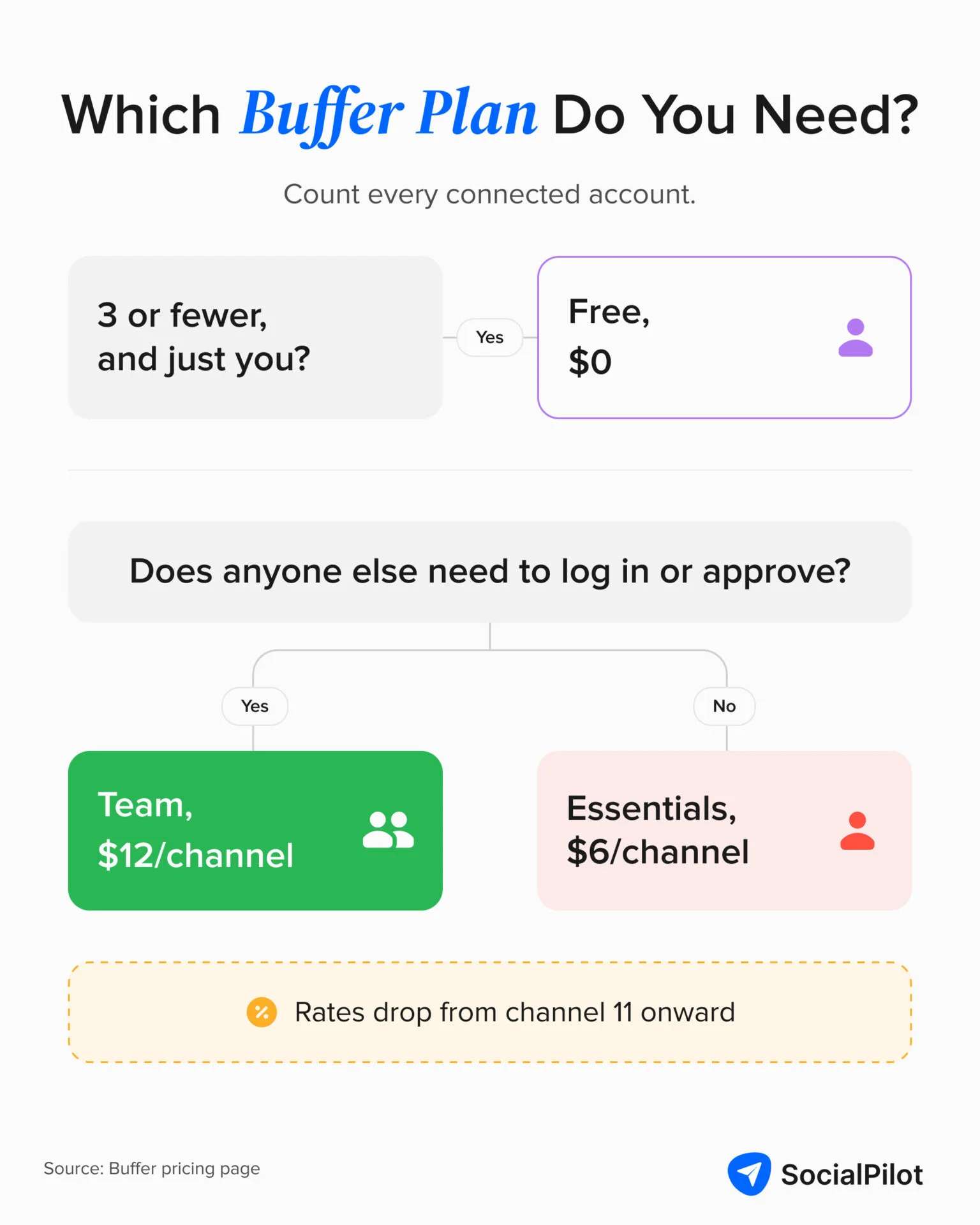
Skip the tier names for a moment. Three questions decide your bill.
Channel Count Is the Real Cost Driver
Buffer has no brand limit, no client limit, and no per-post charge, so your invoice is a function of how many social media accounts you connect and nothing else. Everything else is rounding.
Which means the useful exercise before you sign up is counting honestly. Every Instagram account, every Facebook page, every LinkedIn page, every location. A five-client agency where each client runs Instagram, Facebook, and LinkedIn is fifteen channels, not five, and $80 a month on Essentials rather than $30.
There’s also no penalty for landing just above a threshold, which tier-based pricing tends to punish. Your eleventh channel costs $4, not a jump to the next plan. Nothing about Buffer’s model punishes you for being an awkward size.
The decision is binary, and it isn’t really about money.
Essentials has one seat. If anyone other than you needs to log in, draft, approve, or be restricted to specific channels, you’re on Team regardless of channel count. There’s no middle option, no second seat to buy, no add-on.
What Team adds beyond seats is the approval layer: content approval workflows, access levels controlling which channels each person can post to, and branded reports for client-facing work. If you’re a solo operator who reports to nobody, none of that is worth $60 a month. If you hand work to a colleague or send reports to a client, all of it is.
The cost of that decision falls as you grow. At three channels, Team is $18 a month more, and the gap widens with every channel up to the tenth. Past that it stops moving, so it becomes a steadily smaller share of a larger bill.
Free Plan Limits Worth Knowing Before You Commit
Two things surprise people about moving off free.
First, your three free channels are not grandfathered. Buffer is explicit: upgrade and you pay for every connected channel, including the ones that were free. Going from three free channels to four means paying for four, so your first paid month is $24 on Essentials monthly billing, not $6.
Second, there’s a 14-day free trial that runs separately from the free tier, and it places your account on the Team plan so you can try every paid feature. If you don’t add payment details, the account drops back to Free when it ends and your scheduled posts still publish, as long as you’re inside the three-channel limit. Channels above three get locked, not deleted.
Nonprofits should not pay list price. Buffer publishes a 50% discount for nonprofit and charity organizations, applied by submitting documentation through a request form, with a stated 48-hour review. The percentage is published up front, so you can work out what you would actually pay before you apply.
How We Verified This Data
Every figure in this piece has a traceable origin. Here is the audit trail.
| Claim | Fonte | Method | Stato |
| Plan structure, per-channel rates, feature matrix | Buffer's pricing page and its FAQ | Read at both billing settings | Confirmed |
| Volume discount bands and totals at 1 to 50 channels | Buffer's pricing page and its FAQ | Reconstructed from Buffer's published totals, then checked against the mechanic stated in its FAQ | Confirmed |
| Totals at 15 and 20 channels | Calculated from Buffer's published band rates | Matched against the live pricing slider | Confirmed by calculation and slider |
| November 2025 repricing date and discount mechanic | Buffer's pricing page FAQ | Quoted from the vendor's own page | Confirmed |
| Pre-repricing page state | Archived copy of buffer.com/pricing, 2 August 2025 | Read in full against the live page | Confirmed |
| Exact date the Agency plan was withdrawn | Not published by Buffer | Archive search | Not confirmed, not stated here |
| Buffer nonprofit discount of 50% | Buffer's help centre | Read from the published policy | Confirmed, percentage published |
| 14-day trial terms and what happens when it ends | Buffer's pricing page FAQ | Read from the vendor's own page | Confirmed |
| Fair use cap of 5,000 posts per channel | Buffer's pricing page FAQ | Quoted from the vendor's own page | Confirmed |
| SocialPilot plan prices, accounts, and seats | SocialPilot's plans page | Read on the US-served page in USD | Confirmed, US pricing |
The same verification process runs on every pricing piece in this series, including our Agorapulse pricing breakdown e our Loomly pricing breakdown.
Three notes on what that process caught.
Buffer’s own page disagrees with itself on the annual saving. The plan cards say two months, the FAQ says 20%. We went with the published totals, which support the plan cards.
The discount bands take work to pin down. The slider shows totals, not rates, so we reconstructed the bands from Buffer’s own published totals and checked them against the mechanic Buffer describes in its FAQ. That is why almost every write-up does flat linear math instead.
We didn’t date the Agency plan’s removal. An archived page from August 2025 shows it was already gone, so tying it to the November 2025 repricing would have been wrong. Where the evidence stopped, so did we.
Prices move, as the timeline above shows, so check the live pricing page before you commit to a plan.
The Only Number That Matters Is Your Channel Count
Buffer’s pricing is unusually precise. It is also hard to read from a headline figure, because there isn’t one.
Count your channels first. Under six, Buffer is hard to beat on price, because you pay for exactly what you connect and nothing is rounded up to a tier you don’t fill, and the free plan is permanent rather than a disguised trial. Past that, the per-channel bill climbs faster than a flat tier does, until the volume discount pulls it back somewhere in the high thirties. The discount does more work than almost anyone writing about Buffer gives it credit for, and Team stops being the expensive choice it looks like at small scale.
The question that decides it isn’t price at all. It’s whether one person can run the whole operation. Buffer’s entry plan assumes yes, at any size, and everything about its cost advantage depends on that assumption holding.
So work out your channel count, then ask how many people need to touch it. Those two numbers will tell you more than any pricing table.
If that second number is more than one, Buffer’s cheapest tier is already out of the running, and a flat per-tier plan is worth pricing against before you commit to a year. Here, SocialPilot bundles the seats and the accounts into a single rate, so the roster you just counted is the only figure you need to check it against. Iniziate oggi la vostra prova gratuita di 14 giorni, no credit card needed.




 Unisciti agli oltre 55.000 gestori di social media