
How much does Loomly actually cost right now? Search that question and you’ll land on a handful of different answers, some quoting the current $65 starting price, others still repeating tier names Loomly retired in 2025. Add in a Reddit thread claiming a price hike, and a pricing page that doesn’t mention a free plan at all, and it’s fair to walk away more confused than when you started.
This guide settles that confusion using numbers pulled directly from Loomly’s official website, not a secondhand recap. Loomly pricing today runs three public tiers, plus a free option that exists but isn’t listed anywhere a new visitor would see it. Below is exactly what each plan costs, what actually changed in the 2025 restructure, and how the same money compares against SocialPilot at matching account and seat counts.
If you’re already a Loomly customer whose renewal invoice came in higher than expected, or you’re evaluating tools from scratch and the pricing page raised more questions than it answered, the goal here is precision: not “it got more expensive,” but exactly how much, for whom, and what your alternatives cost at the capacity you actually need.
Loomly's Current Plans, Verified Directly From the Source
Loomly sells three tiers today: Starter, Beyond, and Enterprise. Every figure below comes straight from Loomly’s pricing page, checked on both the monthly and annual billing views. These are the only Loomly pricing plans a new visitor sees; the free option covered further down is deliberately left off this page.
| Piano | Mensile | Billed Annually | Accounts | Utenti |
| Avviamento | $65/mese | $49/mese | 12 | 3 |
| Oltre | $332/mese | $249/mese | 60 | Illimitato |
| Impresa | Personalizzato | Personalizzato | 61+ | Illimitato |
As per the Loomly’s pricing page, annual billing saves 25% on both paid tiers, a discount worth calling out on its own since most social media tools land closer to 15-20% for the same commitment. Loomly doesn’t advertise the comparison anywhere on the pricing page, so it’s easy to miss if you only glance at the monthly number.
Starter: $65/Month (or $49/Month Billed Annually)
Starter is Loomly’s entry paid tier, built for one small team running a defined set of accounts rather than a growing roster of clients. At $65 billed monthly or $49 billed annually ($588/year), this is the Loomly starter plan price a first-time visitor sees.
Starter includes:
- 12 social accounts and 3 users
- Unlimited calendars
- AI Assistant chat
- Scheduling and post previews
- Approval workflows with defined roles
- Analisi avanzata
- Link shorteners
Three users comfortably covers a small internal team or a founder plus a couple of collaborators. The complications start once you outgrow it, whether that’s a 13th account or a 4th person needing a login, since there’s no smaller step up from here.
Beyond: $332/Month (or $249/Month Billed Annually)
Beyond is Loomly’s only other paid option, and it’s built for teams juggling far more accounts and far more hands on the calendar. At $332 billed monthly or $249 billed annually ($2,988/year), this Loomly Beyond pricing covers a lot more than a bigger account ceiling.
Beyond includes everything in Starter, plus:
- 60 social accounts and unlimited users
- Custom branding (branded subdomain, custom favicon, custom logo)
- Custom roles and workflows
- Hashtag manager
- Calendar-wide 2FA enforcement
- Scheduled reports
Custom branding and scheduled reports are both exclusive to this tier and are unavailable on Starter. There’s nothing between the two tiers: cross 12 accounts or add a 4th user on Starter, and the only paid option is the full jump here, whether or not you need most of what else Beyond includes.
Enterprise: Custom Pricing for 61+ Accounts
Enterprise picks up everyone past Beyond’s 60-account ceiling. There’s no published number; you talk to Loomly’s sales team, and pricing gets negotiated against your actual usage.
Enterprise includes everything in Beyond, plus:
- 61+ social accounts, unlimited users and calendars
- Assistenza prioritaria
This tier fits organizations running social presences across many sub-brands, regional offices, or franchise locations, where 60 accounts is already too small a ceiling. Loomly doesn’t publish Enterprise pricing anywhere, so there’s no reliable way to estimate a figure.
If you’re nowhere near 60 accounts, the real comparison to make is between Starter and Beyond.
Loomly does have a free plan. It’s real, it’s currently active, and it’s nowhere on the public pricing page you just read. You only find it after you’ve already started a trial, which is exactly the kind of detail that makes searchers wonder if “Loomly free plan” is even a real thing to search for. It is, it’s just deliberately out of sight.
How to Actually Find It
Loomly’s own Help Center article on the New Free plan documents the path directly.
- Sign up for Loomly’s 15-day free trial. No credit card is required to start it.
- Once you’re in, go to Account Settings.
- Click the Billing tab.
- Select the Free plan from the options shown there.
That’s the whole path. It isn’t linked from the homepage, the pricing page, or anywhere in the signup flow before you’re already inside the product.
Loomly is also explicit that this plan isn’t guaranteed to everyone. If you already have a Loomly account, you can check your billing page directly to see whether the Free plan shows up as an option for you. That’s a meaningfully different claim than a standard “free forever” tier: this one comes with no guarantee it’ll be offered to a given account at all.
What It's Actually Good For
The free plan includes:
- 5 posts a month
- 1 utente
- 3 social accounts
Loomly frames this as a way to test the interface, not a plan meant to run a real social presence on. Five posts a month works out to roughly one post every six days, and that’s the combined total across all 3 connected accounts, not 5 posts per account. A single active account posting a normal cadence of three or four times a week would burn through the entire monthly allowance inside the first ten days. Treat it as a sandbox for clicking through Loomly’s calendar and approval screens, not a long-term alternative to Starter.
What the 2025 Price Hike Actually Changed
By mid-2025, people weren’t just asking what Loomly costs, they were asking what happened to make it cost so much more. Interest in the Loomly price increase spiked right after the change landed, and has cooled off significantly since.
Actual paying customers were quick to notice. One G2 reviewer put it directly: “Over the past few years, the value has declined significantly while the price has increased substantially.”
That kind of sentiment is exactly why a percentage like “600%” travels fast online, even when it only describes one specific renewal scenario rather than the typical new-customer price. Any single percentage quoted online is describing someone’s specific starting point, not a universal outcome.
What the Old Pricing Looked Like
Loomly’s old pricing page is no longer live, but according to Capterra’s listed Loomly pricing, the pre-2025 pricing structure of Loomly looked like this:
| Old Plan | Monthly Price | Conti sociali | Utenti |
| Base | $42 | 10 | 2 |
| Standard | $80 | 20 | 6 |
| Avanzato | $175 | 35 | 14 |
| Premium | $369 | 50 | 30 |
That was four tiers. Loomly’s current structure has two paid tiers plus Enterprise, meaning the middle two, Standard and Advanced, were eliminated entirely rather than repriced. The old structure meant a customer needing more than Base’s 10 accounts had two intermediate steps before reaching Premium’s 50-account ceiling. Removing both of those steps means paying $200 more every month, as soon as a business crosses the 12-account ceiling.
Is the "600% Increase" Claim Accurate?
Partially, and only for one specific case. A widely-shared Reddit thread on r/socialmedia helped popularize a “600% increase” framing.
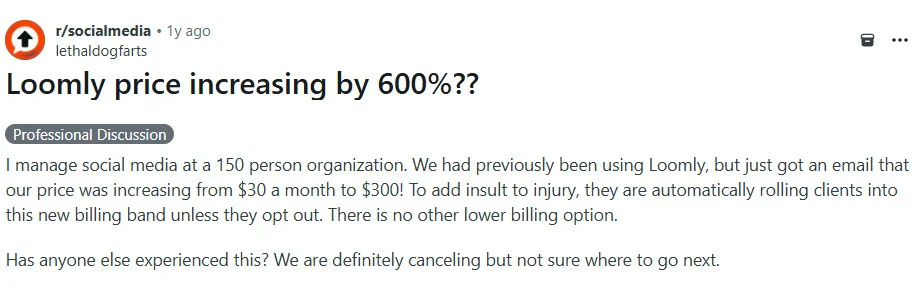
But that figure doesn’t describe what happened to Loomly’s typical customer.
Here’s the actual math: the new Starter plan is priced at $65/month, which is about 55% more than the old Base plan’s $42/month (both when billed monthly). That’s the real entry-tier increase, the one that applies to a new customer signing up today at the equivalent starting tier.
But if someone was on the old Standard tier, paying $80/month and handling more than 12 but less than 20 accounts, they would now have to jump straight to Beyond at $332/month, because Standard and Advanced no longer exist, which is a 315% hike from their previous plan.
Similarly, going from the old $42 Base price to the current Beyond plan, once someone crosses the 12-account limit, leads to a 690% increase in the price. This is probably where the 600% price hike making the rounds on Reddit comes from.
But this price rise didn’t happen in a vacuum. While Loomly’s own pricing update announcement ties the change to “broader enhancements,” including a new kanban-style Idea Board, best-time-to-post suggestions, deeper Canva integration, and bulk CSV uploads, alongside the tier restructure, the company was also acquired by Bending Spoons in early January 2025. Bending Spoons has a documented pattern of raising prices on companies it acquires, which is relevant background for why this restructure happened when it did.
If you’re weighing whether to stay on Loomly or look for other tools, the natural next question is what the same money buys you elsewhere. SocialPilot’s current pricing follows a flat-tier model with per-account and per-user add-ons, rather than Loomly’s fixed jump between two tiers.
Both these tools handle scheduling, approvals, and analytics competently, so we are not comparing the features here. The below table is just to help you compare the prices, the accounts and seats per tier and what SocialPilot charges for that exact capacity today.
| Piano | Billed Annually | Fatturazione mensile | Accounts | Utenti |
| Essentials | $25.50/month | $30/mese | 7 | 1 |
| Standard | $42.50/month | $50/mese | 15 | 3 |
| Premium | $85/month | $100/month | 25 | 6 |
| Ultimate | $170/month | $200/mese | 50 | Illimitato |
Annual billing saves 15% on every tier. Extra accounts cost $4/month each on every tier. Extra users cost $5/month each on Standard, and Premium plans. (Ultimate already includes unlimited users).
Matching tier names isn’t useful here, since the two companies structure their plans differently. What matters is matching actual capacity: the same account count and user count, at the same billing cycle.
| Loomly Plan | SocialPilot Plan | What Changes at This Level |
| Starter, $49/month, 12 accounts, 3 users | Standard, $42.50/month, 15 accounts, 3 users | Standard’s included capacity already covers Starter’s account and user count, for $6.50 less a month, with no add-on needed. |
| Beyond, $249/month, 60 accounts, unlimited users | Ultimate, $170/month, 50 accounts, unlimited users, plus 10 extra accounts at $4 each ($40/month) | Ultimate plus 10 extra accounts reaches the same 60-account, unlimited-user capacity for $210/month total, $39 less than Beyond. |
| Hidden free plan, 3 accounts, 1 user, 5 posts/month, trial-gated | No permanent free plan, only a 14-day trial, no card required | Loomly’s free plan costs nothing on an ongoing basis. SocialPilot’s trial is straightforward and clearly advertised, but it’s still a trial, not a permanent option. |
| Enterprise, custom, 61+ accounts | Enterprise, custom accounts, unlimited users, dedicated account manager | Both require a sales conversation once you’re past their respective published ceilings. |
At Starter’s exact capacity, SocialPilot’s Standard plan already covers it on its own, no add-on required, for $6.50 less a month. At Beyond’s capacity, Ultimate plus 10 extra accounts still lands $39 under Loomly. The one place Loomly has something SocialPilot doesn’t is the free plan itself: limited and hard to find, but it costs nothing at all, while SocialPilot’s free option is a trial with an end date.
Neither the $6.50 gap nor the $39 gap happened by coincidence. Both come directly from how each company structures its tiers, which is the subject of the next section.
Why a Flat Per-Tier Model Changes the Math as You Scale
Both gaps above trace back to the same structural difference. Loomly’s model is whole-tier jumps: you pay for Starter or you pay for Beyond, with no purchasable step between 12 accounts and 60. Cross the Starter ceiling by even one account or one user, and the entire next tier is what you’re buying, whether or not you need most of what’s in it.
SocialPilot’s plans work the other way: a base tier with per-account and per-user add-ons layered on top. Need a couple more accounts than a tier includes? Add them individually. You’re not buying capacity you don’t need to get the extra units you do.
That’s the whole difference. A flat two-tier structure charges you for the entire next bracket the moment you cross it’s one dividing line, regardless of how little of that bracket you actually use. An add-on model charges you only for the extra units, whether that’s one account or ten.
Picture a small agency running Loomly Starter at 12 accounts, comfortably full. A new client signs, and that’s a 13th account. Loomly has no partial step: the only paid option is the full Beyond plan at $249/month annual, a jump of $200 over Starter’s $49, to unlock one additional account. Most of Beyond’s other capacity, up to 60 accounts and unlimited users, sits unused.
Run that same 13th account through SocialPilot’s model instead, and Standard’s 15-account allowance already covers it. The bill stays at $42.50/month. If you need a 16th account, you just end up paying $4/month extra, which brings the total to $46.50/month.
A per-account add-on model can never force a whole-tier jump for one extra client. A flat two-tier model always will, the moment you cross its one dividing line.
What Actually Determines Which Plan You Need
Strip away the vendor names, and the real question is simple: how many accounts and seats do you actually need, and how close are you to a bracket boundary right now. Feature lists, brand preference, and interface taste matter too, but none of them change which pricing bracket you land in. Account count does.
So, here are a few concrete positions right from 3 accounts to 60 accounts, to help you understand how the different pricing models of Loomly and SocialPilot can produce their most different outcomes.
| Your Situation | Loomly’s Cost | SocialPilot’s Cost |
| Solo operator, 3 accounts, 1 user | Hidden free plan (5 posts/month cap) or Starter at $49/month | Essentials at $25.50/month |
| Small team, 10 accounts, 3 users | Starter at $49/month | Standard at $42.50/month |
| Growing team, 13 accounts, 3 users | Beyond at $249/month (forced tier jump) | Standard at $42.50/month (still inside its 15-account cap) |
| Large agency, 60 accounts, unlimited users | Beyond at $249/month | Ultimate plus 10 extra accounts at $210/month |
The pattern holds across every row: SocialPilot’s cost moves in small steps as account count grows. Loomly’s cost stays flat until you cross 12 accounts, then jumps all at once.
When the Jump to Beyond Is Worth It
Beyond earns its price when you’re using features that only exist on that tier, not just when you need one more account. Consider it worthwhile if your team needs any of the following:
- Custom branding on client-facing calendars (a branded subdomain, custom favicon, custom logo)
- Custom roles and workflows beyond Starter’s fixed approval structure
- Account-wide 2FA enforcement across a distributed team
- Scheduled reports delivered automatically rather than pulled manually
If none of that applies and the only reason you’re looking at Beyond is a 13th account or a 4th user, that’s the scenario where running the numbers becomes important before committing to a 5x price jump.
Nonprofit Pricing Paths
Registered nonprofits get more than a simple discount from Loomly. Per Loomly’s non-profits page, there’s a dedicated Standard nonprofit plan: 20 social accounts and 6 users, for $80/month billed monthly or $60/month billed annually ($720/year, a 25% savings for paying yearly). It includes
- Interactions
- Post preview and optimization tips
- Analisi avanzata
- Content export
- Hashtag manager
- Slack and Teams integrations
- Flussi di approvazione
This is an entirely different account and user split from the public Starter and Beyond tiers.
The same page also confirms that Loomly offers a 50% lifetime discount to non-profits when they present a copy of their determination letter or any equivalent government-issued document. That applies for as long as the organization keeps its account, not a limited introductory window.
How We Verified This Data
Every current Loomly figure in this piece, Starter, Beyond, Enterprise, the annual discount rate, and the hidden free plan’s existence and access path, comes from a direct check of Loomly’s own pages.
Every SocialPilot figure comes from that same standard: a direct check of SocialPilot’s current pricing page. The pre-2025 historical pricing is flagged separately as third-party sourced, since Loomly’s old pricing page no longer exists to check directly, and the precise date of the Bending Spoons acquisition carries the same caveat.
So, Is Loomly Worth the Price in 2026?
The numbers settle most of the open questions here. Loomly’s current pricing is exactly what’s on its site: $65 or $49 a month for Starter, $332 or $249 for Beyond, nothing published for Enterprise. A free plan exists, but it’s built for testing, not running a real account. And a typical customer ends up paying atleast 55% more today than what they were paying for Loomly at the start of 2025.
So, here’s how you decide. If your team fits inside Starter’s 12 accounts and 3 users tier, or Beyond’s specific features actually matter to your workflow, Loomly’s current pricing is straightforward to justify.
If the only thing pulling you toward Beyond is one extra account or one extra seat, run the SocialPilot numbers first: Standard alone already covers Starter’s capacity for less, and Ultimate plus a handful of extra accounts still comes in under Beyond. Count your actual accounts today and let that number make the call.



 Unisciti agli oltre 55.000 gestori di social media