

Everything you know about social media algorithms is working against you on Threads.
You post consistently. You engage with comments. You cross-post from Instagram to save time. You have done this for other platforms and it worked. And yet, one Threads post hits 1,200 views and the next, from the same account on the same topic with the same level of effort, gets only 11.
You check the timing. You check the caption length. You try posting at a different hour. Nothing connects.
Here is what is actually happening: the Threads algorithm rewards a specific set of behaviors that every other platform trained you to avoid. The signals that built your Instagram following, your LinkedIn authority, your X engagement are the wrong signals here.
This guide breaks down the 9 signals the Threads algorithm actually rewards. The specific mechanics, the engagement benchmarks, and the structural fixes for the brand account performance gap that has been frustrating agencies since the platform launched.
Key Takeaways:
- Replies outweigh likes. The algorithm measures conversation depth, not passive reactions.
- The first 60 minutes after posting determine your reach ceiling, not the 24 hours after.
- Brand accounts face a structural disadvantage on Threads. It is fixable, but only if you understand what is actually causing it.
- Your Instagram audience is a Threads distribution asset most brand marketers have never activated.
How the Threads Algorithm Actually Works
The Threads algorithm is Meta’s AI-powered ranking system for the ‘For You’ feed. It runs in three steps:
- Gather — pull eligible content from across the platform
- Read — evaluate engagement signals on each post
- Rank — sort content by predicted value to each individual user
The Following feed stays strictly chronological. The algorithm only touches For You.
Understanding how social media algorithms work gives you the core mental model: show content to a small sample first, measure the response, then decide whether to push it further. On Threads, that testing window is the first 30 to 60 minutes after you post.
Threads has grown to 450 million monthly active users as of early 2026. It has surpassed X in daily mobile users with 141.5 million daily active users versus X’s 125 million (Meta, Q1 2026). That scale means the competition for ‘For You’ placement is real and the algorithm is getting sharper at filtering for quality signals.
Three things make Threads distinct from every other platform you manage:
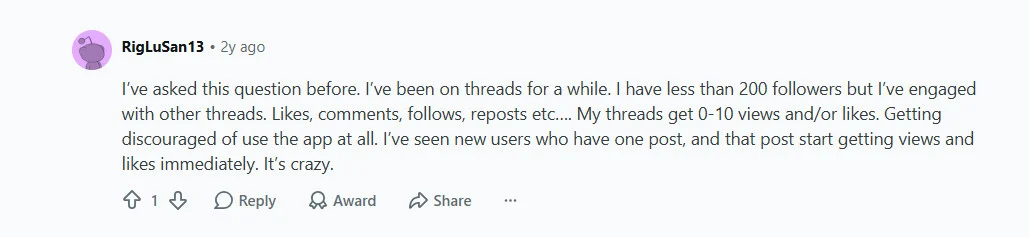
- Replies outweigh likes. Threads is built to surface conversation. A post that earns 10 replies will consistently outperform one that earns 100 likes. In this context, a user on r/ThreadsApp shares their real-life experience:

- The For You feed runs on topic interest, not just follows. The algorithm infers what a user cares about from behavior, then surfaces relevant content from accounts they do not follow. Non-follower discovery is real and reachable.
- Instagram and Threads share signal data. Your Instagram activity influences your Threads reach. There is a full section on this below.
Dear Algo: What It Is and What It Means for Your Strategy
In February 2026, Meta introduced Dear Algo, a feature that lets users redirect their For You feed by posting “Dear Algo, show me more about [topic].” The Threads algorithm reads the post and adjusts that user’s recommendations for roughly three days before resetting.
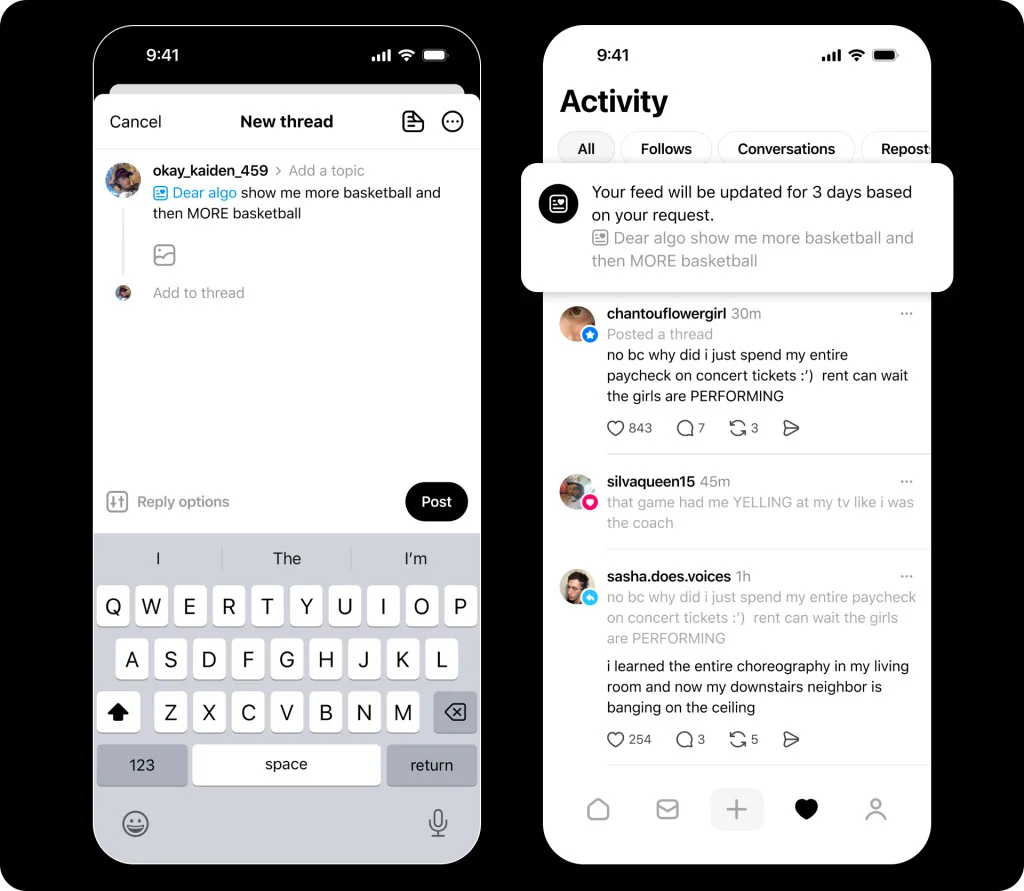
Every article explains Dear Algo as a viewer tool. For brands, it is something more useful: a content brief from your audience, delivered publicly.
When users in your niche post Dear Algo requests about topics your account covers, they have just told the algorithm exactly what they want. Content that matches those requests gets routed more aggressively toward higher-intent viewers.
Monitor the Dear Algo posts circulating in your niche. Create content that directly answers them. The algorithm already knows where to send it!
9 Signals the Threads Algorithm Rewards
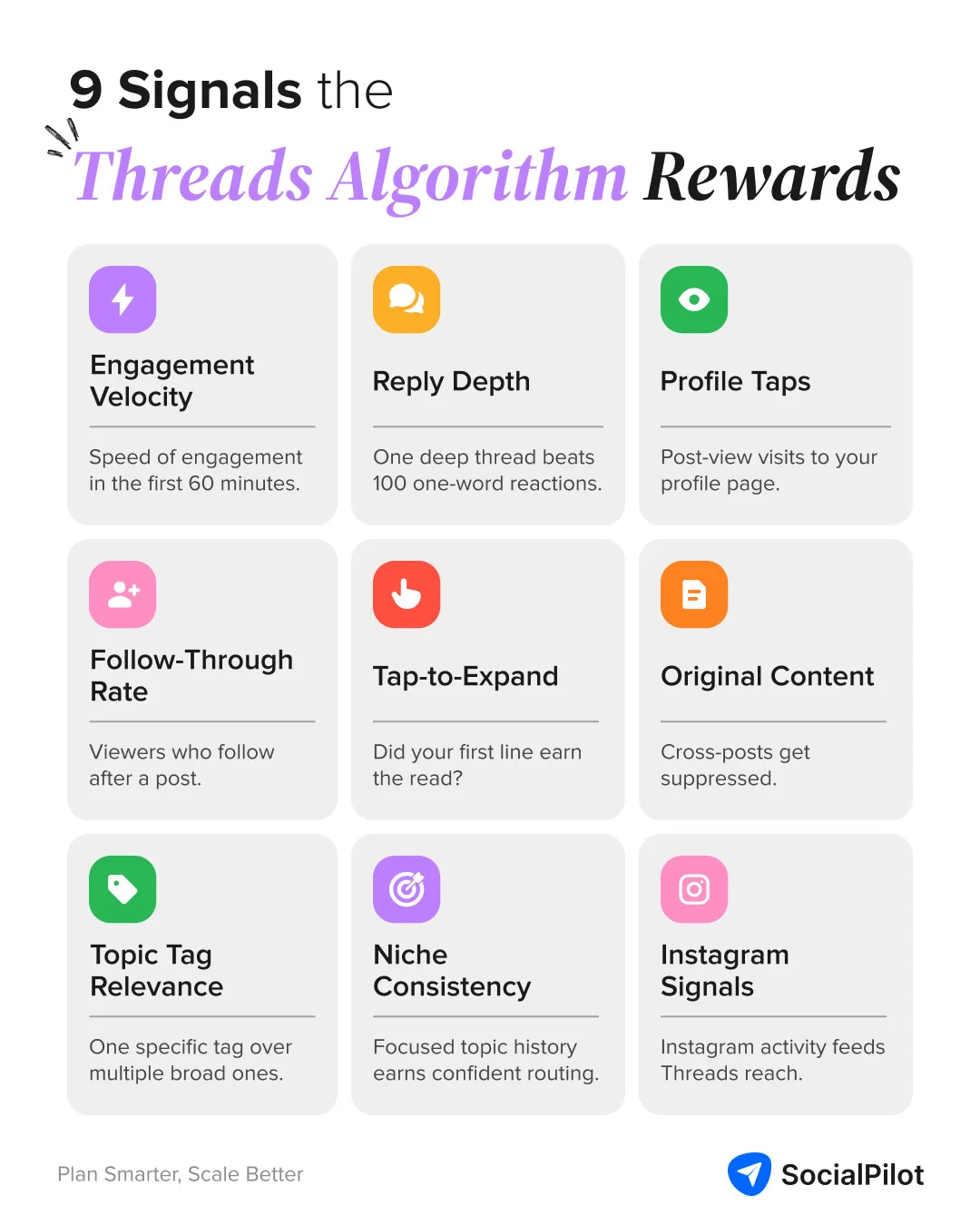
1. Engagement Velocity
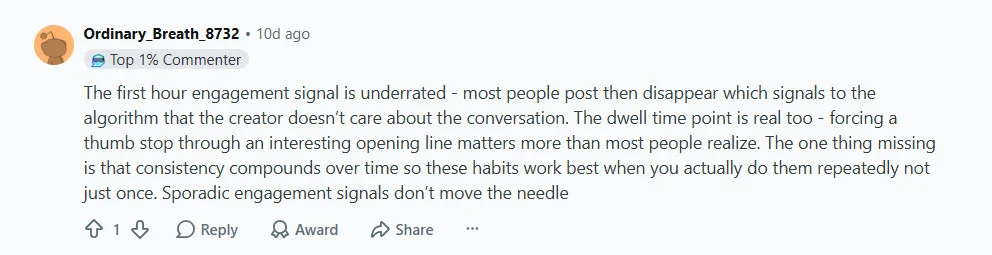
Engagement velocity is the speed at which a post earns engagement in the first 30 to 60 minutes after publishing. It is the most important signal the algorithm reads, and the one most agency workflows are built to lose. A user on r/content_marketing shares:
The system uses this window as a quality test:
- High early engagement = content worth showing to a larger audience
- Flat early engagement = test ends, distribution stops
The outcome is permanent. The algorithm does not revisit a post after the window closes, regardless of how strong the content is. According to Meta’s own transparency documentation, the ranking system evaluates engagement signals shortly after a post is published to determine distribution. Posts where creators engage early consistently outperform those where they don’t. The window is real, and what you do inside it is the variable that determines reach.
Posting Threads post at the optimum time matters, but being present for the first hour matters more.
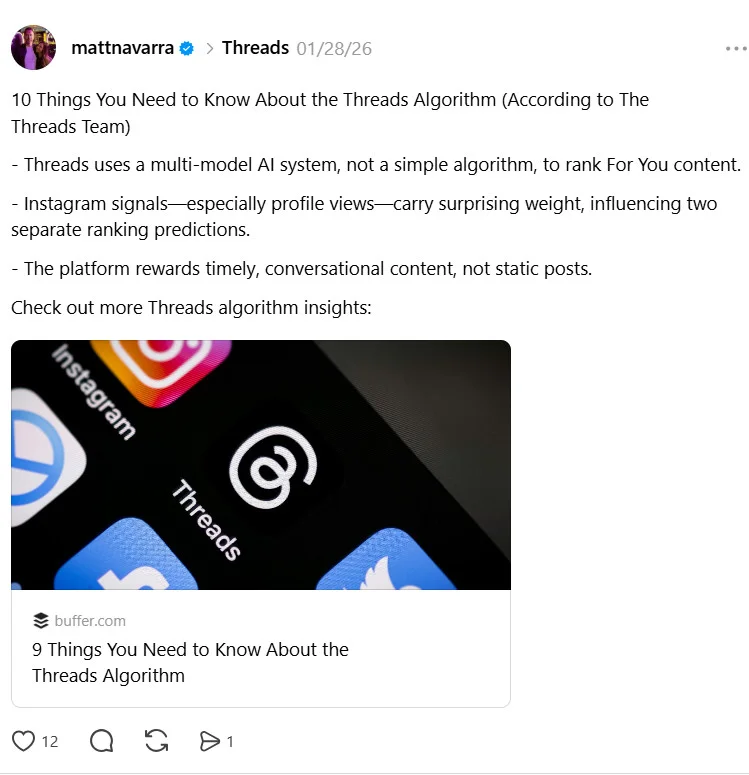
2. Reply Depth
The algorithm does not just count replies. It measures how deep the conversation goes.
Threads’ platform-wide median engagement rate is 6.25%, compared to X’s 3.6%. (WebFX, 2025)A post that generates 3 replies and a 15-message thread signals something fundamentally different from one that collects 20 one-word reactions. The deeper the exchange, the more aggressively the algorithm distributes the post.
What earns reply depth:
- Posts that take a position someone wants to agree or disagree with
- Posts that end with a direct question
- Posts that challenge a common assumption in your industry
- Posts that share a surprising or counterintuitive result
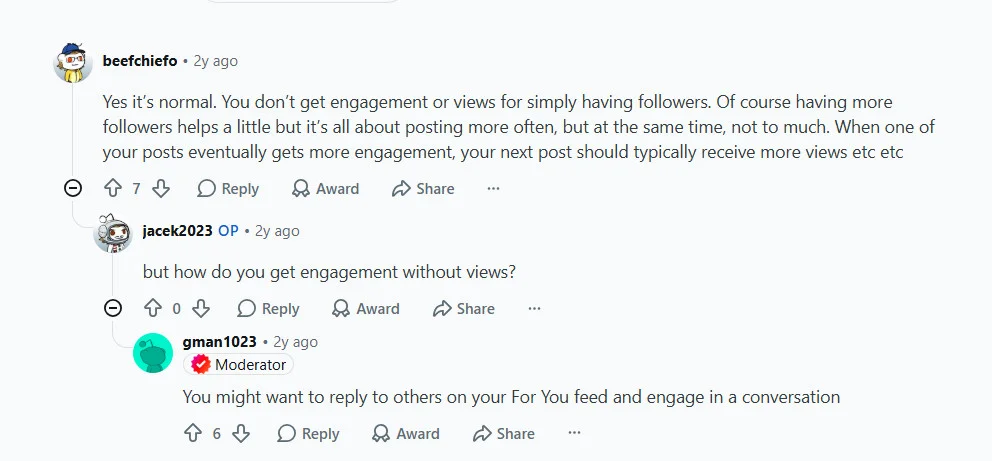
Tip lists and how-to content do not earn the same depth. They answer a question. They do not start a conversation. Like a user in r/ThreadsApp puts it:
3. Profile Taps
A profile tap signals that your content was compelling enough to make someone curious about who posted it.
When someone clicks your account name or avatar after seeing a post, the algorithm registers that as an intent signal. It is evidence that the content did more than inform; it made the viewer want to know more about the source.
For brand accounts, this is one of the more controllable signals:
- Specific, opinionated posts earn more profile taps than generic posts
- Content with a clear point of view earns more than informational content
- Posts that feel like they came from a person, not a brand page, earn the most
The test: If you stripped your logo from the post, would it still have a distinct voice? That voice is what drives profile taps.
4. Follow-Through Rate
Follow-through rate is the percentage of people who see your post and then follow your account. A high follow-through rate tells the algorithm that your content is a reliable match for a certain type of user, and it starts routing future posts to more users like them. A user on r/ThreadsApp talks about what brings more followers on X vs. Threads:
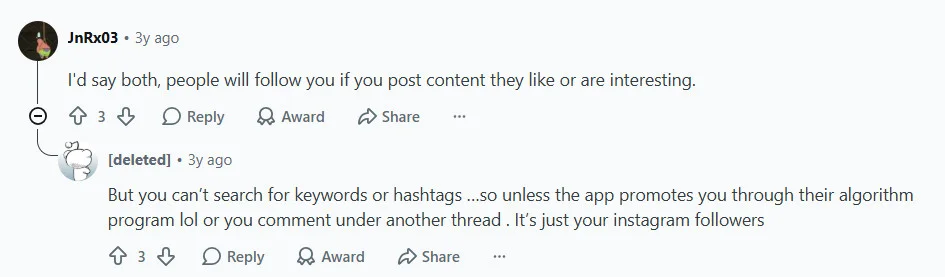
A single high-follow-through post can carry a distribution boost for several days. The system has learned what your content is for, and it applies that signal to the posts that follow.
This is why niche consistency matters so much. Accounts that cover a focused topic earn higher follow-through rates because every viewer knows exactly what they are signing up for.
5. Time Spent and Tap-to-Expand
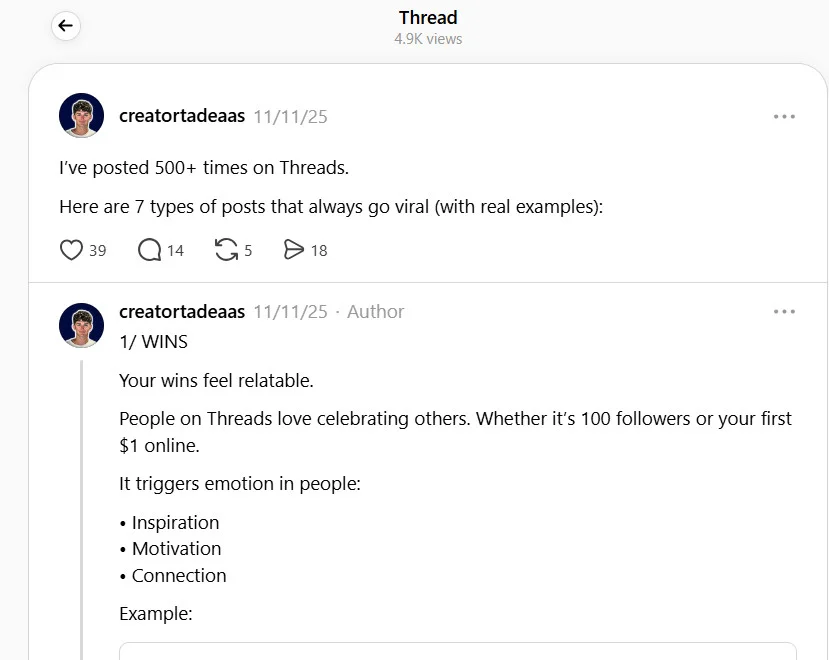
Threads truncates post text at roughly 280 characters in the feed view. The algorithm tracks whether someone taps “more” to read the rest. This is the tap-to-expand signal.
It is a direct measure of one thing: did your first line earn the read?
Dwell time works the same way. A post someone expands and reads fully is ranked higher than one they skim past.
How to write for tap-to-expand:
- Treat the first line as an email subject line
- Make a claim, ask a question, or start a story in line one
- Save the explanation, proof, or payoff for what is behind the tap
- Never open with “I wanted to share…” or “Here are some thoughts on…”
6. Original Content
The algorithm suppresses content that reads like it was written for a different platform. Verbatim X cross-posts, recycled Instagram captions, and polished brand announcements consistently underperform natively written content.
This is not text-detection. It is pattern recognition. The algorithm has been trained on what earns engagement on Threads, and broadcast-style copy does not match that pattern.
What original means on Threads:
- Conversational, first-person voice
- Written for a reader who will respond, not just consume
- Shorter sentences, direct claims, no PR polish
- An opinion or observation, not an announcement
The same information in a conversational frame will outperform the same information in a brand format, consistently.
7. Topic Tag Relevance
Threads uses topic tags to route your content toward users who are interested in that topic, independent of your follower count.
One specific, relevant tag per post consistently outperforms using multiple tags. More than one dilutes the routing signal. The tag needs to match the actual topic of the post, not a broad category.
| Tag Approach | Effect |
| One specific tag (#ThreadsTips) | Reaches interested non-followers |
| Multiple broad tags (#Marketing #Social #Threads) | Diluted routing, lower non-follower reach |
| No tag | Algorithm infers niche from content history only |
8. Niche Consistency
The algorithm builds a model of your account based on your posting history. The more consistently your posts fit a defined topic area, the more confidently it routes new content toward users interested in that area.
Practitioners who run sustained Threads experiments consistently observe the same pattern: accounts focused on a single niche for 30 or more days see a step-change in reach, while accounts with scattered topics struggle to break out of low initial distribution.
The consistency problem for brand accounts:
- Campaign phases shift the topic focus every 4 to 6 weeks
- Product announcements break niche consistency
- Mixed-topic content gives the algorithm less to work with
The practical fix: Find the narrowest topic umbrella that covers your range and post from that perspective consistently, rather than switching frames entirely with each campaign.
9. Instagram Cross-Platform Signals
This is the cross-platform signal that nearly every Threads guide mentions in passing and almost none of them make actionable.
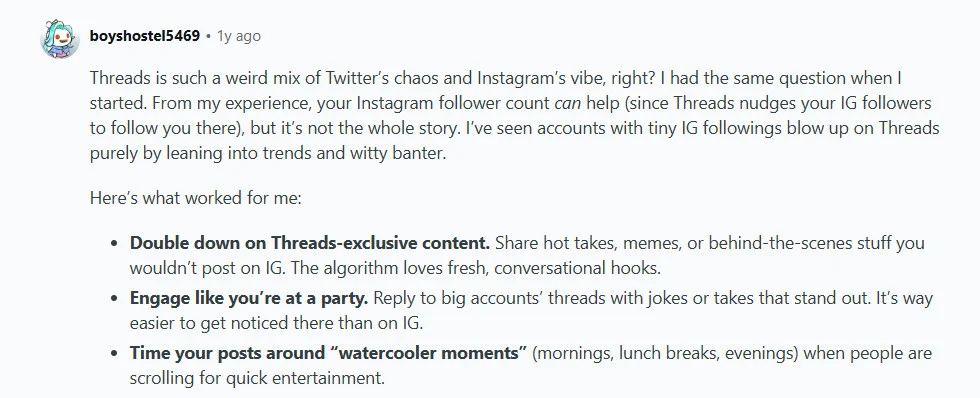
If someone has viewed your Instagram profile or engaged with your content there, they are more likely to see your Threads posts in the For You feed, even without following you on Threads.
For brand marketers, this is a structural head start. Your Instagram audience is already a warm Threads audience. You are not building from zero. Like a user on r/ThreadsApp puts it:
What activating this looks like:
- Link your Threads account to your Instagram profile to enable signal sharing
- Keep Instagram active. Engagement there generates signal Threads can use
- Create Threads content that extends your Instagram topics, not separate content for a separate audience
- Cross-promote Threads posts to your Instagram Story to push existing followers into the Threads follow graph
Brands with active Instagram audiences have a structural distribution advantage on Threads that standalone creators do not have access to. Understanding the Instagram Reels algorithm alongside this gives you the full picture of how Meta’s recommendation systems work together across both platforms.
What Good Engagement Actually Looks Like on Threads
Every Threads guide tells you engagement matters. None tell you what good engagement looks like for your account size. The table below fixes that.
| Follower Tier | Typical Reach per Post | Healthy Engagement Rate | Reply Target |
| Under 1,000 | 50-300 views | 5-8% | 3-8 replies |
| 1,000-10,000 | 300-2,500 views | 3-5% | 5-20 replies |
| 10,000-50,000 | 1,500-12,000 views | 2-4% | 15-40 replies |
| 50,000+ | 5,000-50,000 views | 1-3% | 25+ replies |
If you are working to grow your Threads following, this table helps you separate posts generating reach from posts generating follows. Those are two different outcomes and they need different strategies.
Brand accounts typically land toward the lower end of the tier ranges above. The next section explains why.
Why Brand Accounts Don’t Get the Same Reach (And What to Do About It)
Brand accounts on Threads structurally underperform personal creator accounts. The algorithm does not penalize business profiles directly, but several of its most-weighted signals are harder for brands to earn.
Three-quarters of Threads users follow at least one brand (inBeat Agency, 2026). The audience is there. The distribution gap is a content and behavior problem, not a platform hostility problem.
What the Algorithm Is Actually Suppressing
The signals Threads weights most: reply depth, engagement velocity, follow-through rate, all favor content that feels personal and conversational. A product announcement, campaign message, or polished brand caption rarely earns the same response.
The algorithm is not targeting brand accounts. It is rewarding content that generates conversation. Traditional brand-voice content is structurally less likely to do that. The outcome is the same: lower reach, slower growth. Algorithm explicitly rewards the human voice over the brand voice.
The Fix: Post Like a Person, Not a Brand
The brand accounts that consistently outperform on Threads write with a point of view.
Not this: “Here are 5 tips to improve your content strategy on Threads.”
This: “Everyone says post consistently on Threads. I’ve watched accounts post daily for 90 days and go nowhere. Here is the variable that actually makes the difference.”
That shift, from information delivery to an opinion with a stake in it, earns replies. Replies are what the algorithm treats as proof the post is worth distributing further.
What this looks like in practice:
- Lead with the claim, not the setup
- Take a position your audience has a reason to agree or disagree with
- Avoid corporate hedging: “we think,” “it seems,” “some might argue”
- End with an open question or a provocation, not a summary
Building community on Threads requires this kind of approach: less broadcast, more conversation starter.
The Approval Workflow Problem
Here is the structural problem for agencies: the algorithm’s 60-minute window requires someone online and responsive immediately after a post goes live. Most agency workflows do not allow for that.
Content gets approved, scheduled, and the team moves to the next client. By the time anyone opens Threads, the window has closed.
The fix:
- Schedule the post as normal
- Set a go-live notification on the account
- Assign someone to be in the account for the first 60 minutes
- Respond to early replies, engage with 2-3 posts in the niche
- Keep the conversation alive while the algorithm is still watching
Scheduling and walking away costs reach every time.
The Algorithm Doesn’t Pick Favorites. It Picks Conversations.
Nine signals, one through-line: the Threads algorithm rewards accounts that show up, take a position, and talk back.
The brands that will win on Threads are the ones that understand the algorithm rewards conversation and have built their content process around earning it.
Conversation cannot be bought. It compounds. The gap between the teams that understand this and the teams that do not will keep widening. You now know which side to be on.
For agencies managing multiple Threads accounts, SocialPilot handles scheduling across all clients, tracks which signal pattern drove each result, and produces white-label reports that make the client review a data conversation. Start your 14-day free trial and run Threads for your clients with actual data behind every decision.



 Join 55,000+ social media managers


