

Our agency didn’t stall at fifteen clients because the work got worse. We stalled because the systems under the work were never built to carry that much, and we didn’t see it until the cracks were everywhere.
I’ve watched it happen from the inside. Somewhere past the tenth client, a firm that felt unstoppable starts missing small things. A caption goes out with the wrong shop’s offer. An approval sits for a week. Nobody’s sure who owns Thursday. We were all working harder, and the wheels kept coming loose.
If you run a lean agency, the number matters less than what it signals. Four systems that were fine at five clients quietly stop working around fifteen, and they break in a predictable order. Ours went in that exact sequence.
Saurav, my co-founder, and I came out of tech before we started 47 Consulting. So when our own firm started to strain, we didn’t reach for “hire more people” first. We looked at it the way you’d look at a system failing under load.
The 15-client wall is a systems problem wearing a growth problem’s clothes.
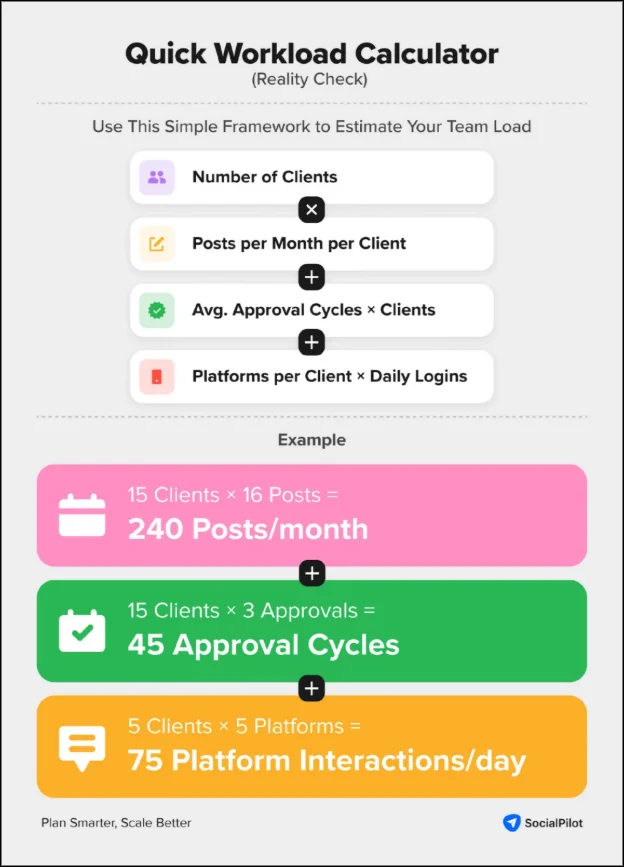
Fifteen was never a magic number. It’s just where the math finally caught up. One social client was never one deliverable: it’s 12 to 20 posts a month, plus the engagement, the reporting, and the steady drip of “can we move the Tuesday post” messages. Run that across fifteen clients and you’re coordinating 180 to 300 pieces of content a month, each with its own brand voice, approver, and deadline.
| At this many clients | Posts a month (12–20 each) | What it feels like |
| 5 | 60–100 | Busy, but manageable |
| 10 | 120–200 | Tight. Tools start straining |
| 15 | 180–300 | Coordination becomes the job |
Making the content was never the hard part. The work around the work is what buries you. Coordination, approvals, status updates, chasing information, hunting for the thing someone already sent. At five clients that overhead is annoying. At fifteen, it quietly becomes the actual job. You didn’t start an agency to be a router for other people’s messages, but that’s the seat you get promoted into if nothing changes.
What This Actually Sounds Like at 15 Clients
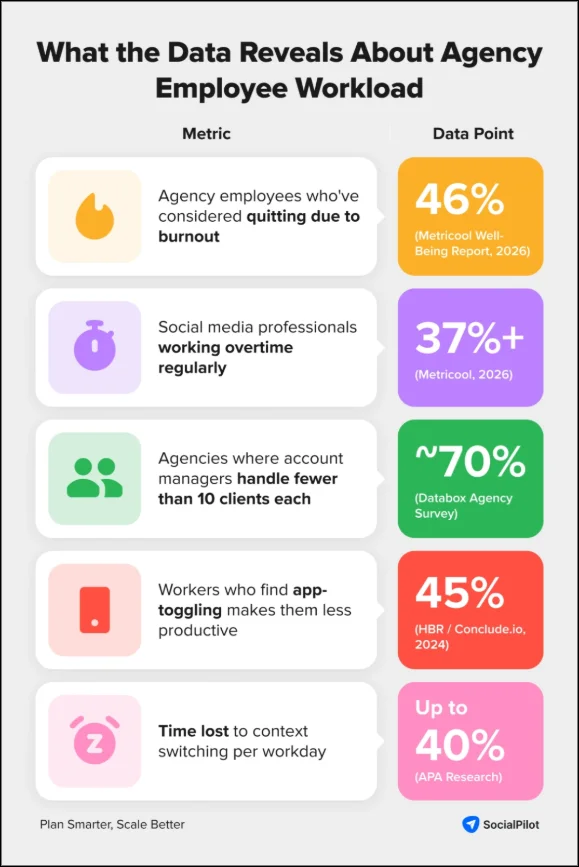
I never saw our ceiling in the revenue. I heard it in the team. The sentence we hear constantly, from our own people and from operators inside bigger firms, is some version of this: “we’re busier than ever and it feels worse than ever.” Growth stops feeling like progress and starts feeling like a tax. A few owners have told us they’d rather stay at ten good clients than climb to twenty and hate the work.
Saurav would push back right here, and he’d be right to. Staying small on purpose is a completely fair choice. Staying small because your systems won’t let you grow is a ceiling you never agreed to. Only the second one is worth solving here.
The Four Systems That Break, In the Order They Break
They don’t break all at once, and they don’t matter equally. We learned the order the hard way, so here it is, ranked by the damage it did:
- Communication and approvals go first, so that’s the one I’d fix first.
- Content production strains next.
- Execution and publishing is the quiet one, taxing you all day without ever announcing itself.
- The last, how your tools are priced, doesn’t break the work at all. It breaks your ability to hire your way out.
1. Client Communication and Approvals: The Silent Time Drain
This is the one that compounds, which is why it tops the list. Every client comes with an approval chain, and every chain is where the time disappears. A post you could write in ten minutes sits for days, bouncing through email, Slack, and the occasional text. It gets worse with every person you add: industry guidance on approval workflows puts it plainly, each extra approver roughly doubles the time to sign-off.
The drain is invisible on any dashboard. There’s no line item for a week of waiting, so it never gets fixed. Saurav and I only caught ours when we mapped one client’s approval path end to end. We’d assumed it took a couple of days. It took most of a week.
2. Content Production: Volume Starts Outrunning Quality
The first crack is subtle, and it’s the one I miss most often in my own shop. One client’s carousel gets “adapted” for another. Captions get written the morning they post. Brand voices blur, because one person is holding nine of them at once. Nobody decides to lower the bar. It just gets crowded out.
Here’s the tell to watch for: when a team reaches for AI tools, notice why. A 2026 social-media well-being report found most teams adopting AI to keep pace with demand, not to cut their workload. That’s the ceiling talking, not a fix. The tools aren’t buying time back. They just help people run in place faster.
If you’re at five clients and everything still gets a real second look, you don’t have this problem yet. But if you can feel the sameness setting in, that’s the signal.
3. Execution and Publishing: The Context-Switching Tax
Then count the logins. Fifteen clients across five platforms each is a lot of separate places to stand, and every switch carries a cost. The average person toggles between apps around 1,200 times a day, Harvard Business Review reported in 2022.
Switching does more than eat minutes. Gloria Mark’s UC Irvine study, The Cost of Interrupted Work: More Speed and Stress, found interrupted people finish about as fast but pay for it in stress, frustration, and pressure, and it takes around 23 minutes to climb back into a task once you’re pulled out.
I stopped defending my own multitasking the day I counted the tabs. This is where “just work harder” does the most damage, because harder means more switching, and switching is the problem.
4. The Per-Seat Trap: When Your Tools Punish You for Growing
This is the one that punished the exact fix I needed. Most agency tools charge per seat. That sounds fair until you grow. The moment you add the coordinator who’d relieve the pressure, the software bill jumps too. So owners do the rational thing: they don’t add the seat. They share one login, and now that person is the bottleneck for fifteen clients.
Read that back. You bought a tool to scale, and its pricing is why you can’t. The per-seat model taxes exactly the move that would save you.
I won’t tell you which platform to buy. I’ll tell you what to check: add up what the tool costs at your team’s size two hires from now, not today. If the number climbs every time you add a person, you’re renting a growth cap. If it stays flat, the pricing is on your side.
Why Hiring More People Usually Makes It Worse
The instinct at the ceiling is to add bodies. More work, more people. We tried exactly that, and the experience was unkind. More often than not, hiring makes the ceiling lower, not higher.
Every person we added in the hope of fixing something became another node in the graph. Five people have ten connections between them. Add a sixth and you’ve got fifteen. Coordination grows faster than headcount. So the hire we brought on to reduce the chaos spent their first months adding to it, and added an approval layer on the way.
Systems first, then people. The infrastructure has to catch up to the headcount, not the other way around. Add the person before the system exists and you’re paying a salary to make coordination worse.
Here Saurav and I disagree, and I’ll give you his side fairly. He thinks the right senior hire can be the system: one operator who owns a process end to end beats any tool. He’s not wrong for some firms. My take is that the hire only works if the process already exists for them to own. Same destination, different doors. Where we don’t argue anymore is the sequence: process first, then the person to run it, never the other way around. That’s the one call we’ve never second-guessed.
How We Rebuilt the Four Systems to Get Past Fifteen
I can’t speak for every agency. I can only tell you what we did. Our first move was to rebuild those four systems so they carried their own weight instead of leaning on us. Same four systems, from the other direction.
1. We Put Everything on One System, Not Five Stitched Together
We stopped treating our tools like a junk drawer. Everything for a client, the calendar, drafts, approvals, scheduling, now lives in one place instead of five tabs and three chat apps.
When we consolidated ours, the win wasn’t scheduling. Every tool schedules. It was that context stopped leaking. Nobody asked “where’s the latest version,” because there was only one place it could be. We run our client calendars through SocialPilot for that reason: the whole team sees the same board without buying a seat for everyone who needs to look. The hours we got back weren’t in publishing. They were the ten daily “which version” messages that stopped.
If you’re checking this for yourself, skip the feature list. Ask whether one person can see everything for a client without logging into four things. If not, you don’t have a system. You have a pile.
2. We Treat Approvals as Infrastructure, Not Conversation
Approvals stopped happening in our inbox and started happening in one place, on a defined path. Instead of “did you see the post I sent,” the client gets one link, one queue, one button. Feedback lands on the actual post, not a thread from Tuesday. We moved ours into a client-approval queue in SocialPilot where the client clears everything in one pass, and the week-long slog became a same-day habit. The point wasn’t speed. It was that the waiting became visible, and visible problems get fixed.
The test: can a client approve two weeks of content in one sitting without you chasing them? If your process only works when you nag, it isn’t a process. It’s you, being the process.
3. We Standardized Content Operations
The pattern I see in every firm that gets past this, ours included, is that they treat content like an operation, not a scramble. Templates for the repeatable stuff. A brand guide per client a new writer can follow. A calendar built two weeks out, not two hours out.
This is the boring one, and it protects the work. When the system holds the brand voice, one person juggling nine clients follows nine documented voices instead of carrying them in their head. The sameness problem mostly dies here.
If you’ve got three clients and time to give each a real look, you don’t need a content factory yet. Build it when you can feel the volume winning.
4. We Chose Tools That Scale With Us, Not Against Us
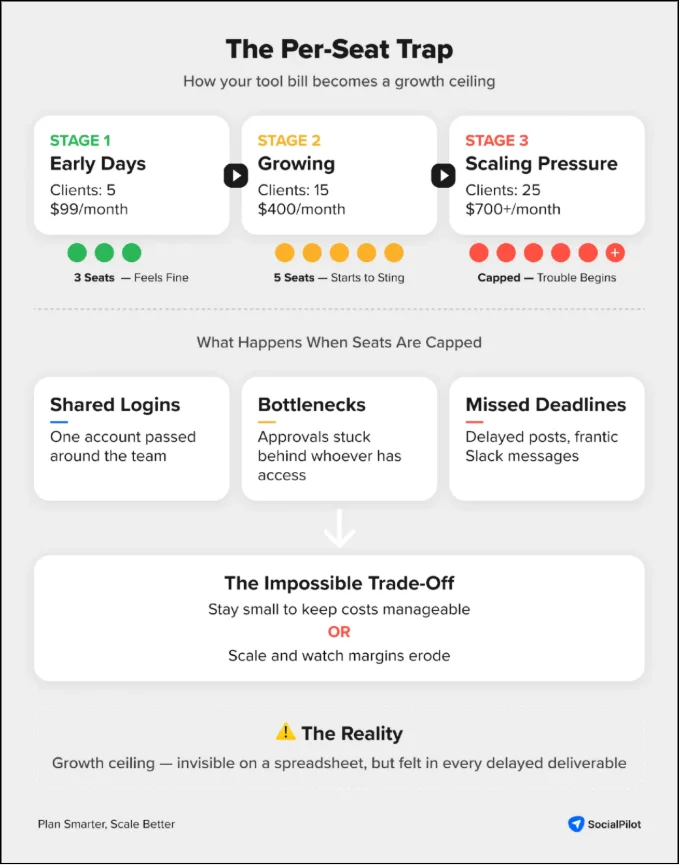
Back to the per-seat trap, from the other side. This is the one worth being opinionated about, because we’ve watched good firms, ours included, cap their own growth just to avoid a bigger invoice.
We started picking tools whose price doesn’t punish us for adding people. Flat or account-based pricing, so the coordinator who takes work off your plate doesn’t raise the bill. Every hire after that is a clean win instead of a line item to justify.
When we ran the numbers, the gap was stark. Same team, growing, on two different pricing models:
| Tool | How it’s priced | 2-person team /mo | 5-person team /mo | 10-person team /mo | Annual cost (10 people) |
| Sprout Social | Per seat ($199/seat) | $398 | $995 | $1,990 | $23,880 |
| SocialPilot | Flat plans, unlimited users at top tier | $42.50 | $85 | $170 | $2,040 |
Annual-billing list pricing, 2026. Per-seat cost climbs with every hire; flat pricing barely moves.
It’s part of why we run on SocialPilot: the team works out of it without per-seat math, so “who needs a login” stopped being a budget conversation. But it isn’t the only answer, and the table shows it: a couple of these dodge the per-seat trap too, Buffer’s channel pricing among them. The rule: price the tool at the team size you’re growing into, and make sure the number doesn’t move when your team does. Tools that scale with you are on your side. Tools that charge by the head are quietly rooting for you to stay small.
A Quick Stress Test for Your Own Firm
You don’t have to wait for something to break. Run through these. Three or more yeses means your systems are already at the ceiling, whatever your client count.
- Do posts sit waiting on approval for days, with no way to see how long?
- Is one person’s login the only way most work gets published?
- Has “we’ll fix the process later” been true for more than a quarter?
- Do you hear that something slipped from the client, not from your own system?
- Would losing one team member take a client’s whole history out the door?
- Are you adding AI tools to move faster, not to work less?
- Does your software bill climb every time you try to add help?
Three yeses means the wall isn’t a client count away. You’re leaning on it right now.
The Job Changes at Fifteen
Somewhere around the fifteenth client, the work quietly hands you a new job. You stop being the person who does the work and become the person who builds the thing that does it. Most owners never notice the promotion. They keep showing up for the old job, faster and later and more tired, and wonder why the wall won’t move.
You don’t get past fifteen by holding more in your head. You get past it by building a firm that doesn’t need your head to run. That’s harder than another late night, and it’s the only thing that actually scales.
So the next time something slips, don’t ask how to work harder. Ask what system should have caught it. The wall was never there to stop you. It’s there to show you what to build next.





 Join 55,000+ social media managers


