Birdeye packs a lot into one platform. You get review monitoring, listings, messaging, surveys, payments, AI tools, and plenty more, all under one roof.
That kind of breadth can be useful, but it also comes with a few trade-offs. Pricing isn’t listed publicly, contracts may require annual commitments, and with so many features to choose from, the platform can feel like a lot to learn, especially for smaller teams.
That doesn’t mean Birdeye is a bad fit. If your business needs a wide range of tools and more enterprise-level capabilities, having everything in one place can be a big advantage.
But what if you’re paying for features you barely use? Or you want more flexible billing? Or maybe your team just wants something simpler and easier to manage?
That’s where Birdeye alternatives come in. We tested 10 platforms across pricing, review management, features, contracts, usability, and different business needs to see how they compare, and where each one may be a better fit.
Why Look Beyond Birdeye
Birdeye’s customer ratings are hard to overlook. It has a 4.7/5 rating on G2 from 4,233 reviews and a 4.7/5 on Capterra from 707 reviews. Its security page also itemizes SOC 2 Type II, ISO/IEC 27001, HIPAA, and GDPR.
But a strong product can still be the wrong size for the job you have. Here’s why businesses typically switch from Birdeye.
Cost Concerns
Birdeye’s price is the one number you can’t look up. Its pricing page carries no dollar figures at all, in any tier or currency.
Instead there’s a location-band selector running 1 to 3 up to 1000 or more, feeding a quote form. The framing, verbatim, is “Pricing built around outcomes, not seat counts.”
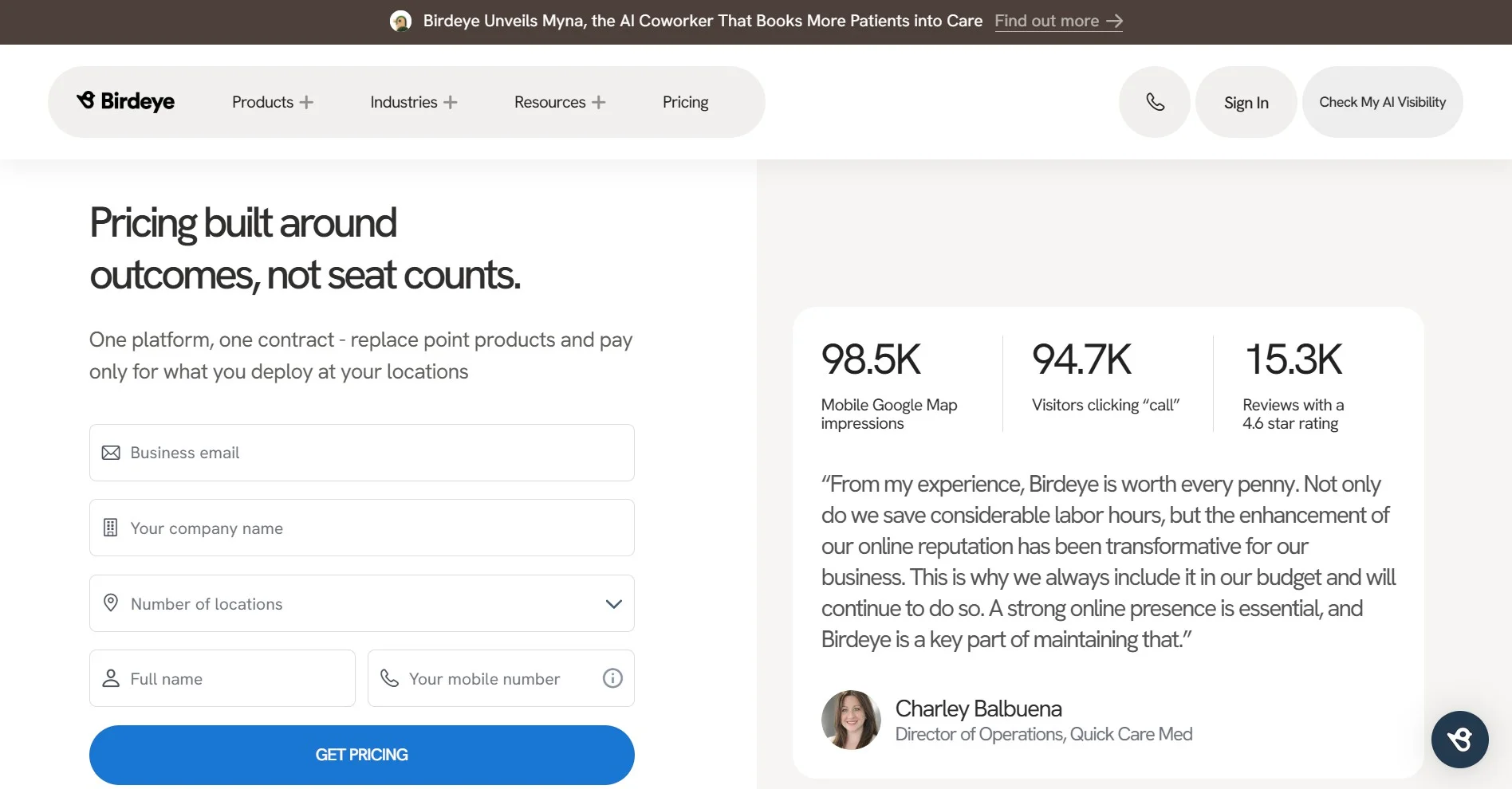
Pricing is structurally per location, with no published rate against any band and no stated contract length. So you have no reference point, and the numbers on comparison pages aren’t Birdeye’s either.
Brant S.
Birdeye is a little more expensive than some of their competitors. Sometimes I get frustrated with what is included and what is an additional cost. It is not always clear until you add it and get billed for it.
Contractual Commitments
Birdeye’s Terms are specific where the pricing page is silent.
First, auto-renewal. An agreement “will auto renew for the same period of time as the initial term of the agreement unless written notice of non-renewal is provided to BirdEye at least 90 days prior to the date of renewal.”
Second, the uplift. “At the time of any auto renewal… Birdeye will apply an 8% fee on all recurring Services fees to cover product innovations, enhanced services and inflation.”
Third, refunds. “All payment obligations under any and all Order Forms or Statements of Work are non-cancellable and all payments made are non-refundable.”
Contract length itself isn’t published, and none of these clauses appears on the pricing page.
Padma G.
I feel like there are issues with transaction fees and that the contract is too rigid and expensive. It would be better if the contract was easier to understand and didn’t have hidden things.
Complexity
The feature depth is the selling point and the problem at the same time.
Birdeye states it monitors “over 200+ review sites” from one dashboard, but names only Google and Facebook and publishes no itemized list. If the sites that matter to you sit outside those two, you’re taking the count on trust.
Verified User in Automotive
There’s a lot of functionality, which is great, but it can also make setup and ongoing management more complex than expected.
Learning Curve
Birdeye’s breadth can make the learning curve steeper than it first appears.
The platform covers reviews, listings, messaging, surveys, payments, and AI features, so there’s a lot for a new team member to learn. And as Birdeye continues to add features, getting familiar with the platform isn’t necessarily something you finish during onboarding.
Juliana B.
Communication is horrible after your 6 month onboarding is over… We emailed 3 times asking about questions on our account with no response from 8/2025-12/2025.
None of this makes Birdeye a poor platform, and for a large brand with a dedicated reputation team it may still be the right call.
It can simply make other tools a better fit for teams whose needs are narrower than the contract they signed. So how did we check the alternatives to Birdeye below?
How We Tested These Birdeye Alternatives
We went past feature lists to work out what each platform does, what it costs, and how it differs from Birdeye. Where something couldn’t be verified, we say so.
Our Testing Protocol
We ran each platform against our own test locations rather than live client profiles.
- Connected the same Google Business Profile and Facebook Page wherever supported.
- Sent the same test reviews through each reply workflow and recorded where the reply posted.
- Generated an AI reply to the same 2-star review and assessed tone and editability.
- Ran email and SMS request campaigns and checked what recipients received.
- Priced 1, 12 and 50 locations on each published rate card.
How We Fact-Checked Every Comparison
- Re-verified every price against the vendor’s own live pricing page.
- Recorded where a vendor publishes no price, instead of repeating a third-party figure.
- Standardized billing units, per month against per year and per location against per domain.
- Read the published terms for contract length, auto-renewal and cancellation windows.
- Checked ownership, including two changes inside the last ten months.
What We Didn’t Test, and Why
- Quote-only platforms at full depth. Birdeye, SOCi and ReviewTrackers all need a sales call before you see a number, so we evaluated published capability and said where pricing stops.
- Enterprise tiers with custom onboarding, SSO or managed services. Vendor claims are labeled as such.
- Long-term support responsiveness, which needs a longer window than any test period gives.
- Review-site totals no vendor enumerates in full, Birdeye’s 200-plus included.
The goal wasn’t to find a single platform that beats Birdeye across the board. It was to see where each alternative fits better, whether that comes down to pricing, review management, listings, ease of use, or the needs of a growing business.
With those criteria in mind, here’s a quick look at how the Birdeye alternatives compare side by side before we get into what each platform offers in more detail.
Birdeye Alternatives at a Glance
Not every Birdeye alternative is built for the same job. If you’re comparing Birdeye alternatives, it helps to see the key differences before getting into the details. Birdeye sits at the top as the baseline you’re measuring against.
| Tool | Best For | G2 Score | Starting Price | Review Sources | Free Plan or Trial |
|---|---|---|---|---|---|
| Birdeye | Multi-location brands wanting one platform | 4.7 | Quote only | 200+ claimed, 2 named | Not stated |
| SocialPilot Reviews | Agencies and multi-location brands | 4.5 | Free, then $30/mo | 9 platforms | Free plan, plus 14-day trial |
| SOCi | Large enterprises and mid-size businesses | 4.5 | Quote only | Not published | Not available |
| Yext | Unified listings and reviews | 4.4 | $199 per location per year | 200+, reviews at top tier | No free tier, no standard trial |
| Podium | SMB communication and review requests | 4.5 | Quote only | Google and Facebook named, no count | Not published |
| NiceJob | Freelancers and small agencies | 4.8 | $75/mo | 9 named sites | 14-day trial, no card |
| Reviews.io | E-commerce businesses | 4.8 | $29/mo billed annually | First-party, Google from $99 | Free tier, plus 14-day trial |
| BrightLocal | Agencies and local SEO teams | 4.6 | $41/mo at one location | Reviews on Grow tier only | 14-day trial, no card |
| Reputation.com | Enterprise-level reputation insights | 4.5 | $80 per location per month | Not published | Not published |
The table gives you a quick sense of how these platforms differ. Features, pricing, usability, and specific limitations can look very different once you dig into each platform.
The 8 Best Birdeye Alternatives, Reviewed in Depth
Let’s look at what each Birdeye alternative does well, where it falls short, how much it costs, and who it makes the most sense for.
That makes it easier to see which alternative actually fits your needs, rather than choosing based on feature count alone.
Free Starter plan, then $25.50 per month billed annually, or $30 monthly
Rating
4.5 on G2
Apps
Android, iOS and web
Review Platforms Supported
Google Business Profile, Facebook, Yelp, Tripadvisor, Trustpilot, Foursquare, Zillow, YellowPages and Influenster.
SocialPilot’s review management platform sits at the reputation end of this category rather than the enterprise-suite end. Birdeye’s job is to be the platform your whole local marketing operation runs through, from listings to paid ads to messaging. The job that SocialPilot Reviews does is narrower on purpose, and the rate sits on a public page.
If you’re leaving Birdeye because the platform was thin on capability, this is the wrong direction. But if you’re leaving because you’re paying enterprise money for the review half of an enterprise suite, this is the closest match.
Key Features
- Unified review feed: Centralized listing management and review consolidation across nine named platforms, pulling up to 1,000 past reviews per source you connect.
- AI replies with rules attached: Responses in 40-plus languages, triggered by star rating, publishing immediately, after a delay or through an approval workflow.
- Multi-channel request campaigns: Email, SMS through Twilio and WhatsApp, with bulk upload and duplicate request prevention so nobody is asked twice.
- Widgets and white-label reporting: Embeddable widgets for your own site, plus invite emails and landing pages carrying your client’s brand on Enterprise.
Pricing, Tier by Tier
SocialPilot Reviews’ pricing scales by location, not by feature tier, so a two-person agency isn’t paying for an enterprise module it will never open.
| Tier | Monthly | Annual | Locations |
| Starter | Free | Free | 1 brand, 1 location |
| Pro | $30/mo | $25.50/mo | 3, then $10 each |
| Enterprise | Custom | Custom | White label, custom |
Extra email credits run $10 per 1,000 emails.
Direct Reply, and Where It Actually Posts
Replies publish directly to Google and Facebook only. Everything else is draft and paste, so a person still opens Yelp or Trustpilot to post it.
Nine sources monitored against two answered looks like a contradiction, and it isn’t one. Google and Facebook are where the overwhelming majority of local review volume lands, so those two cover most of the daily work. If your volume sits on Tripadvisor or Zillow, count that step in minutes per week before you move.
Listings Reach, the Gap You Have to Price In
Listings publishing covers Google Business Profile and Facebook Pages, and nothing else. No Yelp, no Apple Maps, no Bing, none of the directory networks Yext sells by the hundred. New Facebook listings can be connected but not created, because Meta doesn’t allow it.
Who Should Actually Use This
The stronger fit is an agency or multi-location brand between 3 and 60 locations. Think of a six-person agency carrying 30 client locations, where the pressure points are response time, per-location cost and a client report somebody actually reads.
The weaker fit is a 250-location franchise network that needs paid local advertising, directory syndication and a corporate-to-local approval chain in one login. That’s a Birdeye-shaped job.
A Realistic Scenario
Say a three-person agency carries 12 client locations. On Pro billed annually that’s $25.50 for the first three plus nine more at $10 each, so $115.50 a month, or $1,386 a year.
You can’t set that against a Birdeye quote, because there isn’t one to read without a sales call. What you can set it against is Birdeye’s terms, where the agreement auto renews for its original term, notice is due 90 days ahead, and an 8% fee lands on recurring fees every time.
Pros
- Published pricing with a free single-location tier that’s usable rather than decorative, plus a flat $10 per extra location rather than a rate that climbs by band
- Review generation and monitoring sit inside one product, so the campaign that asks and the feed that catches aren’t two subscriptions
- Team and client management with role-based access, plus white-label invite emails and landing pages on Enterprise
Katie F.
I like consolidating our social and reviews down to one platform. Their support team was incredible about onboarding and accommodating specific feature requests, super quick to respond, pleasant and flexible.
Cons
- Replies post directly on Google and Facebook only, so Yelp, Tripadvisor, Trustpilot, Foursquare, Zillow, YellowPages and Influenster are all draft and paste
- Listings publishing reaches Google Business Profile and Facebook Pages only, so Apple Maps, Bing and the aggregator networks are a separate job
- No rank tracking, citation auditing or paid local advertising, and no connection to G2 or Capterra, so SEO reporting and marketplace reviews need another tool
Company Snapshot: SOC 2 Type 2 certified. Review management and listings share one dashboard, so a location added for one becomes a review source for the other.
What Sets It Apart: A free single-location tier and a flat $10 per-location add-on, where the two closest competitors publish no number at all.
No published price. Quote only, through a demo request
Rating
4.5 on G2 based on 4,680 reviews and 4.5 on Capterra based on 251 reviews.
Apps
Android, iOS and Web
Review Platforms Supported
Travelocity, Tripadvisor, Google Business Profile, G2, Grubhub and Capterra among others. The list skews towards hospitality and food service, which tells you who buys it.
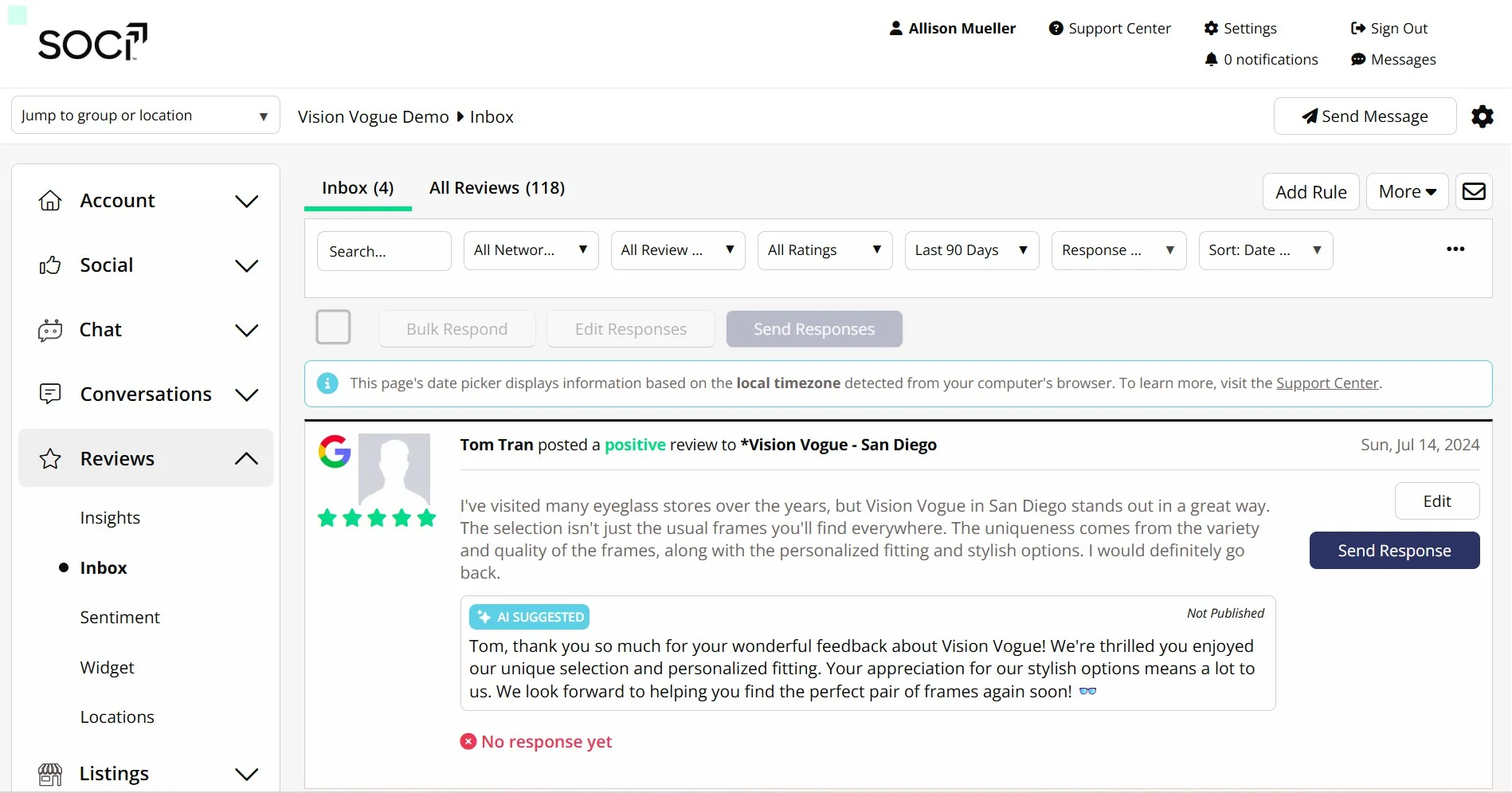
SOCi is a localized marketing platform that happens to include reviews, not a review tool that grew into one. It is built for franchises where every location needs its own social presence, listings and reviews, governed centrally so the brand does not drift.
Key Features
- SOCi Genius Reviews: Responses trained on your brand voice, so they read the same at location 4 and location 400.
- Per-location aggregation: Each franchisee sees their own queue rather than a firehose of everyone else’s reviews.
- Sentiment tracking over time: How a regional manager spots a store going wrong before the average moves.
Pricing, Tier by Tier
| Plan | Price | Billing basis |
| All plans | Custom pricing, quote only | Not published. Enterprise sales motion |
You’re Leaving a Quote-Only Contract for a Quote-Only Contract
Two quote-only platforms, so there’s no arithmetic to do, and that’s the finding. Both price by location count, both run an enterprise sales motion, and neither will give you a number without a call.
So choosing between them isn’t a budget exercise, it’s a structural one. SOCi assumes a franchise hierarchy and Birdeye assumes a corporate marketing team. Ask both for a written per-location rate at your exact location count and compare the two quotes side by side, because the published pages won’t help you.
Replies Are Governed by the Org Chart
Responses written by SOCi Genius post back to the connected profile as part of the review workflow, which is the entire point of the feature. What’s unusual is who’s allowed to send them.
Permissions run down the hierarchy, so a franchisee answers their own reviews inside guardrails head office set once. Nothing else on this page models that relationship. Per-platform reply behavior comes from SOCi’s documentation rather than from an account we tested.
Who Should Actually Use This
The stronger fit is a brand above roughly 100 locations, especially a franchise model where the local operator owns the customer relationship and head office owns the brand.
The weaker fit is a 12-branch business, where you’ll pay for governance layers nobody needs. It’s a poor fit for any team that wants a price before a meeting.
A Realistic Scenario
Say a restaurant group runs 240 locations across four regions. Roughly 60 franchisees post their own local content and answer their own reviews, and the brand voice has to hold across all of it without head office reading every response.
That’s the job SOCi is built for, and it’s also why the quote will be shaped by your location count rather than by a plan name. At 240 locations, the per-location rate matters more than any feature in the demo.
The honest read: a strong Birdeye alternative and a bad Birdeye escape route. If you’re leaving because of the price opacity and the annual contract, you’re walking into the same model. If you’re leaving because Birdeye doesn’t model your franchise structure properly, this is the one that does.
Pros
- Built for hierarchy, with brand-level control and location-level ownership in the same account
- Genius Reviews holds a consistent voice across hundreds of profiles, which no template library manages at that scale
- Competitive monitoring is local rather than corporate, comparing a store against the restaurants on its own street
Freyen Jafeth F.
SOCi makes it easy to manage all my social media accounts, reviews, and business listings from one dashboard. It seriously saves time and keeps things organized.
Cons
- No published pricing at all, so budgeting before a sales call is impossible
- Reviewers report specific features going down for stretches, including the events tab, which is the kind of thing that erodes trust with local operators fast
- The governance layers that make it work at 400 locations are overhead at 20
Layth A.
The biggest downside of SOCi is that some features can be difficult to find, and the interface can feel a bit cluttered at times. Improved navigation and more customizable reporting options would make the platform easier and more efficient to use.
Company Snapshot: Second only to Birdeye in this roster, on 3,571 published reviews. That volume comes from enterprise franchise rollouts rather than self-serve signups, which is also why there’s no price on the page. Nobody buys this without a conversation.
What Sets It Apart: Nothing else here treats the individual franchisee as the user and the brand team as the approver, with review replies governed by that same permission structure.
$199 per location per year on the entry tier, billed annually, on a 12-month term.
Rating
4.4 on G2 based on 1,124 reviews and 4.2 on Capterra based on 114 reviews.
Apps
Web only. No iOS app, no Android app.
Review Platforms Supported
Facebook, Google Business Profile, Trustpilot, Yelp and Tripadvisor among others, riding the same publisher network Yext states reaches 200-plus publishers.
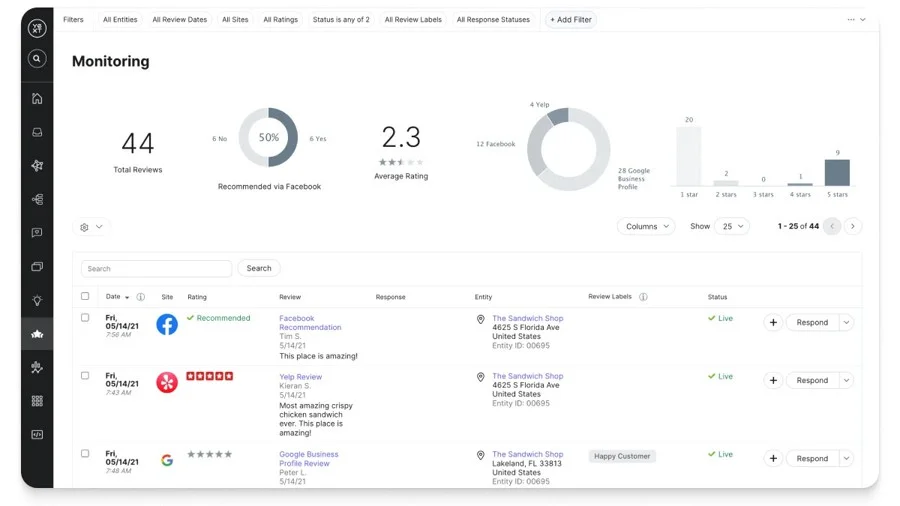
Listings come first here and everything else hangs off them. Yext built a machine with one real job. It makes sure your name, address, hours and services are identical on Apple Maps, Bing, Yelp, voice assistants and dozens of directories you’ve never opened. Reviews are one more field in that record.
So if you’re leaving Birdeye to save money, read the pricing block below carefully. But if you’re leaving because Birdeye couldn’t see the rest of your online presence, this is the most complete answer on the page.
Key Features
- A 200-plus directory network: The publisher reach no other tool here comes close to matching, and the reason enterprises buy it.
- Yext Content: The structured store of your business facts that feeds every listing and every search surface from one record.
- AI review responses: Replies generated from that same business record, so the response knows the store’s hours.
- Review generation: Email and SMS requests tied to the location entity rather than to a contact list.
Pricing, Tier by Tier
Self-serve pricing is per location and billed annually only. There’s no monthly option on any tier.
| Tier | Annual per location | What You Get |
| Emerging (Starter Package) | $199 | Listings on 40-plus sites |
| Essential (Plus Package) | $449 | Google, Yahoo, Facebook, Bing, Apple, Yelp, MapQuest, Citysearch, Local.com and Foursquare |
| Complete (Standard Package) | $499 | Full Essential and Emerging networks, PowerListings+ and analytics |
| Premium (Advanced Package) | $999 | Everything above, plus review monitoring and website widgets |
Every plan runs a 12-month contract. Yext’s own words on the PowerListings plans page are “*Billed at $199 Annually” and “Choose the package that works for your business. All Yext plans last 12 months.”
Enterprise contracts beyond this ladder are quoted individually.
Review Management Costs $999 Per Location, Per Year
Review monitoring doesn’t appear until Premium, the top self-serve tier, at $999 per location per year. So ten locations wanting review management on Yext is $9,990 a year.
What Yext sells you at that price is a directory network several times larger, and listings that update almost instantly. So if reviews are your actual problem, you’re paying an enormous premium for listings infrastructure you didn’t come for.
Replies Publish Only Where Yext Owns the Listing
Replies go out through the same publisher network that carries the listing, so a Google response posts from Yext rather than sitting in a draft box.
The trade is that your reviews are only as connected as your listings are. A directory Yext hasn’t claimed for you is a directory it can’t answer on. And the claiming is the part that takes time in month one.
Who Should Actually Use This
The stronger fit is a brand whose hours are wrong on Apple Maps and whose phone number is wrong on Bing. That’s the actual problem, with reviews as a secondary worry.
The weaker fit is a team where review generation and response volume are the daily job, because reviewers consistently describe the review tooling as thin on insight. It’s a poor fit for anyone who needs to work from a phone.
A Realistic Scenario
Say a retail group has 30 branches and moved eight of them in the last two years. Customers keep turning up at the old addresses, because a directory nobody monitors still lists them.
That’s a Yext problem rather than a review problem, and no amount of AI reply drafting will fix it. Thirty locations on Emerging is $5,970 a year and solves the listings half. Adding review monitoring means Premium at $999 each, or $29,970. That’s the moment most teams put reviews somewhere else.
The honest read: directory coverage is the row Yext wins. It loses on usability, on mobile, and on the depth of what it tells you about the reviews it collects. Buy it for the listings network and you’ll be happy. Buy it as a Birdeye replacement for reviews and you’ll be back here in a year.
Pros
- Directory coverage nothing else on this page matches, including Apple Maps and Bing
- One structured record feeds listings, reviews and search surfaces, so you update hours once
- $199 for a year at a single location is low enough to run a real test before you commit a budget line
Toni T.
I like the simplicity of Yext, as it allows me to manage everything in one place instead of using multiple vendors. The help videos Yext provides are really great because they let me solve problems on my own and work independently when I need to.
Cons
- Review monitoring requires the $999-per-location Premium tier, which is the most expensive way to solve a reputation problem on this list
- No mobile app of any kind, which rules it out for teams who reply on the move
- Review analytics are shallow compared with tools built review-first, so you get the reviews but not much insight from them
Verified User in Staffing and Recruiting
We test piloted a couple other Yext services but they ended up not being the right price or fit for us. Specifically, we thought the Reviews tracking service was expensive.
Company Snapshot: A listings network reaching 200-plus directories, with 1,124 published reviews behind it. The company sells listings first and reviews second. Every part of the product structure shows it, from the packages named after listing tiers to the absence of a mobile app.
What Sets It Apart: Your review sits on the same publisher network that controls your listing across 200-plus directories. So one corrected fact updates everywhere at once. That wiring exists nowhere else on this page.
Custom pricing, quote only. Podium publishes no tier figures of any kind.
Rating
4.5 on G2 based on 2,109 reviews and 4.3 on Capterra across 526 reviews.
Apps
Android, iOS and Web.
Review Platforms Supported
DealerRater, Google Business Profile, Yellow Pages, BBB and Facebook among others. The presence of DealerRater isn’t an accident. Car dealerships, home services and clinics are the core customer.
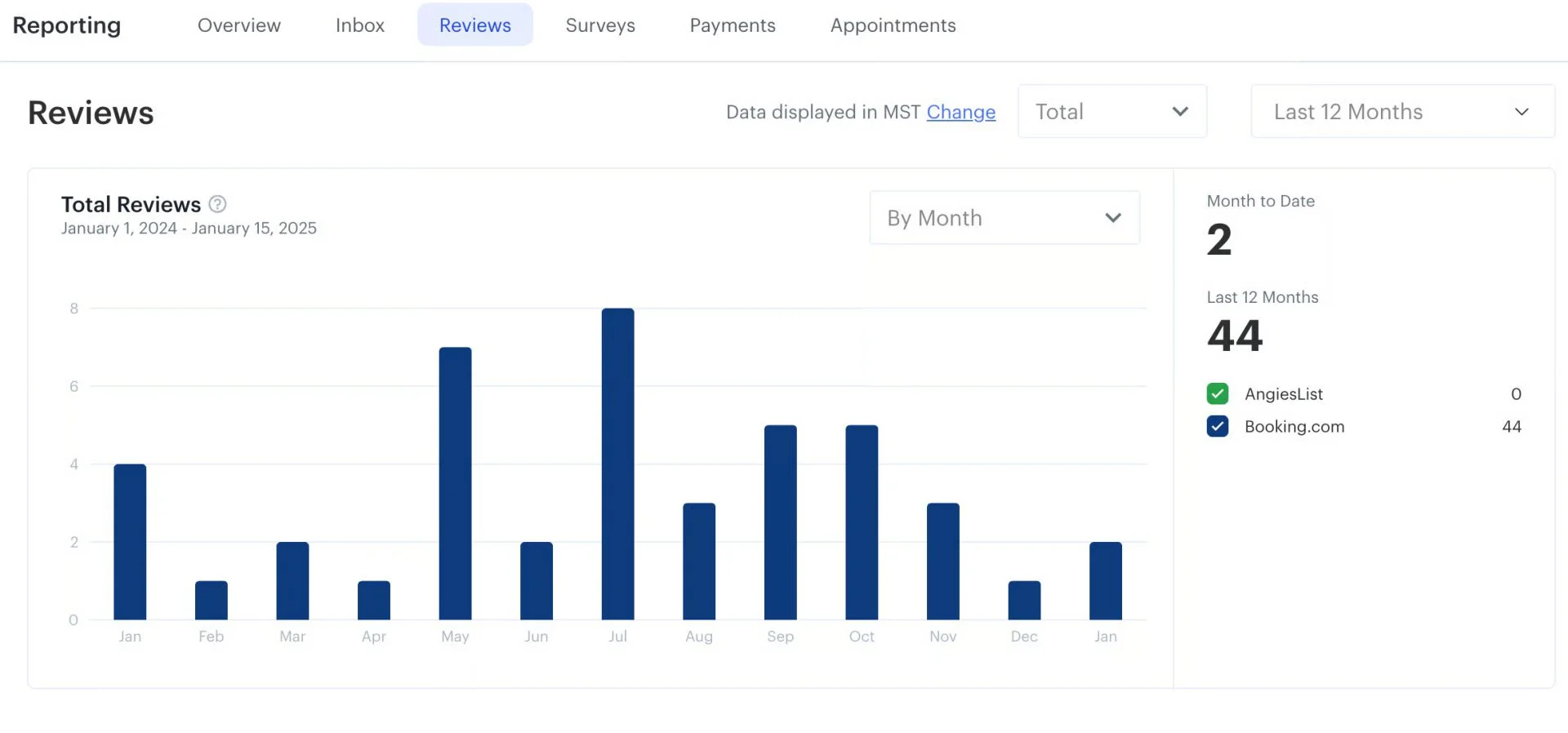
One phone number carries the whole relationship. Podium is a messaging product that collects reviews, not a review product with messaging bolted on. Customer texts, webchat, payment requests and review invitations all run through one inbox and one business phone number.
Against Birdeye, the difference is direction of travel. Birdeye runs a campaign out to a customer. Podium asks for the review inside the conversation you were already having, by text, in the same thread as the appointment reminder.
Key Features
- One shared inbox: Texts, webchat, calls and review requests held against a single customer record.
- SMS review invitations: Automated reminders on the highest-converting request channel a business with a phone number has.
- AI-drafted replies: Responses written for you, with an AI Employee add-on that answers inbound messages.
- Webchat widgets: Capture a mobile number on your site and drop the conversation into the same inbox.
Pricing, Tier by Tier
| Plan | Price | Billing basis |
| All plans | Custom pricing, quote only | Not published. AI Employee sold as an add-on to any plan |
Podium’s own words on their pricing page, checked 16 September 2026: “Plans designed to fit your specific business needs, talk to our sales team for details.”
Where a Published $399 Used to Be, There’s Now a Form
This page carried $399 a month for Podium Core, and half the internet still does. That figure doesn’t appear anywhere on Podium’s current pricing page. So it’s gone from here, and it hasn’t been replaced with a guess. We wrote up what Podium actually costs separately rather than repeat a number we can’t source.
Which leaves you comparing two quote-only tools. Same shape, smaller building.
The difference is who the sales motion is built for. Birdeye’s dropdown starts at 1-3 locations and runs to 1000+. Podium aims squarely at the single-site and few-site business, so the quote arrives faster and smaller.
The Reply and the Text Thread Land in the Same Inbox
Review responses go out from the same inbox that holds the customer’s text history, and post back to the source profile.
That context is genuinely useful. The person leaving a two-star review is often the person who texted you about the same job last week. Nothing else here puts the complaint and the conversation on one screen.
Who Should Actually Use This
The stronger fit is a business where the customer relationship already happens by text: dealerships, dentists, HVAC, anything with a service counter and a follow-up call.
The weaker fit is a 40-location brand that needs governance and roll-up reporting. The strength here is the individual conversation, not the portfolio view. It’s a poor fit for e-commerce, where there’s no phone number and no counter.
A Realistic Scenario
Say a group runs six auto service centers. Each one does roughly 400 jobs a month and asks nobody for a review. The service advisor is already on to the next car.
A text sent 20 minutes after collection converts far better than an email sent the next day. And 2,400 jobs a month is a lot of texts that currently go nowhere. That’s the entire Podium argument. At six locations, the quote will be a manageable number.
The honest read: if your customers already text you, nothing here collects reviews faster. It’s also the entry with the worst documented support failure in this roster. So read the review below before you sign anything with an auto-renewal in it.
Pros
- Review requests by SMS convert better than email for local service businesses. The whole product is built around that one insight
- 4.5 across 2,109 reviews is the strongest score of any quote-only tool here
- The shared inbox means whoever answers the review can see the whole customer history first
Timothy F.
I also appreciate that it allows us to manage multiple conversations simultaneously, making communication simple and intuitive. The system is very intuitive, which made the initial setup pretty easy.
Cons
- No published pricing, so you’re back in the same sales process you’re trying to leave
- Thin for multi-location roll-up reporting compared with SOCi or Reputation
- Little to offer an e-commerce business, and no listings network worth the name
Waqas F.
Although it is one of the those platforms which gives you centralized insights but it stands out as the one of the most expensive tools especially for small businesses.
Company Snapshot: The customer is a local business with a front desk and a phone that rings. The product is shaped entirely around that. One number, one inbox, one thread per person.
What Sets It Apart: The review request and the sales conversation run down the same text thread. It goes to the same phone number the customer already has saved. Every other tool here needs a second channel for one of those two jobs.
$75 a month on Starter, billed monthly, with no contract.
Rating
4.8 on G2 based on 419 reviews and 4.9 on Capterra across 203 reviews.
Apps
Web and iOS. No Android app.
Review Platforms Supported
G2, Google Business Profile, Capterra and Facebook among others, with Google as the primary target for review generation.
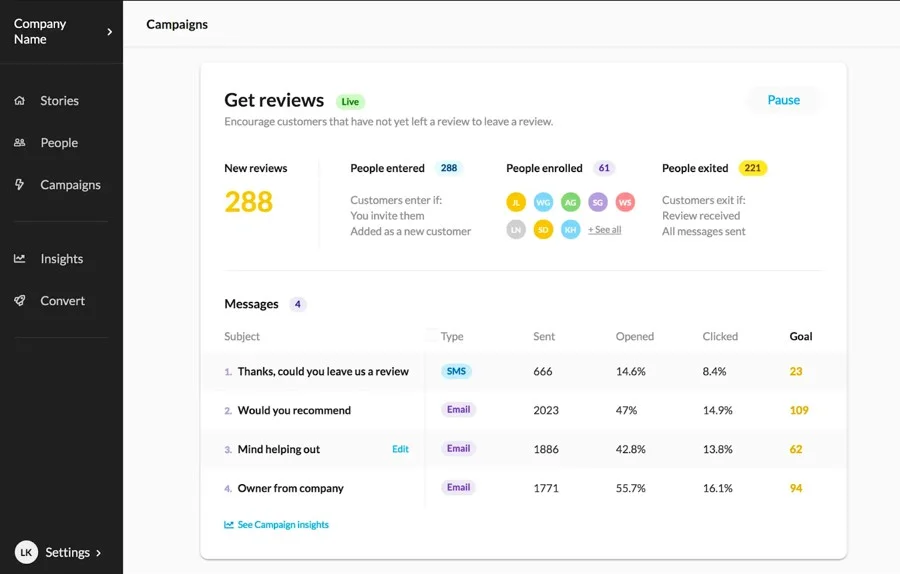
Asking for reviews is the whole job, and NiceJob automates it. You can connect it to a system that already knows a job is finished (such as a CRM). It sends the review request to customers, chases the non-responders, and turns what comes back into social proof on your website.
There’s very little to configure. That’s both the pitch and the limit. If you’re leaving Birdeye because you never used four fifths of it, this is the opposite end of that trade.
Key Features
- Automated review requests: Triggered from your CRM or scheduling tool, so nobody has to remember to send anything.
- Review sharing: New reviews republished to your website and social profiles as they land.
- Microsite and team leaderboard: On the entry plan, which turns review collection into something staff compete at.
- The Pro bundle: AI Replies, Referrals, Repeats, Broadcasts, Gifts and NPS surveys, all one tier up.
Pricing, Tier by Tier
| Plan | Price | Billing basis | What you get |
| Starter | $75/month USD | Monthly, no contract | Reviews, Social Proof, Social Sharing, Team Leaderboard, Microsite |
| Pro | $125/month USD | Monthly, no contract | Everything in Starter, plus Repeats, Referrals, Broadcasts, AI Replies, Gifts, NPS Surveys, Competitive Intel |
| Sites (add-on) | $99/month USD plus $199 one-time setup | Monthly | Fully managed website |
Cancel anytime. 14-day free trial, no credit card.
AI Replies Start at $125, Not $75
Here’s the catch in the cheaper plan. AI Replies arrive on Pro at $125 a month. On Starter you’re still writing and posting responses yourself on the review site.
That’s fine for one location and tedious across five. So price the entry plan as a review generator rather than as a review manager, because that’s what it is until you upgrade.
No Contract, So the Exit Costs Nothing
Starter at $75 a month is $900 a year on billing you can stop in 30 days. Pro at $125 is $1,500 a year. Both are published, both are cancellable, and neither needs a phone call.
Now compare that with a Birdeye contract that has no public figure and an annual renewal customers report struggling to escape. The comparison is less about the money than about the exit.
Who Should Actually Use This
The stronger fit is a freelancer, or a small agency running a handful of client accounts. It also suits a single-location business that just wants more reviews without thinking about it.
The weaker fit starts the moment you pass a few locations. The licensing gets awkward, and the multi-location navigation is reported as clunky. It’s a poor fit if you need directory management, because there’s none.
A Realistic Scenario
Say an agency has nine clients. Each is a single-location home services business, and each currently gets about three reviews a month by accident. Automating the request is the entire fix.
If it takes those nine from three a month to twelve, that’s 81 extra reviews a month across the book. The cost is $75 or $125 per account, and nobody opens the tool after week one.
The honest read: nothing here is rated higher, and nothing here tries to do less. It does review generation and social proof extremely well. It doesn’t pretend to do listings, messaging or enterprise reporting. If that’s your whole problem, nothing here beats it on satisfaction scores.
Pros
- The best-rated tool on this page on both review platforms, and by a clear margin
- Genuinely automated. Connect it once and the requests keep going without anyone touching it
- Published prices, no contract, cancel any month, 14-day trial without a card
Aaron L.
I really like the automation in NiceJob. It’s synced with our CRM and is pretty much hands-off. Review invites are sent out automatically when a work order is completed in our CRM, which is great. The invites go out first by text and then by email, and this sequence is customizable too.
Cons
- AI Replies sit behind the Pro plan, so the cheaper tier still means manual responding
- No Android app, and the iOS app is reported as less capable than the web version
- Multi-location handling is the weak point. Reviewers name duplicate Facebook reviews and awkward switching between locations
- “Overall, NiceJob is a decent solution if you only need a simple way to collect more reviews. But if you’re hoping to use the other features such as SEO benefits, referrals, or multi-location support, you may find it falls short.”
- Steve G., G2 Review
Company Snapshot: Published plans, published prices, no contract and a trial without a card is a small-company posture. It’s a deliberate one. Everything about the packaging is designed so you never have to talk to a salesperson.
What Sets It Apart: Add $99 a month and a $199 setup fee and NiceJob will build and run your website as well. Nothing else on this page offers that alongside a review engine.
$29/month on Essentials, billed annually, and the billing unit is a domain rather than a location or a seat.
Rating
4.8 on G2 based on 654 reviews and 4.2 on Capterra across 10 reviews.
Apps
Web and iOS.
Review Platforms Supported
Bing, G2, Google Business Profile, Capterra and Facebook among others, with Google Licensed Review Partner status feeding seller ratings into search results.
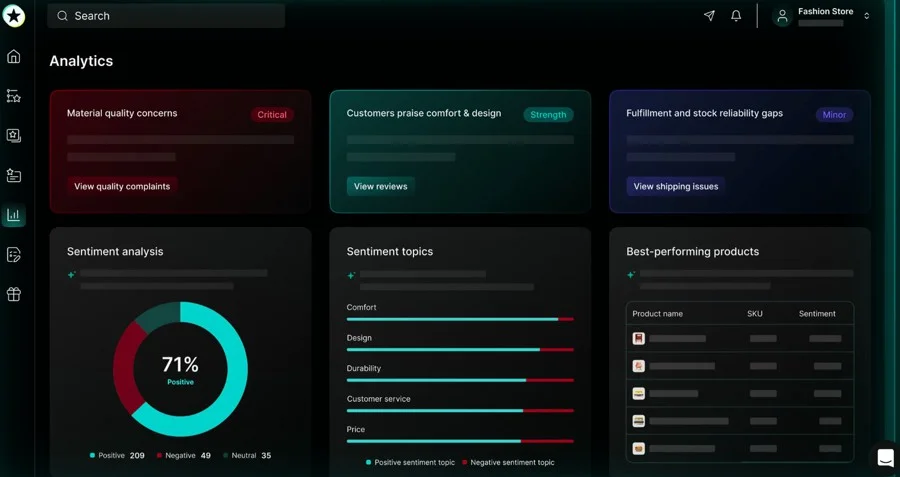
The reviews live on your own domain. Reviews.io collects and hosts them rather than monitoring reviews that already exist somewhere else. So company reviews and product reviews stay separate objects, and invites are tied to an order. The output is built to sit on a product page and convert a stranger.
Strictly speaking that makes it a different category from Birdeye. It’s here for one reason. A meaningful share of people searching for Birdeye alternatives are e-commerce teams who bought the wrong category of software in the first place.
Key Features
- Verified-purchase invites: Triggered by an order, separating what someone thought of the product from what they thought of the company.
- Video reviews: A first-class format collected in the same flow as text and photos.
- Review Nuggets: Short pulled phrases from real reviews that you can place beside a price or an add-to-cart button.
- No-code widgets: Built in an editor, with session replay and analytics on how visitors actually interact with them.
Pricing, Tier by Tier
| Plan | Price | Monthly review invites | What you get |
| Essentials | $29 per month | Up to 300 | Product/company reviews, photo/video collection, automation, 15+ widgets |
| Start-Up | $79 per month | Up to 1,000 | Everything in Essentials + Google Seller Ratings, rich snippets, review importing, Klaviyo, 100 SMS invites |
| Grow | $175 per month | Up to 1,000 | Everything in Start-Up + reputation management, AI review summaries, competitor analysis, 100 survey replies |
| Plus | $500 per month | Up to 7,500 | Everything in Grow, plus AI review replies, translation, Bazaarvoice syndication, API access, a customer success manager |
All plans are month to month with no annual contract required, 20% off if you pay annually, and a 14-day free trial. Pricing is calculated per domain.
The Billing Unit Is a Domain, Not a Location
The billing unit is the whole comparison here. Birdeye counts locations, so a 40-store retailer pays for 40 of something. Reviews.io counts domains and invites instead. So that same retailer running one website on Grow pays $175/month for up to 1,000 invites, however many stores feed it.
Say your revenue arrives through one checkout rather than through 40 front doors. Then per-location pricing is charging you for a shape your business doesn’t have. It cuts the other way too. A second brand or a country site is a second subscription, and no plan fixes that.
You Own the Page, So the Reply Publishes Instantly
Reviews collected on your own domain are hosted by Reviews.io, so a reply publishes the moment you send it. There’s no copy and paste anywhere. No third-party platform decides whether a tool may post on your behalf.
That’s the advantage of owning the review page. The limit is the other side of the same coin. Reviews you didn’t collect still live on somebody else’s site, and this doesn’t reach them.
Who Should Actually Use This
The stronger fit is an online store that needs verified-purchase reviews and star ratings on product pages and in Google Shopping.
The weaker fit is a business whose reviews land on Google Business Profile for physical branches. That isn’t what this is built to manage. It’s a poor fit for a franchise network too, where per-domain pricing makes no sense at all.
A Realistic Scenario
Say a retailer sells through one Shopify store doing 3,200 orders a month. On Grow at $175/month you can invite every one of those customers and still have 1,800 invites spare.
Collect video from the happiest of them. Put a Review Nugget beside the price on your 40 best-selling products. None of that is a job Birdeye is designed to do.
The honest read: this isn’t a Birdeye competitor so much as a correction. Say you’re an e-commerce team that ended up on a multi-location reputation platform. This is the category you actually needed, at roughly a tenth of the commitment.
Pros
- 4.8 across 581 reviews, matching NiceJob at the top of this page
- Verified-purchase model, which carries more weight on a product page than an open review does
- Video reviews and UGC collection built in rather than sold as an add-on
Verified User in Computer Hardware
Reviews.io has been an excellent tool for our business. The platform makes it simple to collect verified customer feedback and display it in a professional way that enhances brand reputation.
Cons
- Per-domain pricing is the wrong unit for a multi-location business. No plan fixes that
- The top published tier at $500/month is more than most tools here charge. And invite caps apply on every tier
- Widgets have been reported to slow page loads. That matters more on a store than anywhere else
Rachel F.
I’d love to see the widgets perform a bit faster, as they are faster than the Yotpo widgets but are still making a lot of unnecessary calls that make them perform a little slower than is ideal.
Company Snapshot: Pricing per domain with invite ceilings is an e-commerce shape, not a storefront shape. The plan names track order volume rather than headcount or branches.
What Sets It Apart: It’s the only tool here priced per domain instead of per location or per seat. It’s also the only one that treats a video review as a standard collection format rather than an upsell.
From $41 a month on Track at one location.
Rating
4.6 on G2 based on 230 reviews and 4.8 on Capterra across 283 reviews.
Apps
Web only.
Review Platforms Supported
80-plus sites by BrightLocal’s own claim. That includes Google Business Profile, Yelp, Facebook, Yahoo and Tripadvisor, with real-time alerts when something new lands.
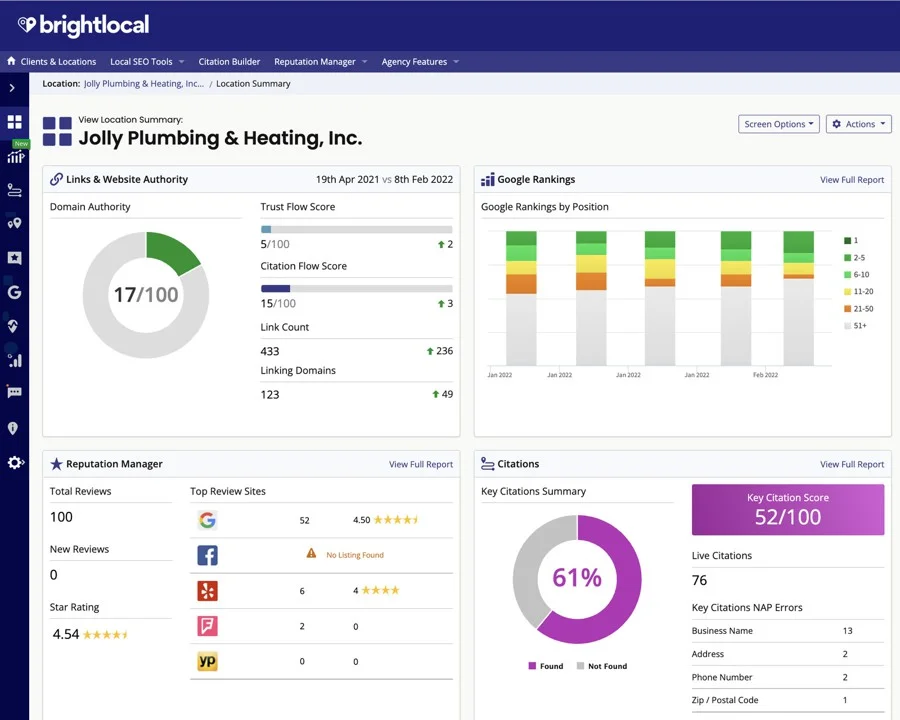
Local SEO is where this came from, and it still thinks that way. BrightLocal treats reviews as one signal among several, sitting beside rank tracking, citation building and audit reporting.
So the reason an agency buys it is usually the white-label client report, not the review inbox. Say you’re paying for reputation software and still buying rank data somewhere else. That’s the gap this closes.
Key Features
- Review monitoring across 80-plus directories: Alerts on new reviews, so nothing sits unanswered because nobody was watching Yahoo.
- Local Search Grid and geolocation tracking: Where in a town you rank, street by street, rather than just whether you rank.
- Citation Builder: Individual directory listings bought outright, pay-as-you-go, with no recurring fee attached.
- White-label reporting: Audit and performance reports an agency can send to a client without editing anything.
Pricing, Tier by Tier
Priced by the number of active locations in the account. Every figure below is at one location.
| Plan | Billed monthly | Billed annually | What you get |
| Track | $41 per month | $369 per year | Local search visibility tracking and auditing |
| Manage | $54 per month | $485 per year | Business listings management |
| Grow | $65 per month | $584 per year | Track plus Manage plus review monitoring and review responses |
| Citation Builder | $3.20 per site, or $2 with bulk credits | Pay-as-you-go, no subscription | Citations you own outright, zero recurring fees |
| Aggregator submissions | $30 each, or $120 a year for all five | Pay-as-you-go | Submissions to the five data aggregators |
| Managed SEO Service | $1,299 per month | Monthly | Dedicated team, strategy to execution |
Monthly or annual, 25% off annual, no lock-in, and a 14-day free trial with no credit card.
Grow Is the Only Plan That Watches Reviews
Here’s the fact that decides whether this is a Birdeye replacement at all. Review monitoring and review responses aren’t in Track and aren’t in Manage. They arrive on Grow, the top plan, at $65 a month for one location.
And monitoring 80-plus sites still isn’t replying on 80-plus sites. Google replies post from BrightLocal. For most of the rest, it tells you a review arrived and hands you the link. Breadth of monitoring and breadth of reply access are two different things, and only one of them scales to 80 directories.
$65 at One Location, $989 at a Hundred
Grow is the plan you need, so Grow is the plan to price. It’s $65 a month at one location, $494 a month at 50, and $989 a month at 100.
That’s a band, not a per-location multiplier, so your cost per location falls as you add branches. Birdeye’s dropdown moves you between location bands too, but you never see what either band costs.
There’s no lock-in here, and the annual discount is optional. So this is a decision you can make in an afternoon rather than across three calls.
Citations sit outside all of it. They’re pay-as-you-go at $3.20 per site, dropping to $2 with bulk credits. The five data aggregator submissions are $30 each, or $120 a year for all five.
Who Should Actually Use This
The stronger fit is an agency managing local SEO for 20 or 40 client locations. It needs rank data, citations and reviews in one report, with its own logo on it.
The weaker fit is a brand that wants review generation as the main event. The requesting tools are lighter than NiceJob’s or Podium’s. And if you’re weighing it against the rest of its own category rather than against Birdeye, BrightLocal’s own alternatives is the more useful page.
A Realistic Scenario
Say an agency carries 22 client locations across eight accounts. Every month each client wants to know three things. Did they move in the map pack, are their citations still correct, and what did people say about them.
Building that by hand is two days a month. The Local Search Grid plus a white-label report is what you’re actually paying for. The review module on Grow is the part that stops you needing a second subscription.
The honest read: reporting and rank data are excellent. Citations you own outright are genuinely unusual in a category that rents you everything.
Reputation management is the weakest module in the product, and BrightLocal’s own users say so. It’s an SEO tool that handles reviews, not a review tool that handles SEO. Buying it the other way round is where agencies get caught out.
Pros
- Citations bought outright from $2 with no recurring fee. Nothing else on this page offers that
- White-label reporting that agencies can send straight to a client
- Rank tracking at street level rather than city level, through the Local Search Grid
Gazala S.
It has everything that a local SEO needs. I use the grid rank checker, citation checker, and local rank checker the most. The grid rank checker is fantastic and very helpful in removing spam profiles.
Cons
- Review monitoring and responses require Grow, so the two cheaper plans aren’t review tools at all
- Reputation management is the thinnest module in the product. Collecting more reviews still takes manual effort
- Directory listings don’t all go live. Reviewers report new listings being created on directories where the existing one couldn’t be edited
Adam J.
Because of all the tools and options available, it can be a little difficult to navigate or find where you are looking to go the very first time.
Company Snapshot: Grown out of local SEO services, and the product still reads that way, from the audit tooling to the pay-as-you-go citations.
What Sets It Apart: Buy a single directory citation outright at $3.20, or $2 with bulk credits, and you owe nothing afterwards. Every other listings product on this page rents you the same thing for as long as you keep paying.
$80 per location per month on Rep Core.
Rating
4.5 on G2 based on 2,469 reviews and 4.4 on Capterra across 184 reviews
Apps
Web application, iOS and Android app
Review Platforms Supported
Google Business Profile, Facebook, Yelp, Trustpilot, Tripadvisor, and Better Business Bureau (BBB).
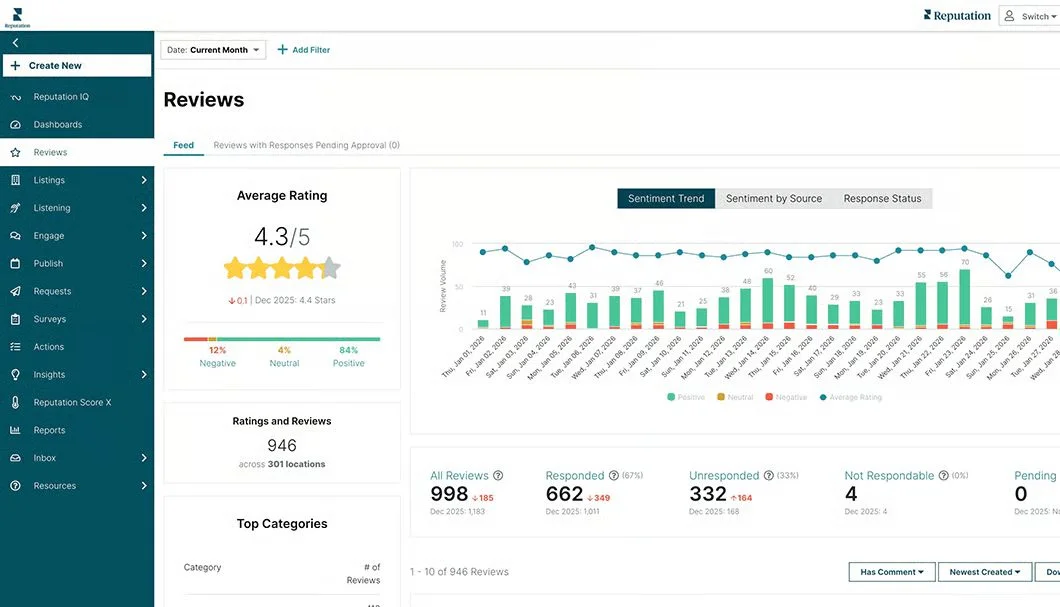
Everything customers say about you gets compressed into one number. Reputation then sells you the tooling to move it. Reviews, surveys, listings and social all feed a Rep Score, and that’s the thing an enterprise marketing lead actually presents upward.
Of everything on this page, this is the closest to Birdeye in scope and in sales motion. The difference is that it publishes a rate.
Key Features
- Rep Score: A single index built from review volume, ratings, response behavior and listing accuracy across every location.
- AI responding in the base tier: Included at Rep Core rather than held back for an upgrade.
- Business Listings and local SEO: Managed in the same account as the reviews.
- Journey Insights and Pulse Analytics: On the middle tier, connecting what people said to where they said it.
Pricing, Tier by Tier
| Plan | Price | Billing basis | What you get |
| Rep Core | $80 per location per month | Per location, monthly | Reviews management (collection, requesting, AI responding), Business Listings and SEO |
| Rep Core + Pulse | $115 per location per month | Per location, monthly | Everything in Rep Core, plus Reputation Insights (Rep Score and Journey Insights), AI Reputation Manager, Pulse Analytics, basic surveys |
| Rep Core + Surveys | $150 per location per month | Per location, monthly | Everything in Pulse, plus advanced surveys (6 templates), email survey requesting, targeted outreach, deep experience insights |
| Enterprise | Custom pricing, quote only | Custom | Custom plans for 125+ locations, dedicated infrastructure, CSM |
Every tier is per location per month. No contract length.
$80 Per Location Means $800 at Ten Locations
This is the one comparison on the page where you can actually do the sum. Reputation publishes its per-location rate and Birdeye doesn’t.
Twenty locations on Rep Core is $1,600 a month, or $19,200 a year. Move to Rep Core + Pulse for the Rep Score and it’s $2,300 a month, or $27,600 a year. Those are enterprise numbers, and they’re honest ones. That’s more than the category usually manages.
Birdeye at 20 locations sits in the 10-39 band and costs whatever the call decides. If you’re shortlisting at this level, Yext against Reputation is the other comparison worth reading. Those two split the enterprise market between listings depth and analytics depth.
AI Responding Sits in the Base Tier
Most tools on this page put AI replies one tier up. Here it’s in Rep Core at $80. So from day one, responses go out from Reputation rather than from each individual profile.
Reviewers single out the quality of those automated responses more often than they mention any other feature. That’s unusual for a platform sold on analytics.
Who Should Actually Use This
The stronger fit is a brand above 50 locations. Someone senior asks every quarter whether reputation is improving, and expects a number rather than a story.
Reputation and SOCi both genuinely beat everything else here on enterprise scale. This is the one to pick if the deliverable is analytics rather than franchise governance.
The weaker fit is anyone below 20 locations. At that size, $80 each per month buys reporting depth you’ll never present. For the wider category view, we maintain a roundup of reputation management platforms.
A Realistic Scenario
Say a healthcare brand runs 60 clinics and the board asks one question each quarter: are we getting better or worse.
Rep Core + Pulse at $115 per location is $6,900 a month, or $82,800 a year. What you get for it is a single defensible index plus the journey data behind it. That’s a real budget line.
Does it beat exporting CSVs and building the deck yourself? That depends on what an hour of your time costs, and on how often the board asks.
The honest read: no other tool here takes analytics this seriously, and nothing that publishes a price costs this much. It earns the enterprise row. The support complaints are pointed though. At $9,600 a year for ten locations, you’re entitled to ask hard questions about them before you sign.
Pros
- Publishes a real per-location rate, which no other enterprise tool here does
- AI responding included in the base tier instead of being an upsell
- Rep Score gives leadership one number to track. That’s what gets budget renewed
Dean M.
The AI Answer Engine has become a powerful source in tracking our GEO efforts in searchability across AI platforms.
Cons
- $80 per location per month compounds fast. Ten locations is $9,600 a year before add-ons
- Published complaints include months of unresolved product problems, with at least one customer describing an active move off the platform
- The Rep Score is only as useful as leadership’s willingness to treat it as a metric. And it isn’t portable if you leave
Jon W.
During peak integration periods (like when adding multiple new branch locations), we’ve occasionally experienced slower-than-ideal response times from technical support when dealing with complex API or listing sync issues.
Company Snapshot: 2,469 published reviews and an Enterprise tier written for 125-plus locations. Everything about the packaging says the buyer is a brand with a portfolio and a board, not a business with a shop. You see it in the per-location rate and in the survey modules sold on top.
What Sets It Apart: Your entire reputation compresses into a single tracked score. The analytics behind that score are sold as their own priced tier. Every other tool here leaves you to build that number yourself.
The eight platforms above cover the strongest options for the reasons people actually leave Birdeye. Two more solve a narrower slice of the problem.
More Birdeye Alternatives Worth a Look
Two tools came up repeatedly in independent roundups without earning a full entry here. Both are legitimate, and both are worth a shortlist slot. Neither had enough published pricing or review volume to stand beside the eight above.
1. GatherUp
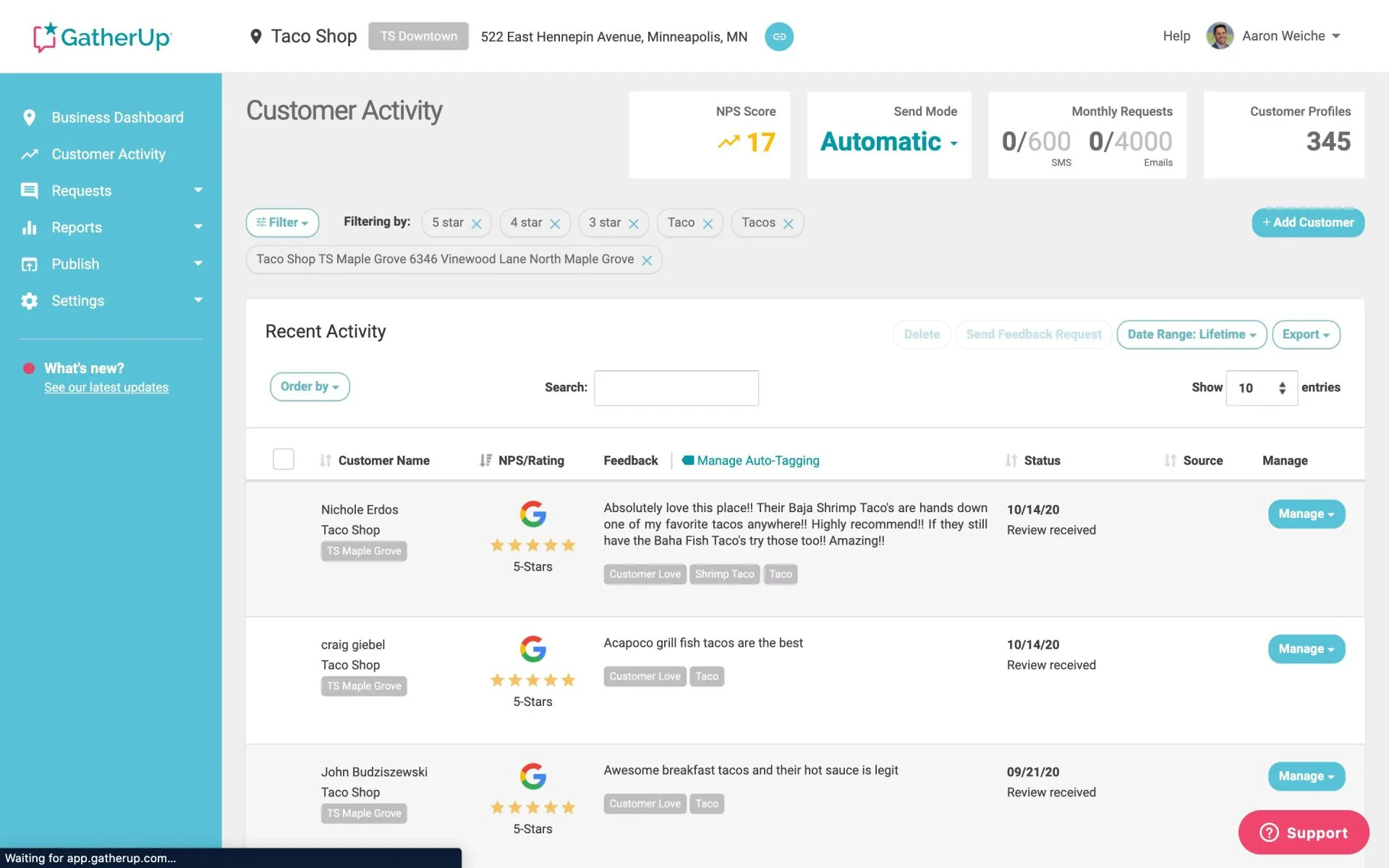
GatherUp has a 4.5/5 rating on G2 from 50 reviews and 4.6/5 on Capterra from 41 reviews.
Pricing starts at $99/month for one location. Its Multi Location plan costs $60 per location per month for 2–10 locations, with pricing tiers extending to 101+ locations. At 10 locations, that works out to $600/month.
If you need listings management, the Listings Hub add-on costs another $40 per location per month and syncs business information across 125 directories.
On the review side, GatherUp monitors 100+ review sites. Every plan also includes up to 300 SMS and 3,000 email credits per location each month, giving businesses plenty of room for review requests.
For agencies, there’s a quote-based Agency plan with white-labeling, which makes it the more relevant option for managing reviews on behalf of clients.
Jon P.
I’ve thoroughly enjoyed getting familiar with this product, both for my own business and for clients I serve in my agency. GatherUp is like a missing puzzle piece I’m grateful to have finally found! Not only is my own review-gathering process more streamlined, but I’ve got a new productized service I can sell to my clients.
2. ReviewTrackers
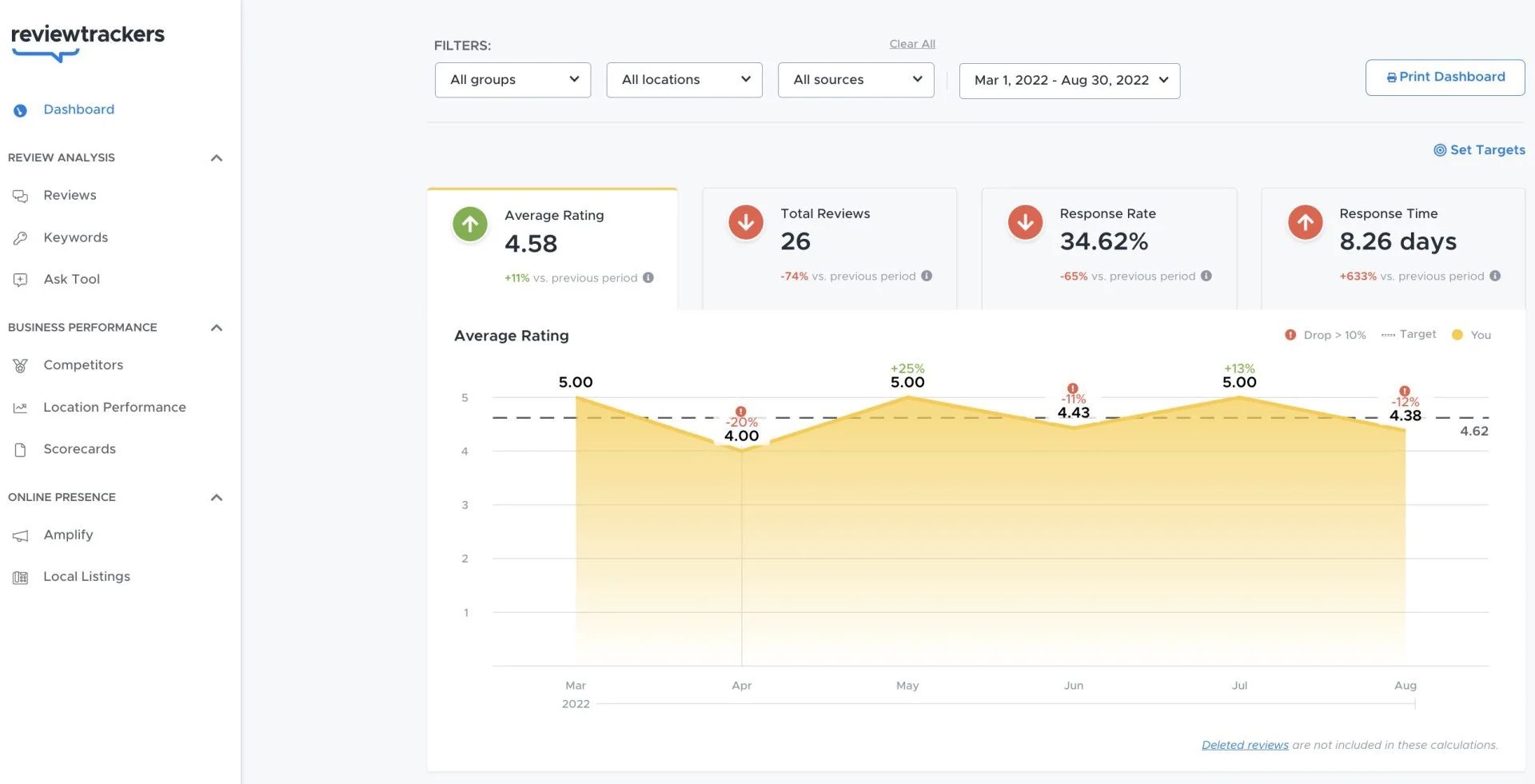
ReviewTrackers has a 4.6 rating on G2 based on 161 reviews and 4.7 on Capterra across 172 reviews.
Pricing is per location per month and billed annually. The exact rate depends on the number of locations and is shown through a calculator on the pricing page.
There are four plans: Data Only, Starter, Essential, and Enterprise, with add-ons for local listings, rank tracking, managed services, white labeling, and App Store monitoring.
ReviewTrackers is worth considering if you need review data that feeds into your existing systems rather than another all-in-one review platform.
The Data Only plan is particularly unusual in that regard. The main thing to factor in is the annual commitment, especially if you’re looking for more flexibility than Birdeye offers.
Verified User in Automotive
The aggregation feature is great. I can easily see reviews all in one place and don’t have to worry about collecting it from individual sources. Additionally, they make it very easy to respond to Google reviews and help us with quick response times.
Which Birdeye Alternative Should You Choose?
There’s no single alternative here that works best for everyone.
The right choice depends on what brought you here. Leaving over cost points somewhere different from leaving over complexity, and over the contract different again.
Automated Review Responses
If you want automation without losing editorial control, look at how much of the reply you get to approve before it posts.
Replies triggered by star rating, with immediate, delayed or approval-gated publishing, sit on every SocialPilot Reviews plan including the free one.
Centralized Review Management
If your reviews arrive on six sites and your team only watches two, coverage is the thing to buy.
Birdeye’s stated 200-plus sites is the widest claim here, though it names only two. GatherUp and ReviewTrackers both state coverage above 100 sources, while SocialPilot Reviews covers nine and NiceJob covers nine.
Usability
If your team is small, day-to-day simplicity will save you more than feature depth ever will.
NiceJob carries the highest Capterra ease-of-use score here at 4.9, matched by 4.9 for customer service across 203 reviews. Reputation.com sits at 4.5, SOCi and Podium at 4.3.
Customer Support
If support is why you’re leaving, check the sub-score rather than the headline rating.
NiceJob leads at 4.9 on Capterra. Reputation.com sits at 4.3 and SOCi at 4.4, both below their own ease-of-use scores, and Podium is lowest at 4.0.
Making the Switch from Birdeye
Birdeye remains a strong platform. The breadth is real, the AI layer is further along than most of this category, and its security page is the most detailed here. For a large brand with a dedicated reputation team, it can still be the right answer.
What’s changed is that you can’t check its price, and the terms carry a 90-day non-renewal window and an 8% uplift at every renewal. Those aren’t reasons to leave on their own. They’re reasons to know what the market charges before you renew.
The goal isn’t to find the platform with the most features. It’s to find the one that fits the job you actually have, at a number you can read before you sign.
For teams focused on reviews and listings rather than a full enterprise suite, one option worth a look is SocialPilot’s review management platform. SocialPilot Reviews’ pricing starts with a free tier and scales based on locations.
For everyone else, the comparisons above should narrow the field to two or three Birdeye alternatives worth a trial, each of which will tell you its price before you book a call.
Frequently Asked Questions
What brands are similar to Birdeye?
Eight platforms compete directly with Birdeye on review and reputation management: SocialPilot Reviews, SOCi, Yext, Podium, NiceJob, Reviews.io, BrightLocal and Reputation.com. SOCi and Reputation.com are the closest enterprise equivalents, Podium fits conversation-led review requests, and Reviews.io serves e-commerce. Moz Local is often listed alongside these, but it's a listings and local SEO tool rather than a review management platform, which is why it isn't in this roster.
What are some key features to look for in a Birdeye alternative?
Start with where replies actually publish, because most platforms post directly to Google and Facebook and draft everything else. Then check whether review monitoring is in the plan you're pricing, since Yext gates it to its $999 tier and BrightLocal to Grow. After that, look at request campaigns, listings reach, per-location versus per-domain billing, and whether the vendor publishes a contract length at all.
Why should businesses look for Birdeye alternatives?
Three reasons come up repeatedly. Cost, because Birdeye publishes no price and you can't benchmark your quote. Contract terms, because renewal is automatic for the full initial term unless you give 90 days' written notice, and an 8% fee applies at every renewal. And scope, because many teams use a fraction of what they're billed for. Cheaper alternatives to Birdeye exist at every size, from a free single-location tier up to published enterprise rates at $80 per location.
How much does Birdeye cost?
Nobody outside a sales call knows. Birdeye's pricing page publishes no dollar figures at all, in any tier or currency. What it publishes is a location-band selector running from 1 to 3 locations up to 1000-plus, a quote form, and the line "Pricing built around outcomes, not seat counts." Pricing is structurally per location with no published rate. Figures quoted on third-party comparison pages are reconstructions from working that quote form, not Birdeye's rate card, which is why you'll find several different numbers and no source for any of them.
Is Birdeye a Google partner?
Birdeye integrates with Google Business Profile, and reviews collected through it post to your Google profile in the normal way. We could not verify a current partner badge on Birdeye's own site, so if formal partner status matters to procurement, ask for it in writing.
About the Author