

If you run an agency, you already know the struggle. Clients keep asking for more blogs, more social posts, more videos, and expect quick turnaround times. You could hire more people, but that means higher salaries, more management, and more overhead eating into your margins.
That’s where white label content creation comes in. Think of it as having an extended content team working behind the scenes. They create the content, and you deliver it under your agency’s brand while maintaining full control of the client relationship. It’s not a shortcut, it’s a smarter way to scale your services.
And you’re not alone thinking this way. In fact, about 73 % of agencies outsource at least one service, such as Content, SEO, and PPC, to stay competitive and manage growing workloads.
Let’s break down: what white label content writing really means, how it works, when it makes sense for your agency, and how you can use it to take on more clients without the chaos. Whether you’re a small team trying to punch above your weight or a growing agency looking to scale, this guide is for you.
Key Highlights:
- White label content creation helps agencies scale content production without hiring in-house teams, allowing them to handle more clients efficiently.
- It reduces operational costs while giving agencies access to experienced writers across multiple industries.
- Agencies can focus on high-value work like strategy and client management while outsourcing content execution.
- A hybrid model combining a small in-house team with white label partners offers the best balance of control and scalability.
- Choosing the right provider is critical and should be based on content quality, communication, turnaround time, and SEO expertise.
- In 2026, AI-assisted workflows, niche specialization, and content repurposing are shaping how white label content services operate.
What Is White Label Content Creation?
White label content creation is a business arrangement where an agency or company outsources content production to a third-party provider. The provider creates the content, and the agency delivers it to clients under its own brand. The client never knew a third party was involved.
Think of it like store-brand groceries. The manufacturer makes the product, but it carries the retailer’s label. In the content marketing world, that means blog posts, social media captions, email newsletters, website copy, and more, all produced by an external team but branded as your agency’s work.
How It Differs from Freelancing and Ghostwriting
People often confuse white-label content by hiring freelancers or ghostwriters. Here’s the distinction:
- Freelancers work independently and may serve your competitors. There’s no exclusivity, no production pipeline, and scaling means finding more freelancers.
- Ghostwriters create content credited to someone else, usually a specific author. The focus is on mimicking a personal voice.
- White label providers operate as an extension of your agency. They maintain dedicated production pipelines, follow your brand guidelines at scale, and deliver content ready for client delivery under your banner.
The key difference is infrastructure. A white label content service provider has built the systems, teams, and quality control processes that let you scale content production without building those systems yourself.
Types of Content You Can White Label
White label content creation for agencies covers far more than blog posts. Here’s what most providers offer:
- Blog posts and long-form articles (SEO-optimized)
- Social media content (captions, graphics, short-form video scripts)
- Visual Creations (Images, Infographics, videos)
- Email marketing copy (newsletters, drip sequences, promotional emails)
- Website copy (landing pages, service pages, product descriptions)
- Ebooks and whitepapers
- Case studies and reports
- Press releases
- Video scripts and podcast show notes
The most versatile providers bundle multiple content types into packages, which lets agencies offer comprehensive white label content marketing services without managing separate vendors for each format.
Tip: When evaluating white label content providers, ask which content types they produce in-house versus outsource themselves. Some “full-service” providers subcontract heavily, which adds quality control risk.
How White Label Content Marketing Works
The white label content workflow is simple once you understand the moving parts. Here’s how it typically works, step by step.
The Standard White Label Content Creation Workflow
- Client brief: Your agency gathers content requirements from the client, including topics, keywords, brand voice guidelines, and goals.
- Provider brief: You pass these requirements to your white label content service provider, often through a shared project management system or content portal.
- Content production: The provider’s writers and editors create the content according to your specifications.
- Review and revisions: Your team review the deliverables, requests changes if needed, and approves the final versions.
- Client delivery: You deliver the finished content to your client under your agency’s branding. Similarly, all reports, invoices, and communication all carry your name.
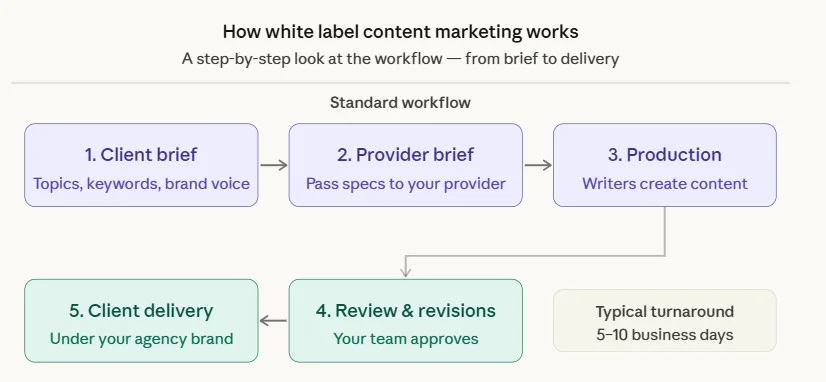
Most established providers complete this cycle in five to ten business days for standard blog content, with rush options available for tighter deadlines.
Getting Brand Voice Right Before Forwarding to Clients
The biggest concern content marketing agencies have about white label content is brand consistency. Will the content sound like it came from your team?
A good marketing agency solves this issue through a structured onboarding process:
- Brand voice documentation: You provide style guides, tone descriptions, sample content, and “do/don’t” lists for each client.
- Writer matching: The provider assigns writers with relevant industry experience to your accounts.
- Calibration period: The first few deliverables involve extra feedback rounds to align the writing with expectations.
- Ongoing feedback loops: Regular check-ins and revision notes help writers refine their understanding of each client’s voice over time.
The onboarding period typically takes two to four weeks. After that, most agencies find their white label content is indistinguishable from in-house work.
Benefits of White Label Content Creation for Agencies
Many agencies today turn to white label services to handle surging content demands efficiently. This strategic choice allows them to scale offerings without expanding internal teams. Here are some of the key benefits that make white label content creation a popular choice for agencies.
1. Cost Savings That Compound Over Time
Building and maintaining an in-house content team can be expensive. Salaries, employee benefits, tools, and training costs quickly add up, especially as agencies grow and take on more clients.
With white label content creation, agencies can access professional writers and specialists without committing to full-time hiring. This allows agencies to manage costs more efficiently while still delivering consistent content to their clients. It also gives them the flexibility to invest more in strategy, marketing, or business development.
2. Scale Without the Hiring Process
Hiring content writers takes time. Posting jobs, reviewing applications, conducting interviews, and onboarding new hires can take weeks before they begin producing work.
White label providers remove much of this delay. When content demand increases, agencies can simply adjust their service package to handle additional workload. During slower periods, production can be reduced without the challenges that come with staffing changes.
This flexibility allows agencies to respond quickly to client needs without expanding internal teams. According to Armaan Delma, most agencies that outsource 40 to 60% of their service delivery grow 2.3 times faster than those that keep everything in-house.
3. Access Specialized Expertise on Demand
Agencies often work with clients from different industries. A single in-house team may not have deep expertise across all sectors.
White label providers typically work with a broad network of writers who specialize in different industries. This makes it easier to produce accurate, well-informed content for clients in areas such as healthcare, technology, finance, or local services without hiring separate specialists.
4. Faster Content Production
White label providers often have dedicated teams focused on content creation and delivery. This allows agencies to produce content more quickly and maintain consistent publishing schedules for their clients.
5. Allows Agencies to Focus on Strategy
Content production can be time-consuming. When internal teams spend most of their time writing or editing, it reduces the time available for higher-value activities.
By outsourcing production tasks, agencies can focus more on strategy, campaign planning, client communication, and business development. This shift allows teams to concentrate on the work that drives long-term client relationships and agency growth.
White Label Content Creation vs. In-House: A Direct Comparison
Choosing between white label and in-house content production isn’t always an easy decision. Here’s how they stack up across the factors that matter most to agencies.
| Factor | White Label | In-House |
| Annual cost (equivalent output) | ~$50-72,000 yearly | ~$100-150,000 yearly |
| Time to scale | Days to weeks | 6-8 weeks per hire |
| Expertise range | Broad (multi-industry) | Narrow (limited to team skills) |
| Brand voice control | Requires onboarding | Immediate alignment |
| Management overhead | Low (provider manages writers) | High (you manage everything) |
| Quality consistency | Varies by provider | Easier to maintain |
| Flexibility | Scale up/down easily | Fixed capacity |
| Brand knowledge | Lower initially | Builds over time |
Benefits of White Label Content Creation vs In-house Team
- Growing agencies often add clients faster than they can expand their in-house team.
- Agencies serving clients across multiple industries may need specialized expertise for different types of content.
- Content requirements can fluctuate throughout the year, especially during busy campaigns or seasonal periods.
- Some agencies want to offer content services without making it their core operational focus.
- It also helps keep overhead low while experimenting with or testing new service offerings.
Drawbacks of White Label Content Creation vs In-house Team
- You serve a single industry requiring deep, specialized knowledge.
- Brand voice is extremely nuanced and difficult to externalize.
- Content production is your agency’s primary service and differentiator.
- You have the budget and management capacity for a full team.
Many agencies in 2026 are adopting a hybrid approach. They maintain a small in-house team to handle high-impact, strategic content such as thought leadership and major campaigns, while working with white label providers for larger-volume needs like regular blog posts, social media content, and email newsletters.
This approach allows agencies to retain strong brand control for strategic work while scaling content production in a more cost-efficient way.
How to Choose a White Label Content Provider
Not all white label content services deliver the same quality. Here’s a framework for evaluating providers, so you don’t end up apologizing to clients.
Essential Evaluation Criteria for Hiring White Label Partner
- Content quality: Request samples in your clients’ industries. Read them critically. Check for originality, depth, and accuracy, not just grammar.
- Writer qualifications: Ask how providers vet their writers. Do they require subject-matter expertise? What’s their acceptance rate? Providers with writer acceptance rates below 10% tend to deliver more consistent quality.
- Turnaround time and capacity: Can they handle your current volume plus projected growth? What’s their standard turnaround? What happens during demand spikes?
- Revision policy: How many revision rounds are included? What’s the turnaround on revisions? Avoid providers with limited or paid revision models.
- SEO capabilities: Do their writers understand keyword integration, search intent, heading structure, and on-page optimization? Ask for examples of content that ranks.
- Communication process: Is there a dedicated account manager? How do you submit briefs? What project management tools do they use?
- Pricing transparency: Watch for hidden fees. Some providers charge extra for revisions, SEO optimization, images, or rush delivery. Get the full cost picture upfront.
- Confidentiality: Ensure the provider has non-disclosure agreements (NDAs) in place. Your clients should never discover you’re using a white label partner.
Red Flags to Watch For:
- No portfolio or writing samples: Any legitimate provider will share recent work.
- Prices that seem too good: If they’re charging $20 for a 2,000-word SEO article, the quality will reflect that price.
- No dedicated contact: You need a consistent point of contact, not a different person every time you email.
- Vague revision policies: “We’ll work with you” isn’t a revision policy. Get specifics in writing.
- No onboarding process: If they don’t ask detailed questions about your clients’ brands, they can’t match the voice.
So, it’s better to run a paid trial before committing. You can order three to five pieces across different content types and industries. Evaluate them as if you were the client receiving them. This small upfront investment can save you from a costly partnership mistake.
White Label Content Creation Trends Reshaping 2026
The white label content industry is evolving fast. Here are the trends defining how agencies and providers operate this year.
1. AI-Assisted Content Workflows
AI has become an important support tool in content production, but it hasn’t replaced professional writers. Instead, many white label providers use AI to assist with tasks like research, outlining, and content optimization, while human writers and editors handle strategy, creativity, brand voice, and fact-checking.
Agencies deploying AI-assisted content pipelines are producing significantly more output without proportional headcount growth — a shift driven by gen AI’s rapid adoption in marketing, which more than doubled year-over-year according to McKinsey’s State of AI research.
This combination helps teams produce content more efficiently without compromising quality. For agencies, the key is to understand how providers use AI in their workflows and ensure that human oversight remains part of the process.
Agencies can reduce their reliance on white label providers by using SocialPilot’s AI Pilot to generate social media content quickly for routine posts and campaigns. By creating first drafts in-house with AI, teams can lower outsourcing costs and reserve white label services for more specialized or long-form content.
When combined with SocialPilot’s team collaboration and approval-on-the-go features, this approach helps agencies manage more clients efficiently while maintaining a smooth and scalable content production process.
2. Niche Specialization Over Generalist Services
Generic content is becoming less effective, especially for SEO and specialized industries. As a result, many white label providers are focusing on industry-specific expertise.
Writers with experience in sectors like SaaS, healthcare, finance, real estate, and legal services can create more accurate and relevant content. This helps agencies deliver higher-quality work to their clients while ensuring content aligns with industry expectations and regulations.
When evaluating providers, it’s helpful to look for teams that have experience in the industries your clients operate in.
3. Content Repurposing at Scale
Creating everything from scratch is expensive, even with white label partners. The smartest agencies in 2026 are shifting toward a “create once, repurpose many” model.
Here’s what that looks like in practice: a white label provider creates one in-depth blog post, then repurposes it into a LinkedIn article, an email newsletter, a few social media posts, a short-form video script, and an infographic outline. One brief, seven content assets.
This approach maximizes the ROI on every piece of content and gives clients a more comprehensive content presence without a proportional cost increase.
4. Full-Service White Label Bundles
The line between white label content creation and white label content marketing is blurring. Providers increasingly offer bundled services that combine content production with:
- SEO strategy and keyword research
- Content distribution and scheduling
- Social media management
- Performance reporting and analytics
- Email marketing execution
For agencies, this means you can potentially outsource an entire content marketing function, not just the writing. It also means higher revenue per client, since bundled services command higher retainers.
Typical client pricing for AI-powered content full packages ranges from $800 to $2,500 per month for small to midsize businesses, with enterprise arrangements reaching $5,000 to $10,000 per month in the US.
5. Video and Multimedia Integration
Content strategies today go far beyond written blogs. Video, podcasts, and visual content play a major role in audience engagement, especially on social media platforms.
To support these needs, many white label providers now include services such as video script writing, podcast outlines, and multimedia content planning. Agencies that incorporate these formats into their content offerings can provide more diverse and engaging marketing strategies for their clients.
Common Mistakes to Avoid in White Label Content Creation
While white label content creation can help agencies scale efficiently, it works best when the process is managed carefully. Avoiding these common mistakes can help maintain quality and strong client relationships.
1. Providing Incomplete Content Briefs
One of the most common issues is unclear or incomplete briefs. If the provider doesn’t receive details about the brand voice, target audience, keywords, or goals, the final content may not meet expectations. Clear instructions from the start help reduce revisions and improve content quality.
2. Skipping the Internal Review Process
Even when working with experienced providers, agencies should review the content before sharing it with clients or publishing it. An internal review ensures the content aligns with the client’s brand voice, messaging, and accuracy standards.
3. Choosing Providers Based Only on Price
Lower pricing can be tempting, but poor-quality content can harm client relationships and brand reputation. It’s better to evaluate providers based on writing quality, industry expertise, and reliability rather than cost alone.
4. Not Setting Clear Communication and Workflows
Without clear communication and structured workflows, projects can quickly become disorganized. Setting expectations around timelines, revisions, approvals, and feedback helps both the agency and the provider work more smoothly.
5. Ignoring Performance Tracking
Content creation shouldn’t stop at delivery. Agencies should track metrics such as traffic, keyword rankings, and engagement to understand what content performs best and to improve future strategies.
6. Over-Promising Turnaround Times
Setting unrealistic timelines can create unnecessary pressure and lead to rushed work. It’s better to build a buffer into your timelines. For example, if a provider typically delivers in seven business days, communicate a 10-day timeline to clients. This approach helps manage expectations and creates room to deliver earlier when possible.
Scaling Smarter with White Label Content
White label content creation has become a practical solution for agencies that need to manage growing content demands without significantly expanding their internal teams. By working with trusted content partners, agencies can scale production, access specialized expertise, and maintain consistent delivery for their clients.
At the same time, this approach allows internal teams to focus more on strategy, client relationships, and campaign planning. With the right systems, workflows, and quality checks in place, white label content can support both operational efficiency and long-term agency growth.
As content marketing continues to evolve, agencies that combine strong strategy with scalable production models will be better positioned to meet client needs and stay competitive.


 Join 55,000+ social media managers


