
Over the past two decades, social media has transformed from niche online communities into a global network of 5.79 billion users [DataReportal]. What started as a way to stay in touch has become a powerful driver of communication, commerce, and culture.
Ma con le piattaforme che si moltiplicano, le funzionalità che si evolvono e il comportamento degli utenti che cambia di giorno in giorno, come si fa a stare al passo con la curva?
Le risposte si trovano nei dati. E per capire che cosa significhino effettivamente questi dati per i marketer, questo blog è la vostra guida di riferimento per capire che cosa sta funzionando, che cosa sta svanendo e che cosa sta per arrivare nel mondo dei social media.
So, whether you are planning your next campaign, refining your content strategy, or just love a good stat fix, let us break down the numbers that matter.
Social media is now a global constant. As of April 2026, 5.79 billion people sono attivi sulle piattaforme sociali, il che è 69.9% of the world’s population. Non si tratta solo di un fenomeno diffuso, ma quasi universale tra gli utenti di Internet, con 94.7% of internet users ora sui social media. [DataReportal Digital 2026 Mid-Year Global Update]
Here’s how the market has evolved and what it means in real numbers:
- Social media users grew by 5.4% YoY (294 million people), adding an average of 9.3 new users every second. [DataReportal Digital 2026 Mid-Year Update]
- Over the past decade, the growth has been remarkable, from 2.46 billion users in April 2016 to 5.79 billion today. Social media adoption has more than doubled in ten years. [DataReportal Digital 2026 Mid-Year Update]
| Year (April) | Utenti in miliardi | Crescita a/a (%) |
| 2026 | 5.79 | +5.3% |
| 2025 | 5.50 | n/a (China data revision) |
| 2024 | 5.07 | +5.6% |
| 2023 | 4.80 | +3.2% |
| 2022 | 4.65 | +7.5% |
| 2021 | 4.33 | +14% |
| 2020 | 3.81 | +7.5% |
| 2019 | 3.54 | +7.9% |
| 2018 | 3.28 | +12% |
| 2017 | 2.92 | +19% |
| 2016 | 2.46 | — |
- The average daily time spent on social media was 2 hours and 21 minutes in February 2025. Under GWI’s updated method, people now spend 18 hours 36 minutes a week on social media, or more than 2.5 hours a day. [Statista Daily Uses Stats]
- A typical user actively visits 6.52 social platforms per month (Q4 2025), down from a peak of 6.86. [DataReportal Digital 2026 Mid-Year Update]
- The world collectively spends over 15 miliardi di ore al giorno sui social media. [DataReportal]
- China (1.28B), India (500M), and the U.S. (254M) are the top three countries by total social media users (October 2025). [DataReportal China] [DataReportal India] [DataReportal US]
Social media penetration in selected countries (April 2026): [DataReportal Digital 2026 Mid-Year Update]
| Paese | Penetrazione dei social media |
| Arabia Saudita | 118.6% |
| EMIRATI ARABI UNITI | 116.5% |
| Malesia | 97.8% |
| Corea del Sud | 95.5% |
| Singapore | 91.9% |
| Cina | 90.8% |
| Hong Kong | 85.6% |
| Paesi Bassi | 85.2% |
| Filippine | 83.8% |
| Canada | 82.9% |
Figures above 100% reflect duplicate accounts and gaps in population data, not more users than people.
- Social media is still growing. From 5.4 billion users in 2025, the number is projected to reach 6.5 billion users by 2029, or 82.6% of the world’s population. [Statista SM Users Forecast]
With billions logging in daily and spending hours across multiple platforms, the real question becomes, where are they actually spending that time, and how is that time turning into sales?
On a side note, planning holiday campaigns? See our list of Black Friday SaaS deals for marketers.
Quali piattaforme conquisteranno l'attenzione dei consumatori nel 2026?
Social media isn’t just where people scroll it’s where they discover, engage, and shop. For marketers, this shift is critical. This year, platforms like TikTok, Instagram, and Facebook are not only driving traffic but also influencing real buying behavior.
Here are the key signals that show where consumer attention and buying intent is strongest:
- Younger adults lean into TikTok: 63% of US adults aged 18–29 use it. Facebook use peaks among adults aged 30–49, at 80%. [Pew Research Center]
- TikTok isn’t just a content platform; it’s a discovery engine. Its ads reach 2.21 billion adults worldwide (April 2026, up 20%), and more than 200 million Americans use it. [TikTok Newsroom]
- Facebook (56.3%), YouTube (55.3%), Instagram (54.6%) and WhatsApp (54.4%) are the most-used social platforms among internet users aged 16+ (Q4 2025). [DataReportal Digital 2026 Mid-Year Update]
- Asked to name their favourite platform, internet users picked WhatsApp (17.3%), Instagram (16.5%), Facebook (13.2%) and TikTok (9.5%). [DataReportal Digital 2026 Mid-Year Update]
- Threads crossed 500 million monthly active users, Pinterest reached 640 million (+11%), and Snapchat hit 971 million monthly users with 493 million daily (Q2 2026). [Meta Q2 2026 Earnings Call] [Pinterest Q2 2026] [Snap Q2 2026]
- The US social commerce market reached $87 billion in 2025, growing 21.5% year-over-year, and is projected to surpass $100 billion in 2026. [eMarketer USA eCommerce]
- 48% of Gen Z i consumatori preferiscono scoprire i prodotti attraverso video di breve durata come TikTok e Instagram Reels. [HubSpot State of Consumer Trends 2024]
- 62.2% of Instagram users follow, research, or evaluate brands and products on the platform. [DataReportal Digital 2026 Mid-Year Update]
- 87% dei venditori say social selling has been effective for their business. [HubSpot Social Shopping Trends]
- Social media drove 4.6% of US online holiday revenue in 2025, up 40.3% from the year before. [Adobe Holiday Shopping]
- 51% of US adults have bought something through social media, and 35% of those social shoppers buy on social platforms at least once a week. [Morning Consult, 2025]
- Mobile continues to dominate: 56.4% of US online holiday spending came through smartphones in 2025, up from 54.5% in 2024. [Adobe Holiday Shopping]
- Social is a starting point: 26.4% of internet users use social media to find products to buy. [DataReportal Digital 2026 Mid-Year Update]
- TikTok Shop captured 18.2% of total US social commerce in 2025, generating about $15.8 billion in sales, a 108% year-over-year increase. [eMarketer TikTok Shop]
- 35% of US adults used TikTok Shop in 2026, up from 23% the year before. [eMarketer TikTok FAQ]
Now that we know where consumers are spending and spending money, let’s break down who’s actually driving this behavior.
- Social media skews young, but not as heavily as often claimed. 61.6% of Instagram users are aged 18–34, and about 65% of TikTok’s adult ad audience falls in that range. [Statista] [DataReportal]
- Adults aged 25–34 are TikTok’s largest adult ad audience at 41.6%, with 18–24-year-olds at 23.5%. Instagram’s largest US demographic is also aged 25–34. [DataReportal] [Statista US users]
Nota: Visual discovery platforms like Pinterest and Instagram attract a higher share of female users, while networks like X, LinkedIn, and Bluesky are more male-dominant. Platform demographics continue to evolve as new features attract more diverse user segments.
People across the globe collectively spend oltre 15 miliardi di ore every day on social media, proof of how deeply integrated these platforms have become in how we connect, consume, and communicate. [DataReportal]
Analizziamo i comportamenti specifici che modellano il modo in cui gli utenti si impegnano quotidianamente sulle piattaforme sociali:
- 49.0% of social media users primarily use platforms to keep in touch with friends and family (Q4 2025). [DataReportal Digital 2026 Mid-Year Update]
- Globally, YouTube’s Android app users spend 1 hour 24 minutes per day in the app, and TikTok users 1 hour 34 minutes (February 2026). [DataReportal Digital 2026 Mid-Year Update]
- The average Bluesky visit lasts 7 minutes and 53 seconds, compared to 12 minutes 37 seconds on X (August 2026). [Similarweb bsky.app] [Similarweb x.com]
- Instagram users spend an average of 1 hour 15 minutes daily on the app (Android, February 2026). [DataReportal Digital 2026 Mid-Year Update]
- Snapchat users spend an average of 18 minutes per day on the app (Android, February 2026). [DataReportal Digital 2026 Mid-Year Update]
Now that we know how embedded social media is in everyday routines, the next step is understanding what truly captures users’ attention and keeps them engaged.
Quale tipo di contenuto genera il maggior coinvolgimento?
Nel 2026, il video continua a dominare, e i contenuti di breve durata sono in testa alla classifica. Che si tratti di clip di TikTok, di Instagram Reels o di corti di YouTube, gli utenti si impegnano maggiormente con formati dinamici e coinvolgenti.
- Instagram Reels get about 40% more engagement than image posts (0.52% vs 0.37% in 2025), though carousels edge ahead of both at 0.55%. [Socialinsider benchmark report]
- On LinkedIn, documents lead engagement at 7.00%, followed by multi-image posts (6.45%) and video (6.00%), while text-only posts average 4.50%. [Socialinsider LinkedIn Benchmarks]
- Median engagement per post in 2025: TikTok 2.01%, Instagram 0.30%, YouTube 0.21%, Facebook 0.04%, and X 0.03%. [Rival IQ 2026 Benchmark Report]
Nota: Engagement rates vary widely by platform. TikTok leads on engagement per post, while Instagram and Pinterest benefit from visual, discovery-driven use.
More than format, user behavior across platforms reveals what truly hooks attention:
- TikTok leads for entertainment: 80.6% of users seek funny or engaging videos. [DataReportal Digital 2026 Mid-Year Update]
- Instagram dominates visual sharing: 69.8% of users post photos or videos. Facebook remains a hub for connection: 70.7% use it to message friends and family. [DataReportal Digital 2026 Mid-Year Update]
Social media has evolved into more than just a marketing channel; it’s now a core business engine.
Here are more business-driven stats:
- 430 million items and 44 million vehicles are listed on Facebook Marketplace every month. [Meta Newsroom Marketplace Update]
- 87% of Gen Z users (ages 16–24) say they’ve followed a business on Instagram. [Meta for Developers]
- Over 67.1 million companies have a LinkedIn Page, and LinkedIn now has more than 1.3 billion members. [LinkedIn Audience] [LinkedIn]
- Economic activity supported by TikTok generated $81 billion in US GDP and supported 410,000 jobs in 2025. [TikTok Newsroom]
- A Nielsen marketing-mix study found Pinterest delivered the highest return on ad spend for beauty and personal care brands, ahead of other social media, TV, online video, display, and print. [Pinterest Business]
- Snap’s Other Revenue, led by Snapchat+, grew 85% to $316 million in Q2 2026. Snapchat+ had 24 million subscribers at the end of 2025. [Snap Q2 2026] [Snap Q4 2025 Letter]
- YouTube ranks third for marketing ROI, with 41.9% of marketers putting it in their top three, behind Instagram (48%) and Facebook (42.7%). [HubSpot 2026 State of Marketing]
- Instagram has overtaken Facebook as the platform most used by brands (70% vs 69.6%). [HubSpot 2026 State of Marketing]
With social platforms now central to sales, service, and storytelling, the question is no longer, if your business should be online, but how effectively you’re using it.
Quali sono le piattaforme che offrono la migliore portata pubblicitaria e il miglior ROI?
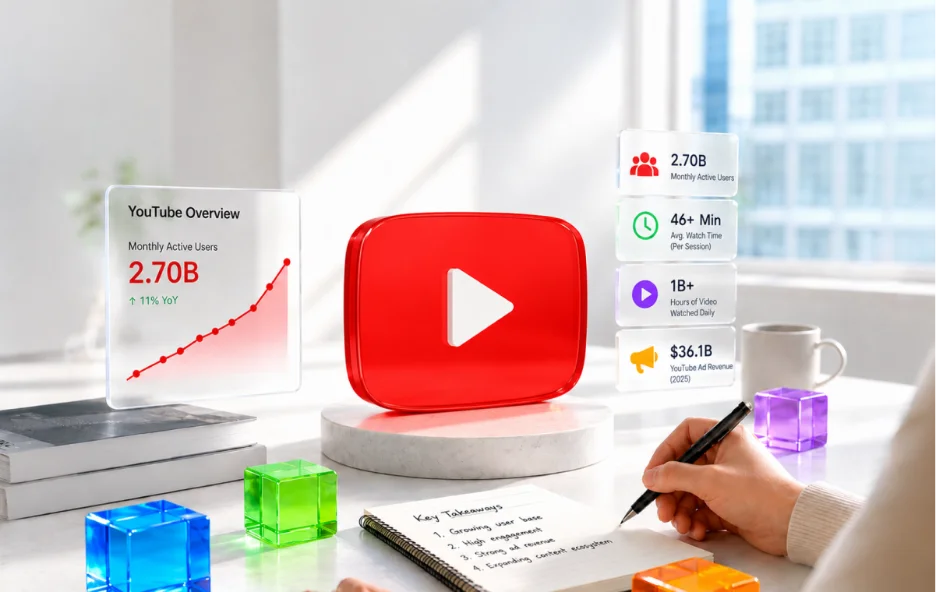
YouTube è in testa con la più alta portata pubblicitaria potenziale a 2.65 billion users, seguito da vicino da Facebook at 2.39 billion (April 2026). [DataReportal Digital 2026 Mid-Year Update]
Ecco le principali statistiche pubblicitarie che vale la pena conoscere:
- Instagram’s US ad revenue was forecast to hit $32.03 billion in 2025, more than half of Meta’s US ad revenue. [eMarketer Instagram PC]
- Pinterest reaches 578.7 million people via advertising (April 2026). [DataReportal Digital 2026 Mid-Year Update]
- LinkedIn ads increase purchase intent by 33%, making it ideal for high-value B2B conversions. [LinkedIn Audience]
- Snapchat’s ad reach hit 716 million users (April 2026), and its total active advertisers grew 28% year-over-year in Q4 2025. [DataReportal Mid-Year Update] [Snap Q4 2025 Letter]
- X (formerly Twitter) generated $1.84 billion in ad revenue in 2025, up 6.7%, its first year of ad revenue growth since Elon Musk’s acquisition. [SpaceX IPO Prospectus, SEC]
- YouTube ad revenue reached $11.06 billion in Q2 2026, up 13% year-over-year. [Alphabet Q2 2026]
From massive reach to laser-focused B2B targeting, social platforms in 2026 aren’t just ad spaces, they’re business growth ecosystems.
Social media is already moving fast, but what’s coming next will challenge marketers to be sharper, faster, and more data-informed. With audiences fragmenting, AI reshaping creation, and commerce blending directly into content, the next wave is about smarter strategy, not more platforms.
1. L'ascesa dei contenuti generati dall'intelligenza artificiale e guidati dai creatori
- 37.1% of marketers plan to increase their video investment, and short-form video is the top ROI format at 48.6%. [HubSpot 2026 State of Marketing]
- 86.4% of marketing teams now use AI in at least a few areas of their work. [HubSpot 2026 State of Marketing]
- 81.2% of internet users aged 16+ use AI tools every month. [DataReportal Digital 2026 Mid-Year Update]
- AI tools are reshaping content creation, recommendations, and campaign automation across every major platform.
- Social commerce is forecast to make up 9.3% of US retail ecommerce by 2029, up from 6.9% in 2025. [eMarketer USA eCommerce]
- 67% of weekly social media users say they’ve purchased a product after seeing it on social media. [Chainstoreage article]
3. La frammentazione sta spingendo le comunità di nicchia
- L'utente medio visita 6.52 platforms monthly, seeking more tailored content experiences. [DataReportal Digital 2026 Mid-Year Update]
- Piattaforme emergenti come Bluesky e Discordia attirano un pubblico alla ricerca di connessioni più strette e meno rumore algoritmico.
4. La messaggistica è il nuovo canale di marketing
- WhatsApp Business and Messenger sono sempre più utilizzati per l'assistenza ai clienti, la scoperta dei prodotti e le offerte personalizzate.
- Private, one-on-one interactions are increasingly dominating engagement strategies.
5. ROI, attribuzione ed efficienza della spesa pubblicitaria al centro della scena
- As CPMs and CPCs rise, marketers are doubling down on performance analytics, attribution tracking, and channel-specific ROI.
- Ad budgets are shifting from broad reach to high-intent micro-targeting.
Conclusione
The aforementioned social media statistics are more than just numbers, they are signals. They show where your audience is, what they care about, and how they are interacting with brands in 2026. Whether you are planning your next campaign, testing ad formats, or rethinking your posting strategy, this data gives you the clarity to act with confidence.
Per gestire efficacemente tutte queste informazioni è necessario lo strumento giusto. È qui che SocialPilot social media management tool fits in, bringing scheduling, analytics, collaboration, and reporting together so you can turn trends and insights into real growth.
So go ahead, turn those stats into strategy and let us help you scale it.



 Unisciti agli oltre 55.000 gestori di social media


