
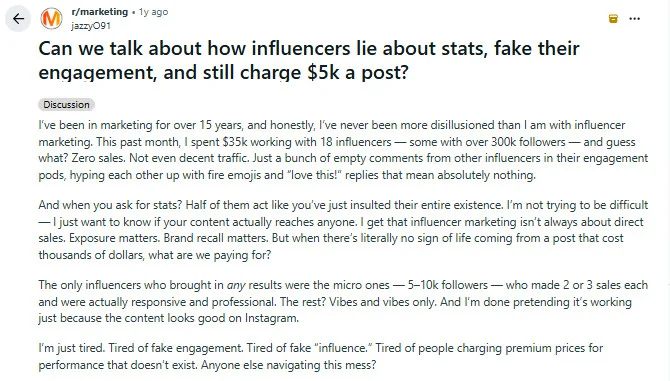
You find a creator with strong engagement, launch the campaign, and the results look promising, until you check the numbers. Plenty of likes, but few clicks, conversions, or meaningful interactions. That’s common experience in micro-influencer marketing, where surface-level metrics don’t always reflect real audience impact.
You are not the only one.
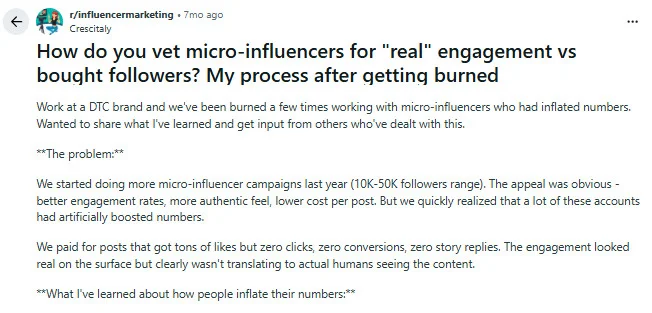
A DTC marketer wrote on r/influencermarketing.
Another marketer shared a similar experience, in a post on r/marketing.
These stories highlight a common challenge: engagement alone isn’t enough. According to Influencer Marketing Hub’s 2025 benchmarks, micro-influencers (10K–100K followers) average a 3.86% Instagram engagement rate, compared to 1.21% for mega influencers. That higher engagement is exactly what makes micro-influencers attractive, but it’s also why engagement metrics deserve closer scrutiny.
This guide goes beyond finding creators. You’ll learn how to vet influencers, set fair pricing, measure ROI, and stay compliant, so your campaigns are built on meaningful performance, not vanity metrics.
Who Micro-Influencers Are and Where They Fit in Your Influencer Strategy
Micro-influencers occupy the sweet spot between reach and authenticity. They have large enough audiences to drive meaningful visibility while still maintaining close relationships and engagement that often fade as creators grow. For many brands, they offer the best balance of cost, credibility, and performance.
Choosing micro-influencers isn’t a default decision; it’s a strategic one. Understanding how they compare with other influencer tiers make it easier to decide when they’re the right fit.
A Clear Definition to Work From
A micro-influencer is generally a creator with 10,000 to 100,000 followers, and micro-influencer marketing refers to partnering with creators in that range through paid collaborations, gifted campaigns, or long-term partnerships.
You’ll find slightly different definitions across the industry. Some B2B marketers, particularly on LinkedIn, use a narrower 5,000–25,000 follower range. The exact cutoff matters far less than having a consistent definition for your campaign. Pick a range, document it in your brief, and focus on what really matters: audience quality, relevance, and results.
Micro vs. Nano, Macro, and Celebrity, Where Micro-Influencers Actually Win
Influencer tiers aren’t just about follower counts, they reflect different trade-offs between reach, engagement, and trust. As audiences grow larger, engagement rates typically decline, making micro-influencers an attractive middle ground for brands that want both visibility and meaningful audience interaction.
| Tier | Follower range | Typical Instagram engagement | What you are really buying |
| Nano | 1,000–10,000 | Highest (~4%) | Tight-knit trust, tiny reach |
| Micro | 10,000–100,000 | ~3.86% | Balance of reach and engagement |
| Macro | 100,000–1M | Lower | Reach, weaker per-post trust |
| Mega / celebrity | 1M+ | ~1.21% | Mass awareness, lowest engagement |
These benchmarks come from Influencer Marketing Hub’s 2025 report, while HypeAuditor shows the same trend: engagement steadily declines as follower counts increase. That’s why micro-influencers often outperform larger creators for campaigns focused on clicks, conversations, and conversions, not just impressions.
Micro-influencers aren’t the answer to every campaign. If your goal is instant mass awareness, macro or celebrity creators may be the better choice. But when you’re looking for authentic engagement, niche credibility, and stronger value for your budget, the micro tier is where many brands see the best return.
Running a Micro-Influencer Marketing Program the Right Way: Four Non-Negotiables
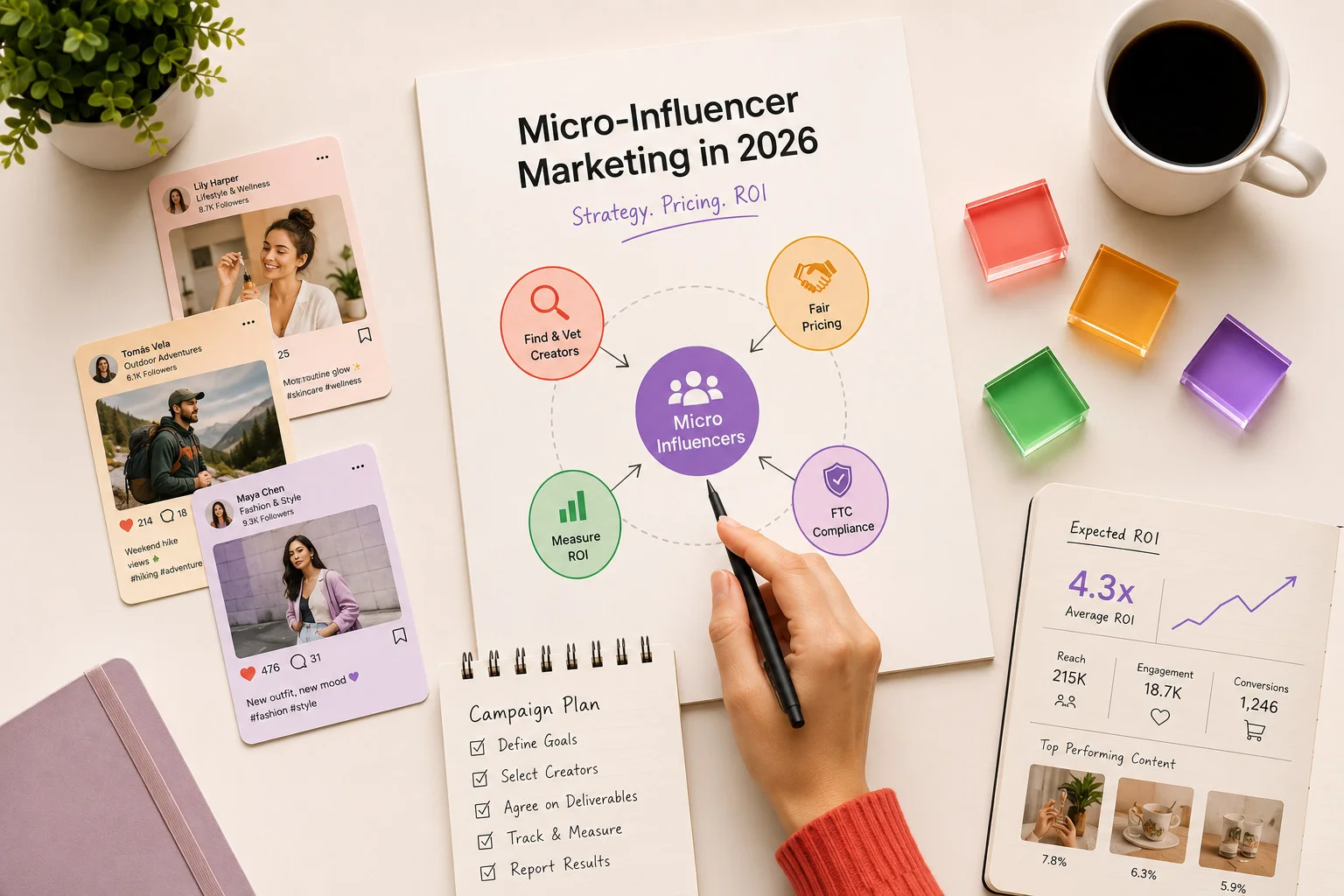
Successful micro-influencer campaigns aren’t built on finding the right creator alone. They depend on four systems working together: vetting, pricing, measurement, and compliance. Miss one, and even a campaign with strong engagement can fail to deliver real business results.
Think of these as the foundation of every successful influencer program. The order matters, too, you vet creators before negotiating rates, and you define success before the first post goes live.
| Pillar | The question it answers | What breaks without it |
| Vetting | Is this engagement real? | You pay for bots and pods |
| Pricing | Is this rate defensible? | You overpay or get gouged |
| Measurement | Did this make money? | You report likes, not sales |
| Compliance | Is this disclosed correctly? | You carry legal risk |
Each pillar builds on the previous one, creating a workflow that’s consistent, measurable, and easier to scale. These systems don’t replace strong campaign planning, they make it more effective by ensuring every partnership is vetted, fairly priced, measurable, and compliant as part of a broader influencer marketing strategy.
Vetting Micro-Influencers Before You Spend a Dollar
Vetting simply means evaluating whether a creator is genuine, brand-safe, and likely to deliver real business results before you invest in a partnership.
It’s the most important step in any micro-influencer campaign. Creators in the 10K–100K follower range often have enough social proof to look credible, but they’re also where inflated engagement, fake followers, and engagement pods are hardest to spot.
That’s why creator evaluation should happen before you discuss pricing, not after the campaign is live.
Marketers often ask the same question, like this operator asked on r/influencermarketing:
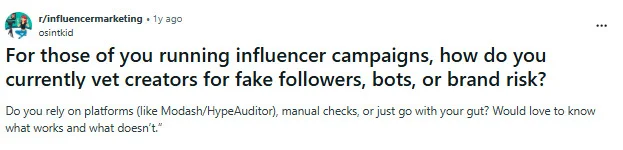
The answer is all three, in that order. Audit tools help you spot unusual patterns, manual reviews add context, and experience helps with the final decision. But instinct should never replace evidence.
As Neil Patel points out, many brands still pay for follower counts instead of audience trust. The vetting checklist below helps you measure whether that trust is genuine before you invest.
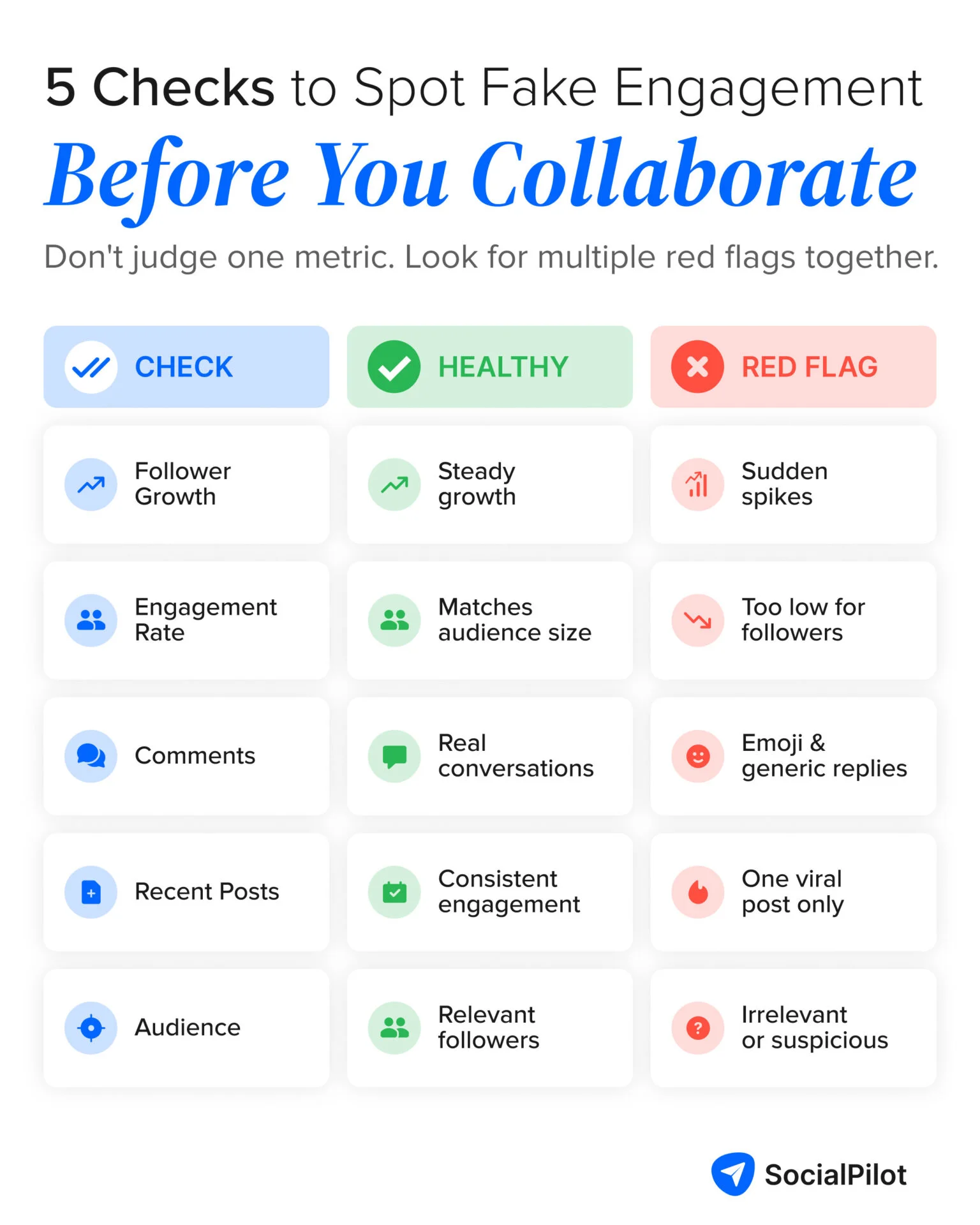
Engagement Authenticity Red Flags
No single signal proves a creator has fake engagement. But when several appear together, it’s usually a reason to walk away.
- Sudden follower spikes instead of steady, organic growth.
- Engagement that doesn’t match the audience size (for example, 40K followers but only 60 likes per post).
- Generic comments like “Great post 🔥” or emoji-only replies that suggest engagement pods.
- Very high like-to-comment ratios with little meaningful conversation.
A quick reality check is the engagement rate itself. Add the likes and comments from a recent post, divide by the follower count, and multiply by 100.
For example, a creator with 30,000 followers and a 4% engagement rate should average roughly 1,200 interactions per post. If the same account consistently gets only 80 interactions (about 0.3%), the follower count deserves a closer look.
Always review at least five recent posts, not just one. A single viral post can hide an otherwise weak account.
Audience Quality and Brand Safety Checks
Even authentic engagement has little value if it comes from the wrong audience.
Check whether:
- The audience location and language match your target market.
- Followers reflect your ideal customer profile and interests.
- Recent content aligns with your brand values.
- Sponsored posts are clearly disclosed.
- The creator hasn’t recently promoted direct competitors.
- Previous brand collaborations generated meaningful engagement, not just impressions.
For the discovery and audit side of this, a scheduling or reporting tool will not vet creators for you, so point yourself at purpose-built influencer discovery tools for that step instead of guessing.
A Practical Vetting Scorecard
Turn the checks above into a score you run on every candidate before you send a dollar. Rate each item 1 to 5, and set a floor (say, 20 out of 30) that a creator has to clear.
- Engagement authenticity (does the rate match the follower count?)
- Comment quality (real questions and buyers, or pods and emoji?)
- Audience match (location, language, and interest fit your buyer?)
- Growth pattern (steady climb, or suspicious spikes?)
- Brand safety (clean, on-brand recent content?)
- Track record (did past sponsored posts drive anything?)
The exact scoring threshold matters less than having a consistent evaluation process. A repeatable scorecard turns influencer selection from a gut decision into one that’s measurable, defensible, and easier to scale.
But where to find micro influencers in your industry? Because finding the right creators is often harder than evaluating them. While manual searches on Instagram, TikTok, or YouTube can work for small campaigns, influencer discovery platforms make it much easier to filter creators by country, niche, audience demographics, engagement rate, and follower size before you start outreach.
| Platform | Best For | Industry Filters |
| Modash | Global creator discovery and audience analytics | Beauty, Fashion, Fitness, Food, Travel, Gaming, Finance, Tech, and more |
| HypeAuditor | Audience quality, fraud detection, and influencer search | 35+ content categories with audience demographics and brand safety filters |
| Upfluence | Enterprise influencer discovery and campaign management | Search by niche, interests, audience location, engagement, and ecommerce data |
| Influencity | Finding and comparing creators across multiple platforms | Lifestyle, Business, Parenting, Sports, Beauty, Education, Health, and custom keyword filters |
Pricing a Micro-Influencer Campaign the Right Way
There isn’t a standard rate card for micro-influencers and that’s a good thing. The right price depends on the value a creator brings, not just their follower count. Two creators with the same audience size can deliver completely different results, which is why pricing should reflect engagement quality, niche, content effort, and usage rights, not followers alone.
What Actually Drives Rate Variation
Follower count is only the starting point. These factors have a much bigger impact on what a creator can reasonably charge:
- Engagement quality: An active, trusted audience is worth more than passive followers.
- Niche: Specialized audiences (such as B2B SaaS, finance, or healthcare) typically command higher rates than broad lifestyle content.
- Content format: Short-form videos and high-production content usually cost more than static posts.
- Usage rights: Reusing creator content in ads or on your own channels should be priced separately.
- Exclusivity: Preventing creators from working with competitors increases campaign costs.
Typical Rate Ranges by Platform
Use these ranges as benchmark estimates, not fixed pricing. Actual rates vary based on the factors above we discussed:
| Platform | Typical per-post range (10K–100K) | What moves it |
| Instagram (feed or Reel) | ~$150–$1,500 | Niche, format, usage rights |
| TikTok (video) | ~$200–$800 | Trend fit and volume over raw followers |
| YouTube (integration or video) | ~$800–$3,000 | Production time and shelf life |
A commonly used starting benchmark is around $10-$100 per 1,000 followers, meaning a creator with 30,000 followers might begin at $300–$3000 before engagement, niche, deliverables, usage rights, or exclusivity are factored in. Treat this as a negotiation floor, not a pricing formula.
The best pricing conversations focus on value, not vanity metrics. A creator with a highly engaged niche audience often delivers a stronger return than one with a much larger but less responsive, following.
Negotiating Beyond a Flat Per-Post Rate
A flat fee is the simplest pricing model, but it’s rarely the most effective. Depending on your goals, gifting, affiliate partnerships, and retainers often create better incentives for both brands and creators.
Many marketers ask whether gifting can reduce campaign costs:
“What if I send the influencer a product to wear—will that lower the price?” — r/socialmedia
In many cases, yes. Product gifting can offset part of the cash payment, especially for smaller creators building their portfolio. Just remember that gifted collaborations still require proper disclosure.
Affiliate partnerships are another popular option because they tie compensation directly to measurable sales or leads. Revenue-share agreements, however, deserve caution. As one entrepreneur on r/Entrepreneur put it:
“Don’t do the revenue deals unless it’s affiliate commission.”
The takeaway is simple: compensate creators based on trackable performance, not an open-ended share of your business.
Retainers work differently. Instead of paying for one-off posts, you agree on a monthly or quarterly partnership with a fixed amount of content. This usually lowers the effective cost per post while giving creators time to understand your product and produce more authentic content.
For example, a $1,200 one-off collaboration could become a $2,400 quarterly retainer for six posts, reducing the average cost to $400 per post while creating a more consistent brand presence. Retainers work best after a creator has already proven their value through your vetting process.
Structuring a Campaign That Can Prove Its Own ROI
Define how you’ll measure success before reaching out to creators. Without a measurement plan, you’ll end up reporting vanity metrics like likes and impressions instead of the business outcomes that justify your budget.
That’s the same challenge marketers often raise on Reddit:
“How much traffic do you get from a niche influencer post? What’s the end cost per click?”
The real goal isn’t more engagement, it’s knowing whether the campaign generated meaningful business results.
Setting Measurable KPIs Before Outreach
Choose KPIs that match your campaign objective. The closer the metric is to revenue, the more valuable it becomes.
| Goal | Primary KPI | How to read it |
| Awareness | Reach, views | Cheap to hit, weakest signal, easy to fake |
| Consideration | Saves, shares, profile visits, link clicks | Real intent, harder to fake |
| Action | Sales via code or UTM, cost per acquisition | The number that actually pays |
From UTMs to Incrementality, Building an Attribution Ladder
No single metric tells the whole story. Layer your tracking methods so every campaign is easier to measure.
- Unique promo codes to attribute sales to individual creators.
- UTM-tagged links to track clicks and conversions in analytics.
- Post-purchase surveys to capture attribution that links and codes miss.
- Holdout or geo tests for larger campaigns where measuring incremental lift becomes worthwhile.
For example, if a creator’s unique discount code generates 40 sales with an average order value of $60, that’s $2,400 in attributable revenue. Against an $800 campaign cost, you have a clear basis for calculating ROI and deciding whether to work with that creator again.
For the fuller measurement picture, it is worth walking through how to measure influencer marketing ROI properly before you scale spend.
What the Real Evidence Actually Supports (and Doesn’t)
Not every influencer marketing statistic deserves equal weight.
A 2024 Journal of Marketing study analyzing 1.8 million purchases found that campaigns with nano-influencers often outperformed those using larger creators. That’s compelling evidence for working with smaller creators, but it shouldn’t be cited as proof that micro-influencers (10K–100K followers) always deliver the highest ROI.
The widely repeated claim that “businesses earn $6.50 for every $1 spent on influencer marketing” has similar limitations. It comes from a 2015 Tomoson marketer survey, reflecting industry opinion rather than verified revenue outcomes. Treat it as historical sentiment, not a modern performance benchmark.
The most reliable way to evaluate ROI is still your own campaign data, measured against clearly defined KPIs and consistent attribution.
If you want defensible numbers, start from broader influencer marketing statistics and check what each one actually measured.
Bring Campaign Data into One View
Once campaigns are live, reporting often becomes the most time-consuming part of the process. Performance data is spread across creator dashboards, analytics tools, and spreadsheets.
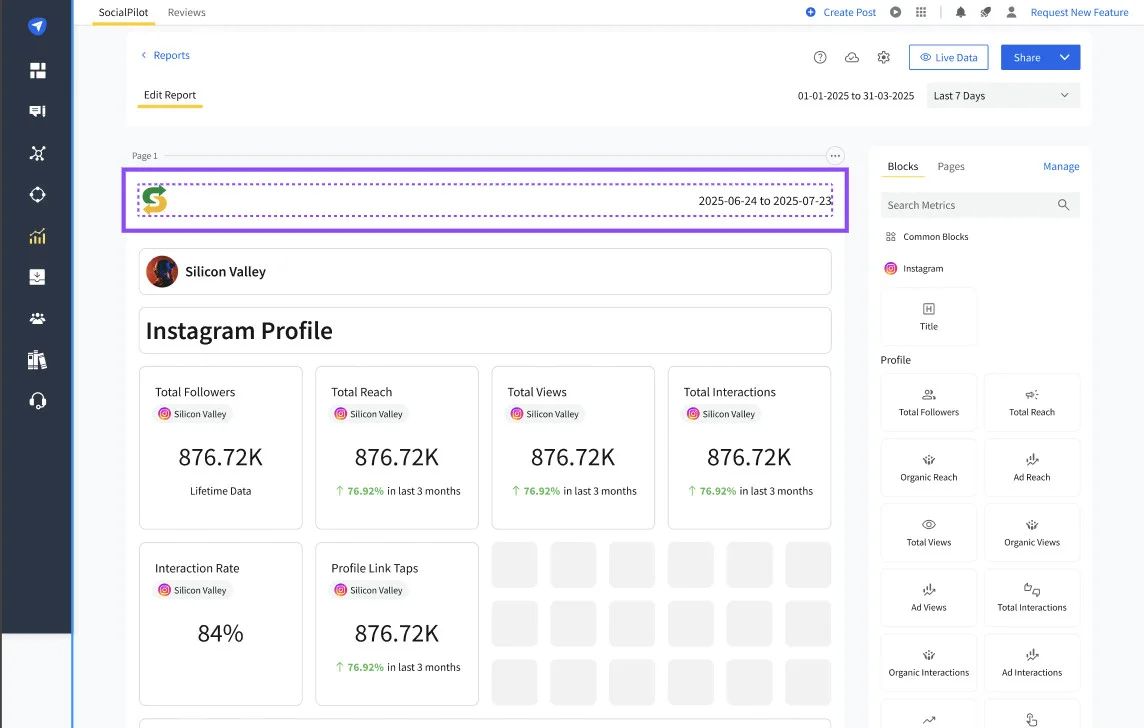
A platform like SocialPilot’s analytics and reporting feature helps simplify that workflow by letting you:
- Track post performance from one dashboard.
- Monitor link clicks and engagement across campaigns.
- Generate white-label reports for clients or stakeholders.
- Schedule influencer and brand content from the same content calendar.
Instead of piecing together screenshots from multiple platforms, you get one place to measure and report campaign performance.
Disclosure and Compliance, What the FTC Actually Requires
Disclosure isn’t optional, it’s a legal requirement. The Federal Trade Commission (FTC) endorsement rules apply whether you’re working with a nano creator or a celebrity, and whether you’re paying in cash or simply sending free products. If there’s a material relationship between your brand and a creator, it must be disclosed.
Current Endorsement Guide Requirements
Per the FTC’s own guidance, a disclosure has to be hard to miss and sit inside the post itself. The requirements, straight from Disclosures 101 for Social Media Influencers, are:
- Place it in the post or video itself, not in the bio, not behind a “more” link, and not buried in a block of hashtags.
- Superimpose it on images and put it in the video, not just the description.
- Repeat it during live streams so viewers who join late still see it.
- Use plain words like “ad,” “sponsored,” or “advertisement,” and avoid vague tags like “sp,” “spon,” or “collab.”
The stakes are real. FTC civil penalties run up to $53,088 per violation as of January 17, 2025, adjusted for inflation each year, and that is per violation, not per campaign.
Gifting vs. Paid Posts, Different Disclosure Obligations
One of the biggest misconceptions in influencer marketing is that only paid partnerships require disclosure. They don’t.
The FTC’s rules apply whenever a creator receives anything of value in exchange for mentioning your brand, including:
- Cash payments
- Free products
- Discounts
- Affiliate commissions
- Travel, experiences, or other perks
If the relationship could influence the endorsement, the audience should know about it.
Just as importantly, compliance is the brand’s responsibility too. You can’t assume creators will disclose correctly on their own. Include disclosure requirements in your contract or campaign brief, and verify they’re present before approving the content.
Platform-Native Disclosure Tools vs. Manual Hashtags
Most major social platforms now offer built-in Paid Partnership or branded content labels. Use them whenever they’re available.
These native labels are more prominent than manually adding #Ad at the end of a caption and make it easier for audiences to recognize sponsored content. Manual disclosures still satisfy FTC requirements when they’re clear and placed where viewers will notice them, but they should support, not replace, the platform’s native disclosure tools whenever possible.
Common Mistakes That Undermine Micro-Influencer Marketing Campaigns
Most underperforming influencer campaigns don’t fail because micro-influencers don’t work, they fail because brands skip one of the fundamentals.
Here are the four mistakes that cause the biggest problems and how to avoid them.
1. Treating Vendor Case Studies as Independent Proof
Eye-catching campaign results are everywhere, but many come from the agencies or platforms that ran them, making them difficult to verify independently.
Instead, prioritize well-documented examples. Daniel Wellington remains one of the strongest case studies because its influencer-led growth has been extensively analyzed in academic research, showing how consistent creator partnerships helped scale the brand over multiple years.
The fix: Use independently verifiable case studies, not marketing claims you can’t validate.
2. Applying Nano-Influencer Research to Micro-Influencers
Not all creator tiers perform the same. A common mistake is citing research on nano-influencers as proof that micro-influencers always generate the highest ROI.
For example, the widely referenced Journal of Marketing study analyzed nano-influencers, not creators with 10K–100K followers. It supports investing in smaller creators, but doesn’t prove the same results for the micro tier.
The fix: Match every statistic to the creator tier it actually studied
3. Skipping Vetting Because the Budget Is Small
A low campaign budget doesn’t reduce the need for due diligence.
Many fake engagement cases happen because brands assume a $200 collaboration isn’t worth auditing. But repeating that mistake across dozens of creators quickly becomes an expensive lesson.
The fix: Run the same vetting checklist for every creator, regardless of campaign size.
4. Assuming Small Creators Don’t Need Disclosure
FTC disclosure rules don’t depend on follower count.
Whether you’re partnering with a creator who has 12,000 followers or 12 million, paid partnerships and gifted collaborations must be disclosed clearly. Smaller creators aren’t exempt from compliance requirements.
The fix: Require disclosures for every paid or gifted collaboration and verify they’re live before approving the campaign.
Building This into Your Broader Influencer Strategy
Micro-influencer marketing scales when it’s built on a repeatable process, not one-off collaborations. Vet creators before you negotiate, price partnerships on value instead of follower count, measure every campaign with clear attribution, and make compliance part of your workflow.
Over time, the goal is to build a trusted roster of creators who consistently drive measurable results, not keep chasing the next viral partnership.
As your program grows, SocialPilot helps you plan content, track performance, and generate campaign reports from one place, with pricing plans that’s accessible for both growing brands and agencies.


 Join 55,000+ social media managers


