
Influencer marketing continues to grow rapidly in 2026, with rising global spending, expanding platform opportunities, and increasing brand investment. From market size and budget allocation to platform trends, pricing benchmarks, and consumer trust data, these statistics highlight how influencer marketing is evolving into a core pillar of digital strategy.
Influencer marketing isn’t just growing; it’s reshaping modern advertising. What started as sponsored posts has evolved into a multi-billion-dollar global industry, driving brand awareness, customer acquisition, and measurable revenue.
In 2026, brands are allocating larger portions of their marketing budgets to creators, platforms like Instagram and TikTok continue to dominate attention, and micro influencers are outperforming traditional celebrity endorsements on engagement and trust.
At the same time, pricing benchmarks are shifting, AI is influencing content production, and consumer expectations around transparency are rising.
These 2026 influencer marketing statistics break down the numbers that matter, from global market size and U.S. spending to platform trends, niche performance, engagement rates, and ROI insights, giving you a complete view of where the industry stands and where it’s headed next.
General Influencer Marketing Statistics
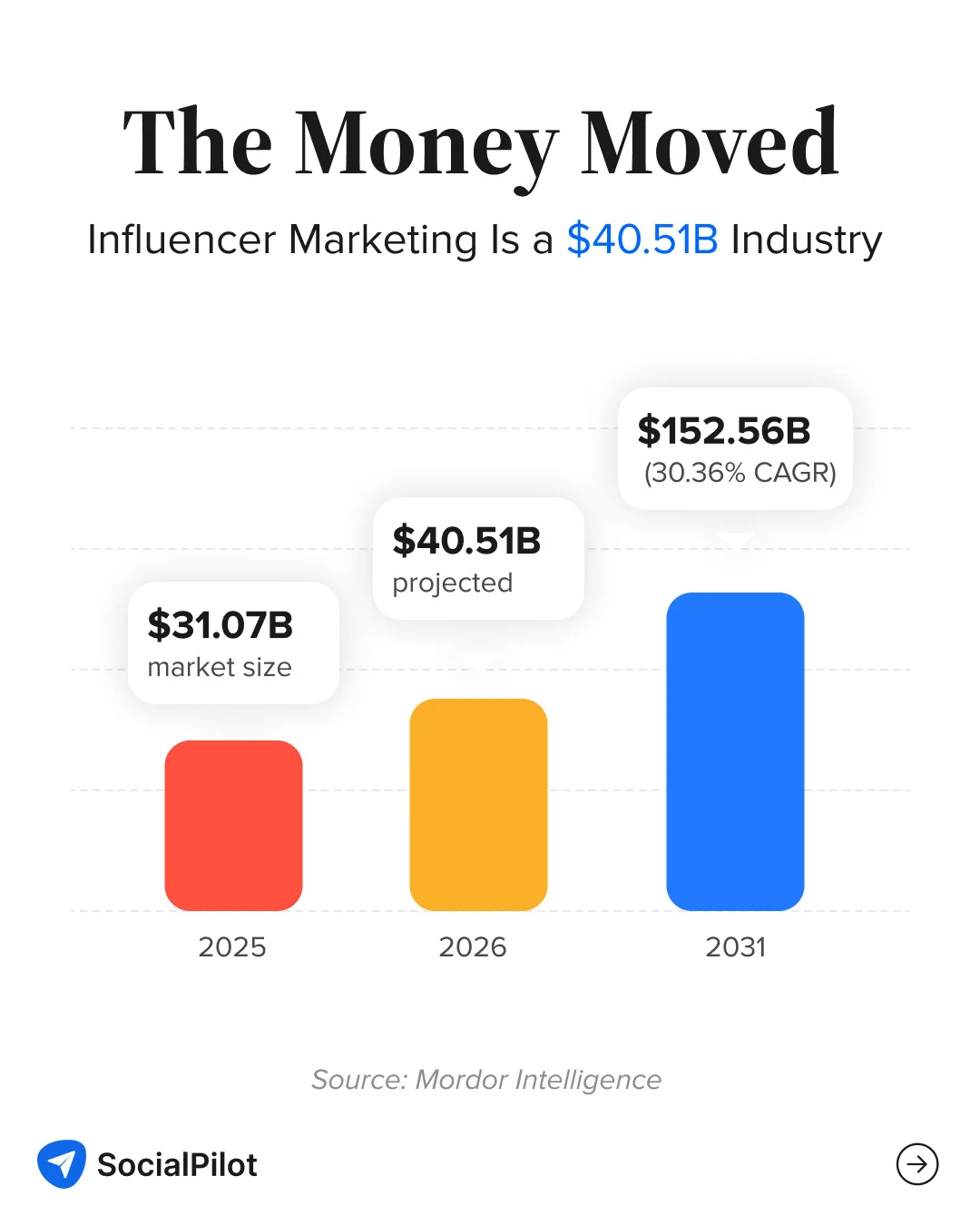
1. The global influencer marketing market is experiencing rapid growth. According to data sourced from Mordor Intelligence, the market was valued at $31.07 billion in 2025 and is projected to reach $40.51 billion in 2026. By 2031, the market size is expected to grow significantly to $152.56 billion, reflecting a strong compound annual growth rate (CAGR) of 30.36% between 2026 and 2031.
The study period covers 2020 to 2031. During this time, Asia Pacific is identified as the fastest-growing market, while North America remains the largest market. The industry shows low market concentration, indicating a competitive landscape with many players.
2. According to eMarketer, influencer marketing spending in the United States reached $10.52 billion in 2025 — up $1.37 billion year over year — with growth accelerating to 15.7% in 2026. This continued climb highlights brands’ increasing reliance on creators as a core part of their digital advertising strategies.
3. Across major social media platforms, women significantly outnumber men in influencer roles. According to available industry data, women represent approximately 70–80% of all influencers on platforms such as Instagram, TikTok, and YouTube.
On TikTok and Instagram specifically, women account for 78% of influencers, highlighting their dominant presence in short-form and visual content creation. YouTube’s creator ecosystem is somewhat more balanced, with 65% female and 35% male influencers, but women still make up a clear majority.
Source: Collabstr 2025 Influencer Marketing Report
4. Analysis of large influencer collaboration datasets shows a clear gender pay gap in the industry. On average, male influencers earn about $291 per collaboration, compared to around $208 for female influencers, even when follower size and engagement rates are similar. That works out to roughly $83, or about 40%, more per deal for men.
While women make up the majority of influencers, particularly in categories such as fashion, beauty, and lifestyle, rates in these segments tend to be lower due to market oversaturation and high competition for brand partnerships.
Source: Collabstr 2025 Influencer Marketing Report
5. According to an analysis of over 15,000 brand–influencer collaborations, Collabstr identified the top 10 most popular countries for influencer marketing in its 2025 Influencer Marketing Report.
The United States ranks as the leading country, followed by Canada, the United Kingdom, Australia, and the United Arab Emirates. In Europe, key markets include Germany, France, Spain, the Netherlands, and Italy.
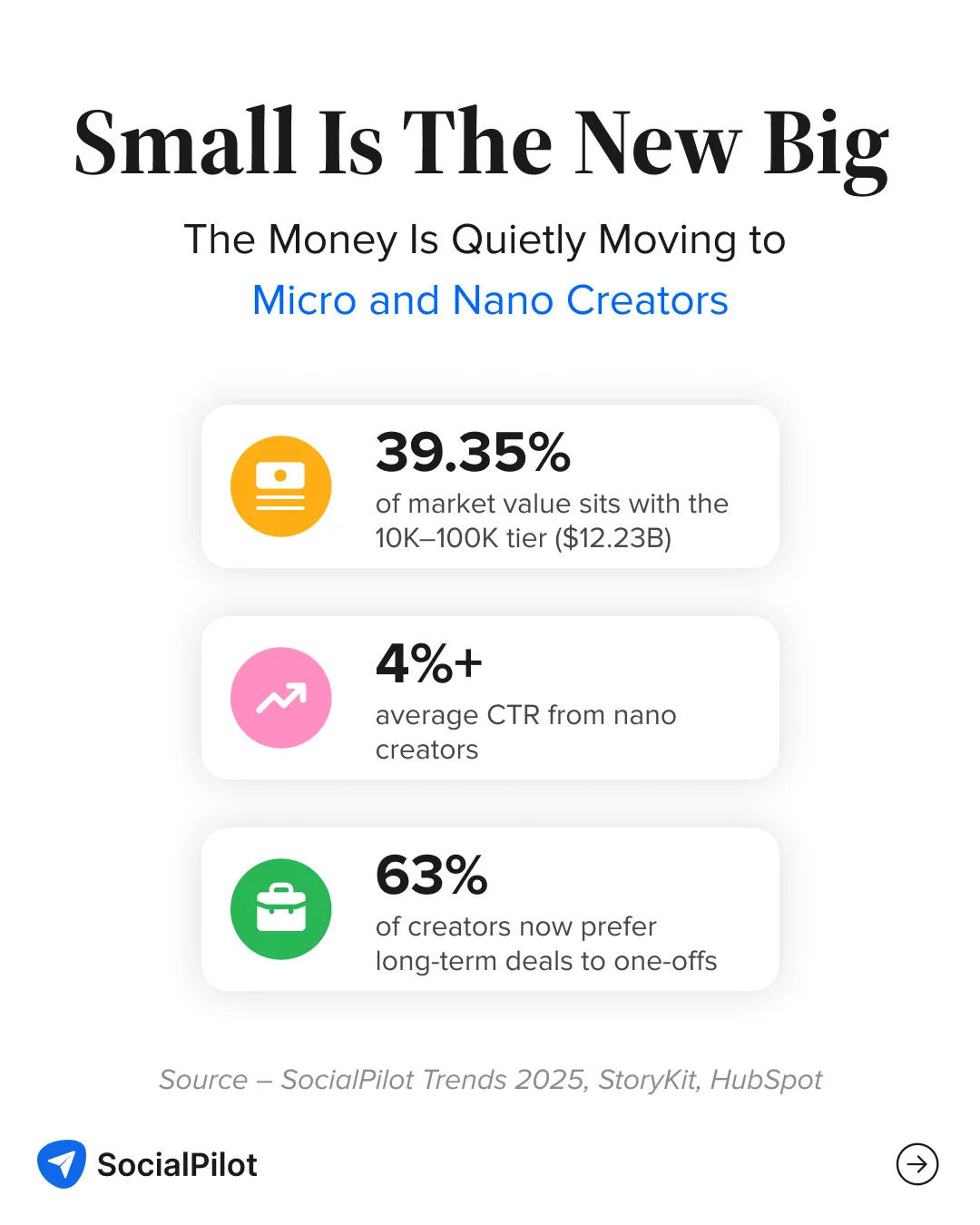
6. Micro-influencers (10k-100k) account for 39.35% of the market value ($12.23B in 2025), as brands favor them for their higher engagement rates compared to mega influencers, who charge significantly more.
Nano creators (1-10k), despite smaller audiences, deliver strong click-through rates (4%+). As a result, brands are reallocating portions of their paid search budgets toward nano influencer partnerships, with agencies using CRM-style tools to manage large creator networks efficiently.
Mega influencers (1 million+) remain valuable for large-scale brand awareness campaigns, though their market share declined by 3.2% from last year.
Meanwhile, macro influencers (100k – 1 million) are particularly effective at the consideration stage, especially for complex B2B offerings.
You can select influencers for your campaigns based on your goals and the customer journey stage. Brands now choose different types of influencers depending on where their audience is in the buying journey, creating a balanced mix of creators for maximum impact.
Source: Mordor Intelligence
7. According to the Mordor Intelligence 2025 report, Instagram generated the highest revenue in influencer marketing, holding 29.25% of the total market share, approximately $9.09 billion.
However, TikTok is growing much faster than other platforms. It is expected to grow at a compound annual growth rate (CAGR) of 36.85% through 2031. This means TikTok’s share of influencer marketing revenue could increase significantly as more brands use its strong discovery algorithm and viral content potential.
8. According to a WARC x impact.com survey, Instagram remains the dominant platform for influencers, with 92% reporting it as their primary channel; it’s no surprise that brands continue to invest heavily in Instagram influencer marketing. TikTok ranks second at 43%, followed by Facebook (41%) and blogs (39%) as key secondary platforms.
Usage declines significantly beyond these top four platforms. Pinterest is used by 20% of influencers, while YouTube stands at 15%. Meanwhile, Snapchat (4%), LinkedIn (2%), podcasts (1%), and Twitch (1%) cater to more niche or specialized audiences.
9. According to the 2025 global survey of marketers and industry leaders (Statista), the share of marketing budgets allocated to influencer marketing varies widely across all companies or brands.
| Budget Allocation to Influencer Marketing | Share of Respondents |
| Less than 5% | 5.1% |
| 5–10% | 12.7% |
| 10–15% | 14.4% |
| 15–20% | 11.9% |
| 20–25% | 9.7% |
| 25–30% | 6.8% |
| 30–35% | 6.8% |
| 35–40% | 8.1% |
| 40–45% | 6.8% |
| 45–50% | 7.2% |
10. According to Collabstr’s 2025 Influencer Marketing Report, the top U.S. cities for influencers have mostly stayed the same. Los Angeles, New York, Miami, and Atlanta continue to lead, thanks to their strong creator communities, brand activity, and media presence.
The only major change this year is that Dallas has moved into the top five, replacing Tampa. This shift likely reflects the rising focus on localized and regional marketing strategies.
11. Smaller cities in the US are emerging as some of the highest-paying markets for influencers. Salt Lake City, Utah leads with an average of $421 per collaboration, followed by St. Louis, Missouri ($363), Bloomington, Indiana ($342), Ottawa, Ontario ($340), and Fort Lauderdale, Florida ($324). This trend indicates that less saturated markets often provide higher earning potential for creators.
Source: Collabstr 2025 Influencer Marketing Report
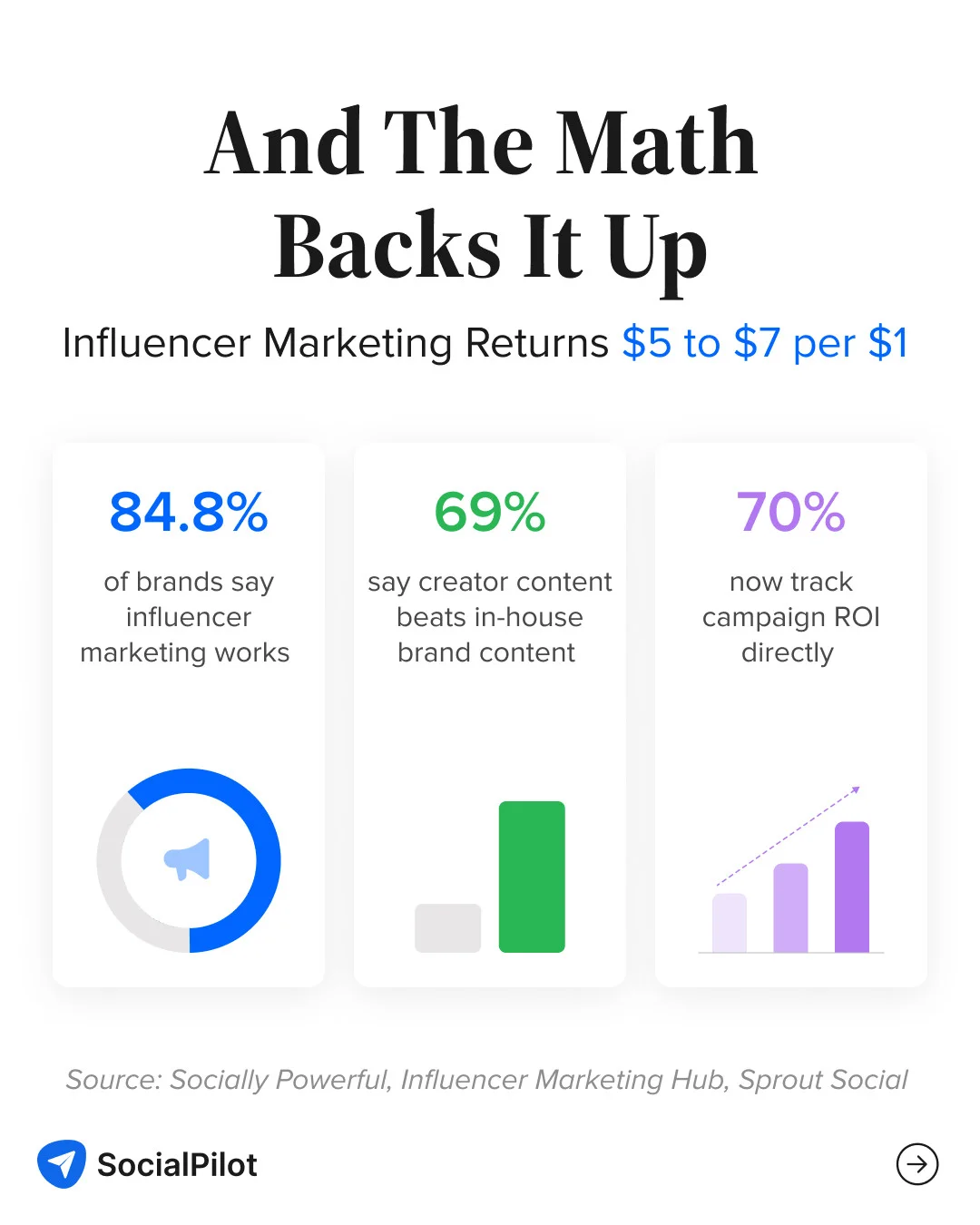
12. Influencer marketing continues to deliver strong returns. On average, businesses earn about $5 to $7 in value for every $1 they spend on influencer campaigns, making it one of the higher-return channels in digital marketing.
Source: Socially Powerful
13. Marketers are confident in the channel. 84.8% of brands say influencer marketing is an effective form of marketing, and 83.8% report that it brings in better-quality customers than other channels.
Source: Influencer Marketing Hub
14. Measurement is catching up to spend. 70% of brands now track the ROI of their influencer marketing campaigns, which still leaves roughly 30% flying blind on results.
Source: Influencer Marketing Hub
15. Creator content is winning on performance. 69% of marketers say influencer-generated content outperforms brand-created content, making creator partnerships a reliable way to lift campaign results.
Source: Sprout Social
Influencer Marketing Engagement Statistics
16. 69% of consumers are likely to trust a recommendation from a friend, family member, or influencer over information that comes directly from a brand. This shows how important trusted voices have become in shaping buying decisions. When consumers trust an influencer, they are more likely to purchase a product and even buy from the brand again.
Source: Matter Communications
17. According to Sprout Social, Instagram influencers averaged an engagement rate of about 1.36% per post in 2025, while TikTok influencers show significantly higher engagement, with nano-influencers reaching around 11.97% and micro-influencers about 10.21%, making TikTok one of the most engaging platforms for influencer content.
18. According to industry engagement benchmarks, influencer marketing engagement rates vary by sector worldwide, with the travel industry showing the highest average engagement (around 2.4%), followed by beauty at about 1.95%, sports & fitness around 1.6%, and fashion close to 1.53%, highlighting that some industries tend to drive stronger audience interaction than others.
Source: Statista
19. Influencer marketing is helping brands attract better and more relevant customers. As a result, it’s more important than ever to work with influencers who genuinely align with your brand and whose followers match your target audience. In fact, 85% of marketers say influencer marketing helps them acquire new customers.
Source: Influencer Marketing Hub Benchmark Report
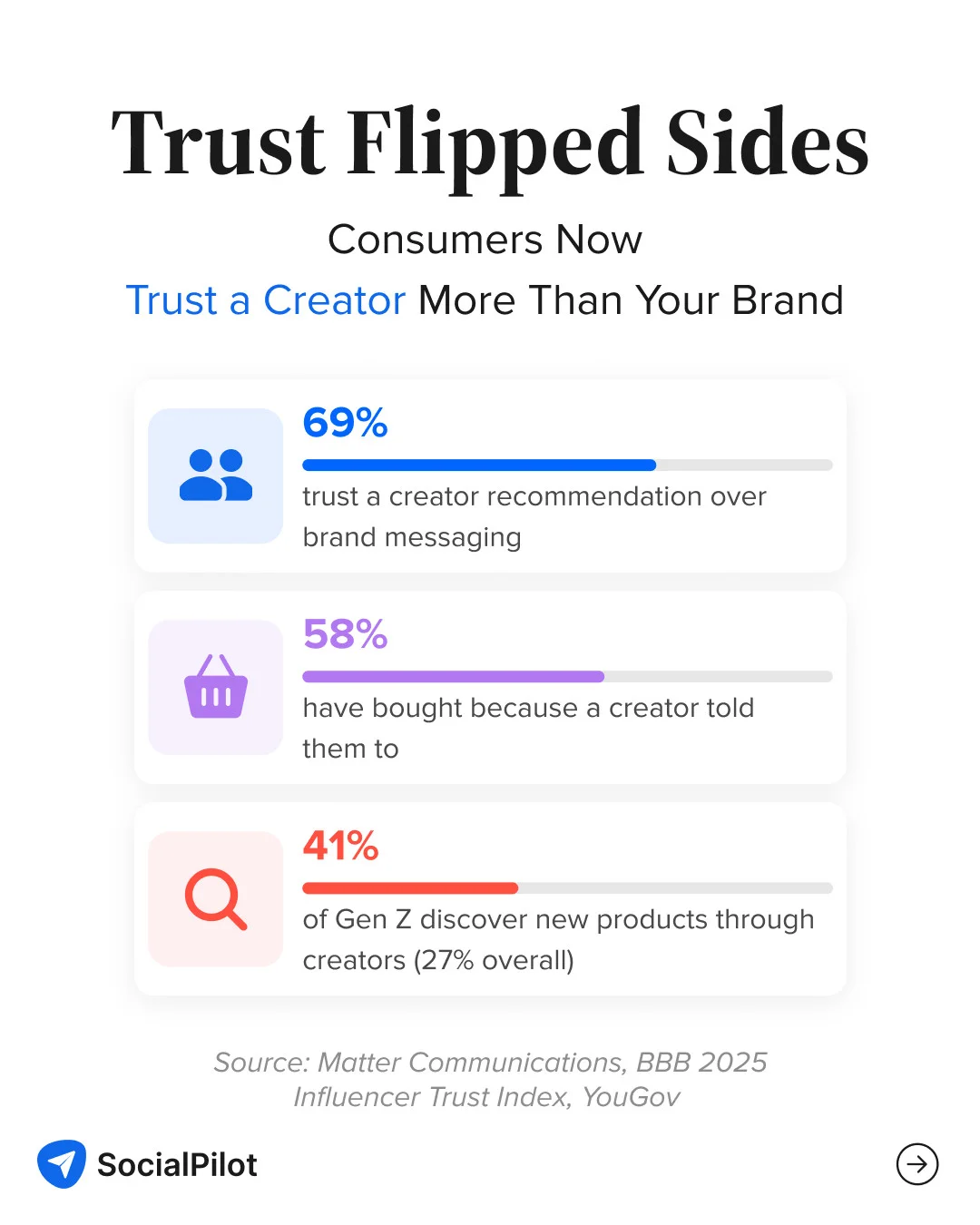
20. According to the 2025 Influencer Trust Index by BBB National Programs, 58% of consumers reported they have made a purchase as a result of an influencer’s endorsement of a product or service, and 35% of consumers said they have made four to six purchases based on influencer recommendations.
21. According to the 2025 Influencer Trust Index, 52% of consumers watch influencer content that appears in their social media feeds, while 33% actively seek out influencer content to learn more about a product or topic. This means businesses can use influencer marketing not only to reach passive audiences, but also to target consumers who are actively researching and considering products.
22. In the United States, 74% of consumers trust influencer advertising, with 5% trusting influencers completely and 69% trusting them somewhat, while 26% say they do not trust influencers. Additionally, 7 out of 10 consumers dislike it when influencers do not disclose a brand partnership, whether paid or not. So, influencer marketing can be effective because most consumers show some level of trust, but brands must focus on transparency and proper disclosure.
Source: 2025 Influencer Trust Index Report
23. Influencers are now a mainstream discovery channel. 27% of Americans say they discover new products through influencers or bloggers, and among Gen Z that jumps to 41% — roughly level with search engines (42%) and ahead of website or blog reviews (37%).
Source: YouGov
24. Short-form video keeps proving its worth. 80% of marketers rank short-form video among their top three most effective content formats, just behind long-form video at 83%, which explains why so much creator spend flows to Reels, TikToks, and Shorts.
Source: Influencer Marketing Hub
Influencer Marketing Budget Statistics
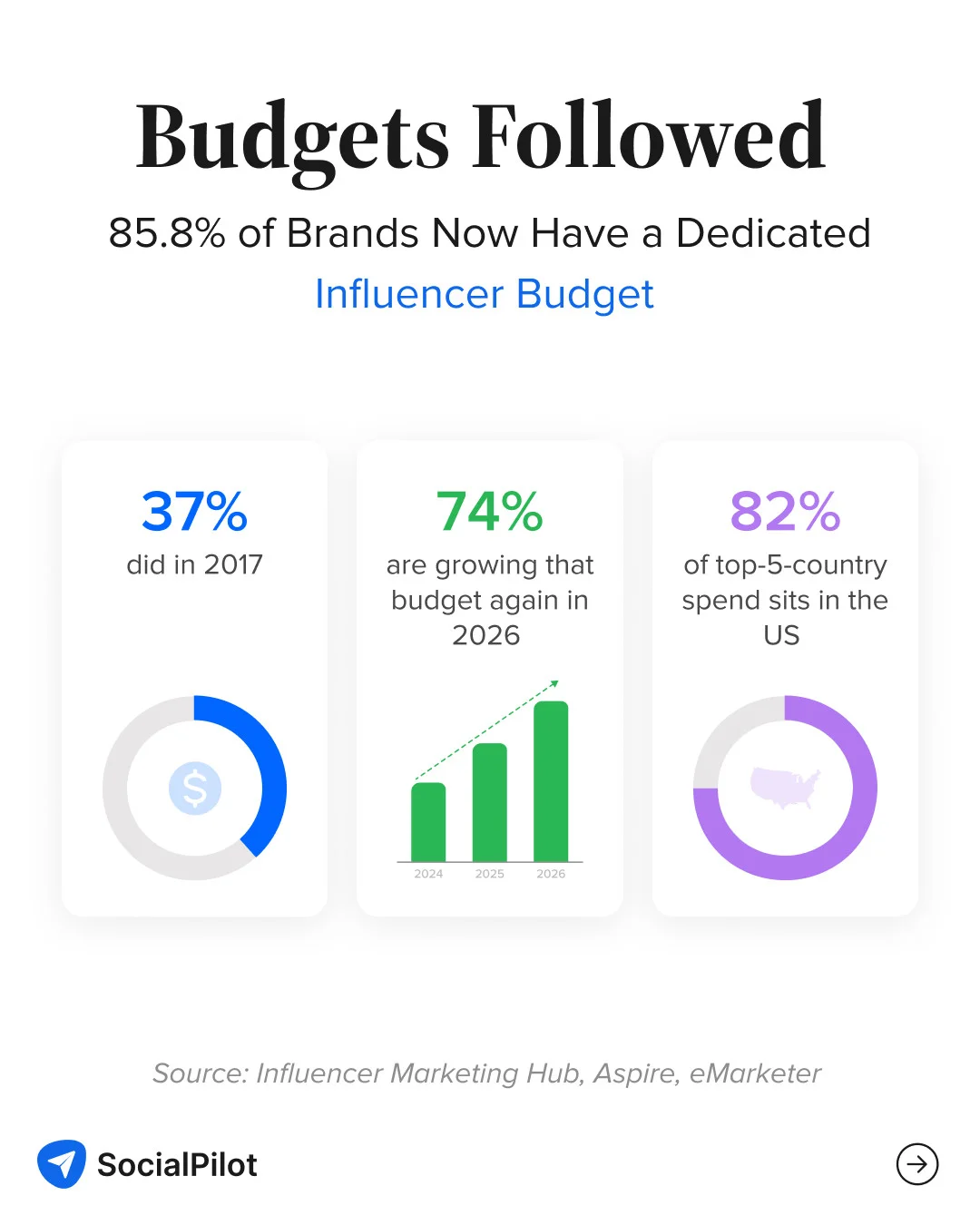
25. Nearly 74% of marketers plan to increase their influencer marketing budgets in 2026, showing that even with tighter overall spending, most companies are choosing to invest more in creators because they continue to attract attention and drive ad value, though how much each brand plans to spend still varies widely depending on their size and priorities.
Source: Aspire 2026 The State of Influencer Marketing Report
26. According to data from Collabstr’s 2025 Influencer Marketing Report, influencer marketing spend is heavily concentrated in one primary market. The United States accounts for 82% of total influencer marketing budget spend among the top five countries, making it by far the dominant market. The remaining spend is distributed as follows:
- Canada: 8%
- United Kingdom: 5.3%
- Australia: 4.2%
- United Arab Emirates: 0.5%
This distribution highlights the overwhelming concentration of influencer marketing investment in the U.S., with all other leading markets representing relatively small shares in comparison.
27. According to Statista data, as social media use grows, brands are putting more of their marketing budget into influencer marketing. Here’s how budgets are typically divided worldwide:
- 25% of brands spend 10–20% of their marketing budget on influencers.
- 23% allocate 40% or more to influencer marketing.
- 20% spend less than 20% on influencers.
- 18% invest 20–30% of their budget.
- 13% dedicate 30–40% to influencer campaigns.
28. According to Collabstr’s 2025 Influencer Marketing Report, the average asking price per post by platform is as follows:
- YouTube: $675.23
- Instagram: $363.64
- TikTok: $350.06
- Twitch: $237.72
- Amazon: $215.10
- Twitter (X): $171.35
These figures represent what influencers ask brands to pay, not necessarily final negotiated rates. Compared to last year, average asking prices declined across major platforms:
- Instagram: ↓ 13.00%
- TikTok: ↓ 32.68%
- YouTube: ↓ 17.25%
For a clearer idea of outreach before negotiating rates, you can also check the guide on how to email an influencer effectively.
29. On average, Instagram Reels cost 32% more than TikTok videos, with an average price of $288 per Reel compared to $217 per TikTok video. Reels are more expensive because Instagram gives them strong algorithm support, which increases their reach and visibility.
Instagram Reels tend to outperform other formats, generating 55% more engagement than single-image posts and 29% more than regular videos, which makes them a higher-value format for brands looking to boost engagement.
30. The creator economy is growing fast. Goldman Sachs estimates there are around 50 million content creators worldwide, and expects that number to grow 10–20% a year over the next five years. Only about 4% are full-time professionals who earn more than $100,000 a year, so the vast majority create on a part-time basis.
Source: Goldman Sachs Global Investment Research
31. According to Collabstr’s 2025 report, the average spend per influencer collaboration in the U.S. is $202, down from $214 last year, showing a slight decline in pricing. Whereas average brand spend per influencer varies significantly by platform. YouTube leads at $418 per influencer, making it the highest investment platform. It is followed by:
- Instagram: $212
- TikTok: $200
- Amazon: $130
- Twitch: $119
- X (Twitter): $87
This data shows that long-form, high-production platforms like YouTube command the largest budgets, while platforms like X remain the most cost-efficient for brands.
32. According to the BBB Programs Trust Index survey, a staggering 82.7% of U.S. marketers used influencer partnerships in creative campaigns, driving the influencer marketing industry to an impressive $24 billion domestic valuation. This underscores the immense significance of influencer marketing for both brands and consumers alike.
33. Based on Collabstr 2025 industry benchmarks, here is a clear breakdown of average influencer charges per post by platform, organized by influencer tiers (nano, micro, macro, and mega).
| Platform | Nano (1K–10K) | Micro (10K–100K) | Macro (100K–1M) | Mega (1M+) |
| Instagram (Post/Reel) | $50 – $250 | $250 – $1,000 | $1,000 – $10,000 | $10,000 – $100,000+ |
| TikTok (Video) | $50 – $300 | $300 – $1,200 | $1,200 – $12,000 | $12,000 – $150,000+ |
| YouTube (Dedicated Video) | $100 – $500 | $500 – $5,000 | $5,000 – $50,000 | $50,000 – $300,000+ |
| Facebook (Post/Video) | $25 – $200 | $200 – $800 | $800 – $5,000 | $5,000 – $50,000 |
| Pinterest (Pin/Idea Pin) | $50 – $200 | $200 – $800 | $800 – $5,000 | $5,000 – $25,000 |
| LinkedIn (Post) | $100 – $400 | $400 – $2,000 | $2,000 – $15,000 | $15,000 – $75,000+ |
| Blog Post (SEO Sponsored) | $100 – $500 | $500 – $2,000 | $2,000 – $10,000 | $10,000 – $50,000 |
| Podcast Mention (Host Read) | $50 – $300 | $300 – $2,000 | $2,000 – $25,000 | $25,000 – $100,000+ |
| Twitch (Sponsored Stream) | $100 – $500 | $500 – $3,000 | $3,000 – $30,000 | $30,000 – $200,000+ |
| Snapchat (Story/Post) | $50 – $250 | $250 – $1,000 | $1,000 – $8,000 | $8,000 – $60,000 |
34. Dedicated influencer budgets are now the norm. 85.8% of brands run a dedicated influencer marketing budget, up sharply from just 37% in 2017, showing how the channel has matured from a test line item into a standing investment.
Source: Influencer Marketing Hub
35. Most influencer budgets are still modest. 68.3% of brands spend less than $50,000 a year on influencer marketing, and 47.4% spend under $10,000, which means the field remains wide open for small and mid-sized brands.
Source: Influencer Marketing Hub
Influencer Marketing Industry Niche-Based Statistics
36. According to Collabstr’s 2025 report (based on 1M+ advertiser searches), the top 10 in-demand influencer niches are:
- Fashion
- Beauty
- Lifestyle
- Health & Fitness
- Food & Drink
- Travel
- Family & Children
- Entrepreneur & Business
- Music & Dance
- Technology
These niches represent the categories where influencers are currently seeing the highest advertiser demand.
Additional Influencer Marketing Statistics
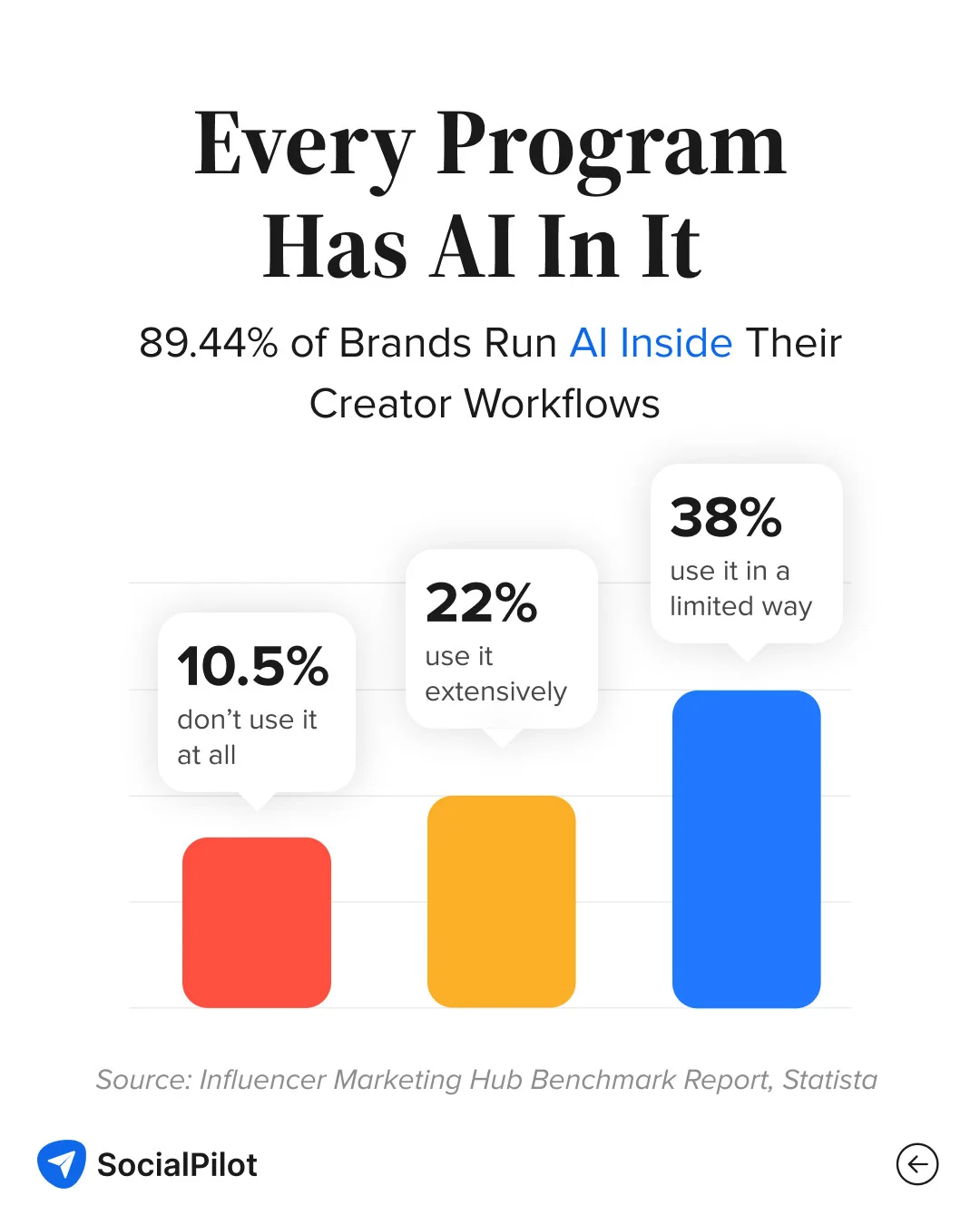
37. Statista reports that 38% of marketing professionals use AI for influencer marketing on a limited basis while another 22% use AI extensively. In addition, AI integration improves campaign outcomes for 66% of marketers, according to Influencer Marketing Hub.
38. According to the 2025 B2B Influencer Marketing Report, 99% of B2B marketers using an always-on influencer strategy say their programs are effective, and 72% of advanced teams have a dedicated influencer budget that is expected to grow.
39. 77% of marketers reuse creator content in paid social ads to reach more people and improve results beyond organic posts. This trend is growing even faster with Meta’s AI-driven system, which now focuses more on having a large variety of strong creative content rather than detailed audience targeting, meaning brands need to consistently produce high-quality content to perform well.
Source: Aspire report
40. 63% of creators prefer long-term partnerships, making it the most popular way to work with brands. In comparison, 17% prefer one-off campaigns, 15% choose UGC campaigns, 2% favor affiliate campaigns, and 3% select other options.
This shows that creators value ongoing relationships, which can help brands build stronger trust, more authentic content, and better long-term results.
Source: NetInfluencer Famesters Report
41. 86% of creators are open to working with brands in exchange for free products, with 61% saying yes if they love the brand and 25% agreeing if the product value is high, while only 14% would not work for free products.
This shows that product-only collaborations can work in the right situation, but brands should still prioritize fair payment to maintain strong relationships and protect their reputation.
Source: Aspire State of Influencer Marketing Report 2026
42. 54% of marketers work mainly with nano and micro influencers, with 27% partnering with nano creators (2.5K–25K followers) and 27% with micro creators (25K–60K followers).
Meanwhile, 32% collaborate with mid-tier influencers (60K–250K followers), 12% work with macro influencers (250K–1M followers), and only 2% partner with mega influencers (1M+ followers), showing a clear preference for smaller creators with strong engagement and niche audiences.
Source: Aspire report
43. Influencer marketing has become more cost-effective, with the average CPM dropping 42% compared to last year. In 2025, the average influencer marketing CPM across platforms was $2.68, showing that brands are now able to reach audiences at a lower cost than before.
Source: Influencer Marketing Stats by Aspire
44. Influencer-driven buying is now a habit, not a one-off. 86% of consumers make at least one influencer-inspired purchase each year, and 49% buy something on an influencer’s recommendation at least once a month.
Source: Sprout Social
45. Short-form video converts directly to sales. 79% of weekly Instagram Reels users say they have purchased a product after seeing it in a Reel, showing how tightly discovery and buying now sit together on the platform.
Source: Meta, via Sprout Social
46. Virtual influencers are becoming a real market of their own. The global virtual (AI) influencer market was valued at $6.06 billion in 2024 and is projected to reach $45.88 billion by 2030, a 40.8% compound annual growth rate.
Source: Grand View Research
47. AI is now nearly universal in influencer programs. Only 10.56% of brands say they do not use AI in influencer marketing at all, and creator discovery is the top AI use case at 36.67%, followed by content generation at 21.11%.
Source: Influencer Marketing Hub
Fuel Your Marketing Strategy with These Statistics
Influencer marketing offers strong growth potential, but success requires realistic expectations and a strategic approach. Every campaign should be treated as an investment, measured, optimized, and refined based on performance.
The statistics shared in this article highlight where the market is headed and what’s driving results. To run successful influencer marketing campaigns, focus on choosing the right influencers, aligning with their audience, setting clear goals, tracking performance, and staying updated with industry trends.
With the right influencer marketing strategy and data-backed decisions, influencer marketing can become a powerful driver of brand awareness, engagement, and customer acquisition.



 Join 55,000+ social media managers


