
A sound is blowing up. Someone has already sent you the link. A client, your boss, or the person who sits two desks away and does not have to answer for what goes out. They want to know if you can do something with it.
You have maybe two hours. And you are stuck between two bad outcomes. Post it, it lands wrong, and your name is on it. Skip it, and next week someone asks why the brand missed the moment everyone else caught.
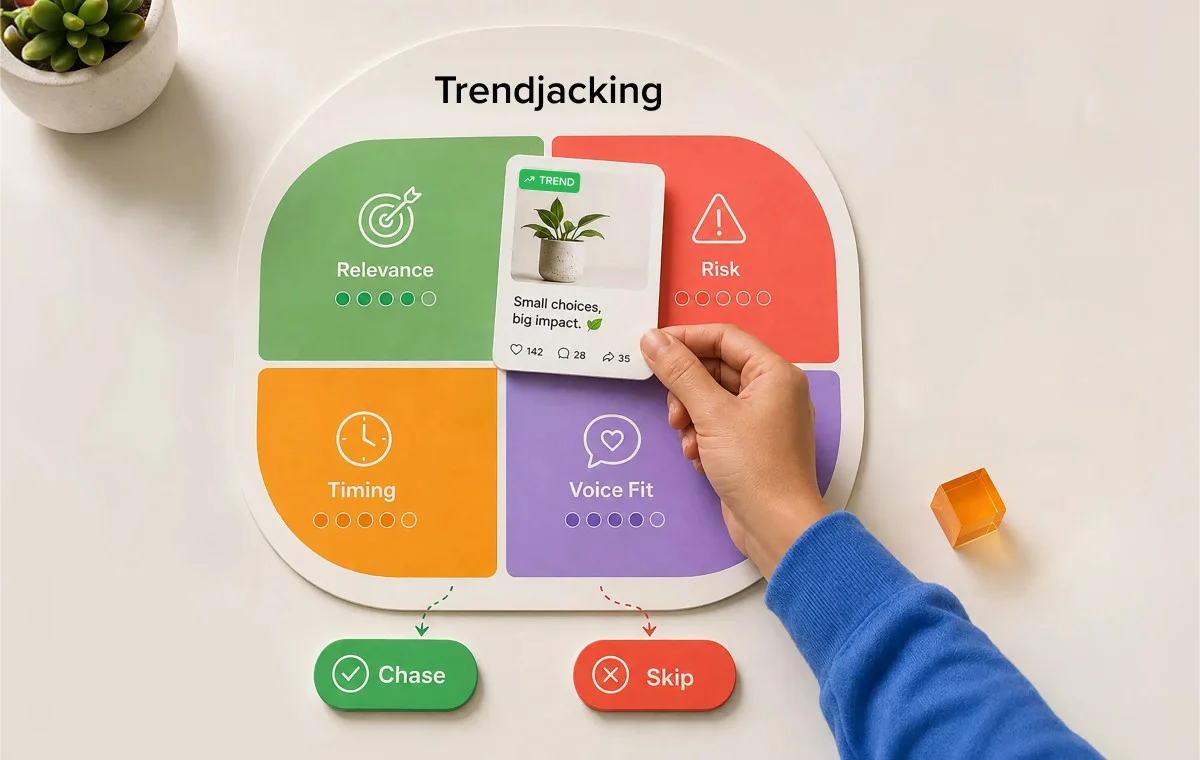
Trendjacking is making your own version of a format, sound, or joke that is already spreading, while it is still spreading. That window closes fast, which is what makes the call hard.
Nobody hands you a way to make that call. This one takes about ten minutes.
But one belief has to go first, because it is the reason most of these decisions get made badly.
Why Fit Beats Speed Every Time
Every guide you have read says the same thing. They tell you to move fast, that the window is 24 to 48 hours, and that speed is the whole game.
Speed is not the whole game. Fit is.
From working with lean social media teams, the posts that went wrong were rarely too slow. They were wrong for the brand that published them.
Two studies back that up better than an opinion can.
The first, published in Frontiers in Psychology, ran three experiments on how people react when brands make jokes at each other’s expense. The finding worth your time is what happened when the researchers changed the brand’s personality.
When the brand was a sincere one, sharp humor did measurably worse than gentle humor. When the brand was already an exciting, loud one, the sharp version cost it nothing at all.
Same joke. Different brand. Opposite result.
That is the whole framework in one line. Your brand’s personality sets your ceiling. A joke that is free for one brand is expensive for yours.
One caveat. Those experiments tested brands teasing other brands, not brands joining a trend. The mechanism carries over, that the same joke costs different brands different amounts. A number you can apply to your own feed does not.
The second study, in the Journal of Research in Interactive Marketing, surveyed 595 people about brand memes. Three things made a meme work. People could understand it, it felt fresh, and it matched the brand posting it. The one thing that broke it was sarcasm, which made every one of those effects weaker.
So the instinct is to move faster. The actual job is to check the fit first.
The Trendjacking Brand-Fit Framework

Five steps. Step 2 is the scoring, Step 4 is the arithmetic. Steps 1, 3 and 5 are what stop a good score from fooling you.
Step 1. Trace Where the Trend Came From
Find the origin. The first social media post, the first video, the moment it started spreading.
This takes five minutes and it is the step almost nobody writes about. It is what separates a fast decision from a blind one, because you cannot judge fit against a meaning you have not looked up.
This is not the failure that catches most brands. Both of the ones further down knew exactly what they were joining and still got it wrong. It is just the cheapest one to rule out.
If you cannot find where a trend started, you do not know what you are joining, and that is a skip, not a close call.
Step 2. Score the Four Questions
Four questions, each scored 1 to 5. High is always good, on all four.
Question 1. Relevance
Does this trend connect to what you actually sell or stand for?
Relevance is not topic overlap. A beer brand has nothing to do with filming yourself on the London Underground, and it still worked. What you want is a real bridge, from your product, your customers’ actual lives, or something your brand believes. Not one you have to build in the caption.
| Score | What it looks like |
| 5 | The trend is already about something you do |
| 3 | You can connect it in one line, honestly |
| 1 | You need a paragraph to explain the link |
Question 2. Brand-Voice Fit
Could you post this in the voice you already use?
This is where the Frontiers finding does its work. Be honest about which brand you are, not which one you wish you were. If your feed is warm and straightforward, an edgy trend reads as a costume. If it is already loud, you have room the sincere brand does not.
Read the caption you would write. Does it sound like you, or like you doing an impression of a different account?
| Score | What it looks like |
| 5 | You could post it with no explanation and nobody would blink |
| 3 | A stretch, but your feed has been in this register before |
| 1 | It only works if you pretend to be a different brand |
If you have never written down what your voice actually is, that is the real gap. Consistent brand voice comes before any of this.
Question 3. Timing
Can you be live before the format dies?
Not “can you make it.” Can you make it, get it approved, and publish it. The second is where most teams lose, because it is usually the approval step and not the creative that decides the answer. That is a tooling problem more than a talent one.
| Score | Where you are |
| 5 | You can publish today, approvals included |
| 3 | Two to three days, and the trend still has legs |
| 1 | A week out, or you genuinely cannot tell |
Question 4. Risk
How safe are you if this reads wrong?
Ask what happens in the replies, not just what happens in the social media post. Ask whether anyone could reasonably read it as making light of something. Ask whether you would be comfortable if it got screenshotted with no context.
| Score | Worst realistic outcome |
| 5 | It gets ignored |
| 3 | Some people find it try-hard |
| 1 | Someone could reasonably be hurt or offended |
And if the honest answer is “I would need legal to look at this,” you already know your score.
Step 3. Adjust for What Your Audience Will Accept
This is the part that gets missed. A brand can fit a trend perfectly and still have no standing to join it.
Permission is earned by what you posted before. If your audience has spent two years seeing product announcements and nothing else, a sudden dance video does not read as fun. It reads as a brand that just found TikTok.
If your audience has never seen you be playful, subtract 4 from your total. That number is a judgment call, not a measurement, and it is set high on purpose because this is the failure that surprises teams most.
You can earn permission. It takes posting like a human for a few months before the moment arrives, not during it.
Step 4. Add It Up and Read the Verdict
Four scores, out of 20. Then the permission adjustment.
| Total | What it means |
| 16 to 20 | Go. Move now. |
| 11 to 15 | Not as-is. Change the format or take the slower lane below. |
| 10 or under | Skip. |
Run it end to end once and it stops feeling abstract.
Say you handle social media for accounting software, and a dance format is everywhere this week. You score each of the four questions from 1 to 5, add them up, then apply the audience-permission adjustment from Step 3. Here is how that plays out.
| Question | Score | Why |
| Relevance | 1 | No honest bridge to bookkeeping |
| Brand-Voice Fit | 2 | The feed is calm and useful, not silly |
| Timing | 4 | Could film and publish tomorrow |
| Risk | 5 | Nobody gets hurt by a bad dance |
| Subtotal | 12 | |
| Permission | − 4 | Two years of feature posts, no personality |
| Total | 8 | Skip |
Notice what happened. Two questions scored well. The trend was fast and safe. It still came out a skip, because safe and fast are not the same as right.
Step 5. Check the Overrides
A score can be gamed. Three high numbers can drag a bad idea across the line, and that is exactly how smart teams end up apologizing.
So these override the total. Any one of them, and you stop.
You cannot trace the origin. Step 1 again, because it is the step people skip once the clock starts.
The trend touches a tragedy, a crisis, or an active controversy. This isn’t a hypothetical worry, either. The exact version of this question gets asked in public, in real time, every time a moment like this hits. In a thread on r/socialmedia, a social media manager asked:

If you’re asking the question at all, you already have your answer, and it’s the one this override gives you.
- Joining it means claiming an experience your brand has not had. Nobody wants a logo speaking about something it never lived.
- The audio is not licensed for business accounts. Unglamorous, and easy to miss because it has nothing to do with taste. Check it.
There is one exception to the crisis rule, and it is narrow. A brand can post into a crisis if it adds something genuinely useful and asks for nothing. One case further down shows what that looks like.
If you cannot post without an ask attached, you are not the exception.
If any of this is landing close to home, read up on social media crisis management before you need it.
When the Answer Is No, You Still Have a Move
Run those five steps honestly and you will say no more often than yes. Which raises the obvious problem.
Most advice stops at yes or no, which is why people abandon these frameworks the first time they get a no. A dead end is not useful at 4pm.
You have a second lane.
You do not have to join a trend in its format to join the conversation. You can talk about it afterward, and there are only really three angles.
What it says about your industry. Why this format caught on with the people you sell to.
What your customers made of it. Their reaction is social media content you already have.
Why it worked. A teardown of the mechanics, the version other people in your field will share.
Commentary is not tied to a sound, so it does not expire when the sound stops trending. That makes this lane slower and lower risk than the first one.
This is also the exception from Step 5. In April 2020, Steak-umm posted a nine-part thread about spotting misinformation. A frozen meat brand, account run by essentially one person at a small agency. No product, no offer, nothing to buy. NC State News reported almost 60,000 new followers in a week plus national press coverage.
Score that moment on format fit and you post nothing, because there was no format to score.
What follows is what it looks like when real teams run it, and when they do not.
Every article on this topic reaches for Oreo and Wendy’s. Those brands have a room full of people and a lawyer on call. You have neither, so here are teams your size.
1. Days Brewing and the Tube Girl Trend
Days Brewing is a small UK alcohol-free beer company. In 2023, the “Tube Girl” format was everywhere. Filming yourself dancing to camera on public transport.
Their social media team did something smart first. They asked their audience to talk the founders into it. Then the founders filmed it themselves.
The Grocer reported around 20 million views and the brand’s best ever week of sales in Tesco. Brewbound confirmed they were briefly more liked on TikTok than Coca-Cola. The founders talked it through later, citing 1,225% follower growth and a 432% jump in web traffic. Those two are company figures, so hold them more loosely.
The question that explains it is Relevance. Beer and the Underground have nothing in common. But Days sells the idea that you can be out and social without drinking, and a video about being visible in public is exactly that. Relevance was tonal, not topical.
The founders also shot it themselves, which meant no approval chain. That is the only reason the timing worked.
2. Scrub Daddy and Biteable, One Lesson From Both Sides of B2B
Two brands, nothing in common, same finding.
Scrub Daddy sells sponges. Its TikTok following passed 4.5 million as of August 2026, run by a small in-house team. Ad Age has social media managers Kerrie Longo and Davis Miller on record, and the Philadelphia Inquirer covered how deliberate the edgier tone is. They do not pick a trend a quarter. They are on whatever is current, constantly.
Biteable makes video software for businesses. Its social media was run by one person, Haily Moulton, Social Growth Marketer. In an interview about her work she described dropping branded product videos, which flopped, in favor of humor and trending audio. That work passed 50 million views. The same interview reports the careers page going from 60 to 80 visits a day to over 20,000, her own figure rather than an audited one.
The question that explains both is Brand-Voice Fit. Neither brand treated a trend as a campaign. They posted in that register constantly, so when a format arrived the fit was already there and the permission already earned. They were not deciding whether to sound like this. They already did.
Biteable is B2B software. This is not a consumer-brand trick.
Two Brands That Should Have Said No
Both of these had more time than any of the three above, and both used it badly.
1. Barbenheimer Worked in One Market and Broke in Another
In 2023, “Barbenheimer” was a genuine meme. Two very different films opening the same weekend, mashed together by fans. Warner Bros.’ US Barbie account joined in, replying warmly to fan social media posts.
In the US it went fine. In Japan it did not.
Warner Bros. Japan then publicly criticized Warner Bros. US, on its own Japanese-language Barbie account. Variety and CNN both covered it.
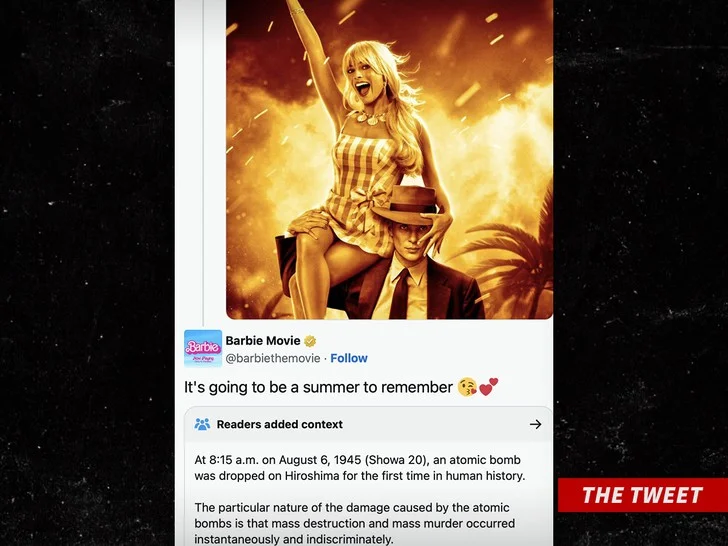
The jokes involved mushroom clouds. In Japan, where the atomic bombings are taught in every school and marked nationally every year, that is not a meme.
The step that explains it is Step 3, audience permission. Same brand. Same trend. Same week. Opposite outcome, because the audience was different.
Brand fit is not a fixed property of your brand. It is a property of your brand and the specific people watching.
If you post across markets, you do not get one answer to this framework. You get one per audience.
2. Burger King UK Knew the Date Was Coming
On International Women’s Day in 2021, Burger King UK tweeted this.
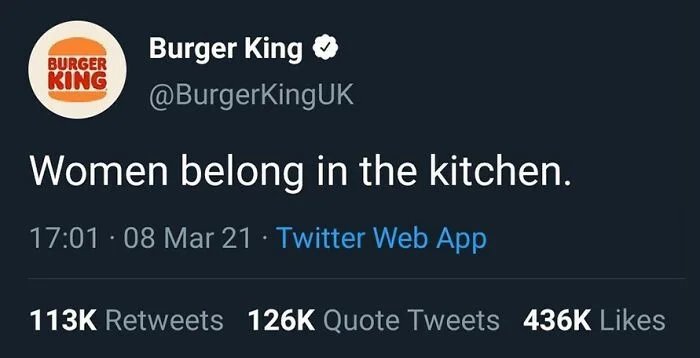
A follow-up explained the point. Only 20% of UK professional chefs are women, and the brand was funding culinary scholarships.
The first tweet took off on its own. Around 113,000 likes and 126,000 retweets, most of it anger. The clarifying tweet was retweeted and quote-tweeted over 250,000 times. They deleted the original and apologized, saying the thread had filled with abuse they did not want to leave open.
The question that explains it is Brand-Voice Fit, and it should have been caught. Nobody was racing a format here. International Women’s Day is on the calendar every year. There was time to write it, read it, sleep on it, and read it again.
A meme misstep is a fast decision made badly. This was a slow decision made badly.
That is harder to forgive and much easier to avoid. If a date is on your calendar, run this a month out.
Note the second failure too. They lost control of the replies, not just the message. Risk is never only about what you publish.
Newsjacking, Trendjacking, and Calendar Moments Are Not the Same
You have now seen three different kinds of moment in this article, and they do not behave alike. A viral format. A breaking news story. A date that comes round every year. Worth separating them, because the clock and the risk change with each one.
Start with the one you have probably heard of. David Meerman Scott, who describes himself as founder of the newsjacking movement, popularised the term in a 2011 book and defines it this way.
“Newsjacking is the art and science of injecting your ideas into a breaking news story so you and your ideas get noticed.”
David Meerman Scott, newsjacking.com
The difference from a trend is what you are reacting to.
| Newsjacking | Trendjacking | |
| You react to | A news event | A format, sound, or joke |
| Clock | Hours, tied to coverage | Days, tied to the format |
| How often | Rarely | Regularly |
| Main risk | Reading the room wrong | Looking like you are trying too hard |
Steak-umm was newsjacking. Days Brewing was not. Both worked, for different reasons.
The framework runs on either. Just weight Risk far more heavily for news, because the cost of a bad call is a different order of magnitude. For the fuller picture, here is what newsjacking means.
That leaves the third kind. Burger King’s was neither a format nor breaking news. It was a calendar occasion. Recurring, predictable, and therefore the one kind you have no excuse for rushing.
Which leaves one problem the framework cannot solve on its own.
Why Trendjacking Dies in the Approval Queue
Ask people who do this for a living and the same tension surfaces unprompted. In a thread on r/content_marketing, one marketer framed it this way:
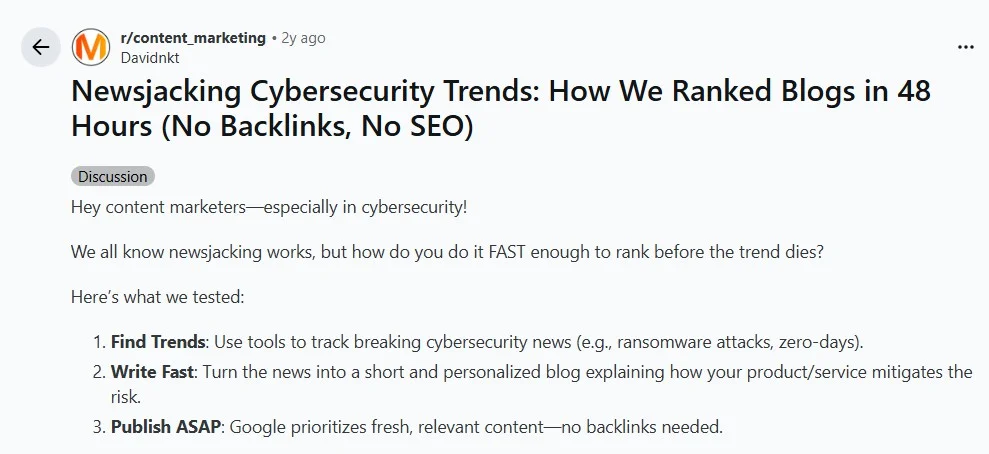
You can run all of this in ten minutes. That is not where teams lose.
You spot the trend at 10am. You have a verdict by 10.20. You write the caption by 11. Then you send it for approval, and you wait. The client replies the next morning. The trend is dead by lunch.
The framework did not fail. The queue did.
This looks like a contradiction after everything above it. It is not. Fit decides whether you should post at all. The queue decides whether you still can. Get the first one wrong and speed only helps you publish a mistake faster.
Here is the same ten minutes with and without something to move it through.
| Step | On email and spreadsheets | On a scheduling platform |
| Verdict to caption | 20 minutes | 20 minutes |
| Caption to approval sent | Email, then wait | Notification, then wait |
| Approval to live | Next morning, if you are lucky | Same hour, from a phone |
| Collision check | Nobody does it | Visible on the calendar |
That “approval to live” row is the whole game. The trend that died in someone’s inbox overnight goes out the same afternoon, because the yes happened on a phone instead of waiting for a desk. That gap, the hours between “we should do this” and “it is live,” is exactly what SocialPilot is built to close.
Here is what each piece does the moment a trend lands.
- Approvals On-The-Go sends the trend post to your client’s phone the second it is ready, so they can tap approve from a train and you publish while the format is still alive, instead of losing the afternoon to an unanswered email.
- The Content Library keeps your logos, brand fonts, and standard disclaimers pre-cleared, so a fast trend post is an edit, not a from-scratch build under a clock.
- The Content Calendar shows the trend post next to everything else booked that day, so you catch a jokey post sitting ninety minutes behind a somber announcement before it goes out, not after.
That is the specific difference. SocialPilot will not find the trend for you, and anyone telling you a scheduling tool will is selling you something. But the gap between deciding and publishing, the one that kills most timely posts, is the part it takes off your hands.
The Next Link That Lands in Your Inbox
So the link arrives. You still have two hours.
But you are not arguing about whether the trend is good any more. You are tracing an origin, scoring four questions, adjusting for your audience, reading a total, and checking the override list. Ten minutes of that beats two hours of debate, and it gives you something to say back that is not a hunch.
The bind at the top of this article was that there was no way to be both fast and defensible. There is. It is arithmetic and one honest look at your own feed.
Do this on the next trend that lands, before you write a single caption. Score it, then decide. If the answer is skip, take the commentary lane instead of taking the loss.
If the last trend you skipped was really a trend you could not approve in time, that is the gap worth closing before the next one. You can try SocialPilot free for 14 days, run a real trend through mobile approvals and the calendar, and see whether the window stops closing on you. No card to start.


 Join 55,000+ social media managers


