

You probably haven’t billed a client for the hour you spent chasing their approval on a Tuesday. But maybe you should.
Imagine this: you send a batch of content to three clients on Monday. By Wednesday, two still haven’t replied. One client approves on WhatsApp but sends a note about the caption by email. Another leaves a comment in Google Docs, but you miss it because they emailed instead of tagging you. By Thursday, the post meant to go live on Wednesday is still in draft. You send your third follow-up of the week and wonder why things never seem to run smoothly.
This isn’t just a client management problem. It’s a real cost, but most social media agencies miss it because it never shows up on an invoice.
A Ziflow survey of over 500 marketing professionals found that 80% of marketers face delays in getting feedback, and creative teams spend just 19% of their working hours actually creating.
Several agency owners on Reddit have shared that their teams spend 30-40% of their time just chasing feedback from clients.
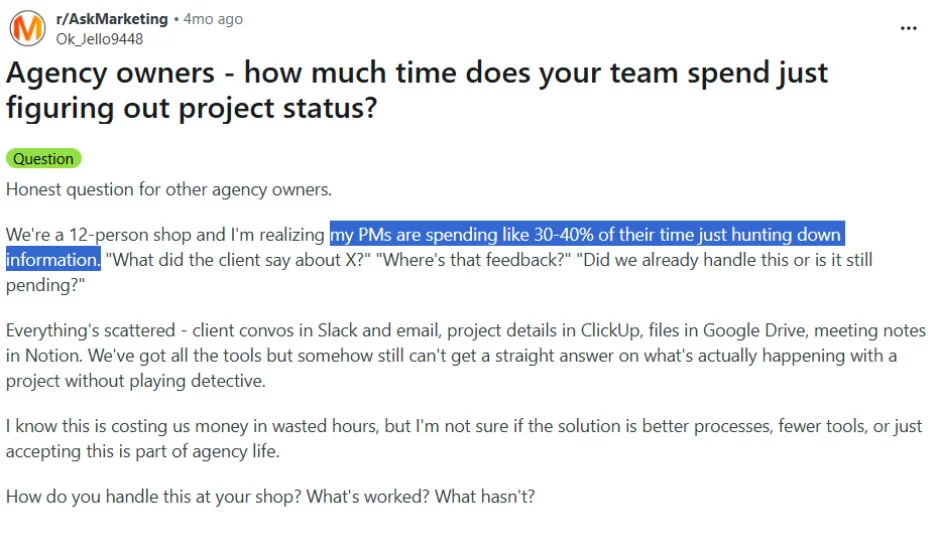
Most agency owners find that much of their time is lost to coordination, chasing, and approvals, and this time never appears in any financial report.
This article will show what those lost hours are really costing you and how you can reclaim them.
The Approval Tax
Most agencies don’t have an approval management system. Instead, they stick to whatever method their clients prefer. That’s exactly what this Reddit thread on “how do you handle client approvals” discusses:
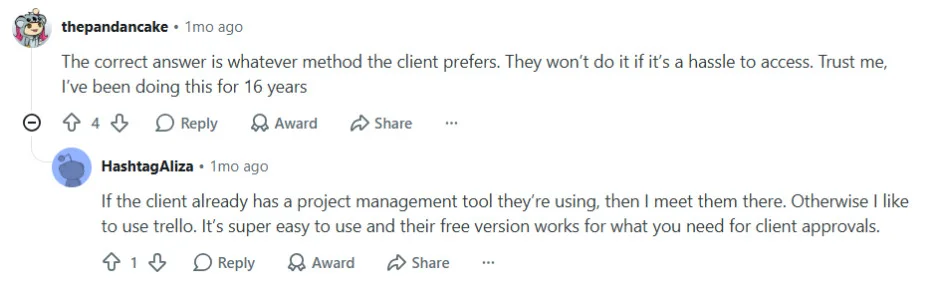
This is what usually happens when your posts enter the approval process.
You finish the content, write the handoff message, and send it out. Then you wait. If there’s no reply in 48 hours, you follow up. The feedback comes back in three separate messages, sometimes with conflicting notes: one on Slack, another by email. You sort out the feedback, make changes, send it again, and wait for confirmation on which version is approved.
Each of those steps takes time.
| Task | Time per post |
| Writing the handoff message | 5–8 min |
| Following up when it goes quiet | 10–15 min |
| Reconciling feedback from multiple channels | 10–15 min |
| Confirming which version is approved | 5–10 min |
| Total per post | Approx 35–45 min |
That’s not time spent creating. It’s all admin work, and it happens with every post, for every client, every week.
On average, it takes eight days for a social media post to go from submission to final approval. This isn’t because clients are difficult, but because feedback comes from too many places. Every approval becomes its own coordination project.
If you have five clients and two posts in approval each week, that’s already more than six hours of admin work. None of it is billable or trackable.
The bigger problem is that this overhead is invisible. It gets grouped under “client management” and written off as just part of the job. Since it’s never measured, it never gets fixed.
At 40 minutes per post and at least 2 posts per week for each client, here’s the total time you spend on approvals.
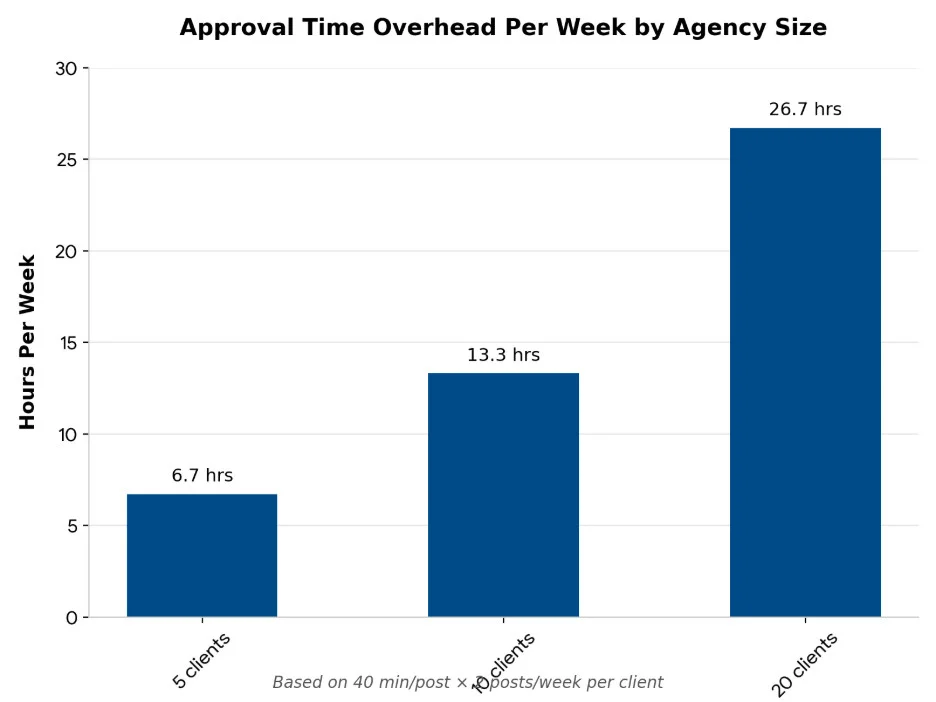
How to Calculate Your Approval Cost
Approval overhead sticks around because it’s invisible. Agency owners know they spend time chasing approvals, but since they never put a dollar amount on it, it stays hidden.
Here’s the formula:
(Avg minutes per post ÷ 60) × posts in approval per week × 4.33 × hourly rate × number of clients = monthly approval cost.
If you use 40 minutes per post (the middle of the 35 to 45 minute range) and an internal rate of $50 per hour for small agencies, your monthly approval costs will look like this:
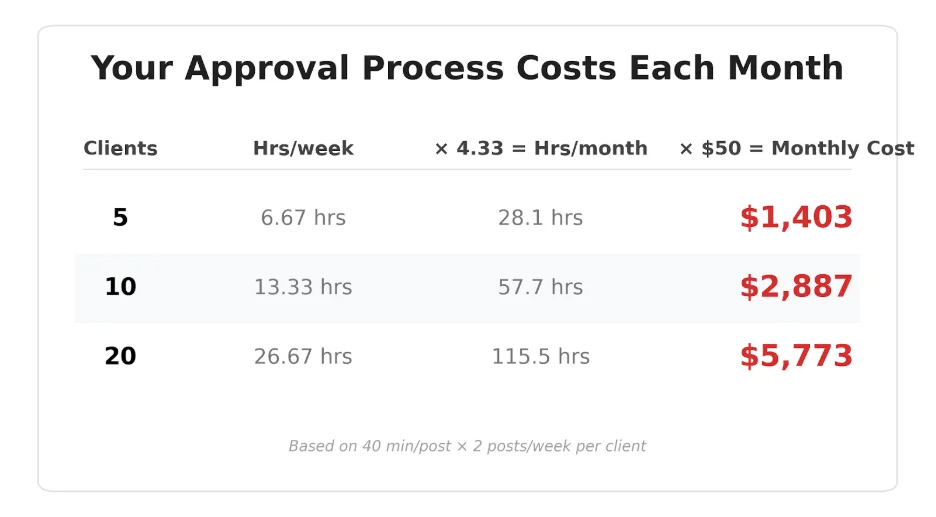
These numbers aren’t unusual – they show a bigger trend. Asana’s research, which surveyed over 10,000 workers, found that the average knowledge worker spends 60% of their day on “work about work,” like status updates, chasing information, and coordinating tasks, and only 27% on the skilled work they were hired to do.
For a 20-client agency, these costs add up to the same as having one full-time employee spend all day on approval admin work.
The Three Things Your Agency Ends Up Losing
The time cost is the easiest to calculate, but it’s not the only one.
According to an Asana study of 9,600 knowledge workers, “chasing approvals” is one of the main reasons teams work late. Unfortunately, most agencies facing this problem still haven’t found a fix.
Here are 3 things that your agencies are losing:
| Category | What it looks like | What it actually costs |
| Time | Chasing, reconciling, re-sending, confirming | 35–45 min per post × post volume = unbillable hours every month |
| Revenue | Posts miss trends, campaigns launch late, results suffer | Client dissatisfaction, at-risk retainers |
| Morale | Creative work blocked by admin loops; team frustration compounds | Creative ambition narrows before deadlines do |
That 8-day approval cycle for every piece of content doesn’t just waste time. It also prevents timely content from going live. Agencies end up missing important trends, which can lead to client dissatisfaction and even the loss of key retainers.
Morale costs also start to build up quietly. When creators know a post will take a week to get approved, they stop pitching anything risky or timely. Creative ambition shrinks before the deadline even arrives.
According to Gartner research, 84% of marketers report experiencing high levels of collaboration drag — the friction from approval loops, review cycles, and cross-functional bottlenecks — and those experiencing it are 15 times more likely to feel burned out. By the time you notice the team is feeling flat, the process has been causing problems for months.
These problems keep growing as your agency grows. Each new client adds another approval system, another follow-up chain, and another inbox to monitor. Revenue increases, but the admin work and morale issues grow even faster.
How Agencies Try Fixing This Problem (and Why It Doesn’t Work)
Most agencies experiencing this have already tried to fix it.
The first attempt is usually a shared document, like a Google Sheet or Notion page, where clients are supposed to leave feedback. We often see agency owners switch to Google Docs, Notion, or Trello, thinking it will fix the problem. [Source]

These methods might help with organization, but they don’t improve response time. The client still doesn’t respond, and you still have to follow up. The sheet just gives you a slightly neater way to track the silence.
The second attempt is usually a stricter email process: a standardized template, a subject line convention, and a reply-by deadline in the body. This works for about three weeks. Then one client ignores the deadline, you let it slide, and within a month the process has reverted. You can’t enforce an email deadline without creating friction in the client relationship.
Both of these approaches treat the symptom, which is disorganized feedback. But neither addresses the root cause: visibility. The agency doesn’t know where anything is, and the client doesn’t know what’s waiting for their response. When no one can see the state of the queue, follow-up is the only way to get approvals, and that’s what eats up the hours.
What Actually Works: Building a Process the Client Is Accountable To
Shared Google Sheets and stricter email templates don’t fix the approval problem because they don’t change who is responsible.
What actually works is removing the agency from the follow-up loop entirely by building a process where the system applies the pressure, not the account manager.
That requires five specific fixes:
| Fix | What it eliminates |
| Client gets a direct link to pending content | Email threads, login confusion, “where do I find it?” |
| 48-hour response window agreed at onboarding | Ambiguity about when feedback is due |
| Automated reminder sent before the deadline | Manual follow-up from the agency |
| One portal for feedback, edits, and sign-off | WhatsApp notes, Slack comments, fragmented email threads |
| Auto-approve if no response by scheduled time | Last-minute scrambles when a client goes quiet |
Set a two-round revision limit in the contract and make sure the social media management tool that you use enforces it, so you don’t have to. When auto-publish is a default tool feature the response window automatically closes, clients stop going quiet because the stakes are clear. The client becomes accountable for the process, not just for responding to your follow-up messages.
The result isn’t just a faster version of what you’re already doing. It’s a completely different dynamic: approvals move because the systems and workflow move them.
How a Tool Builds These Fixes into the System
Most scheduling tools were built to answer one question: when does this post go live? Approval was added later as a checkbox, not a workflow. That’s why agencies end up layering WhatsApp groups, shared spreadsheets, and email chains on top of their scheduling tool. The tool was never designed to manage the approval process.
SocialPilot was built specifically for agencies, where multiple clients, approval chains, and deadlines run at the same time. Each of the five fixes above maps directly to a feature in the platform:
| Fix needed | SocialPilot feature | What it does |
| Direct link to pending content | Approvals On-The-Go | Sends each client a personalized magic link to their pending posts — no account or login required |
| 48-hour response window | Client Approval Workflow | Sets defined approval windows per client so deadlines are built into the process, not chased manually |
| Automated reminder before deadline | Pending Approval Reminders | Sends automatic email reminders to clients with outstanding approvals — agency writes nothing |
| One portal for feedback and sign-off | Content Approval Portal | Clients approve, comment, request edits, or reject — all in one place, visible to both sides |
| Auto-approve on schedule | Auto-Approve Toggle | Automatically approves posts one hour before scheduled publish time if the client hasn’t responded |
Agencies that have consolidated approvals into a single system usually reclaim at least 10 to 15 hours per client each month. With 10 clients, that’s up to 150 hours saved – hours that were spent on follow-ups instead of real work.
Stop Paying for a Problem Your Process Created
The approval overhead you see in your calendar every week isn’t just the cost of running an agency. It’s the cost of running an agency without a system built for it.
The math is simple: with 10 clients, a broken approval process costs nearly $2,800 a month in unbillable time. With 20 clients, it’s closer to $5,600. That money doesn’t disappear; it gets paid out in hours your team spends chasing instead of creating.
The fix isn’t a complete overhaul. It’s about replacing the parts of the process that depend on you – the follow-up, the reminder, the confirmation – with a system that handles them automatically. Fix the process once and get those hours back every month.





 Join 55,000+ social media managers


