

Most agencies find out their account manager had too many clients around the same time they find out they’ve lost one.
It doesn’t come out of nowhere.
The posts are still going out. The AM (Account Manager) says they’re managing. But two clients mentioned last month that content felt “off.” Response times have crept up. The AM who used to flag things before they became problems is now just executing.
None of that reads as overload. It reads as a team running normally.
But this isn’t a performance issue. It’s a capacity issue, and capacity issues have a specific cause: the hours don’t add up, and nobody checked.
Here’s what that looks like from inside the role.
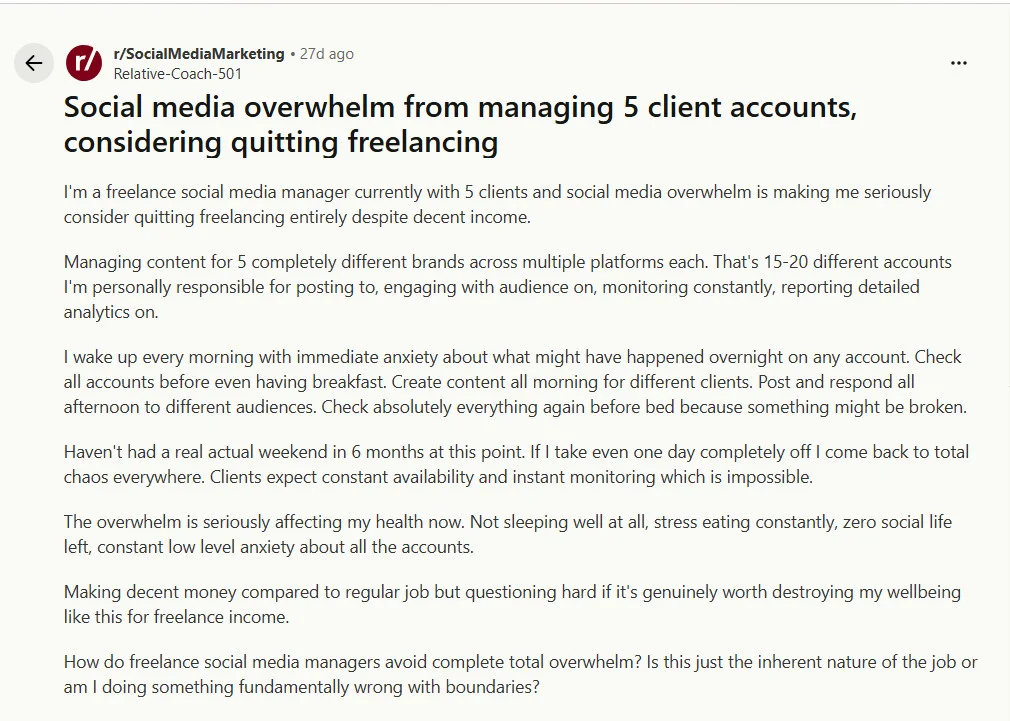
We see this pattern consistently across agencies of every size. The ones that lose clients over delivery quality almost never had an AM who couldn’t do the work; they had an AM running more accounts than the hours supported, for longer than anyone realized.
Here’s how you find that number before it costs you something.
The Number Experts Agree On
There’s a range that keeps coming up when agency consultants and operators compare notes: 4 to 8 clients per account manager. It doesn’t come from a single study. It’s the number practitioners land on after watching where things break.
Databox surveyed dozens of social media agencies and found nearly 70% keep their AMs under 10 clients, with most clustering between 5 and 8. (Databox)
Karl Sakas, who has advised hundreds of agencies, puts it at “6 to 8 easy-going clients, or just 2 to 3 needy ones.” (Sakas & Company)
From what we’ve seen across agencies, the ones that stay healthy: retaining clients, not scrambling, tend to sit at the lower end of that range, around 5 to 6. Not out of caution. Because they’ve actually run the hours.
That range is grounded. It’s also not specific enough to tell you anything useful about your agency, because it assumes a client profile most agencies don’t have, and it ignores the actual math.
Two things change that: knowing what you’re counting, and running the hours.
You’re Counting Clients. Count Accounts Instead.
That range assumes clients at a standard scope: roughly 2 to 3 platforms, one approver, one brand voice. What an AM actually manages is accounts, and those numbers diverge fast.
We’ve seen agencies onboard what looked like one client (A retail brand with three regional locations) and realise two weeks in that one logo actually meant ten active accounts.
Six clients sounds manageable. If each runs Fac ebook, Instagram, LinkedIn, and Twitter/X, that’s 24 accounts. Add one client with a primary brand and three regional franchise locations, and you’re at 28. One “client” can represent six to eight active accounts depending on the scope.
Hence, do this now: count the accounts, not the clients!
| Scenario | Clients | Avg. Platforms | Real Account Load |
| Standard scope | 8 | 2–3 | 16–24 accounts |
| Multi-platform clients | 6 | 4–5 | 24–30 accounts |
| Franchise / multi-location | 5 | 3 + 3 sub-accounts | 30+ accounts |
Most AMs who say they can take one more client are right about the headcount. They’re wrong about the hours.
The Per-Hour Math: What Each Client Actually Costs
A standard-scope client (2 platforms, 12 posts per month, one approver, no content creation required) takes roughly 12 to 18 hours of AM time per month. Here’s where those hours go:
| Task | Hours/Month |
| Content planning & calendar | 3–4h |
| Writing & scheduling | 4–5h |
| Client comms & reporting | 2–3h |
| Monitoring & engagement | 2–3h |
| Revision rounds | 1–3h |
| Total per client | 12–18h |
At 3 hours per week per client, a 35-hour work week looks like it supports 11 clients. But that calculation ignores the most expensive cost in AM work: context-switching.
Context-switching, the cognitive cost of moving between completely different brand voices, platforms, and approval chains, cuts productive capacity by up to 40%, according to research on task-switching. (American Psychological Association) For an AM holding 10 different client contexts simultaneously, that’s not overhead. It’s most of the job.
Apply it:
| Weekly Hours | After 40% Context-Switch Cost | Sustainable Client Load |
| 35h available | ~21h effective | 6–7 standard-scope clients |
| 35h available | ~21h effective | 4–5 if one client is complex |
The math puts the real ceiling at 6 to 7 clients at standard scope. One high-maintenance client (daily revision requests, three-stakeholder approval loops, constant urgent messages) consumes 25 to 30 hours per month alone. That client doesn’t take one slot. It takes two or three.
Most agencies find out this number after the AM breaks, not before.
Where the Hours Go Faster Than the Model Predicts
The per-hour math assumes a reasonably efficient AM. In practice, one thing makes the math worse faster than anything else: approval.
At 1 client posting 3 times a week, an AM is managing 3 to 6 active approval threads at any time. At 15 clients doing the same, that becomes 45 to 90 simultaneous threads, spread across email, Slack, WhatsApp, and DMs. It’s the core of why agencies stall at 15 clients: a single 100-word post can take up to 8 days to get final approval, not because the post is bad, but because no one owns the process.
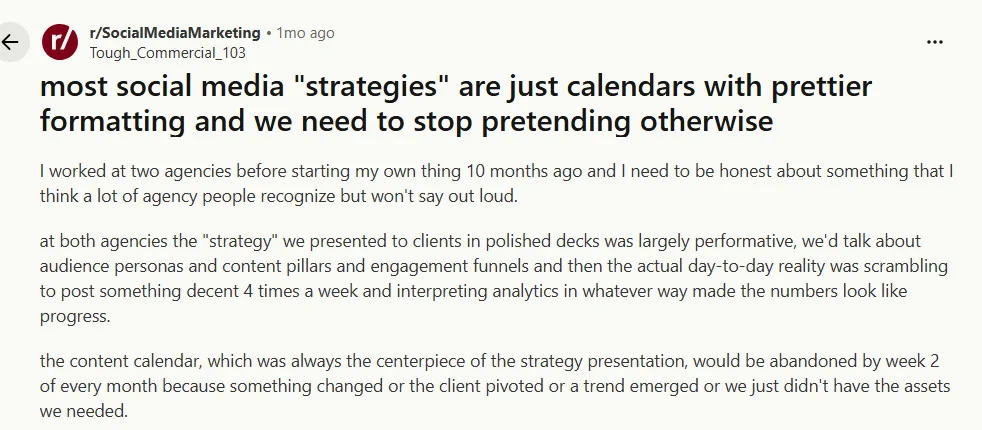
This is where the math breaks down faster than the model shows. The calculation assumes an AM spending their hours on client work. When a significant portion of those hours is spent chasing approvals across fragmented channels, the ceiling drops before the headcount limit is ever reached.
63% of social media managers report job-related burnout. That number doesn’t come from too much creative work. It comes from too much coordination with no system behind it. (Sprout Social, 2023)
7 Signals Your AM Is Past the Limit
These aren’t self-reported complaints. They’re operational signals visible from the outside.
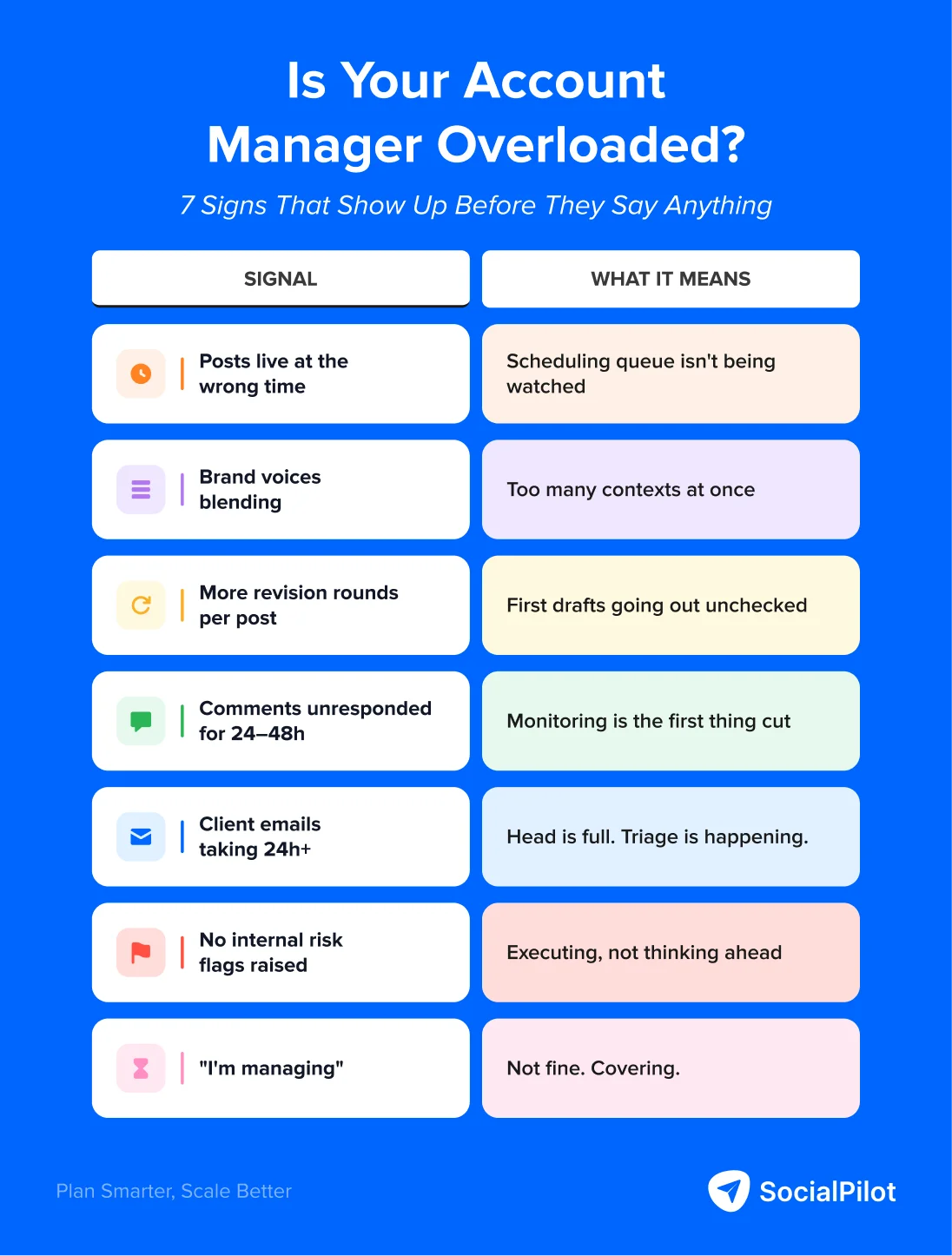
Three or more of these consistently means your AM isn’t approaching capacity. They’re past it. We’ve mapped these signals across agencies of different sizes and structures. The pattern is consistent: the agencies that catch it early are watching the signals, not the headcount.
The Fix Is Structural, Not Motivational
Tighter SOPs won’t fix this. A new scheduling tool won’t fix it. The math is the math, and the ceiling is lower than your roster.
Two things actually move it.
The Hiring Decision
If your AM is past 8 standard-scope clients, showing three or more signals above, and already on a clean tool stack, the problem is headcount, not process. The clear triggers:
- AM exceeds 8 standard-scope clients (or 6 at complex scope) and revenue supports a hire
- Pipeline has 3 or more active prospects within 60 days
- A client churned in the last quarter for a reason that traces back to attention or quality
- Your AM has said even once that they don’t have time to do something properly
That last signal is the most reliable. AMs are the last people to ask for help. By the time they say it directly, it’s been true for weeks.
The Coordination Structure
For agencies not yet ready to hire, the fastest capacity recovery comes from collapsing the approval layer. Most AMs above 8 clients are running two jobs simultaneously: the actual client work, and a parallel coordination system of approval emails, Slack threads, and DMs that was never built for agency scale.
What works is a platform where each client has their own contained workspace. Approvals happen inside the platform, not across a separate email chain. The AM has a single view across every account without switching between apps.
Most scheduling tools were built for a single brand. When you run 8 clients through them, the AM becomes the connective layer between things that don’t connect. That’s where the hours go.
This is one of the problems SocialPilot was built to solve for agencies. Each client gets a contained workspace. Approvals happen inside the platform. The AM gets a single view across every account: no switching, no chasing threads across five channels. Tools like Agorapulse and Planable also offer multi-account approval workflows. Where they differ is in how client-facing approvals are structured and how reporting surfaces per client. For agencies managing 8 to 15 clients, that’s exactly where the ceiling starts to move.
The Math Doesn’t Lie
The hours aren’t gone. They’re buried in a broken process, and broken processes can be fixed.
The agencies that got this right didn’t start by hiring. They fixed the system first. Client delivery steadied. The AM who was running on empty had room to actually manage again, not just execute.
So, the question isn’t “Can we take one more client?”
It’s “What happens to the ones we already have if nothing changes?”
Sources
Benchmark & Expert Data
- Karl Sakas, Sakas & Company, “How Many Accounts Can One AM Handle at an Agency?”
- Databox, “Account Manager Burnout: How Many Clients Are Too Many?”
Context-Switching Research
Burnout Data
SocialPilot Sources
- SocialPilot, “Why Social Media Agencies Can’t Grow Past 15 Clients”
- SocialPilot, “Client Management Features for Agencies”
Forum References



 Join 55,000+ social media managers


