

Most clients do not walk into a new agency relationship excited. They walk in cautious, because they have been here before.
They have sat through the “social is a long game” conversation with the previous agency. They have been handed follower graphs when they asked about revenue. They have emailed in with concerns and waited three days for a reply that never quite answered the question.
Their skepticism is justified and begins as soon as the contract is signed, not after results fall short. This leads to more frequent ROI questions and expectations of guarantees, as highlighted in the Reddit thread below.
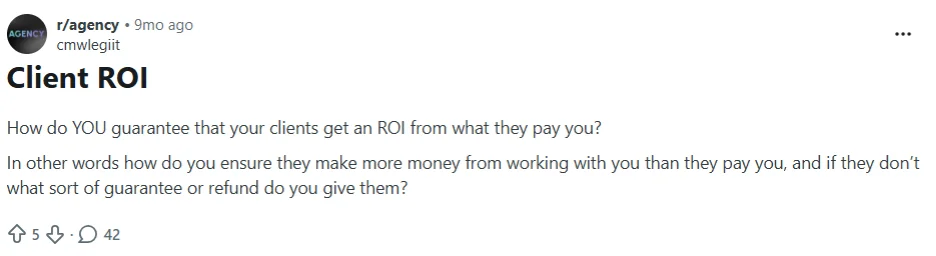
You may have experienced this from the agency side, confident in your work and strategies.
But sometimes, even the agencies doing excellent work are questioned about ROI, just like the agencies falling short. The results you have produced in the past do not protect you from this conversation. Every social media agency, at some point, has to sit across from a skeptical client and make the case for what the work is worth.
And the agencies that hold onto clients are not always the ones with the best numbers; they are the ones willing to have such conversations directly and consistently.
This article is about how to do that. Not how to calculate ROI more accurately, but what to say when a client questions whether any of this is working, how to frame data for different stakeholders, and how to make the ROI conversation a routine part of your job.
Why Clients Are Skeptical Before the Results Even Appear
Three factors contribute to low initial trust, even before your agency delivers results.
First, past experiences shape client expectations. Many have seen agencies make bold promises and then become unresponsive when results lag. This history influences how they interpret reports, communication gaps, and slow progress.
Second, the P&L issue: your retainer is a clear monthly expense, while the value generated is less visible. For finance stakeholders, this creates a real asymmetry between cost and return.
Third, attribution is challenging. Most businesses can track leads from source to close, but social media disrupts this process. If clients cannot link your efforts to CRM data, they often assume the channel is ineffective rather than questioning the measurement.
When meeting with clients, address their specific concerns before presenting data. Acknowledge overdue conversations directly, rather than starting with metrics, to build trust from the outset.
What Clients Actually Mean When They Ask for ROI
Clients considering cutting social media budgets often seek assurance that the agency is invested in their business, not just reporting metrics. Their concern is about trust, not data.
Before you restructure your reporting, understand which one you are actually dealing with.
| Conversation | Cadence | What the Client Needs to See |
| “What Is Actually Happening” | Monthly | What worked, what did not, what decision you made as a result, and what changes next month. Not a metrics dump, but an evidence of thinking. The report that says “engagement dropped 12% this month, here is why and what we changed on Tuesday” builds more confidence than the one that just shows the number. |
| “Are We Moving Toward the Goal” | Quarterly | Connect social activity to a business outcome: social traffic to email signups to pipeline. Show the directional progression against the measurement contract agreed at month one. A client who can see the trend, even a slow one, is a client who stays. |
| “Here Is What This Is Building” | Month 3 and Month 6 | Compounding indicators: content library size, audience quality, inbound DM volume, branded search trend. These are the leading indicators that precede the revenue numbers clients want to see. Month three is not when you evaluate ROI – it is when you evaluate whether the strategy is pointed correctly. |
These monthly conversations build trust in your process, quarterly discussions reinforce confidence in direction, and six-month reviews strengthen belief in the investment. Clients who cancel early often lack these touchpoints.
Before you walk into any client conversation, it helps to understand the reasons this problem exists. Not because your strategy is weak or your reporting is lazy, but because the measurement ecosystem is built against you.
Social media ROI measures the business value returned for every pound or dollar invested, including staff time, tools, and content production – not just ad spend. The formula is:
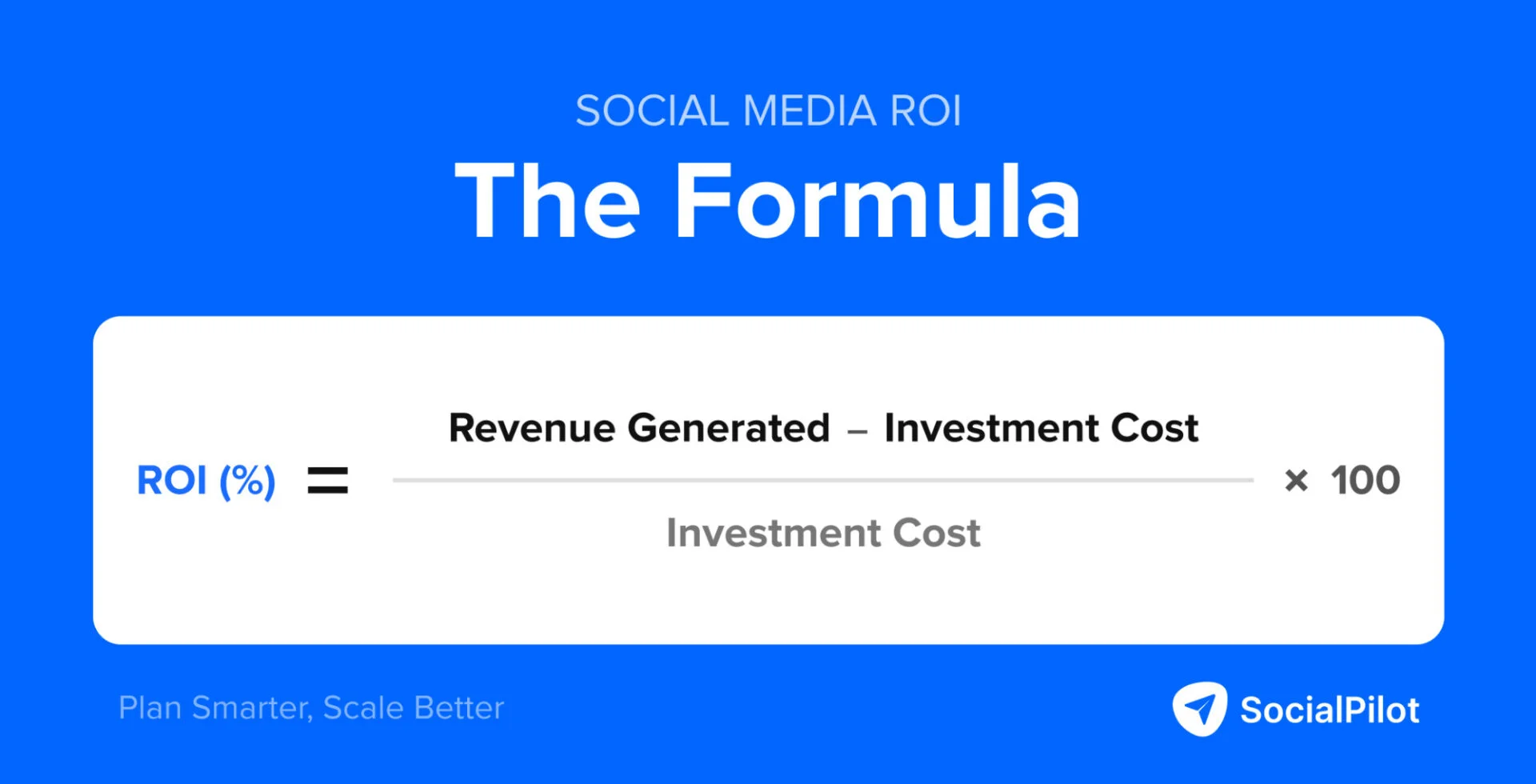
For example, spending $2,000 per month and generating $8,000 in traceable revenue yields a 300% ROI. The challenge lies in attributing sales to social media, not in the calculation itself.
According to the 2024 Nielsen Annual Marketing Report, social media delivers an average ROI 36% higher than the all-media average, based on a survey of nearly 2,000 global marketers. The industry benchmark is 4:1 – four dollars returned for every dollar invested. Anything below 2:1 is close to break-even after accounting for all costs.
A buyer may discover your client via Instagram, engage with content over two weeks, then convert through a branded Google search. In most analytics setups, Google receives the credit, while social media is overlooked.
Fospha’s Q1 2024 research found that last-click attribution significantly undervalues paid social channels. For example, a Fospha case study showed Meta delivering 20 times higher ROAS for an e-commerce brand than last-click attribution reported. Sellforte‘s Marketing Mix Modeling found a 17x difference for TikTok. Most agencies deliver more ROI than reports indicate; the issue lies with measurement tools, not performance.
Most online sharing occurs in private channels such as WhatsApp, Slack, DMs, and forwarded links. For example, a shared post in a group chat may lead to site visits and sales, but these actions are not captured in analytics.
GetSocial’s Dark Social whitepaper reports that 71% of content shares occur via copied links or private channels, making most content influence invisible to standard analytics.
Paid ads can demonstrate ROAS within two weeks. Organic social requires six to twelve months to show measurable business impact.
Clients who cancel at month three often miss the results they invested in. The ROI curve is lowest when cancellations occur and peaks at month twelve, which many clients never reach due to unmet expectations.
Script for setting this expectation at onboarding:
“I want to be upfront with you. There will be moments where the data does not give us a clean answer. No tool does attribution perfectly for organic social. Here is what we can track, here is what we are inferring, and here is how we will be honest with you about the difference.”
How to Build Your ROI Case Before the Work Starts
Agencies that avoid difficult client questions do so by establishing measurement infrastructure before launching content. Once clients question the link between follower growth and revenue, it is often too late to implement effective attribution.
Before starting work, ensure you have a written agreement defining success and a technical system to trace social activity to business outcomes. Most agencies lack both.
Begin with a written agreement. Before posting, secure sign-off on what success looks like at months three, six, and twelve, and which metrics align with business’s social media goals. This signed document ensures future ROI discussions are based on agreed definitions, not shifting targets.
Next, establish the attribution chain. As highlighted in the below Reddit thread from r/SocialMediaMarketing, even with UTM links and assisted conversions in GA4, attribution can still feel uncertain.
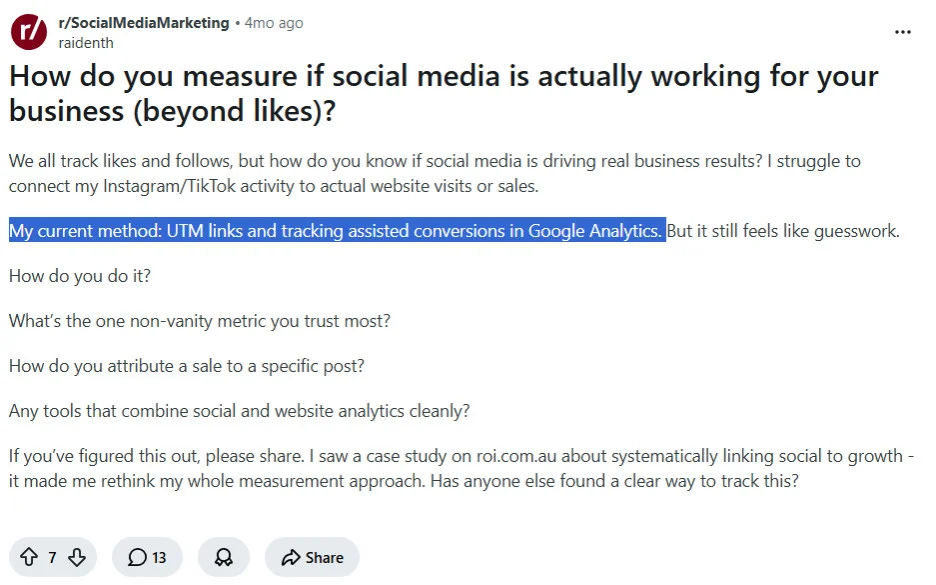
This is not a tool issue but a chain issue. While UTMs, GA4 channel grouping, and CRM source attribution are common, they are rarely fully integrated. When connected, you can trace a client’s journey from post to closed deal. Attribution remains imperfect, but transparency improves client conversations.
Implement both the agreement and attribution chain in the first week, not after questions arise in month four.
What Your Dashboard Will Not Show You
Even with proper attribution, some valuable content signals will not appear in reports. Two should be tracked explicitly.
First, zero-click influence: saves and shares indicate strong purchase intent without a click. A saved post suggests future decision-making. Returning viewer rate also signals interest. These are behavioral indicators that often precede conversions attributed elsewhere.
Second, LLM visibility: buyers using tools like ChatGPT or Perplexity form opinions before searching Google. Brands with strong content authority appear in these responses. Reporting on this positions your agency ahead of industry trends.
Neither metric replaces direct attribution, but both help explain discrepancies between dashboard data and actual business outcomes.
Watch this video to learn more on how you can track the real marketing ROI and now just attribution.
How to Shape Your ROI Argument Based on Your Audience
The same data resonates differently with various stakeholders. CFOs, founders, and marketing directors each prioritize different information, so framing is critical to effective communication.
| Role | What They Fear | What They Want to See | How to Frame It |
| CFO or Finance Lead | Budget waste with no measurable return | Revenue attributed to social, cost per acquisition, ROI formula with hard numbers | Open with numbers. “For every $1 spent on social, we can trace $X back through this attribution path.” |
| Founder or Owner | Wrong channel choice, losing competitive ground | Brand positioning proof, audience loyalty signals, competitor comparison | Connect to brand equity. “Your audience is choosing your content over competitor content at a rate of 3:1 in organic reach.” |
| Marketing Director | Looking bad to leadership, team’s value questioned | Integrated channel view, social’s contribution to the wider pipeline | Show the full funnel. “Social is initiating 23% of website sessions that later convert through other channels.” |
| Procurement or Operations | Unclear scope, no accountability | Specific deliverables, milestone tracking, documented measurement contract | Lead with process. “Here is the measurement contract we agreed at month one and here is where we stand against each milestone.” |
Identifying the source of skepticism determines which data to present, the language to use, and when to introduce metrics in the conversation.
How to Structure Your ROI Report So It Actually Lands
Most social media reports prioritize data over narrative, leading clients to scan for numbers to challenge rather than insights. The following structure addresses this issue.
Stop Reporting the Same Metrics to Every Client
ROI must be tailored to each business. Reporting follower count to a restaurant owner or engagement rate to a B2B SaaS company suggests a lack of understanding. Adjust the metrics accordingly.
| Industry | Stop Reporting | Start Reporting |
| Restaurant and Food and Beverage | Likes, reach, follower growth | Table booking clicks, “get directions” taps, event RSVPs, UGC volume |
| E-commerce | Follower count, impressions | Social-referred revenue, returning visitor rate, add-to-cart from social traffic |
| B2B or SaaS | Engagement rate, post reach | Inbound demo requests, LinkedIn profile-to-site clicks, content downloads, branded search lift |
| Local Service Business | Page likes, story views | Phone call clicks, form fills, “how did you hear about us” responses |
| Retail | Reach, impressions | Foot traffic attribution, product launch awareness lift, branded search volume |
The Five-Part Report Structure That Survives a Skeptical Client
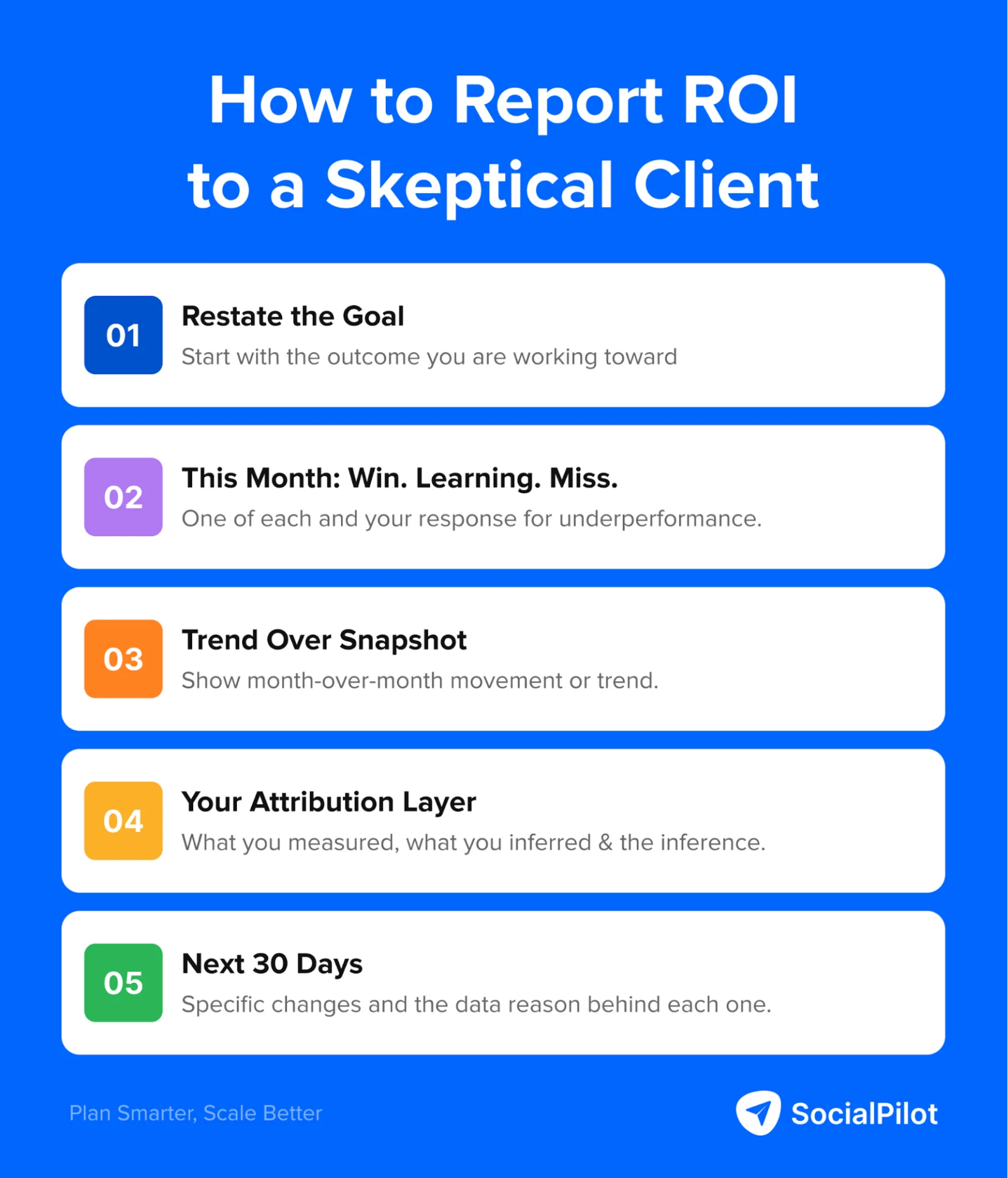
The following five-part reporting structure helps agencies clearly communicate ROI, even to skeptical clients.
1. Restate the Business Goal – Before Any Number
Every report should open with a single sentence that reminds both parties what the work is actually for. Not a metric. The goal. “This report is measured against our month-six target: 80 qualified inbound inquiries driven through social-referred traffic.”
This approach matters because skeptical clients often look for reasons to challenge reports. Starting with the agreed goal provides context for all subsequent metrics.
Your report should state the specific, measurable milestone agreed upon in the initial measurement contract.
2. Three Things That Happened This Month – Win, Learning, Miss
This section distinguishes agencies from vendors. Clients trust agencies that acknowledge underperformance and outline corrective actions, positioning you as a strategic partner rather than just a supplier.
Structure it exactly like this, every single month:
- Win: “Tuesday evening posts are driving 3x the click-through rate of any other time slot. We have shifted 60% of promotional content to that window.”
- Learning: “Video is outperforming static at a 4:1 ratio on this account. We are reducing static post frequency from eight to four per month and reallocating that production time to short-form video.”
- Miss: “The product launch campaign reached 22,000 people but drove only 14 clicks to the landing page. The bottleneck was mobile load speed – 4.2 seconds – not the creative. We flagged this to your web team on the 14th and are building a lighter-weight social-native version for the next campaign.”
Providing a specific diagnosis and response to underperformance demonstrates attentiveness and accountability. It also helps clients understand the overall impact of social media on their business.
3. Trend Before Snapshot
Any single month’s number can be questioned in isolation. A trend line cannot. “Reach was 40,000 this month,” invites the question, “Is that good?” A line showing growth from 22,000 to 28,000 to 35,000 to 40,000 answers the question before it is asked.
Lead with direction, then the number. “Website sessions from social: up 34% over three months – from 8,200 in January to 11,000 in March.”
Every core metric in your report should have a three-month comparison alongside it, because an isolated metric can be challenged, but when a metric is shown as part of a moving trend, it tells a story.
4. Your Attribution Layer
This is the section most agencies skip because it requires admitting that attribution is imperfect. But when you include it honestly, it helps inculcate the client’s trust in the numbers you claim.
Structure it as three clear statements in the report:
- What we measured directly: UTM-tracked clicks, GA4 social channel sessions, form fills tagged to social source, and CRM inquiries with social attribution.
- What we inferred: Branded search volume is up 18% month-over-month, consistent with the campaign period. Fourteen DM inquiries this month referenced specific posts by name. These are strong signals even though they are not directly trackable.
- What we cannot track: Private shares through WhatsApp and DMs, offline conversations triggered by social exposure. These exist, but they do not appear in any dashboard.
When clients see this breakdown, they shift from questioning data validity to discussing next steps, fostering a more productive dialogue.
5. Next 30 Days – Specific Changes, Specific Reasons
Conclude your report with a clear action plan. When clients understand upcoming changes and their rationale, they are less likely to consider cancellation.
Talk about three to five specific actions with the data rationale behind each one:
- “Increasing video frequency from three to five posts per week – video is driving four times more click-throughs than static on this account, and we are underserving the format.”
- “Shifting to a Tuesday and Thursday posting schedule – engagement on those days is running 2.8x higher than the rest of the week across the last 60 days of data.”
- “Running a branded search volume baseline this month to establish a pre-campaign benchmark before the April push.”
Ensure the Next 30 Days section clearly outlines decisions and their rationale. Specific next steps, supported by data, demonstrate active strategy management.
What to Strip from Every Report
- Screenshots of individual posts unless the performance is genuinely exceptional.
- Avoid using follower growth as a headline metric, as skeptical clients often dismiss it.
- Exclude figures lacking comparison points or trend lines, as they are more likely to be challenged.
- Industry benchmarks used to explain away underperformance.
Also, make sure to send social media reports to clients at least 24 hours before meetings. Presenting data for the first time during a call can lead to reactive responses.
SocialPilot’s white-label reporting can help agencies send social media reports on a scheduled cadence without any manual effort, so the conversation always starts informed rather than reactive.
The 5 Objections Every Agency Faces, and Exactly What to Say
Most articles on social media ROI focus on measurement, not on how to respond when clients question effectiveness.
Below are five common client objections and suggested responses to address their underlying concerns.
Objection 1: “I Can’t See Any ROI From This”
What the client is actually saying: The numbers you are reporting do not connect to anything I care about.
Response: “That is a fair challenge, and I want to address it directly rather than defend the numbers we have been sending. The metrics we have been leading with do not connect clearly to your revenue, and that is on us to fix. Here is what the engagement data does tell us about purchase intent – [show saves, DM volume, returning viewer rate]. And here is the chain we are building from social activity to your pipeline – [show UTM data, branded search trend]. Can we agree on one business metric to make the primary focus of next month’s report?”
Why it works: It acknowledges the issue without defensiveness, shifts focus to a client-owned metric, and secures agreement on future measurement.
Objection 2: “Our Competitor Is Getting Better Results”
What the client is actually saying: I am not sure you are good at this.
Response: “Let us look at their numbers together. A 1% engagement rate on 100,000 followers is 1,000 people. Our 5% rate on 8,000 followers is 400 engaged people – different scale, not necessarily different effectiveness. More importantly, do we know whether their engagement is translating to sales? High engagement from the wrong audience does not compound into revenue. Here is what our engaged audience looks like and what they are doing after they see your content – [show DM inquiries, click quality, returning visitors].”
Why it works: It shifts the comparison from vanity metrics to quality and concludes with evidence rather than debate.
Objection 3: “We’ve Been Doing This Three Months, and Nothing’s Changed”
What the client is actually saying: I am losing patience and starting to question whether this investment makes sense.
Response: “Month three is exactly when organic social looks most expensive and least valuable, and I should have told you that in month one. Here is the curve: month one is building, month two is testing, and month three is the first point where the data tells us what to double down on. What the data is telling us right now is [specific insight from your analytics]. Here is what the next 90 days look like based on that, and here is the specific signal we will look at together in month six to evaluate whether the strategy is working.”
Why it works: It normalizes concerns without making excuses and resets expectations with a clear future checkpoint.
Objection 4: “The Last Agency Said the Same Things”
What the client is actually saying: I have been burned before, and I do not fully trust you yet.
Response: “I hear that, and I am not going to ask you to take my word for it. Here is what is different – [show the measurement contract set at month one]. Every decision we have made is documented here alongside the rationale. If something is not working, I will tell you before you ask, not at the end of the month in a report. What specifically did not happen with the previous agency that you need to see from us?”
Why it works: It demonstrates differentiation with evidence and uncovers deeper concerns by ending with a targeted question.
Objection 5: “Can You Guarantee Results?”
What the client is actually saying: I need certainty before I keep spending.
Response: “No ethical agency can guarantee organic social results, and I would be concerned about any agency that does. What I can guarantee: consistent execution against the strategy we agreed on, transparent reporting that includes when things underperform, and a clear process for changing course when the data tells us to. The risk is not that social does not work. The risk is starting and stopping before it compounds. Brands that stay consistent for twelve months see results that brands that pause at month three never do.”
Why it works: It reframes the demand as a trust issue and clarifies that stopping prematurely is riskier than continuing.
How to Have the Pivot Conversation Without Losing the Client
A key agency management skill is discerning when underperformance requires patience versus when it signals a need for strategic change.
When to Defend the Strategy vs. When to Change Course
| Signal You Are Seeing | What It Actually Means | The Right Move |
| Results trending in the right direction, even slowly | Strategy is working, patience needed | Defend it. Document the trend and show month-over-month movement in the next report. |
| An external factor explains the dip: algorithm update, seasonality, a competitor’s viral moment | Timing issue, not a strategy issue | Name the external factor explicitly. Hold the course and explain why. |
| You are inside months one to four of the engagement | Building phase, not performance phase | Reframe the timeline. Reference the measurement contract. |
| Same content approach has run for 60 days with zero positive signal on any metric | Content-audience mismatch | Change the content angle, not the platform. |
| High reach, zero conversion signals after month five | Something structural is broken in the funnel | Audit the full customer journey before the next post goes live. |
| Client’s business goal has shifted but the social strategy has not | Strategy misalignment | Pivot immediately and reset the measurement contract in writing. |
What to Say When You Are the One Calling It
Many agencies wait for clients to initiate pivot discussions, which is a mistake. Proactively addressing the need for change demonstrates confidence.
“I want to share something with you before our next report. The data from the last 60 days is telling us that [specific observation]. I do not think the issue is effort or execution. I think we need to change [specific element]. Here is what I am proposing and why. I would rather tell you this now and give us 30 days to test the new direction than wait another 60 days on a strategy the data is already questioning.”
If the client pushes back: “I understand the hesitation. Changing direction can feel like admitting the first few months did not work. What I would say is that those months gave us data we did not have before. We now know what your audience responds to and what they do not. The pivot is not a reset. It is using what we learned.”
The Retainer Rescue Framework
Warning signs of potential cancellation typically appear two to four weeks in advance. Agencies that act before clients make a final decision are more likely to retain accounts.
Week 1: Diagnose before responding. Review the past three months of data to identify gaps between promised and delivered results. Approach the call with a diagnosis, not a defense.
Opening script for the call: “I have been looking at our last 90 days together, and I want to be direct with you. I can see where the results have not matched what we agreed, and I want to address that specifically before our next report. Can we schedule 30 minutes this week?”
Week 2: Reset the measurement contract. During the call, avoid detailed reviews of past performance. Agree on a single success metric for the next 30 days, document it, and confirm by email within 24 hours.
Week 3: Communicate weekly. Provide focused updates on actions taken, changes made, and next steps. Frequent communication is expected during a retainer rescue.
Week 4: Review progress. Present clear results on the agreed metric and a record of decisions made. If the metric improved, the conversation shifts positively; if not, use the data to discuss next steps or potential changes.
Agencies that retain accounts do so by demonstrating attention and accountability, not just by delivering results. This framework helps you show both.
Each framework in this article relies on one key principle: consistent, professional client communication before questions arise. Most agencies have sound strategies, but often struggle with maintaining regular reporting. Irregular updates, shifting formats, and periods of silence can lead clients to believe that no progress is being made.
SocialPilot’s white-label reporting addresses this issue by generating automated, scheduled reports branded with your agency’s identity. Clients receive timely data proactively, eliminating uncertainty caused by gaps in communication.
When clients ask, “is this working?”, SocialPilot’s social media analytics dashboard provides a unified view across all platforms. You can answer in real time without gathering data from multiple sources while the client waits.
For agencies managing multiple accounts, this efficiency is critical. Automated, branded reports replace hours of manual work with scheduled deliverables.
Every Agency Faces This ROI Conversation, But Only the Best Ones Prepare for It.
Agencies that retain skeptical clients are not always those delivering the best results. They succeed by establishing systems for ROI discussions, including measurement contracts, structured reports, objection handling scripts, and proactive retention strategies.
This approach does not require a larger team or increased budget. It requires a commitment to structured processes rather than improvisation.
Clients lost due to poor communication are often those achieving real results. The most costly outcome in agency management is not poor performance, but strong results that go unrecognized.
Establish your system now to ensure every ROI conversation is conducted on your terms.
SocialPilot’s agency plans are built around white-label reporting, multi-account management, and the analytics infrastructure that makes these conversations easier to have.


 Join 55,000+ social media managers


