
You pulled a client’s analytics on Monday morning and something was off. Reach was down, not a little, but a lot. The posting schedule hadn’t changed. The content strategy hadn’t changed. Nothing in the plan had moved.
And now your client is asking questions.
A 15,000-profile study by marketing researcher Eric Siu found that organic reach has dropped 62% across social platforms in just three years.
So, if your client’s numbers fell this month, nothing went wrong on your end. The accounts you manage have hit a wall that’s been rising since 2022.
This article won’t reassure you with vague platitudes. It gives you a platform-specific recovery plan for the first 30 days: what to do in the first 72 hours, then a week-by-week playbook for Instagram, Facebook, LinkedIn, and TikTok. There’s also a section on how to explain the drop to your client, because that conversation is often harder than fixing the numbers.
What “Organic Reach Dropped” Actually Means (and What’s Normal Now)
Organic reach is the number of people who see a post without paid promotion. It’s a percentage of total followers who actually see what you publish on a client’s behalf.
Here’s what normal looks like across platforms right now:
| Platform | Avg. organic reach (2025–2026) | Trend |
| Facebook (Pages) | ~5.9% of followers | Down from 16% in 2012 |
| ~7.6% of followers | Down ~40% vs. 2023 | |
| LinkedIn (company pages) | ~1.6% of followers | Down from ~7% in 2021 |
| TikTok | ~10% of followers | Down 17% YoY in 2025 |
| X/Twitter | ~3–5% of followers | Link suppression major factor |
Sources: Social Insider Industry Benchmarks 2026 (Facebook, Instagram); Richard van der Blom’s Algorithm InSights 2025 (LinkedIn), Metricool Social Media Study 2026
These numbers aren’t a glitch. They represent a structural shift in how platforms distribute content, and they’ve been falling for years, not weeks.
One important note if you manage Instagram: in April 2025, Instagram removed “organic impressions” as a metric and replaced it with “post views” and “profile views.”
This is also a crucial reason why your year-over-year comparisons look strange. The measurement framework changed, not just the performance.
If your client’s reach is at or near these benchmarks, the drop may not be an anomaly. It may be the new floor.
What Actually Changed: The Platform Shifts Behind Your Reach Drop
Three things happened, and they all happened at the same time. Understanding how the social media algorithm decides what gets seen helps frame why these shifts matter.
1. Platforms prioritize paid content over organic. Every major social network is now primarily an advertising business. Organic posts compete for the same feed slots as paid ads, and ads pay to be there.
2. More content, same number of feed slots. The volume of content uploaded to social media grew significantly between 2022 and 2026. More creators, more brands, more posts: the same audience divides its attention further.
3. Engagement signals replaced follower count. Algorithms now measure quality through saves, shares to DMs, watch time, and comments. A post seen by 5,000 people who scroll past signals low value. A post seen by 500 who save it signals high value.
Two specific updates accelerated the drop: LinkedIn’s November 2024 algorithm change added an external link penalty in post bodies, reducing reach for posts that link out from the body text. This guide on social media updates 2026 talks about the latest algorithm changes and their impact on a business’s social media strategy.
What to Do in the First 72 Hours When Your Client’s Reach Drops
Before you start a full-fledged 30-day recovery plan, spend the first 72 hours diagnosing which platform is actually the problem.
Step 1: Confirm the drop is real, not a metric change. Instagram changed its measurement in April 2025 (impressions to post views). LinkedIn’s analytics panel shifted its default date ranges. Before escalating to your client, verify you’re comparing the same metric, the same way, across the same period.
Step 2: Identify which platforms dropped and by how much. Pull reach data for the last 30 days on every platform you manage for that client and compare it to the previous 30 days. Note the size of the drop as a percentage, not just a directional trend.
Step 3: Check for the easiest quick win. Are external links going into captions or post bodies? Social Media Examiner’s analysis of Facebook content in 2025 confirms that link posts consistently underperform native content. LinkedIn’s November 2024 update formalized the same penalty. Moving links to the first comment is the single fastest fix available across Instagram, Facebook, and LinkedIn.
When multiple client platforms drop at once, the instinct is to fix everything simultaneously. That spreads effort thin and produces no clean signal on what’s working. Pick one platform and run a 30-day plan on it first.
Here’s how to decide:
| Situation | Start here | Why |
| Instagram is the primary client channel | Instagram first | Reels still offer non-follower discovery at scale; format resets are fast to test and measure |
| B2B or professional services client | LinkedIn first | Personal profile strategy produces immediate measurable lift; fastest gap to diagnose |
| Community-based brand with Facebook Group | Facebook first | Groups reach 20–40% of members vs. 1–6% for Pages; exploitable immediately |
| Brand targeting under-35 audience | TikTok first | Still higher base reach (~10%) than Meta; watch time fixes are fast to implement |
| All platforms dropped equally | Instagram first | Largest number of tactics available; format changes can be tested within days |
The reasoning behind this framework: start with the platform where the gap between the client’s current reach and the benchmark is widest, and where the first tactic to test is something you can change this week. A LinkedIn personal profile activation takes two weeks to set up correctly. A Reels format reset can start tomorrow.
Once you’ve done the triage, move to the platform-specific plan.
Instagram: Your 30-Day Recovery Plan
Instagram’s algorithm in 2026 rewards content that gets saved, shared to DMs, and watched to completion. Likes and comments still matter, but they’ve been demoted behind those three signals. Distribution follows watch time and shares, not how many followers you have. Here’s how the Instagram algorithm works if you want the full picture.
Week 1: Diagnose the Format Gap
- Open the client’s Instagram Insights and sort the last 30 posts by reach. Look for the pattern – which format held (Reels, carousels, single images)? Which collapsed?
- Check the captions. Are external links going into the post body? Move every URL to the first comment immediately.
- Check the Reels posting frequency. If the account hasn’t posted a Reel in the past 14 days, that’s a significant factor. The Instagram Reels algorithm still gives Reels preferential distribution over static content.
Week 2: Reset the Format Mix
- The hook is the only thing that matters in the first three seconds. A weak hook kills distribution before the algorithm has a chance to test the content.
Weak Reel hook:
- Opens with “Here are 5 tips for better Instagram reach…”
- Starts with a logo or brand intro
- Tells the viewer what’s coming upfront
Strong Reel hook:
- Opens with “Your client’s reach dropped 40%, and they think it’s your fault.”
- Starts mid-sentence, mid-action, or with a direct provocation
- Forces the viewer to stay to find out what happens.
- The same logic applies to carousels. Slide 1 is the hook – it needs to stop the scroll, not introduce the topic. “How to improve your reach” loses to “Your reach is down. Here’s why posting more makes it worse.”
- Test a carousel with audio. Instagram carousel posts combine swipe-depth signals with audio discoverability, which gives them a reach advantage over static images.
- Avoid posting any external links in captions this week. Zero exceptions.
Week 3–4: Build the Micro-engagement Loop
- Check Insights under Audience → Most Active Times and schedule posts within that peak 30-minute window. You can also use the best time to post on Instagram data as a cross-reference.
- Reply to every comment within the first 30 minutes of posting. Early engagement signals the algorithm to expand distribution beyond the existing follower base.
- Before posting, identify two or three of the most consistently engaged followers and give them a heads-up that something is going up. Their early saves push the algorithm faster than cold distribution.
What This Looks Like in Practice: Duolingo
When Duolingo’s Instagram engagement began declining against an increasingly crowded feed in 2023–2024, the team went further into Reels rather than retreating to static posts. They built a consistent format around the Duo mascot: lo-fi, short-form, and character-driven rather than product-driven. Every post was designed to generate shares and saves, not just views.
The compounding effect showed up clearly in February 2025 when the brand staged its “Duo is Dead” campaign. A single Reel drove 100,000 new followers in one day. The campaign generated 1.7 billion total impressions across platforms and 2.1 million likes on the announcement post alone, according to Meltwater’s campaign analysis.
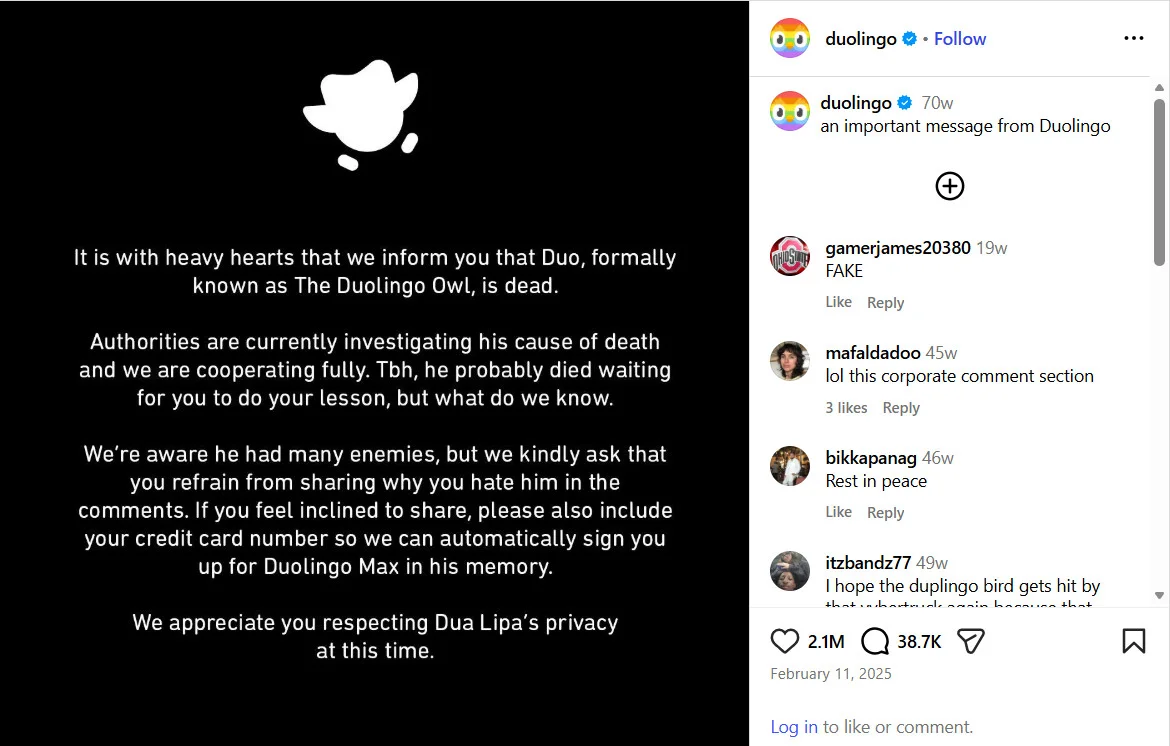
The underlying mechanic wasn’t the stunt itself. It was the consistent Reels-first format, built around a character that reliably generated saves and DM shares, which made the distribution spike possible when the moment came. The format did the work before the campaign even started.
Expected recovery timeline: Initial reach improvement visible by Day 7–10 with format and timing changes. Meaningful recovery toward pre-drop baseline takes 21–30 days of consistent execution.
Facebook: Your 30-Day Recovery Plan
Facebook organic reach for Pages is structurally constrained. But the goal here is not to restore 2019 levels; it’s to get the most out of what the platform still offers.
To understand the Facebook algorithm in 2026, the key point is that it now heavily favors content from personal connections and Groups over brand Pages.
Week 1: Diagnose Post Type Performance
- Open Meta Business Suite and sort recent posts by reach. In most accounts, native video significantly outperforms static images and link posts. That gap tells you what to prioritize.
- Identify all posts with links in the body. Facebook suppresses external link posts in the feed. Move links to comments or remove them from your next two weeks of posts entirely.
- If you manage a Group alongside the Page, compare Group post reach to Page post reach. The difference is usually dramatic and tells you where distribution still lives.
Week 2: Shift Reach to Groups
- Facebook Groups consistently outperform Pages in organic reach, often by a significant margin. If you haven’t set up a Group for the brand, this is the highest-return move available on Facebook right now.
- If creating a Group isn’t realistic this month, engage in existing Groups in your client’s niche. Post as yourself, not as the brand Page. Genuine participation in conversations builds reach without requiring any new infrastructure.
Weeks 3–4: Native Video and Saves
- Upload video directly to Facebook – do not share YouTube links or cross-posted content. Native video is consistently the top-performing format.
- Facebook elevated “saves” as a quality signal in 2025–2026. Post reference-quality content: checklists, how-to guides, comparison breakdowns. Content people want to come back to.
- Post 3–5 times per week, not daily. Higher frequency without stronger content suppresses overall reach.
What This Looks Like in Practice: Tasty
BuzzFeed’s Tasty was built entirely on the insight that native Facebook video would outperform everything else. Every video was shot in a consistent format (overhead angle, 60–90 seconds), uploaded directly to Facebook (never cross-posted from YouTube), and posted with no external links in the body. The format discipline was the strategy.
As of 2019, Tasty owned five of the top 10 highest-viewed sponsored videos in the Food & Drink space on Facebook, according to Tubular Labs. The top video – a one-pot fajita recipe sponsored by Kroger – hit 5.8 million views in three days.
The content itself wasn’t complex. Native upload, no external links, consistent visual style, posted at peak times – the same decisions your recovery plan calls for, executed from the beginning.
Track the right Facebook metrics during recovery by reviewing your reach, saves, and video completion rates and not just likes and shares.
Honest note for clients: Organic reach on Facebook Pages has a structural ceiling. Recovery here means optimizing within a compressed range, not returning to 2020 performance.
LinkedIn: Your 30-Day Recovery Plan
LinkedIn company pages now reach approximately 1.6% of their followers organically, down from around 7% in 2021. Personal profiles consistently reach five times more people per post than equivalent company page content. That gap is the primary lever available for LinkedIn recovery.
Understanding how LinkedIn’s algorithm works in 2026 matters here: LinkedIn is built to surface individual professional voices, not brand broadcasts. Working with that design is faster than fighting it.
Week 1: Diagnose the Content Mix
- Pull the client’s LinkedIn Page analytics for the last 60 days. Look at reach by post type: text posts, document posts (carousels), link posts. Link posts almost always show the lowest reach.
- Look at what percentage of posts are promotional (announcements, product features) versus educational or opinion-based. LinkedIn’s 360Brew AI, deployed in 2025, actively suppresses promotional content and generic AI-written posts.
- If the client’s team has been using AI to draft LinkedIn content, this may be a significant factor in the drop. LinkedIn can now detect generic AI output and reduces its distribution. Edit AI drafts heavily: restructure, add specific examples, and remove the opening sentences AI tools typically produce.
Week 2: Activate Personal Profiles
- Identify one or two people at the client company – founders, executives, senior practitioners – who are willing to post from their personal profiles.
- Have them post the same core ideas the company page publishes, but in a personal voice: their perspective, their experience, their take on an industry development. Not announcements.
- Personal profiles should mention or tag the company’s page for attribution, but the post should read as a human observation, not a brand message.
Weeks 3–4: Content Type and Cadence Reset
- Prioritize these formats: text-only posts with genuine opinions, document posts (carousels work well on LinkedIn), and polls with a real question.
- Avoid these formats: promotional posts, posts with links in the body, posts that read like press releases.
- Reply to every comment within 60 minutes of posting. LinkedIn’s algorithm uses early engagement as its primary distribution signal. A post with five comments in the first hour distributes further than one with 50 comments three days later.
- Target 3–5 posts per week from personal profiles, not daily posts from the company page.
What This Looks Like in Practice: HubSpot
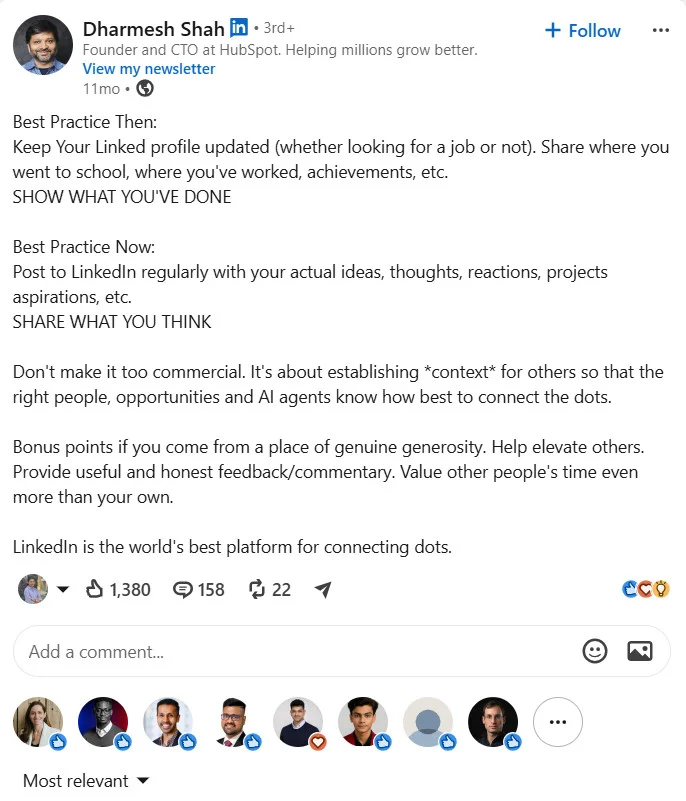
HubSpot co-founder Dharmesh Shah’s LinkedIn activity makes the personal-vs-company-page gap visible. His personal profile (1M+ followers) regularly generates more engagement per post than HubSpot’s verified company page – not because his content is radically different, but because LinkedIn treats individual voices differently than brand broadcasts.
Here is a post from Dharmesh Shah’s LinkedIn profile that has 158 comments and has been reposted 22 times.
An analysis by DSMN8, an employee advocacy platform that analyzed 11,107 LinkedIn posts, found that a CEO with 5,000 followers generated the same average reactions per post (321) as a company page with 300,000 followers (306). DSMN8 subsequently shifted its own LinkedIn content budget to the CEO’s personal profile based on that finding. The channel mattered more than the audience size.
If your client has a reluctant founder who “doesn’t have time for LinkedIn,” show them this data. The distribution case makes the argument more effective than any creative brief.
TikTok: Your 30-Day Recovery Plan
TikTok’s organic reach still outperforms Meta platforms, but the average TikTok reach per post fell 17% year-over-year in 2025. The drop is real, but TikTok’s algorithm rewards different signals than Instagram or Facebook, and those signals are highly actionable.
For a full breakdown, the guide on how to get more views on TikTok can help you understand all the mechanics in detail. Here’s the 30-day recovery version.
Week 1: Diagnose Watch Time and Completion Rate
- Pull the client’s TikTok analytics and check the average watch time and completion rate for the last 20 videos. TikTok’s primary distribution signal is watch time, not likes or follower count.
- If the completion rate is below 40%, TikTok stops expanding distribution beyond the existing audience. That’s the threshold to fix first.
- If TikTok Shop was activated on the account, check whether regular content reach dropped after that activation. Some accounts see a split between organic and commercial reach after enabling Shop features. Isolate that variable in the data before assuming the algorithm penalized the content.
Week 2: Rewrite the Hooks
- The first three seconds of every TikTok video determine whether the algorithm shows it to a wider audience. Write the hook for the next five videos before filming, not after.
- A video watched to completion by 10,000 people outperforms one seen briefly by 100,000 people. Prioritize completion over raw views.
- The sweet spot for completion rate is typically 15–60 seconds. Longer content works if retention holds; shorter content works if the hook is strong.
Weeks 3–4: Authenticity and Consistency
- TikTok deprioritizes content it identifies as over-produced or AI-generated in favor of authentic, human-created videos. Authenticity helps reach; polish alone doesn’t.
- Do not cross-post content directly from Instagram Reels. TikTok detects cross-posted content, including the Instagram watermark, and reduces its distribution.
- Post 4–5 times per week. TikTok rewards posting consistency more than most platforms. Accounts that go quiet for a week typically see reach reset to near-zero.
What This Looks Like in Practice: Ryanair
Ryanair’s TikTok account is the most documented example of a brand choosing authenticity over production value and watching reach follow. When the airline launched in May 2020, CEO Michael O’Leary gave the team a clear brief: “We hired a group of kids under the age of 25 and sent them forth and said, write whatever you want.” The content that followed – greenscreen skits, self-deprecating memes, clips shot on phones – rejected every production standard a conventional social media manager would recognize.
The outcome, documented in a Skift interview with O’Leary: Ryanair grew to 2.1 million followers and 33.6 million likes. In August 2022, the airline posted 16 videos that generated 30 million views. Here is one such video from Ryanair’s page that generated 2.4 million likes and 74.9K shares.
Competitor EasyJet posted 52 videos that same month and generated 13 million.
The lesson isn’t to be edgy. It’s that TikTok’s algorithm distributes authentic content measurably further than polished content, and the gap between those two approaches is larger than most brand teams expect. When managing a client’s TikTok, lean into their most human, unpolished content. That’s what the platform distributes.
Three Moves That Help on Every Platform
These three tactics apply regardless of which client platform you’re recovering. They work because they address universal algorithm logic, not platform-specific quirks.
1. Build the engagement window into your publishing process.
Every major platform uses the first 20–30 minutes after a post goes live as its primary quality signal. Strong early engagement = wider distribution. Silence = suppressed reach.
Most agencies publish and move on. That’s the gap. Build a simple pre-publish checklist:
- Notify the client or a team member before a post goes live,
- Have someone ready to reply to the first comments, and
- Schedule posts during audience-active hours rather than when it’s convenient for your workflow.
If you’re managing multiple client accounts, a scheduling tool like SocialPilot can pull best-time-to-post data per account and queue posts accordingly, so the timing decision is built into the workflow rather than made manually each time.
2. Move links out of post bodies – on every platform, every time.
Instagram, Facebook, LinkedIn, and TikTok all suppress posts with external links in the body. This isn’t a theory; it’s a documented penalty on each platform, and it’s one of the most common mistakes on managed accounts where links are added out of habit or client request.
The fix takes 30 seconds: put the URL in the first comment immediately after publishing. The audience still gets the link. The algorithm doesn’t penalize the post. Make this a non-negotiable part of your posting SOP, not a case-by-case decision.
3. Consolidate your posting schedule before expanding it.
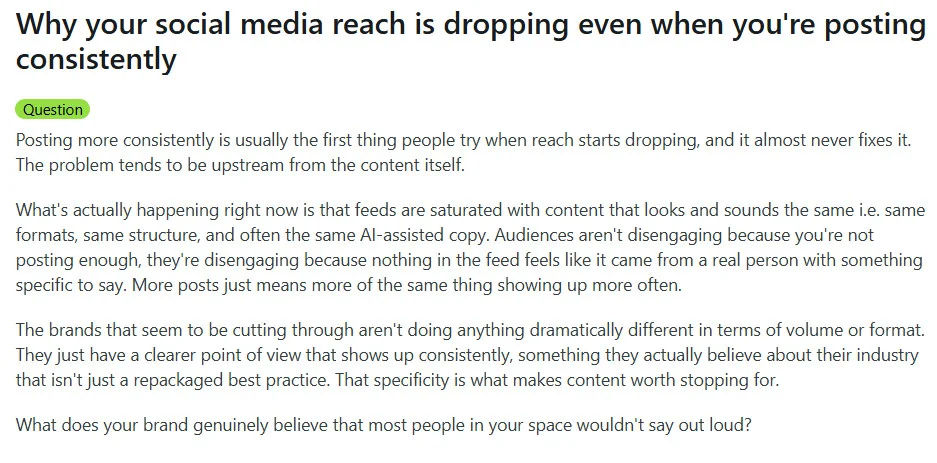
When reach drops, the instinct is to post more. That’s the wrong direction. Algorithms treat low-engagement posts as a negative signal – more posts with weak engagement actively suppresses future distribution. As mentioned in this thread from r/AskMarketing, agencies must focus more on specificity and consistency, because simply posting more content will not help.
Instead of spreading output across every slot, cut posting frequency back to whatever cadence produced the best per-post engagement in the last 90 days. SocialPilot’s analytics dashboard lets you pull per-post engagement data across all client accounts in one place, which makes it easier to identify which cadence and content type is actually performing before you cut or scale.
This is the conversation most agency teams dread more than the actual reach drop. Your client sees the numbers. They know something changed. And they’re looking at you for answers.
Here’s a three-part script that helps you explain the social media drop to your clients:
What to say first:
Pull up their last 30 days versus the previous 30 days. Show them exactly which platform dropped, by how much, and when it started. A client who can see their own numbers going from 8% reach to 4.2% reach on a specific date is having a different conversation than one being told “reach has been declining industry-wide since 2022.”
Specificity does two things: it shows you’ve diagnosed the problem, and it gives the client something concrete to respond to instead of a general explanation they can’t verify.
Then show them what you’ve already changed:
Don’t walk in with a plan. Walk in with actions already taken. “We identified that your Facebook posts were including links in the body – that’s a documented penalty. We’ve already moved those to comments starting this week. We’ve also shifted your Instagram posting to Reels, which we weren’t doing consistently. These are live changes, not proposals.”
Clients lose confidence when their agency explains what happened. They recover confidence when their agency shows what’s already been done about it.
Then set one measurable checkpoint:
“By [specific date], you should see engagement rate stabilize and individual post reach start climbing. That’s the first signal the recovery is working. Full recovery to your previous baseline takes 45–60 days from today – I’ll send you a report at the two-week mark so you can see the trend before that.”
Give them a timeline with checkpoints. It converts anxiety into a plan they can track.
If you need to make this conversation formal, a white-label analytics report from SocialPilot gives you platform-level breakdowns and trend lines to share with clients – cleaner than a screenshot, faster than building a deck from scratch.
Your 30-Day Recovery Clock Starts Now!
The drop in organic reach is real, and it isn’t temporary. But recovery is possible.
The agencies maintaining client reach in 2026 didn’t find a secret. They adapted: different formats, cleaner post structure, better use of the early engagement window, and a realistic understanding of what each platform will and won’t do organically.
Pick the client account where you’re furthest from the benchmark, start with the first 72-hour triage steps, and run the 30-day plan from there.
Monitor your client’s performance closely during the recovery period and provide them with branded, platform-by-platform performance reports.
If you’re running recovery across multiple client accounts, the reporting overhead adds up fast. SocialPilot’s agency plans bundle scheduling, analytics, and reporting features, to help you manage multiple accounts at a time.




 Join 55,000+ social media managers


