

What works at 5 clients breaks at 20. What breaks at 20 collapses at 50.
Not because your team gets worse. Because the process you built at 5 clients was never a process. It was a habit, and habits don’t scale.
We’ve seen it halt agencies: a post going live that nobody approved, a campaign that missed its window because one approver was unreachable for 48 hours, a client questioning a version they never signed off on.
Here’s what breaks at each stage, and what you actually need to change.
How the Same Process Fails at Three Different Volumes
| 5 Clients | 20 Clients | 50 Clients | |
| Active approval threads | 15–30 | 60–120 | 150–300 |
| Tracking method | Memory + email | Email (now failing) | No central system |
| Process overhead per week | 2–4 hours | 10–20 hours | 30–50 hours |
| Risk of the wrong version going live | Low | Occasional | Regular |
| Consequence of one approver going quiet | One post delayed | One client stalled | Systemic backlog |
The process doesn’t erode gradually. It holds, then it breaks.
At 5 clients, the informal setup works because the volume is low and the memory is reliable. At 20, those informal arrangements have compounded into 20 separate micro-processes, none documented, all held in whoever manages that account. At 50, no one person can hold all of it.
The break isn’t caused by bad behavior. It’s caused by a process that was never designed for volume.
Three Things That Break at Scale
These three failures happen in sequence. Each one that breaks makes the next worse.
1. The Channel
Email requires no setup, which is why every agency defaults to it. By 20 clients, one AM is tracking 60 to 120 active approval threads across email, Slack, WhatsApp, and DMs, with no record of which version each client actually saw.
48% of creative professionals spend at least five hours per month chasing feedback, and that’s in organized teams. (Ziflow, 2023) The hours are higher when approvals are fragmented.
2. The Approver Model
Every agency ends up with one approver per client without deciding to. At 5 clients, a delayed approver means one post is held up. At 20, it’s a pattern: three clients pending while the rest of the queue moves.
92% of marketers say approval delays are the main reason they miss deadlines. (Gleanster & Kapost) The bottleneck isn’t the content. It’s the dependency on one person to release it. It’s the same structural problem at the core of the single approver issue every agency eventually hits.
3. Per-client Customization With No System
Client A wants a PDF. Client B only approves on Fridays. Client C needs a legal sign-off. At 5 clients, you remember all of it. At 20, it lives in one AM’s head and leaves with them when they’re out.
43% of creative teams report that feedback on outdated versions happens regularly or occasionally. (Ziflow, 2023) It’s the same failure behind how version confusion breaks multi-client draft workflows, showing up one step earlier.
The Fix Follows the Failure
1. Fix the Channel
Move approvals into one platform or an approval management tool. When a client approves inside the platform, there’s a timestamp, a name, and a locked version. “Which version did we send?” stops being a question your AM has to answer manually.
2. Fix the Approver Model
Every client needs a named backup approver before you need one, configured from day one with the same access and the same approval link. Build the coverage window into the contract: if the primary approver hasn’t responded within 48 hours, the backup is authorized to step in. Most clients accept this without pushback when it’s framed as protecting their posting schedule.
3. Fix the Customization
Client A’s two-stage review, Client B’s auto-publish window, Client C’s three-stakeholder flow: all of it set up in the platform at onboarding, not carried in someone’s memory. This is where the tool matters.
A social media management platform built for agencies stores and runs each client’s approval settings automatically; no one needs to remember a preference, check a doc, or brief a replacement when someone’s out. The AM follows the process because the platform enforces it. That’s what turns 20 separate informal arrangements into one system.
Is Your Approval Process Scaling-Proof?
Check where you stand with the following checklist.
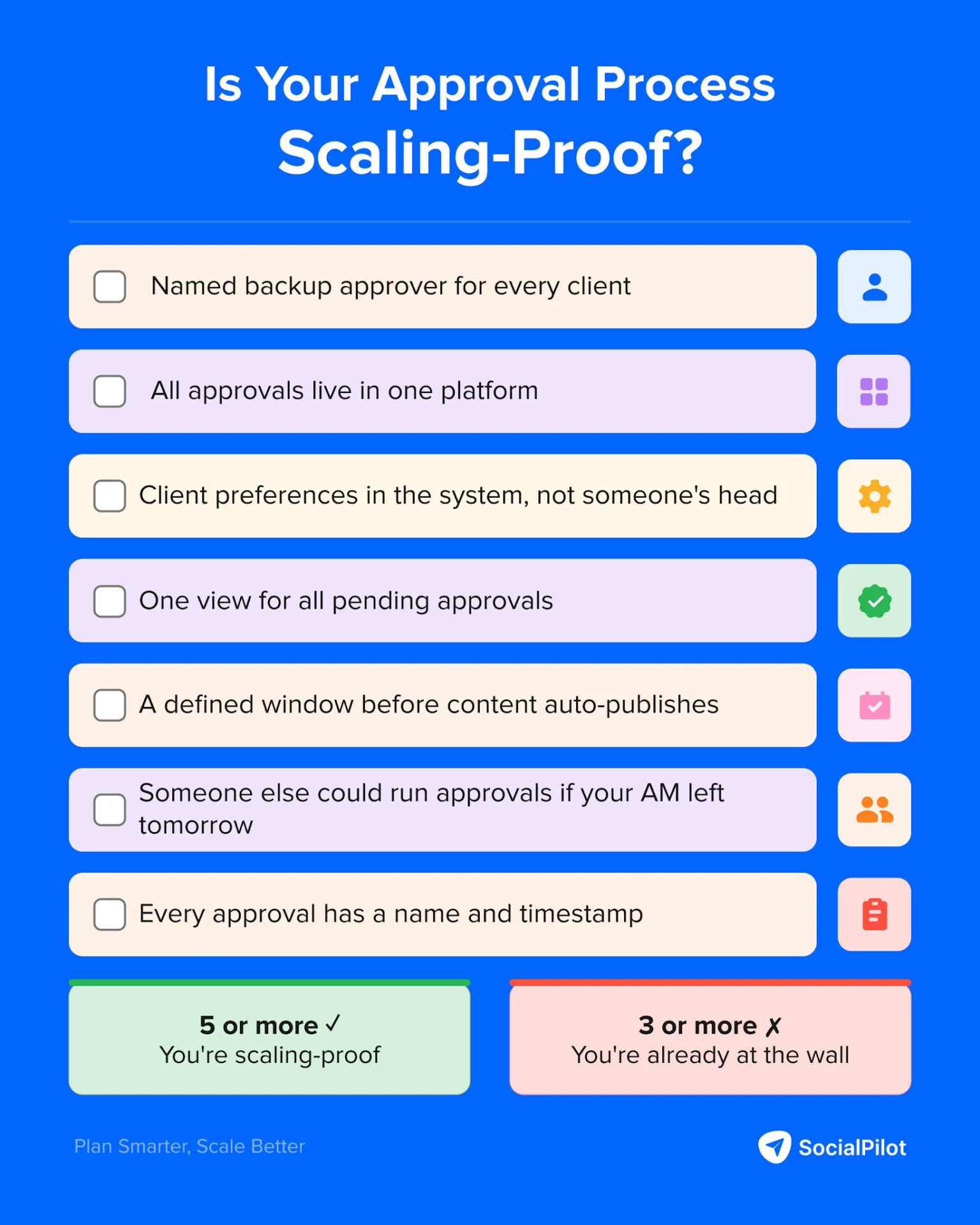
Three or more “no” answers mean the process is already under strain. Five or more “no” answers isn’t a scaling problem. It’s a structural one.
The wall isn’t ahead of you. You’re already at it.
What This Looks Like at 30+ Clients
SocialPilot was designed around exactly this constraint: one grouped view, per-client configuration, no manual overhead.
At 30 clients, no AM opens 30 email threads to check approval status. SocialPilot gives the team one grouped view: every post, every client, every status in one place. No inbox archaeology. No Slack thread to cross-reference before publishing.
Per-client settings mean each client’s workflow is configured in the platform at onboarding. The AM doesn’t manage preferences manually. For client-facing approvals, clients get a direct link through SocialPilot’s Approval on the Go feature, where they review and approve without needing to log in. When no one responds within the configured window, the auto-approve setting keeps the schedule running.
| Old Setup | SocialPilot Workflow |
| Approval threads across email, Slack, WhatsApp | All clients, all statuses, one approval view |
| Client preferences held in the AM’s memory | Per-client workflow configured in the platform |
| No record of which version was approved | Every approval has a name, timestamp, and locked version |
| One approver per client, no coverage plan | Multiple approvers, backup access from day one |
| Manual follow-up when clients go quiet | Auto-approve keeps the schedule running |
The agencies we work with that have scaled to 30, 40, 50 clients without approval becoming the ceiling built this system early. For account managers handling more than 8 clients, the approval layer is the first place where capacity disappears.
Fix It Before a Client Does
At 5 clients, a broken approval process is an inconvenience.
At 20, it’s a bottleneck.
At 50, it’s the structural risk sitting behind every missed deadline and every client conversation that shouldn’t have needed to happen.
You don’t need a perfect team to scale approvals. You need a process that doesn’t depend on one person’s memory, one channel’s reply, or one client being reachable.
The question is whether you fix it while it’s still a process problem or wait until it becomes a client problem.





 Join 55,000+ social media managers


