
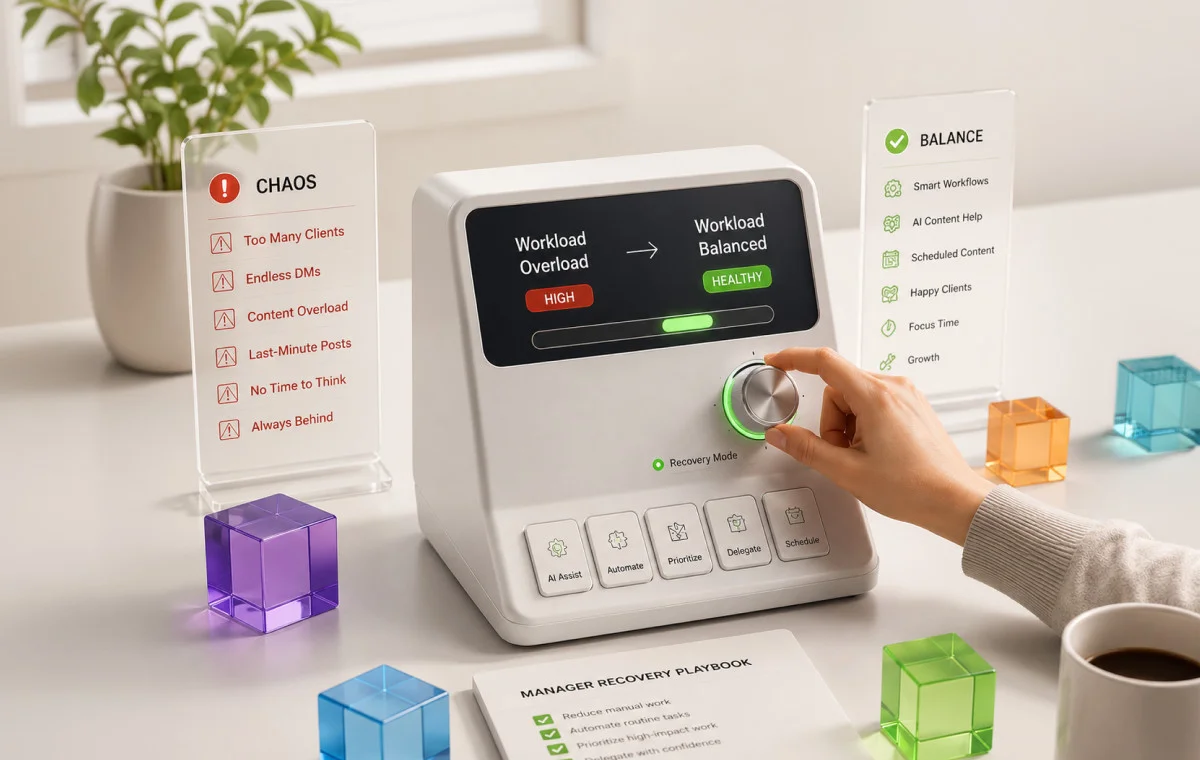
Nobody tells you that managing social media for eight clients means being eight different people.
Not eight different tones. Eight different people.
It’s 9 am. Three Slack messages before your coffee’s done. By 10 am, you’ve written as a lifestyle brand, a B2B SaaS company, and a local restaurant. By noon, you’ve hit a deadline collision. By 5 pm, you’re behind on two accounts. At 8 pm, someone texts about an urgent typo.
There’s this, this, not to forget this, and of course that….
Sounds exhausting, doesn’t it?
Well…
Every burnout article was written for an in-house manager: one employer, one brand voice, one set of expectations. None of them address multi-client burnout: what causes it, how to prevent it, or how to build a structure that actually holds. This one does.
77% of social media professionals report experiencing burnout (Link in Bio, 2025). But the standard advice, take more breaks, log off at a set time, was written for someone whose burnout comes from volume.
Multi-client burnout doesn’t come from volume. It comes from fragmentation. And fragmentation is a structural problem that self-care doesn’t fix.
Clients Don’t Buy Strategy. They Buy Creative Attention.
When a client hires a social media manager, they think they’re buying posts and strategy. What they’re actually buying is a portion of that person’s creative attention.
Creative attention doesn’t scale the way output does.
You can schedule more posts. You can’t manufacture more of the particular quality of mind that produces good creative work: the capacity to fully inhabit a brand, to catch what’s off, to have instincts about what will land.
That capacity degrades under load. Not dramatically, not all at once. Slowly, across weeks, in ways that are easy to rationalize as tiredness or a bad day.
Client 1 still gets the version of you that showed up on Monday morning. Client 8 gets the version that made it to Friday. They’re paying the same rate. They’re not getting the same thing.
This is what multi-client burnout actually depletes. Not your time. Your ability to think clearly for every client you serve.
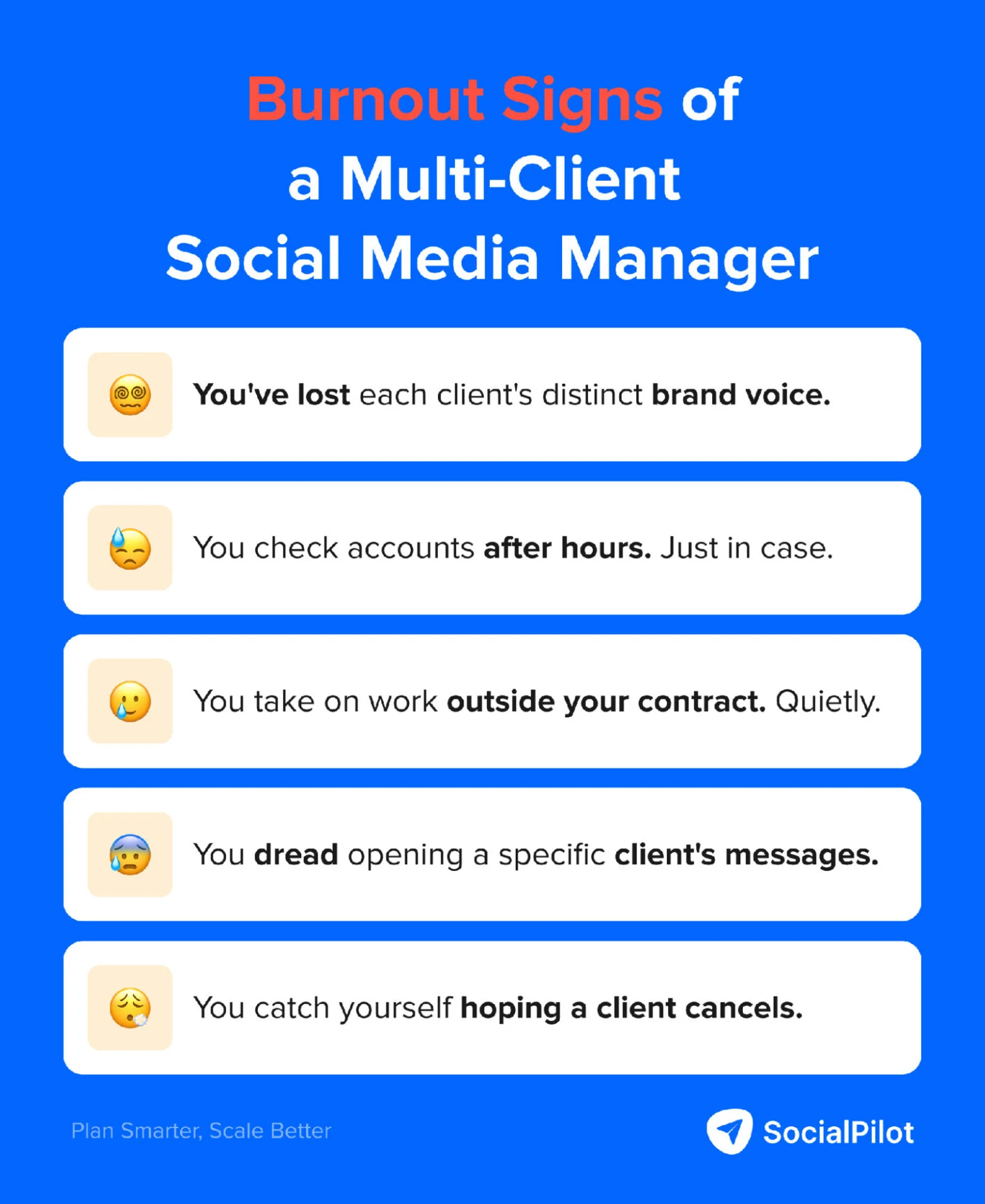
For multi-client managers, burnout shows up in the work before it shows up in how you feel:
- Context fatigue by midweek: Creative quality drops after Wednesday. Posts written for Friday clients are noticeably weaker than the ones written on Monday.
- Voice bleed: One client’s content starts sounding like another’s. The DTC brand starts sounding corporate. The restaurant sounds like the SaaS company.
- Compulsive feed-checking: Opening client accounts outside working hours, not because there’s a crisis, but because you’re anxious there might be one you missed.
- Scope absorption: Doing work that isn’t in the contract because flagging it feels riskier than absorbing it.
- The dread check: Feeling dread rather than neutral before opening a specific client’s messages.
- Relief fantasies: Catching yourself thinking about how much easier things would be if they just cancelled.
Three or more of these simultaneously means the system is producing the burnout. Not the person inside it.
What Actually Causes Multi-Client Burnout
For in-house managers, burnout usually traces to overwork or under-recognition. For multi-client managers, four structural triggers drive it. Almost none of them appear in standard burnout literature.
1. Context-switching Tax
Every shift between brand voices carries a cognitive cost that doesn’t show up on any timesheet. You’re not switching tabs. You’re switching personas. Each one requires fully loading a new identity into working memory. Each one you discard leaves residue. Do that fifteen times a day, and the tank is empty by Wednesday.
When the switching exceeds capacity, voices bleed into each other. One thread on r/socialmediamanagers put it plainly:
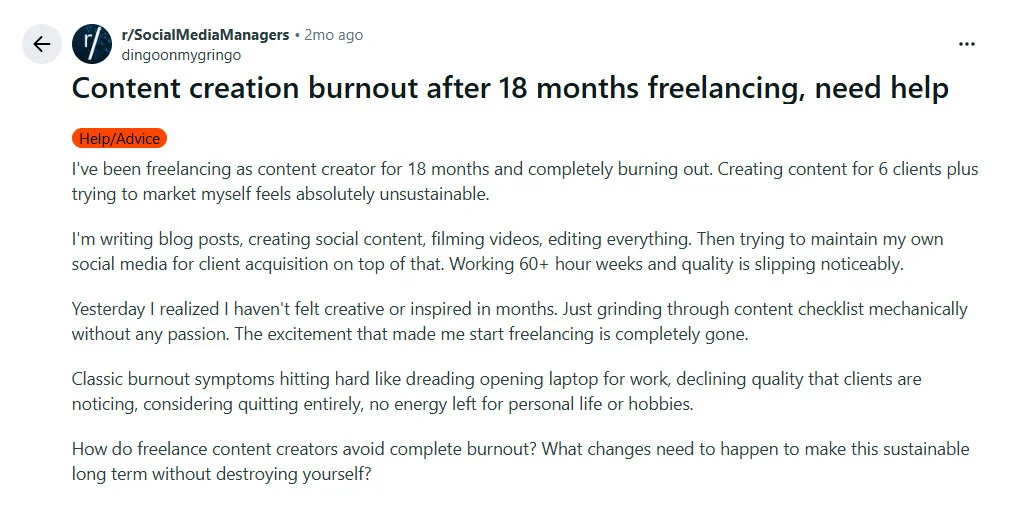
This isn’t venting. Its voice bleed in real time, and your best clients start getting your worst creative before you notice.
2. Client-Anxiety Spiral
One client’s post underperforms. Your confidence takes a hit. Not just for that client. Across your entire roster.
With a single employer, a bad week stays bound to one context. With eight clients, your psychological state is a shared resource. Criticism from Client A draws from the same confidence pool you need for Clients B through H.
The anxiety doesn’t add. It multiplies. And because it manifests as “just checking,” it disguises itself as diligence.
3. Always-on client
Most managers don’t stay available after hours because they want to. They stay available because they’re afraid of what happens if they don’t.
One post from r/freelance described what that fear actually produces:
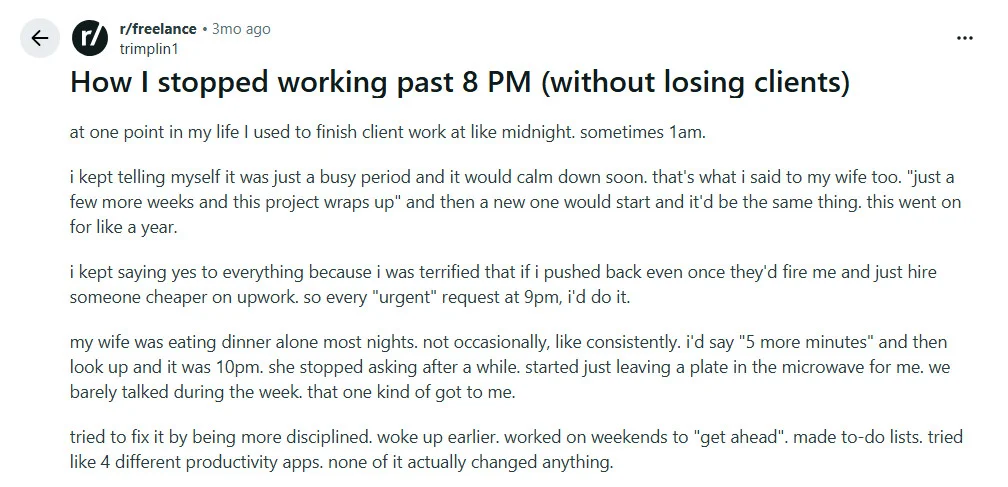
The first time a client texts at 9 pm and you respond, you’ve set a precedent. The next text comes faster. 73% of social media managers say they feel they need to be “always on” (Sprout Social, 2023).
The first time a client texts at 9 pm and you respond, you’ve set a precedent. One client texting after hours twice a week is 8 interruptions a month. Across 8 clients, that’s 64: more than 10 hours of reactive communication monthly, eating into the only time the context-switching tax gets paid down.
4. Invisible Scope Creep
Extra rewrites. A “quick” question on Sunday. A competitor audit that wasn’t in the brief. A 20-minute call that becomes an hour. Each instance feels too small to flag.
Multiplied across 8 clients over 12 months, it’s easily 15–20 uncompensated hours per month, until you can no longer tell where the contract ends and the free work begins.
Fix the Structure, Not Yourself
The instinct is to fix the behavior: log off at a set time, take lunch away from the desk, practice saying no. These work briefly and then stop, because they’re personal adjustments applied to structural conditions. The structure wins every time.
1. Get the client’s knowledge out of your head
One brand voice document per client:
- Three voice adjectives, three anti-adjectives
- Sample approved posts
- Platform-specific rules
The goal is to externalize what you’re currently holding in working memory so each context switch costs less. You’re loading a document, not reconstructing an identity from scratch. A second effect: any client can now be covered by another team member for a week. An agency that keeps knowledge with one person can never fully scale.
2. Build a batch rhythm and protect it
Instead of visiting all 8 clients every day, dedicate full blocks to one client at a time. Monday is Clients 1 and 2. Tuesday is Clients 3 and 4.
Context switches per week drop from 40+ to under 10. Voice bleed decreases. The work Client A gets on Monday is of the same quality Client D gets on Thursday.
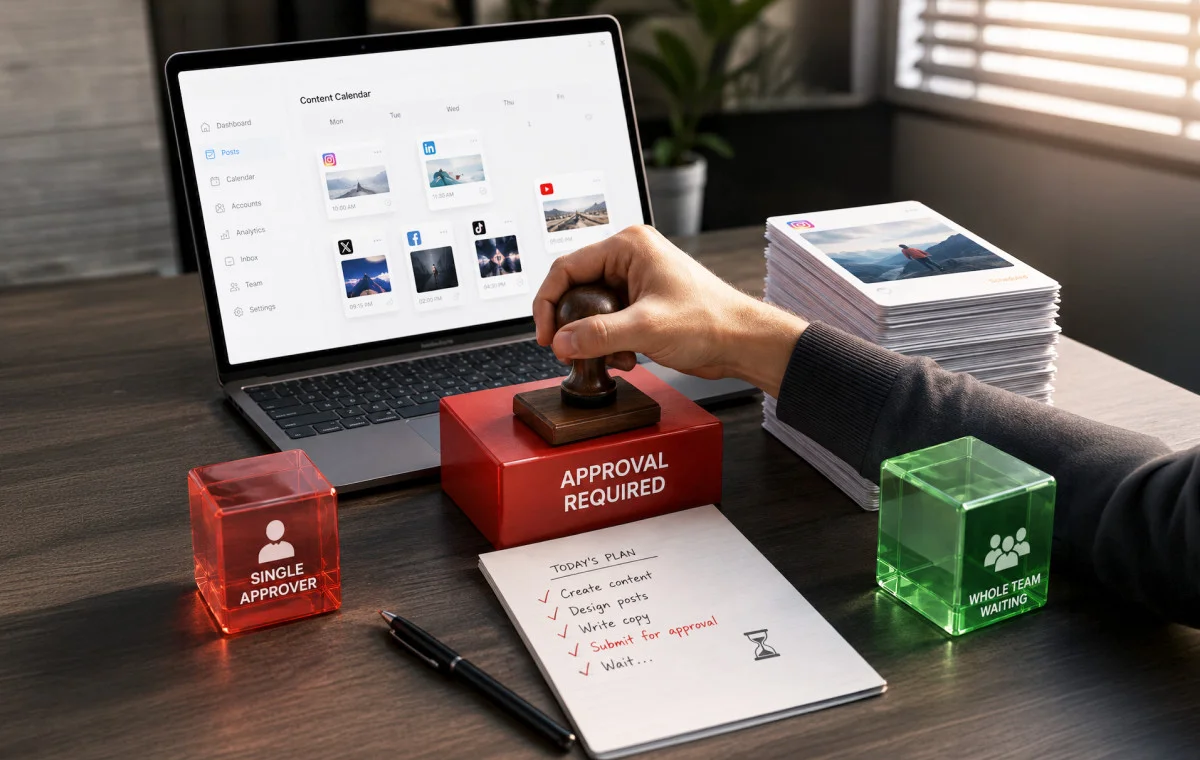
The hardest part of batching isn’t planning ahead. It’s the approval loop. SocialPilot’s content calendar lets you plan across all clients in one view, weeks ahead. The magic link sends drafts to clients for approval without requiring them to log in. Once approved, the scheduler handles publishing. The daily work stops being “what do I post today?” and becomes “what do I review today?”
3. Put response hours in the contract
Not in a Slack message. In the signed agreement, before the engagement starts:
“I respond to messages Monday through Friday, 9 am to 6 pm. Content outside those hours runs via SocialPilot’s scheduler and does not require real-time oversight.”
Written terms change the baseline expectation before it hardens into resentment. A 9 pm text then gets acknowledged the next morning, consistently. No explanation needed. The expectation resets through behavior, not through a conversation.
4. Run the math on the clients who cost the most
Before any exit conversation, track the actual cost per client: direct hours, reactive communication, emotional overhead, and the checking behavior they trigger across other accounts.
One difficult client at $2,000/month often costs $800/month in capacity lost elsewhere. When you see the real margin, the decision usually makes itself. This breakdown of account manager capacity runs the numbers by client load.
Built to Break
Most social media managers don’t burn out because the work is hard. They burn out because they keep waiting for the structure to fix itself.
The burnout literature asks whether you’re coping. That’s the wrong question. Here’s the right one: Could the setup you’re running right now sustain another five years without breaking you?
Most people already know the answer. The only question is whether they’ll act on it before a client forces the issue.
The setup that holds five years from now doesn’t come from working harder. It comes from a system that handles scheduling, approvals, and publishing across every client without needing you to be in five places at once. SocialPilot is where that system lives. Explore the plans and see which one fits how you work.




 Join 55,000+ social media managers


