

Imagine a 58-year-old executive planning for retirement. She searches for “retirement planning advice” on LinkedIn and finds three advisors. The first only has a profile photo and no posts. The second hasn’t posted since 2022, and the third recently shared a clear, easy-to-understand post about how rising interest rates impact retirement income. She reads it twice, saves it, and sends a connection request. By the end of the week, she’s scheduled a discovery call.
The first two advisors never knew she was looking.
This is what effective social media marketing for financial advisors looks like in practice: consistent visibility, useful content, and a presence that works for you even when you are not actively selling.
This isn’t just a rare scenario. For many advisors who keep putting off social media – either because they’re too busy or unsure about the rules – this is a regular Tuesday.
This guide helps with both issues. You’ll learn how to build a social media presence that brings in real leads while following all the FINRA (Financial Industry Regulatory Authority) and SEC (Securities and Exchange Commission) rules that apply to you.
The Clients You’re Missing While You Stay Silent
The business case for being active on social media is no longer a matter of debate.
According to Broadridge’s 2024 Financial Advisor Marketing Report, 41% of advisors have landed a client directly through social media – up significantly from just three years prior. Among growth-focused advisors, that number climbs to 54%. The advisors consistently getting those results post an average of 35 times per month.
The generational shift highlights why staying silent online is risky. According to a joint study by the CFA Institute and FINRA Foundation, 48% of Gen Z investors name social media as their top source for investment information, ranking it above even internet searches. If your profile isn’t active, these potential clients will likely move on without contacting you.
What’s frustrating is that most advisors want to be active online, but the compliance process holds them back. According to Financial Planning, it can take anywhere from a month to eight weeks to get one post through FINRA review and firm compliance. By the time it’s approved, the moment that inspired the post is often over.
It’s smart to be careful about compliance, but staying silent isn’t always the safest choice. The risk of missing out on clients grows every quarter you wait.
The FINRA and SEC Rules That Actually Apply to Your Posts
Financial advisor social media compliance works best when it’s built into your workflow from the start, not treated as a final check before hitting publish.
Before you start posting, it’s important to know which rules apply to you. Not all rules are the same, and many advisors either don’t know the differences or are following old assumptions.
Which regulator governs your social media activity:
FINRA (Financial Industry Regulatory Authority) – governs broker-dealers and their registered representatives
SEC (Securities and Exchange Commission) – governs registered investment advisers (RIAs) and also broker-dealers under certain rules
If you work under a broker-dealer, FINRA Rule 2210 is the primary rule governing your posts. If you’re an independent RIA, the SEC’s Marketing Rule (Investment Advisers Act Rule 206(4)-1) is your main framework.
Static Content vs. Interactive Content: Why This Distinction Changes Everything
FINRA social media rules treat your LinkedIn post the same way they treat a printed brochure, which means the content standards that apply to traditional advertising apply here too.
FINRA Rule 2210 draws a hard line between two types of social media content, and each type has completely different approval requirements:
| Content Type | What It Covers | Approval Requirement |
| Static content | Profile bios, pinned posts, videos, long-standing graphics | Must be pre-approved by a registered principal before publishing |
| Interactive content | Comments, replies, direct messages, live Q&As | No prior approval required, must be supervised and archived |
This difference matters in practice. Your firm can pre-approve a group of static posts all at once, and you can share them over time. Real-time actions, like replying to comments or joining conversations, don’t need approval first as long as you follow content standards.
The 2021 SEC Marketing Rule Change That Most Advisors Still Don’t Know About
Before November 4, 2022, financial advisors couldn’t use client testimonials in advertising. The SEC’s updated Marketing Rule changed this. Now, testimonials are allowed, but you must follow certain disclosure requirements:
- Disclose whether the person is a current or former client.
- Disclose whether the person received any compensation.
- If compensation exceeds de minimis levels and the promoter is not an affiliate, a written agreement is required.
- Include a statement that the experience may not be representative of all clients.
Google reviews, LinkedIn recommendations, and direct client quotes on social media all count as testimonials under this rule. Just make sure your compliance policy covers third-party review sites and your archiving system saves the content.
Recordkeeping: How Long You Need to Keep Everything
| Regulatory Framework | Retention Requirement |
| Broker-dealers under FINRA | 3 years minimum |
| RIAs under SEC Rule 204-2 | 5 years minimum |
You need to archive every post, comment, direct message, and any other business-related engagement – not just your original posts.
Content that is prohibited under both frameworks:
- Predictions or projections about specific investment performance
- Claims you cannot substantiate with a reasonable factual basis
- Content that omits material information (e.g., mentioning potential returns without mentioning risks)
- Third-party links to content your firm knows, or has reason to know, is false or misleading.
A Three-Pillar Content System for Financial Advisors (With What to Actually Post Under Each)
The best social media content ideas for financial advisors are already sitting in your client conversations – the questions people ask most, the misconceptions you correct regularly, and the decisions you help clients think through every year. The challenge is not finding content; it is finding a way to get it approved and out the door without a six-week wait.
Here is how to build that system across three pillars, with what to post under each one.
Pillar 1: Financial Education
Educational content is the lowest compliance risk and the highest trust-builder available to you. Regulators actively encourage advisors to teach financial literacy, and when you explain something clearly, you are demonstrating expertise rather than selling a service.
Pre-approved topic areas to build from: retirement planning, Social Security optimization, estate planning basics, tax-efficient investing, and Medicare decision-making. These are topics you already explain to clients every week, which means you are not creating content from scratch. You are turning existing conversations into posts.
Compliant formats that work well:
- Explain one concept clearly without giving specific advice, for example, “What is a Roth conversion and when does it actually make sense?”
- Turn common client conversations into posts, like “How I explain the difference between a Roth IRA and a Traditional IRA to new clients”
- Share experience-based observations that position you as a knowledgeable guide, such as “The three most common retirement planning mistakes I see people make”
- Short explainer videos work particularly well in this pillar — a 60-second breakdown of one concept can outperform a written post on LinkedIn and Instagram
Here is one such educational post on Facebook by a financial advisor, Josh Rincon, that talks about Roth IRA contribution limits in 2026.

One thing to set up once and reuse consistently: get this disclaimer pre-approved and add it to your bio or the bottom of your posts. “This content is for educational purposes only and does not constitute personalized investment advice.”
Approval takes a few minutes. After that, you use it on every educational post without going back to compliance.
Pillar 2: Market and Economic Context
Market commentary is allowed under both FINRA and SEC rules. Where advisors run into trouble is how they frame it. “Rising interest rates are creating real tradeoffs for retirement savers, and here is how I am thinking about them” is compliant commentary. “The Fed’s decision means you should move out of bonds now” is personalized advice and crosses the compliance line.
As an advisor you can explain what happened, but you must not give it a personalized direction.
A strong market commentary post follows this structure:
- What happened
- Why it matters for someone planning for retirement or managing investments
- What kinds of financial situations this development tends to affect
- A clear disclaimer that this is not personalised investment advice
Here is a post by James McCann, a senior economist, breaking down what a recent Fed rate cut means for investors. This format works well for financial advisors who want to demonstrate economic fluency without veering into specific recommendations.
The operational benefit of pre-approving a commentary template is significant. Instead of submitting each post for individual review, you get the format and disclaimer language approved once. When the next Fed announcement drops, you can respond within 48 hours rather than waiting weeks.
Pillar 3: Credibility and Proof
Since November 2022, client testimonials are permitted under the SEC’s updated Marketing Rule, as long as you meet the disclosure requirements. If you are still avoiding testimonials your compliance policy is worth revisiting.
Before posting any testimonial:
- Confirm whether the client received any compensation, because even small gifts can trigger disclosure requirements
- Include a disclosure stating that the person is a current or former client
- Add a note that their experience may not represent all clients’ outcomes
- Have compliance review the specific testimonial before it goes live
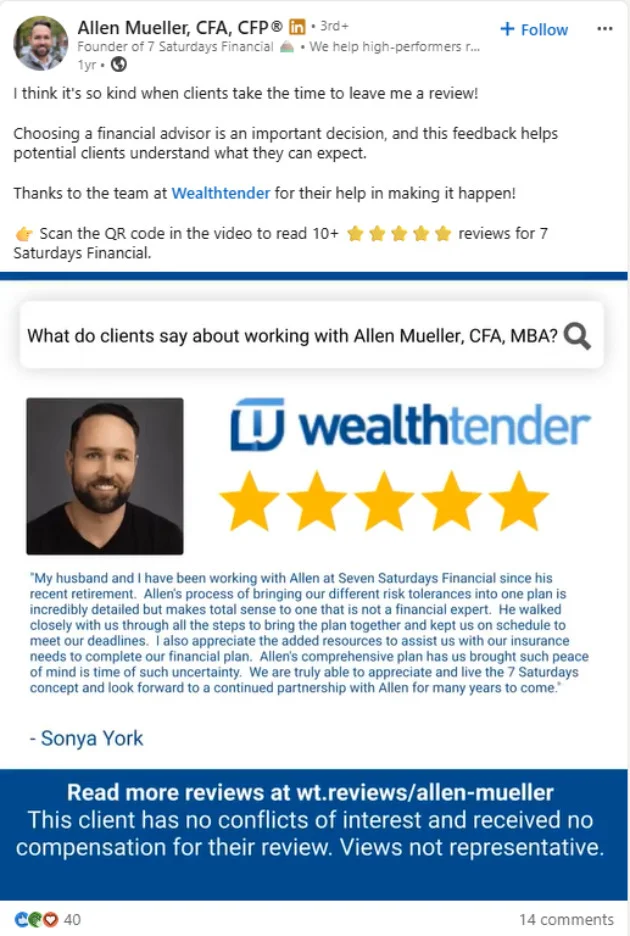
Here is a testimonial posted on Allen Mueller’s LinkedIn page, where one of his clients shares their experience working with him. The format is simple, the disclosure is clear, and it builds the kind of social trust that a bio page cannot.
Beyond testimonials, this pillar includes anything that shows prospects who you are and that real clients trust you: credentials and certifications, third-party mentions, community involvement, and client milestones shared with permission.
None of this requires performance claims. The proof comes from the relationship, not the returns.
How the pre-approval model changes your workflow
Once your compliance team signs off on the three pillars and a template for each, you don’t need approval for every single post. You’re working within a pre-approved system. This change lets advisors move from 6–8-week approval cycles to getting posts out in the same week.
Lead Generation Tactics That Stay Within Regulatory Bounds
Social media lead generation for financial advisors is less about reach and more about being consistently visible to the right people at the moment they start asking questions.
Posting regularly helps you grow your audience. The following tactics help turn that audience into real leads, all while staying within compliance rules.
1. Free educational resources as lead magnets
A retirement-readiness checklist, a tax-planning guide, or a Medicare decision framework gated behind an email opt-in is one of the most repeatable lead-generation tools available to advisors. Once approved, you can reuse it indefinitely.
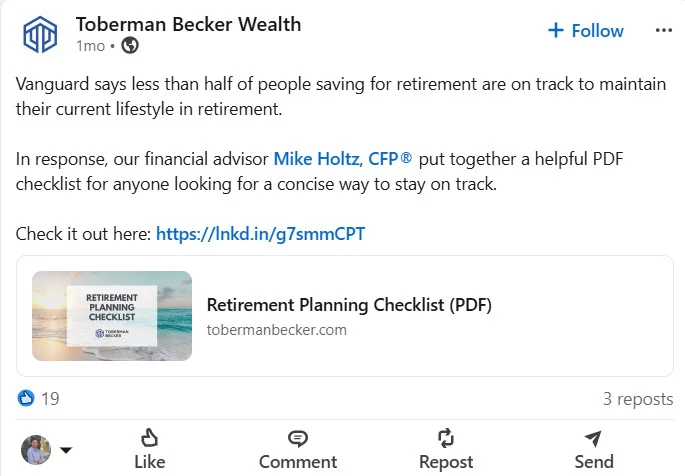
In the below post, Toberman Becker Wealth has shared one such resource, which is their retirement planning checklist.
Compliance requirement: Submit the lead magnet for compliance review before promoting it and include a disclaimer on the download that it is for educational purposes only and does not constitute personalized investment advice.
2. Webinars and live Q&As
Educational events on topics like “How to think about Social Security claiming” or “What to do with a 401(k) when you leave a job” attract pre-qualified prospects and keep you in educational territory. The registration form collects contact information; your follow-up handles conversion.
The below post, by Wade Den Hartog, promotes one such webinar on practical planning strategies for passing wealth and wisdom in families.
Compliance requirement: Submit your script or slide deck for principal review before the event goes live.
3. LinkedIn outreach built around value
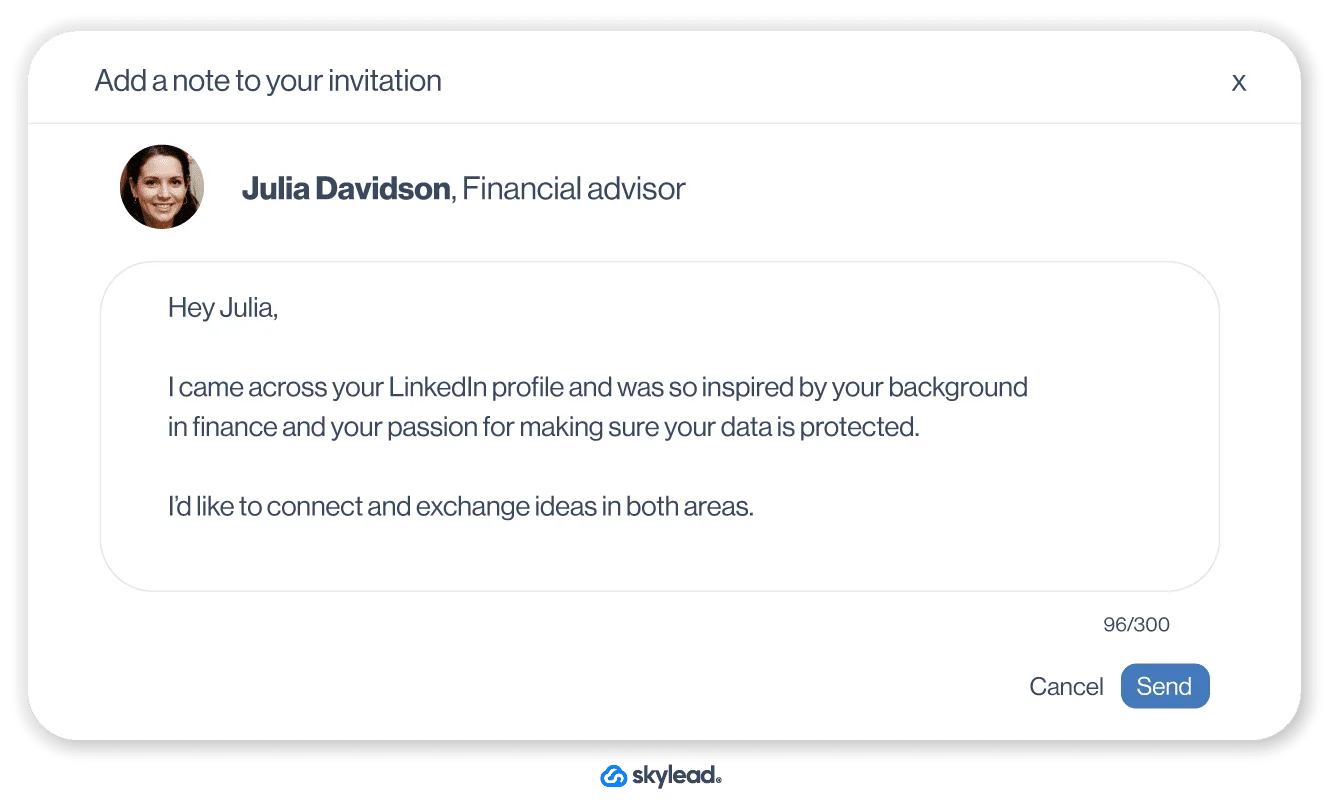
Connect with prospects, then send a message that mentions something specific about them and shares one of your educational posts – not a sales pitch. Make sure every message is relevant and valuable, without focusing on investment performance or results.
The image below shows an outreach template that can be used by financial advisors when approaching their clients.
Compliance requirement: LinkedIn DMs are interactive content under FINRA rules – no prior approval needed, but every message must be archived.
4. Referral-ready content for your current clients
Create content for specific situations, like “if you know someone approaching retirement who’s figuring out their Social Security options,” and give your current clients something useful to share. This helps you reach more people without extra approval steps or advertising costs.
Compliance requirement: Content shared by clients still falls under your firm’s advertising rules. Make sure anything you create for forwarding has already cleared compliance before it gets distributed.
For most advisors, the main compliance challenge isn’t the content itself. The real problem is that the approval process is often informal, slow, and doesn’t create a clear record.
Usually, an advisor drafts a post in Word, emails it to compliance, revises it in an email thread, and then posts it manually. There are no timestamps and nothing is easy to find if there’s an audit.
SocialPilot is built around an approval-first workflow that closes this gap directly.
Pending review queue: Every post sits in a pending queue before it can be published – nothing goes live without passing through the approval stage.
Role-based permissions: A content scheduler drafts, a principal or compliance contact approves, and the account owner publishes. That layered structure is exactly what FINRA and SEC examination frameworks look for in a social media supervision program.
Approver access via shareable link: With SocialPilot, you can send the approver a personalized review link. They don’t need an account or password. Every approval, rejection, and comment is logged with a timestamp.
Post history as compliance documentation: Each post has a timestamped record showing who drafted it, who approved it, when it was published, and on which platform. This creates the paper trail you need for a regulatory exam.
You don’t have to start by posting 35 times a month. What you need is a system that can grow with you and won’t cause compliance issues as you expand.
Start by meeting with your compliance contact or review your own documentation if you’re an independent RIA. Get three topic buckets approved for your content pillars, and have a template approved for each one. Set up an archiving tool to automatically save your posts and interactions. Aim to post three times a week within your approved framework.
Once your system is set up, SocialPilot helps you stay organized by sending all your posts through the right approval queue, logging every action with a timestamp, and keeping the post history your firm needs for regulatory documentation. It removes the administrative friction, so you can focus on creating content instead of managing the process.
Start your free trial and see how SocialPilot fits into your compliance workflow.




 Join 55,000+ social media managers


