

If you’ve ever stared at a blank screen wondering, “What should I even post today?” — you’re not alone. Most brands and creators face this exact problem, not because they lack ideas, but because they lack a framework to organize those ideas.
That’s where social media content pillars come in.
Content pillars give your social media presence a backbone. Instead of posting randomly and hoping something sticks, you build around a set of core themes that reflect your brand, resonate with your audience, and move the needle on your goals.
In this guide, we’ll break down what content pillars for social media actually are, why they matter, how to create your own from scratch, and how to put them to work — with real examples, industry-specific strategies, and practical tips you can act on today.
Key Takeaways:
- Most brands post randomly and hope something sticks. This guide shows you how to build content pillars that replace guesswork with a system — and why brands that do this compound their reach while others stay stuck.
- Your industry determines which pillar mix actually works for you. A SaaS company, a local business, and a personal brand need completely different theme structures, and we break down what works for each.
- The brands that feel “algorithmically favored” are the ones committed to consistent themes long enough to earn it. Learn how you can track performance by pillar and identify themes that drive real engagement.
Social media content pillars are a few core themes that define what your brand consistently talks about across platforms. Every post you publish should ladder up to one of these themes — no exceptions.
A fitness brand, for instance, might organize all content under five pillars: workout tutorials, nutrition tips, client transformations, motivational content, and product highlights. Simple categories. But they do a lot of work.
Not sure if you already have pillars? Scroll through your last 30 posts and try to name 3 to 5 clear recurring themes. If you can, those are your pillars — even if you’ve never formally defined them. If you can’t, that’s your signal to build them.
Here’s why it’s worth doing:
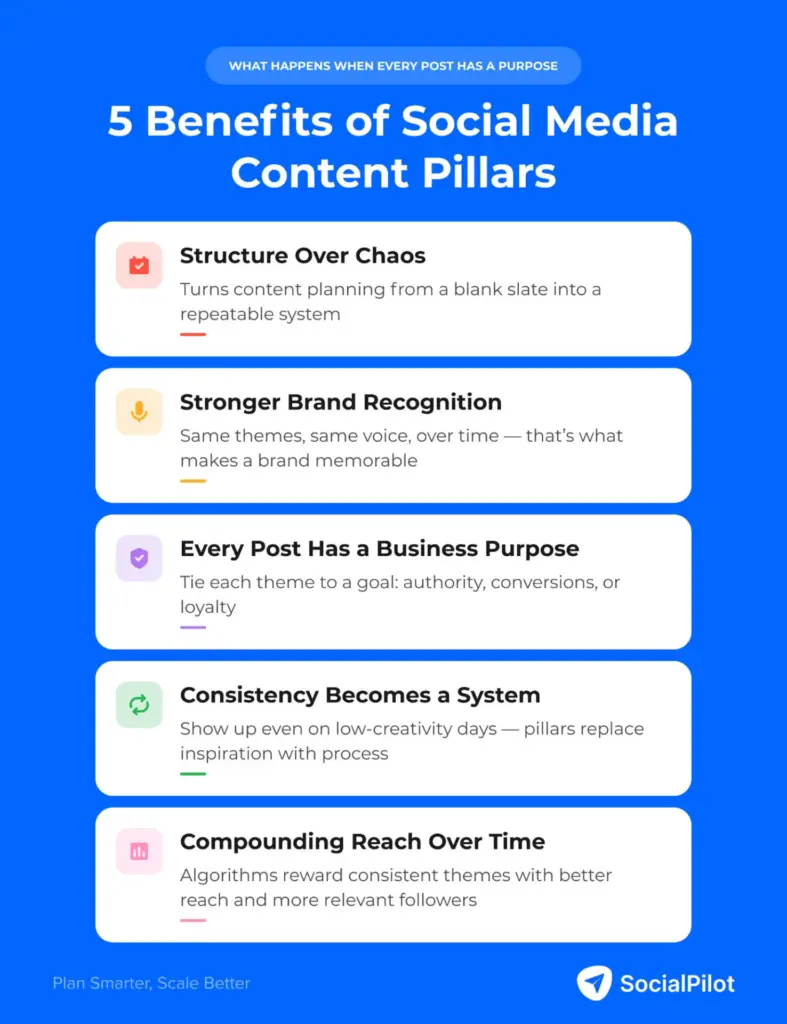
- Structure over chaos — Pillars turn content planning from a blank-slate problem into a fill-in-the-blank system. You know your themes; you just need ideas within them. Batching a month of content becomes realistic, not aspirational.
- Real brand recognition — Recognizable brands aren’t just using consistent colors. They’re talking about the same core topics, in the same voice, repeatedly. Pillars make that possible.
- Every post has a business purpose — Educational pillars build authority. Promotional pillars drive conversions. Community pillars deepen loyalty. Without pillars, it’s easy to optimize for likes instead of outcomes.
- Consistency becomes a system, not a mood — Data from Buffer’s State of Social Media Engagement Report 2026 confirms that posting consistency matters more than posting volume. Pillars give you the framework to show up even on low-creativity days.
- Compounding reach over time — Algorithms categorize accounts that post on consistent themes more reliably – surfacing content to the right audience more often. Your followers engage more when content matches why they followed you. That flywheel only starts when you commit to defined themes.
Knowing you need content pillar strategy is one thing. But creating the right ones is where most people get stuck.
Here’s how to create social media content pillars that actually work:
Step 1: Let Your Goals Define Your Pillars
Your pillars should serve the different social media goals your business, not just fill a content calendar. Brand awareness calls for educational and entertaining content; lead generation needs authority-building paired with conversion-focused posts; direct sales leans on social proof.
Start here — every pillar you choose should answer: does this actually move the needle?
Step 2: Build for Your Audience, Not Yourself
Your pillars should reflect what your audience wants to hear, not just what you feel like saying. Dig into your DMs, comments, and community spaces like Reddit and Quora — the questions your audience keeps asking are your pillars hiding in plain sight.
Use social listening tools like AnswerThePublic or SparkToro to validate what they’re actively searching for.
Step 3: Look into Your Best Posts for the Answers
Pull your top 20–30 posts from the last 90 days — sorted by saves, shares, and comments, not likes. Tag each by theme and watch 3–5 clusters surface naturally. Those clusters aren’t guesses, they’re pillars your audience has already validated with their engagement.
Step 4: Find the Gaps Your Competitors Left Open
Scroll through your competitors’ recent posts and group them by theme — you’ll reverse-engineer their pillar structure in minutes. Don’t use this to copy them. Thorough social media competitor analysis will help you understand what questions their audience are asking and address it in your own content.
Step 5: Name Some of Your Core Themes
Pick some themes that sit at the intersection of your expertise, your audience’s needs, and your business goals. Name each pillar specifically: the tighter the definition, the easier it is to generate ideas and stay consistent.
Start with 3 if 5 feels overwhelming. You can always expand once you’ve built a rhythm.
Tip: Don’t lock in your pillars permanently on day one. Treat the first 2 to 4 weeks as a pilot period. Post 2 to 3 pieces of content under each candidate pillar and see which ones resonate. Keep what works, swap out what doesn’t.
5 Content Pillar Examples (With Real-World Use Cases)
Understanding the types of pillars is easier when you see them in action. Here are five most common types of content pillar categories, each with a real brand doing it well.
1. Educational Content
This is content that teaches your audience something useful — tips, how-tos, step-by-step frameworks, myth-busting, or industry insights. Educational content builds brand identity, authority and trust, and it tends to get saved and shared at high rates.
Example: HubSpot’s LinkedIn presence is a masterclass in educational content pillars. They break down complex marketing, sales, and CRM concepts into digestible carousels and short posts.
Their audience doesn’t just scroll past — they save these posts as reference material. This positions HubSpot as the go-to resource long before a purchase decision happens.
Why it works: Educational content answers real questions. It gives people a reason to follow you beyond entertainment. And because it delivers tangible value, it builds the kind of trust that eventually drives business results.
2. Inspirational Content
Inspirational pillars are about motivation, customer success stories, and aspirational messaging. It taps into your audience’s emotions and ambitions, making them feel something — hope, determination, and possibility.
Example: Nike doesn’t sell shoes on Instagram. They sell the idea of what you could become. Their athlete storytelling — featuring everyone from global superstars to everyday runners — is a content pillar that’s remained consistent for years.
Here is one such post by Nike featuring the paralympic athlete Oksana Masters.

Why it works: Creating content that inspirational creates emotional connections. People share content that reflects who they want to be, which gives this pillar natural virality. It also reinforces brand values without feeling salesy.
3. Promotional Content
Product features, launches, offers, customer results, case studies, demos — this is content that directly serves your business objectives. Every brand needs some promotional content, but the key is making it valuable rather than pushy.
Example: Apple’s product reveal posts are the gold standard for promotional content done right. Minimal text. Stunning visuals. Zero hard sell. They let the product speak for itself, which feels less like advertising and more like a reveal worth paying attention to.
Below is a post by the Apple hub launching their AirPods Max 2.

Their launch posts on different social media platforms consistently break engagement records because the audience is genuinely excited, not annoyed.
Why it works: Promotional content converts — but only when it’s earned. If you’ve built trust through your other pillars (educational, inspirational, community), your audience is far more receptive when you do promote something. The ratio matters.
4. Entertaining Content
Memes, trend participation, humor, relatable moments, hot takes — this is content people consume and share purely for enjoyment. Entertaining content humanizes your brand and makes people want to follow you, not just tolerate you in their feed.
Example: Duolingo’s TikTok presence is the most-cited example for a reason. Their unhinged, chaotic owl mascot content has nothing to do with language learning on the surface — but it’s built them a massive, highly engaged following.
@duolingo #ChkChkBoom Challenge 🎯 w/ @Duolingo #duolingo #듀오링고 #StrayKids #스트레이키즈 #ATE #ChkChkBoom #dominATE_NEWYORK #YouMakeStrayKidsStay @Stray Kids ♬ original sound – MC LEEKNOW
People who’d never engage with a language app’s “normal” content actively seek out Duolingo’s TikToks. That top-of-funnel awareness eventually funnels into app downloads.
Why it works: Entertainment earns attention in a way that educational or promotional content often can’t. It breaks through the noise. And in an era where algorithms prioritize content that gets shared, entertaining posts have a natural distribution advantage.
5. Community-Driven Content
User-generated content, audience spotlights, polls, Q&As, challenges, conversations — this pillar turns your audience from passive viewers into active participants. It builds belonging and loyalty.
Example: GoPro has built one of the most successful community-driven content strategies on social media. Their feeds are dominated by UGC content pillar, where most of their pictures and adventure videos are shot by their users on GoPro.

GoPro essentially lets their customers create their marketing. The hashtag #GoPro has millions of posts, each one serving as social proof and organic advertising simultaneously.
Why it works: Community-driven content scales without scaling your content team. It deepens the relationship between brand and audience, turns customers into advocates, and provides authentic social proof that no polished brand campaign can replicate.
Content Pillars by Industry: What Works Where
A content pillar template that works for an e-commerce brand won’t necessarily work for a SaaS company or a local business. Your industry shapes your audience’s expectations, buying behavior, and the kind of content that builds trust.
Here’s how to create social media content pillars depending on the industry you are from, and post relevant content for your audience:
SaaS Companies
Recommended pillar set:
- Product Education
- Feature Spotlights & Use Cases
- Customer Success Stories
- Integration & Workflow Tips
- Team & Culture
Why this mix works: SaaS buyers need to see the product work before they commit. Your content has to do the demo before the demo — showing real use cases, solving real workflow problems, and building enough trust that a free trial feels like the obvious next step. Culture content humanizes the brand for buyers stuck in long evaluation cycles.
For instance, Slack structures their social content to speak to different stakeholders — productivity tips for end users, collaboration insights for team leads, developer resources for technical buyers, and culture content that keeps the brand.
Below is a productivity tip video by Slack on how documents can be turned into actionable insights using Slack
View this post on Instagram
Each pillar they use serves a different segment of their audience without diluting their core message: work should be simpler.
B2B Companies
Recommended pillar set:
- Industry Trends & Insights
- Thought Leadership
- Client Success & Case Studies
- Educational / How-To Content
- Behind the Business
Why this mix works: B2B sales cycles are long. Your buyer isn’t making a snap decision — they’re evaluating, comparing, and getting internal buy-in over weeks or months. So, the B2B social media strategy require creating pillars that build credibility and authority at the top of the funnel. While case studies and client success content handle the trust-building, thought leadership posts keep you visible in the spaces your buyers are.
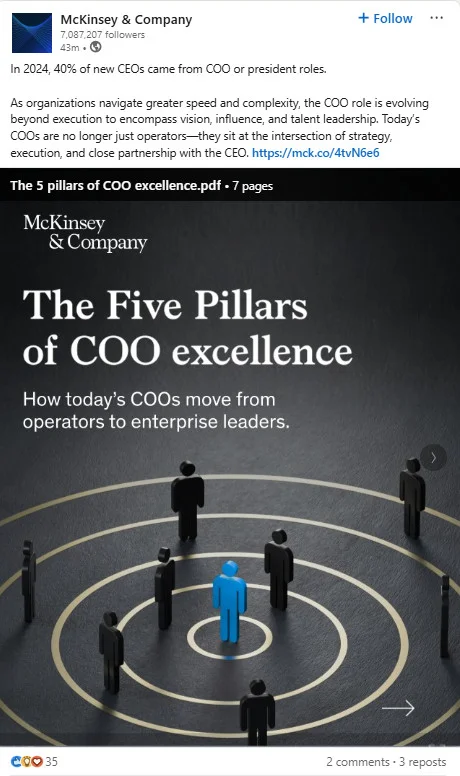
McKinsey & Company is a B2B consulting firm and their social presence is almost entirely thought leadership and industry insights — reports, frameworks, and executive perspectives. Their content focuses on building authority that makes enterprise buyers come to them.
Agencies
Recommended pillar set:
- Client Results & Case Studies
- Process & Behind the Scenes
- Industry Insights & Trends
- Team & Culture
- Educational Tips for Marketers
Why this mix works: Agency buyers — businesses deciding whether to hand you their brand —don’t move fast. They want proof you’ve delivered results (case studies), confidence that your process is structured (behind the scenes), and evidence you understand the landscape better than they do (insights).
Culture and team content builds the human layer that turns an inquiry into a signed contract. Educational content keeps the agency visible and credible in the weeks or months before a prospect is ready to reach out.
VaynerMedia structures its content to demonstrate exactly what they sell. Their posts span client win highlights, internal culture moments, sharp industry commentary from senior leadership, and tactical marketing tips. In the below post, they are talking about ways to judge a creative in 2026.
When every pillar serves a different stakeholder — client, candidate, collaborator — the agency’s social presence does more than build awareness. It does the selling before the sales call happens.
E-commerce and DTC Brands
Recommended pillar set:
- Product in Action
- Customer Spotlights (UGC)
- Behind the Scenes Content
- Trend & Seasonal Content
- Social Proof
Why this mix works: E-commerce purchase decisions are faster and more emotionally driven. Buyers want to see the product in real life, hear from real customers, and feel a connection to the brand — all within a few seconds of scrolling. Visual proof and FOMO are your biggest levers.
Gymshark has mastered this mix. Their feed blends athlete partnerships showing products in action, community-generated workout content, behind-the-scenes footage from their annual pop-up events (which generate massive organic content), and seasonal campaign drops.
Below is one their posts, where they are promoting their running elite race vest.

They prioritize authentic, raw content ideas over polished production — and their community engagement numbers reflect it.
Personal Brands and Creators
Recommended pillar set:
- Core Expertise
- Personal Story
- Audience Engagement
- Providing Valuable Insights
- Aspirational Lifestyle
Why this mix works: People follow people. For personal branding, the content pillar strategy needs to balance value (what the audience learns) with personality (why they stay). Pure expertise without personality feels like a textbook. Pure personality without expertise feels like noise. The magic is in the mix.
For instance: Creator Dre Fox (@timeofdre on Instagram) structures her solopreneurship content using what she calls the “Content Tree” method — each pillar is a trunk that branches into dozens of sub-topics, preventing the repetition trap that kills most creator accounts.
She intuitively matches format to topic: carousels for step-by-step guides, personal photos for storytelling, video for trending commentary. The result is engaging content that feels both structured and spontaneous.
Here is an Instagram carousel by @timeofdre on how to prevent posts from getting ignored on social media.
View this post on Instagram
Local Businesses and Service Providers
Recommended pillar set:
- Tips & How-Tos
- Local Community
- Client Transformations
- FAQs & Myth-Busting
- Offers & Availability
Why this mix works: Local businesses compete on trust and proximity, not global brand awareness. Your audience wants to know you’re credible (tips, FAQs), that you’re part of their community (local content), and that you deliver results (transformations, reviews). These pillars build exactly that kind of trust.
The Seapoint Dental Clinic in Dublin works around five clear pillars: oral care tips (educational), neighborhood event sponsorships and partnerships (community), smile transformation before-and-after’s (social proof), common dental myth-busting (FAQ), and seasonal promotions like back-to-school checkup offers.
Here is a before and after smile transformation video by this clinic
View this post on Instagram
When every post serves your content themes and every follower interaction builds familiarity, it helps local businesses drive more bookings for local businesses.
How to Put Content Pillars to Work in Your Strategy
Your first job is to develop content pillars for your brand. But the real value will come from operationalizing them — turning them from a list on a whiteboard into engaging content ideas that drives your daily content decisions.
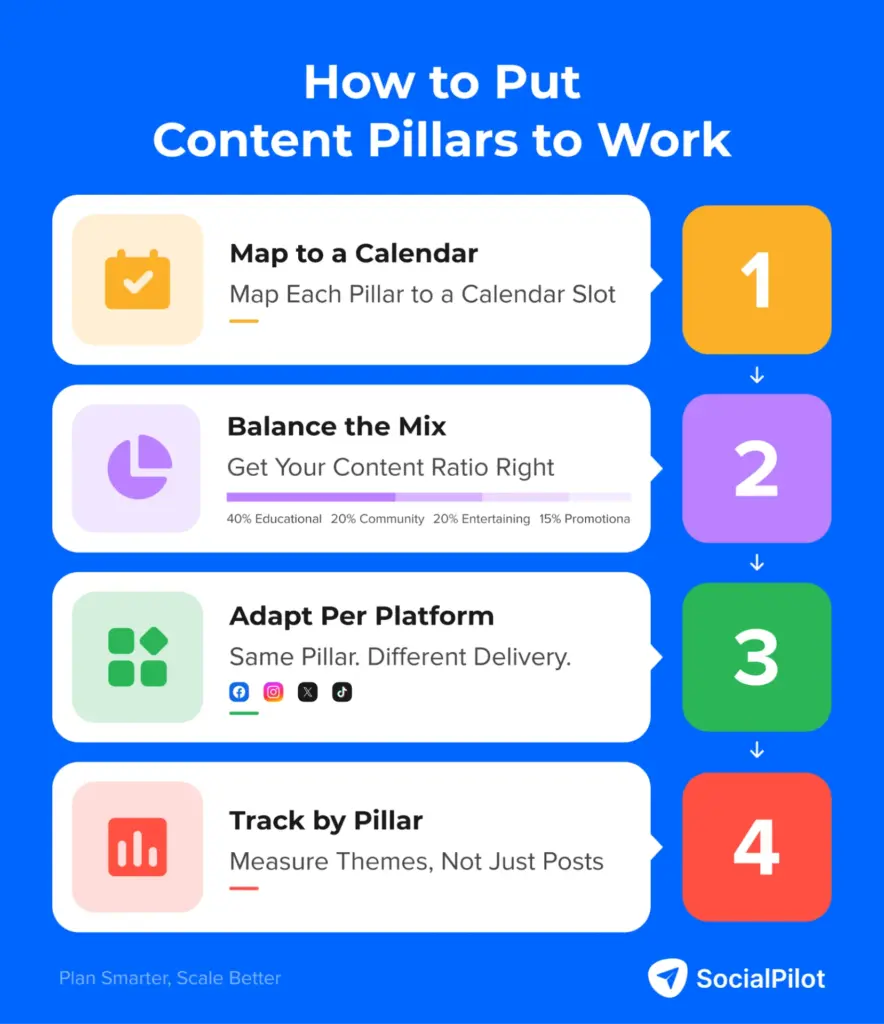
1. Map Pillars to Your Content Calendar
Assign all social media pillars a recurring slot in your weekly or monthly social media content calendar. This removes the daily “what should we post?” decision and replaces it with a predictable rotation.
For example, if you’re posting five times a week, you can assign one day each to educational, community, entertaining, inspirational and promotional content. Also, use this as a starting framework, and not a rigid schedule.
Need a ready-made framework to get started? Download this free social media calendar template to map your pillars to specific days and social media channels without building one from scratch.
This predictability compounds into massive time savings over weeks and months.
Once your pillar rotation is mapped out, the next challenge is actually sticking to it — especially when you’re managing multiple accounts or clients.

SocialPilot’s social media scheduler lets you plan and queue posts across platforms from a single dashboard, so your pillar-based calendar doesn’t live on a spreadsheet you’ll forget to check.
You can batch-schedule an entire week (or month) of content in one sitting, assign posts to specific channels, and let the tool handle the publishing.
The framework you just built stops being a plan and starts being a system.
2. Find the Right Content Mix Ratio
Not every pillar deserves equal airtime. Your social media content strategy should reflect your current business priorities.
A useful starting framework is to post 30 to 40% educational content, 20% community/conversation driven content and 20% entertaining content. Keep the promotional content up to 10 to 15%. These percentages can shift depending on what you’re optimizing for.
3. Adapt Execution Across Multiple Platforms (Same Pillars, Different Delivery)
Your pillars stay the same everywhere. How you execute them changes by platform.
An educational pillar might look like:
- A detailed carousel on LinkedIn
- A 60-second explainer Reel on Instagram
- A step-by-step thread on X
- A quick-tip video on TikTok
Same core message. Different format, tone, and length — matched to how each platform’s audience consumes content.
4.Track Performance by Pillar, Not Just by Post
Most brands track individual post-performance. That tells you whether a specific piece of content worked — it doesn’t tell you whether an entire theme is resonating with your audience.
Start tagging every post by its content pillar and review performance at the pillar level monthly. But the metric you track has to match what each pillar is actually trying to do.
Here’s what to track for each:
| Content Pillar | Primary Metrics to Track | What It Signals |
| Educational | Saves, shares | Depth — people found it worth returning to or passing on |
| Inspirational | Shares, comments | Emotional resonance — content moved them enough to react |
| Promotional | Link clicks, DMs | Conversion intent — audience is considering taking action |
| Community | Replies, UGC generated | Participation — audience is engaging, not just consuming |
| Entertaining | Reach, new followers | Discovery — content is pulling in audiences beyond your existing base |
When a pillar’s numbers consistently underperform against its own signal — not against other pillars — that’s your cue to adjust the angle, format, or frequency. These insights are what turn a content strategy into one that compounds over time.
Read this guide for more details on which social media metrics to track.
Content Pillar Best Practices to Keep in Mind
Here are four practices that will help you get the most out of your content pillar strategy without overcomplicating it.
1. Keep Your Pillars Specific, Not Vague
“Digital Marketing” is not a content pillar. Neither is “lifestyle” or “business.” These are categories so broad they provide zero creative direction.
Compare:
- Education → could mean anything
- LinkedIn growth tactics for B2B founders → instantly suggests dozens of specific post ideas
The more specific your pillar, the easier it is to brainstorm content, the more differentiated your brand feels, and the faster your audience learns what to expect from you. Specificity is a competitive advantage.
2. Always Lead with Audience Value
Every pillar should pass a simple test: “Would my audience care about this if it had nothing to do with my product?”
If the answer is no, the content pillar is too self-serving. Pillars like “product updates” or “company news” are important for internal stakeholders, but they rarely resonate with an external audience unless framed around the value those updates create for the user.
Posting “workflow hacks” instead of a “product updates” pillar, will help you show how your product solves real problems. Same content, completely different audience appeal.
3. Stay Consistent but Not Rigid
If something major happens in your industry, a relevant meme goes viral, or a timely opportunity arises — post it. Don’t skip it just because it doesn’t fit neatly into a pillar.
The 80/20 rule works well here: 80% of your content follows your pillar structure, 20% is spontaneous and reactive. That flexibility keeps your feed feeling human and current while maintaining the strategic backbone.
4. Review and Refresh Quarterly
Set a recurring calendar reminder to audit your pillars every 90 days. During each review:
- Pull performance data by pillar. Which themes are driving the best results? Which ones have flatlined?
- Check audience signals. Have your followers’ interests or questions shifted? Are new topics showing up in your DMs and comments?
- Assess business alignment. Have your goals changed? Is a new product line launching? Has your target audience expanded?
Based on this review, you might swap out one underperforming pillar, add a new one, or adjust the content marketing strategy.
From Strategy to Execution: Making Content Pillars Work
Content pillars for social media aren’t a trend or a buzzword. They’re the structural difference between brands that post randomly and brands that build a recognizable, trusted presence over time.
The concept is simple: choose key themes, create content around them consistently, and refine based on what your audience responds to.
But strategy only holds if execution keeps up. Managing multiple pillars across multiple platforms — without a dedicated tool — can make you lose your consistency.
That’s where SocialPilot comes in. Its content calendar helps you organize, schedule, and publish pillar-based content across every platform from a single dashboard. And when it’s time to review, the built-in analytics let you track performance by pillar — so you can adjust your strategy before it drifts.
Try SocialPilot free for 14 days and turn your content pillars from a plan into a system.





 Join 55,000+ social media managers


