
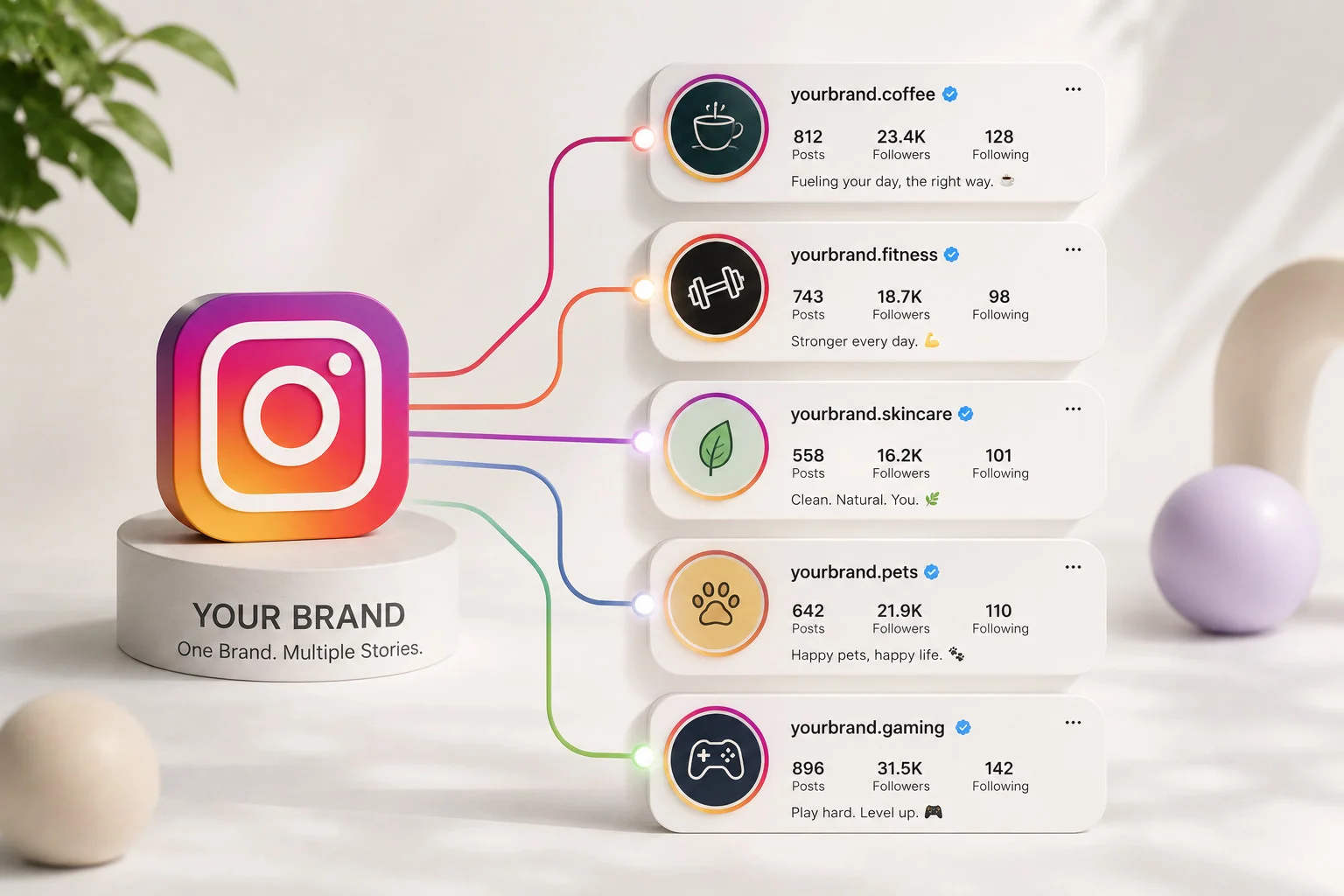
One brand. One handle. One voice. That used to be the rule. It’s quietly becoming the ceiling.
You hit 15K followers. You earned every one, post by post, over a couple of years. No agency. No ad money.
So why does it feel like fewer people see your posts each week?
You’ve probably already tried:
- Posting more often
- Switching to Reels
- Posting at the “best” times everyone talks about
Your follower count holds steady. Your reach keeps dropping anyway.
You’re not imagining it. People ask this exact question out loud: “Is it better to keep sub-brands under one account or run separate accounts? It’s tedious, but is it worth the trouble?” (Quora).
Here’s what nobody tells you. The average Instagram post now reaches only about 3.5% of a brand’s followers, down about 12% in one year. The big following you built no longer protects you. [Socialinsider]
This isn’t a “how to handle your accounts” guide. It’s the reason why running more than one account, even one that doesn’t look like you, is now a way to grow.
One account used to be enough. The app showed your posts to most of your followers. That deal is over.
Two things break at the same time. Let’s take them one at a time.
Problem 1: The reach limit
Years of social media algorithm updates have turned reach into a hard ceiling. The reach limit is the point where more followers stop getting you more views, because the algorithm shows each post to only a sliver of your audience no matter how big it gets.
The numbers tell the story:
- 2020: a normal post reached about 10 to 15% of your followers
- 2025: that dropped to about 2 to 3%
- Big accounts (10K+): many now reach under 1% of their own followers per post
Example: You have 15K followers. At under 1% reach, a post shows up for about 150 people. Grow to 30K and you’re still talking to a tiny corner of a room you spent years filling.
More followers on the same account is no longer the lever. The app already decided that.
Problem 2: One voice can’t talk to everyone
When one account tries to serve every customer, the posts slide into a safe, boring middle. Nobody gets excited.
Think about who follows you:
- New buyers who need to trust you first
- Regulars who want behind-the-scenes stuff
- People who came for one product and ignore the rest
Example: You run a coffee brand. New buyers want “how to brew this.” Regulars want the new seasonal blend. Wholesale cafés want bulk deals. One post can’t excite all three. So you write something that kind of fits all three, and “kind of” doesn’t get shared.
Real owners feel this. They start asking: “Should I separate Instagram accounts for different niches?” (Quora).
Want each account to still feel like you while sounding different? Start with a consistent brand identity across accounts, so they read as one brand, not three strangers.
How to Decide: Sub-Brand Account vs Off-Brand Account
A brand portfolio social media strategy means running more than one account for a single brand on purpose, where each one is built to reach a specific audience with a specific voice, instead of forcing one handle to do all of it. You stop thinking like a single channel and start thinking like a small network.
That network usually has two types of accounts, and people constantly mix them up. Picking the wrong one for your goal is why a lot of second accounts flop. Here’s the line, side by side.
| Sub-brand account | Off-brand account | |
| What it is | An official, on-brand account for one product line, location, or audience segment | An account that doesn’t look or sound like your brand at all, built around a character, joke, or niche |
| Voice | Your brand voice, just narrower and more focused | A separate persona; often doesn’t mention the brand directly |
| Goal | Reach and convert a specific segment without diluting the main account | Reach new people who’d scroll past an obvious ad; build personality and word of mouth |
| Example | A skincare brand running a separate account for estheticians | Arby’s Boys, a fan-style page that barely reads as Arby’s |
| Best when | You have distinct customer segments, regions or product lines | Your category is boring, crowded, or “ad-allergic” and polish is working against you |
A sub-brand account is the safer, more obvious move. An off-brand account is the one driving the trend you keep seeing in your feed, because it sidesteps the exact problem from the last section: the moment something looks like an ad, people put their guard up.
You don’t have to run five of these. The smartest small version is two accounts: your main handle for trust and selling, and one focused second account for reach. That’s the whole shape. Now let’s look at who’s already doing it and what it’s getting them.
Popular Brands Already Running a Portfolio of Accounts
You’re not the first to wonder if this works. Some of the loudest social wins of the last year came from brands that stopped relying on their official account and spun up a second one with a totally different job. None of these are theory. They’re live accounts you can go look at right now.
1.Arby’s Boys (a fan page on purpose)
An agency called Cousin Labs builds off-brand “fan pages” for companies. Their best-known one is Arby’s Boys, a page that barely reads as Arby’s at all. Rachel Karten interviewed the agency making these fan pages.
The difference is the whole point. The official @arbys account (around 408K followers) posts menus, deals, and brand news for people who already buy. Arby’s Boys is pure off-brand comedy: skits about a group of guys obsessed with Arby’s, with no hard sell. That freedom to not act like the brand is exactly what let it pull reach the polished main account never could.
The result:
- 100 million+ views in about the first six months
- Zero paid ads (source)
Why it works: the page doesn’t carry the weight of the official brand, so people share it like a meme instead of skipping it like an ad.
2. Instagram’s own finsta, @notfit4main
Here’s the clearest sign this isn’t a fringe trick: Instagram, the app itself, quietly runs an off-brand account.
A finsta (“fake Instagram”) is a low-key second account for a smaller, more real audience – name @notfit4main. The opposite of a polished main feed. Rachel Karten found Instagram’s own finsta, @notfit4main, where the brand posts loose, messy content it would never put on its main page.
Here’s the breakdown of why it works:
- What it is: a second, anonymous-feeling account that drops Instagram’s polished brand layer entirely.
- Why they run it: to post raw, experimental, “ugly” content without risking the main brand’s image.
- How it pays off: lower stakes mean more creative freedom, which reads as human and pulls engagement a corporate feed can’t.
When the company that owns the feed decides one account isn’t enough, that should settle it.
3. Ryanair and Duolingo
The most-shared brand accounts win by not acting like brands:
- Ryanair: leans into being cheap and a little rude
@ryanair get a grip 🙄#ryanair ♬ original sound – Ryanair
- Duolingo: turned a green owl into a wild, chaotic character
Duolingo’s unhinged videos have driven engagement rates as high as 21.5%, far above typical brand benchmarks, according to an Enrich Labs case study on their social media strategy. It works because the content doesn’t feel like Duolingo selling you a language app, it feels like a character you follow for fun.
And Duolingo runs a portfolio, not one account. The main handle is the unhinged global character. Separate region accounts, like Duolingo Deutschland (around 1.9M TikTok followers, run apart from the ~17M main account), speak each market in its own language and humor. That’s the same split as Arby’s and Instagram: one account protects the brand, the others are free to go where the brand can’t.
You see the same pattern across brands winning with wild marketing and the wider 2025 social media trends. And where each account lives isn’t random. It comes down to choosing the right platform for the audience you want.
Why Off-Brand Accounts Beat Official Ones
Your official account starts at a disadvantage, and it’s not your fault. People scroll with their guard up. The second something looks like a brand selling, attention drops.
Two things explain it.
Real beats polished
- The cleaner a post looks, the more it screams “marketing,” and the faster people scroll past
- Raw, slightly weird content reads as a person, not an ad
Example: A phone-shot clip of your staff messing around gets more views than a glossy product video. Same product, very different reactions.
Your main account can’t go fully wild. It has to protect the brand and close sales. That’s exactly why a separate account feels free; it’s allowed to be weird.
People get attached to characters, not logos
- You don’t form a bond with a logo
- You do form one with Duo the owl or the voice behind Arby’s Boys
A fan-style account acts like a person with an opinion, not a company chasing a target. People follow it, quote it, and defend it. That’s reach you can’t buy.
How to Build Your Own Set of Accounts
You don’t need a big budget. You need two accounts with two clear jobs, and a way to run them without doubling your hours. Here’s the step-by-step.
Step 1: Find the audience your main account is ignoring
Before you open an account, find the people your current feed isn’t serving. Your second account only earns its place if it has a group of its own to talk to.
Tips to do this:
- List every group that follows you: new buyers, loyal regulars, niche fans, wholesale or B2B.
- Read your comments and DMs for the requests your main feed keeps skipping.
- Find the posts that overperform with one small sub-group; that’s a hidden audience.
- Look at who your competitors’ niche or off-brand accounts pull in.
- Pick the one group whose content barely fits your main feed. That’s your second account’s job.
This is just understanding your audience on each platform and being honest that one feed can’t serve them all.
Step 2: Define the character, not the brand
A second account fails when it’s just “more brand.” Decide who it is, not what it sells. This is also where you choose sub-brand or off-brand.
Tips to do this:
- Pick the type: sub-brand (your voice, narrower) or off-brand (a separate persona). Use the table above.
- Sum up the personality in one line (“the unfiltered intern,” “the gear nerd who tests everything”).
- Write three sample posts in that voice before you commit to it.
- Decide what it will never do (no hard selling, no press-release tone).
- Give it a name that stands on its own, not “@yourbrand2.”
Step 3: Pick the right platform for that audience segment
Don’t default to where your main account already lives. Put the new account where its audience and its format already win.
Tips to do this:
- Match format to platform: personality and short video → TikTok or Reels; visual or product → Instagram; B2B → LinkedIn.
- Go where that specific audience already scrolls, not where you’re most comfortable.
- Check which platform rewards the content type you’ll actually make most weeks.
- Start on one platform, prove it works, then expand.
- Leave the polished main account where it already performs.
Choosing the right platform matters more than being everywhere.
Step 4: Keep it separate, with no corporate bleed
The fastest way to kill an off-brand account is to make it sound like the brand again. Keep the voices apart on purpose.
Tips to do this:
- Don’t cross-post the same content to both accounts; that ruins the point.
- Give each account its own lane in your content plan for multiple accounts.
- Keep logos, hashtags, and CTAs light or absent on the off-brand one.
- Let the person running it actually have a voice; heavy approval flattens the fun.
- Cross-promote rarely and only when it genuinely adds value.
Step 5: Run multiple accounts without operational chaos
This is the step that stops most people, and it’s the wrong reason to quit. The fear is real: more logins, more calendars, more dropped balls. But that’s a workflow problem, not a strategy one, and it’s the cheapest part to fix.
Tips to do this:
- Put every account on one calendar so nothing collides.
- Give each account its own posting queue so the voices stay separate.
- Use roles and approvals so a teammate can post in their account without sharing passwords.
- Track each account on its own to see which one reaches which audience.
A single dashboard for managing multiple social media accounts covers all four. The good news is that this doesn’t require more hours or more people, it requires a better workflow. Tools like SocialPilot let you manage multiple social accounts from one dashboard, keep separate content calendars and posting queues for each brand, and collaborate with teammates through roles and approvals instead of shared passwords.
You also get account-level analytics, so it’s easy to see what’s working for each audience and scale without the operational chaos. If the admin is the only thing standing between you and the strategy, that’s the cheapest problem here to fix. You can start a free SocialPilot trial and see your accounts side by side first.
Conclusion
You’ve been stuck on a wall that effort can’t break, because the limit is built into the one-account setup, not into how hard you work. You don’t have to tear everything down. Just pick a second account with one clear job this month, give it its own voice, and run both from one place.
Stop trying to make one account reach everyone, and start thinking like a small network. The brands beating you already do.





 Join 55,000+ social media managers


