

You’ve probably been through something like this before.
You started out small, maybe as a solo freelancer or with just one other person. Clients found you through referrals, and things picked up. You hired a team, got new tools, built content calendars, and followed all the advice you read in the “grow your agency” playbook.
But then, somehow, the quality of your content began to slip.
Your posts lost their edge, brand voices became less consistent, and you were still handling everything yourself. You worked harder, but the results just kept slipping.
You’re not alone in this.
As much as we have seen, quality dilution in agencies is pretty normal. Every agency goes through this phase. This could be at client 8, client 12 or even client 25.
Agency veteran Andy Golpys of MadeByShape puts it at twenty-five —
“If there are more than 25 active clients, you run into a client dilution issue. [Databox, 2025]”
But just grinding along until you hit that number isn’t the move. Let’s get into what’s actually breaking and how to stop letting your own lack of systems sabotage the work you used to be proud of.
Your First 10 Clients Run on One System: You
In the early phase of agency building, quality doesn’t come from the process. It comes from you — your taste, your recall, your ability to hold multiple brand voices and client contexts in working memory and write to each of them naturally.
Up to around 8 clients, this works. You know each brand the way you know a close friend’s sense of humor – no reference doc needed. You catch weak writing before it ships. You make judgment calls in seconds, and they’re almost always right.
At this point, you’re not running a system; in fact, you are the system.
Sure, it felt good, and that’s probably why you thought it would actually scale.
But it doesn’t. It never did. Here’s why.
What Actually Breaks at Client #12
By client 12, something shifts, but this shift isn’t obvious.
Some clients still get great work, while others just get… decent work and “decent” is where things start going wrong.
Because you know it’s not your best and the client knows it too, even if they haven’t said it yet. You tell yourself it’s a bandwidth problem, while in reality it’s a systems problem.
But what really happened here? Let’s find out.
1. You Never Documented the Account Briefs
Every client you manage has an unwritten rulebook – content pillars, tone, audience quirks, what they like, what they hate.
At 8 clients, most of it lived in your head, and it still worked. So, you thought of never documenting it.
Your “onboarding brief” was just a messy brain dump across a Google Doc, some Slack threads, and a few Zoom calls nobody watched again. It worked because you were involved in everything.
Now you’ve got twelve clients, and your team is guessing the brand voice from old posts and hoping they get it right.
The below thread from r/Agency talks about a very valid point. In the absence of documented account briefs, everything will be a lot of interpretation, judgement and back-and-forth every time your team works for the client.
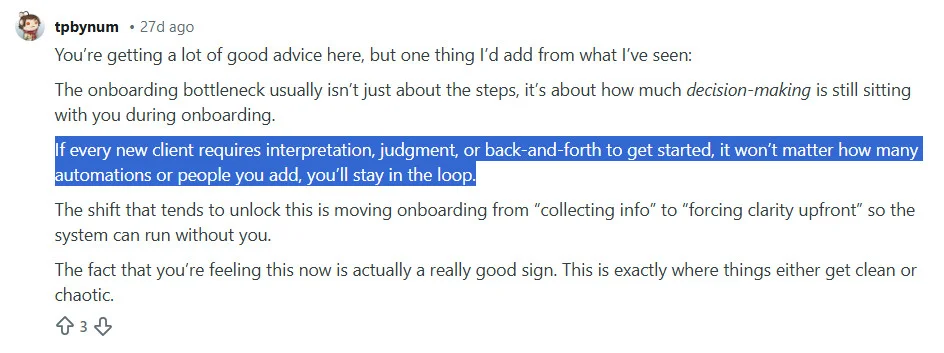
When there’s no documented brief, every new writer scrolls through old posts, dig through emails, and keeps guessing what the client wants. That’s not onboarding – that’s archaeology.
The IPA BetterBriefs Project looked at this across agencies and found poor briefs waste about 33% of marketing budgets. [IPA / BetterBriefs, 2021]
33%. Not 5%. A third of your budget – gone because nobody wrote things down properly.
2. Lack of Automation is Bleeding Your Time and Money
Let’s have some real talk – what is your team actually doing all week?
Are they manually publishing posts, chasing approvals over email, or still building reports from scratch every month?
None of that is creative work; it’s busywork, that’s just eating away all your time.
Most agencies don’t fail because the content sucks. They fail because operations are a mess. You can’t hire your way out of this. And stacking tools doesn’t fix it – especially when nothing connects.
Every new client just adds more manual work, more scheduling, more approvals, and more reporting.
You’re not scaling; you’re just piling more work.
Here’s what adding just three clients – going from 12 to 15 – will cost you in hours:
| Process | Per unit | 12 Clients | 15 Clients | Added Hours |
| Posting | 15 min/post | 60 hrs/month | 75 hrs/month | +15 hrs |
| Approval chasing | 12 min/post | 48 hrs/month | 60 hrs/month | +12 hrs |
| Rework (no brief) | 3 hrs/client | 36 hrs/month | 45 hrs/month | +9 hrs |
| Reporting | 2.5 hrs/client | 30 hrs/month | 37.5 hrs/month | +7.5 hrs |
| Brief reconstruction | 2 hrs/client | 24 hrs/month | 30 hrs/month | +6 hrs |
| Total | 198 hrs/month | 247.5 hrs/month | +49.5 hrs |
Three new clients. 49.5 extra hours a month.
At a blended rate of $40/hour:
3 new clients × $1,000 = $3,000 extra revenue
49.5 hrs × $30 = $1,485 extra overhead
Also, here is what your weekly review reality looks like:
| Activity | 12 Clients | 15 Clients | Added |
| Posts/week | 12 × 3 = 36 posts | 15 × 3 = 45 posts | +9 posts |
| Content pieces (×3 platforms) | 108 pieces | 135 pieces | +27 pieces |
| Revision rounds (×2) | 216 actions | 270 actions | +54 actions |
| Review time (×15 min) | 54 hrs/week | 67.5 hrs/week | +13.5 hrs/week |
67.5 hours a week just reviewing content – that’s not a flex, but a mess.
Research on decision fatigue shows that the quality of your professional decisions can drop from 65% to near zero within a single long session of continuous decision-making. [Danziger et al., PNAS, 2011].
So, by the end of the day, you’re not reviewing anything. You’re just clicking approve.
Not good. Not great. Just… “fine, publish it.”
3. Your Writers Aren’t Creating Anymore. They’re Surviving.
Your team has no real briefs. They’re juggling five client voices, switching accounts every hour, and trying to remember what “casual but professional” means for Client A vs Client D.
Operating in this survival mode is killing their creativity.
Research from the American Psychological Association shows task-switching can cost up to 40% of productive time. [APA, 2001] Also, Gloria Mark’s research at UC Irvine found that after an interruption, it takes an average of 23 minutes and 15 seconds to get back into deep focus. [Mark, UC Irvine / CHI 2008]
So if a writer switches between five clients a day, they’re never fully locked in for any of them. They’re working at maybe 60% capacity, on a good day.
4. You Have More Clients. Not More Profit.
Let’s do the math you’ve been avoiding. Most agency owners look at revenue and go, “we’re killing it” or “see, we went from $5,000/month to $12,000/month.”
While this may feel like a win, it’s not. Here is what actually happened:
| 5 Clients | 12 Clients | 15 Clients | |
| Monthly Revenue | $5,000 | $12,000 | $15,000 |
| Team Costs | $2,000 | $8,100 | $10,500 |
| Tool Subscriptions (multiple) | $150 | $500 | $700 |
| Rework & Coordination Overhead | $300 | $1200 | $1,800 |
| Net Profit | $2,550 | $2,200 | $2,000 |
| Profit Margin | 51% | 18.3% | 13.3% |
Revenue went up, but the profit went down.
Every new client = panic hire, another tool, more back-and-forth, more mess. You didn’t build a system. You just kept stacking people and hoping it wouldn’t break.
Be honest – are those hires actually making you more money, or are they just stopping things from blowing up?
Most small agencies (10–24 FTE) often operate at an average of 15% profit margin. While larger agencies (25+ FTE) average 13% project profitability. Notably: 59% of agencies grew revenue, but only 31% improved margins. [Productive.io]
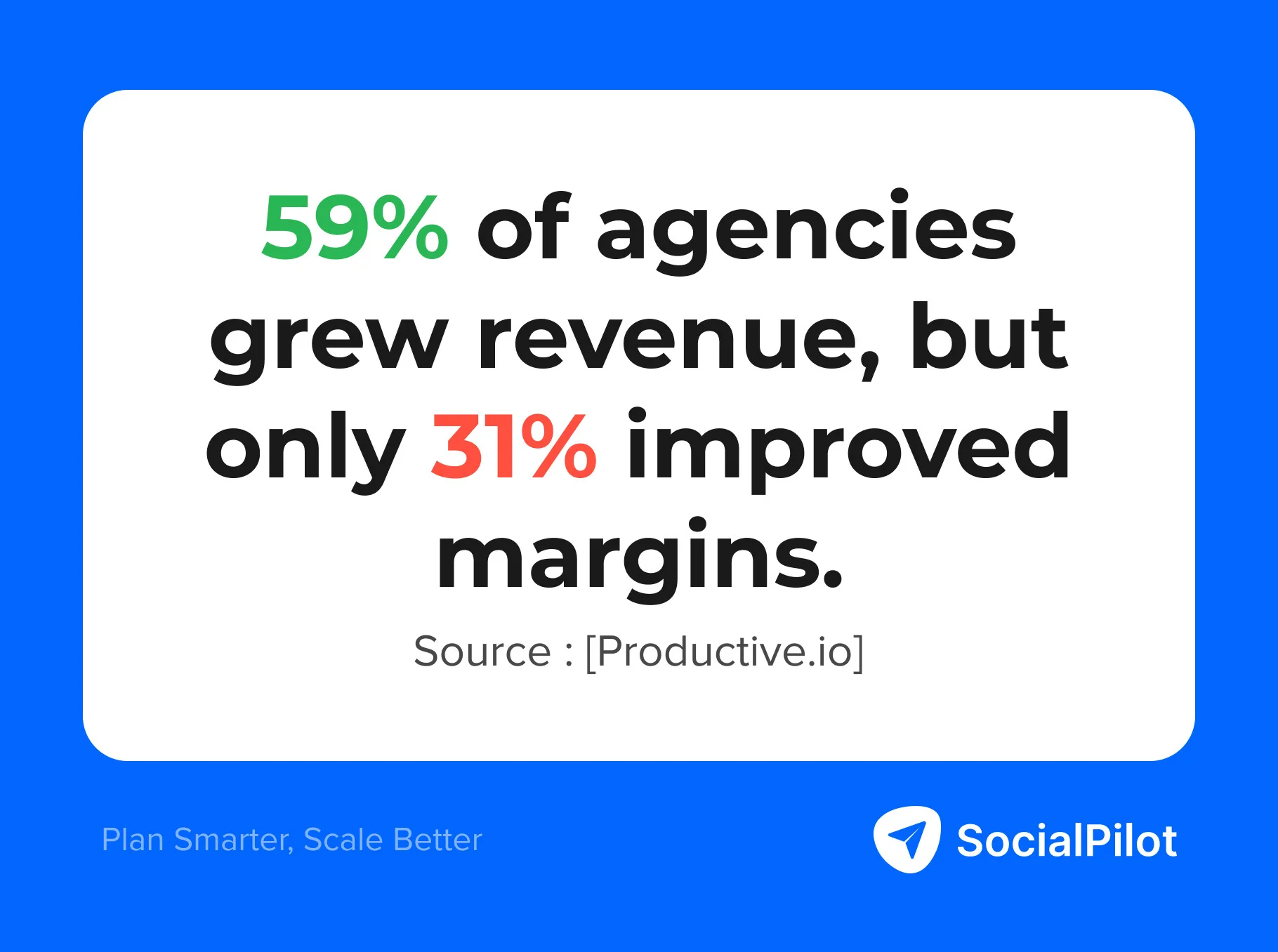
Most agencies fall in this never-ending loop of more clients, more people, more tools, and thinner margins.
Is that even scaling or a treadmill?
So, How Do You Grow from Here While Maintaining the Content Quality?
Alright, we have done enough diagnosing; let’s fix these issues now.
We went through multiple threads on r/AgencyGrowthHacks. The agencies that actually scaled clean didn’t work harder. They got their act together.
Here’s what you must do and not do:
1. Stop Keeping Client Briefs in Your Head
Yeah, this one’s on you.
Having worked with thousands of agencies at every growth stage, we’ve seen this pattern more than any other. We have seen agencies stall not because they are short on talent, but short on documentation.
This thread by u/Kindly_Watercress416 put it plainly:
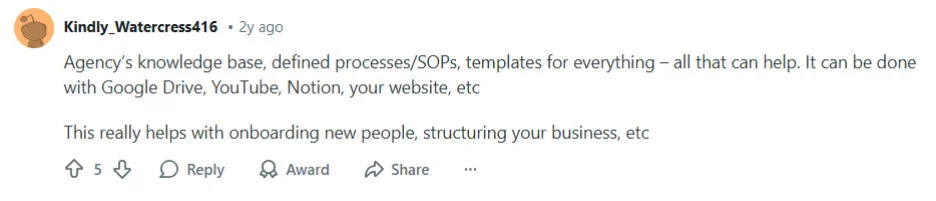
Build a real brand doc for every client. Not some half-baked onboarding notes. A proper doc – voice, tone, ICP, content pillars, platform rules, what works, what’s been rejected.
Keep it where the whole team can see it. Update it every time something important gets approved, or some edits are suggested. Overtime, this will help you improve your content quality.
Your writers shouldn’t be guessing – if they are, you dropped the ball.
2. Replace Fragmented Tools with One Automation Platform
At 12+ clients you would need to invest in some tools. And no, we are not talking about using 4 different tools. You need fewer tools that actually work together. Like one tool for social media automation and one for in-house communication.
Yes, that would be enough.
For social media automation, find yourself a tool that handles scheduling, client approvals, publishing, reporting, and analytics – all in one place, without switching tabs.
Here is how it saves you time:
| Task | Manual (12 clients/week) | With a Tool | Time Saved |
| Scheduling posts across 3 platforms | 9 hrs | 1.5 hrs | 7.5 hrs |
| Chasing approvals across email/WhatsApp | 6 hrs | 1 hr | 5 hrs |
| Context-switching between accounts | 4 hrs | Minimal | 4 hrs |
| Compiling reports | 6 hrs | 15 min | 5.75 hrs |
| Total | 25 hrs/week | 3 hrs/week | 22 hrs/week |
You end up saving ~22 hours every week with a tool.
At 12+ clients, you should look for tools that help you:
- Manage multiple clients
- Centralize approvals
- Schedule in bulk
- Use AI drafts
- Track analytics
Here are some tools that can help:
| Tool | Multi-Client Workspace | Native Client Approvals | AI Content Generation | Bulk Scheduling | Advanced Analytics |
| Buffer | Limited | ✗ | Limited | ✓ | Limited |
| Later | Limited | Limited | Limited | Limited | Limited |
| Hootsuite | ✓ | ✓ | ✓ | ✓ | ✓ |
| Sprout Social | ✓ | ✓ | ✓ | ✓ | ✓ |
| Metricool | ✓ | Limited | Limited | ✓ | ✓ |
| SocialPilot | ✓ | ✓ | ✓ | ✓ | ✓ |
Three tools that can help you with all your agency requirements are SocialPilot, Hootsuite, and Sprout Social.
While the standard plan for Hootsuite and Sprout Social will cost you $249 and $199 per seat respectively, SocialPilot, comes at a flat pricing $170 for unlimited users. Choose a tool that best suits your agency’s scaling needs.
3. Give Your Writers Room to Think, Not Just Deadlines to Meet
If your writers are always executing, nobody is ever thinking. That’s how you end up with content that’s technically correct and completely forgettable.
“Writing is thinking. To write well is to think clearly. That’s why it’s so hard.
– David McCullough”
For writers to create well, agencies can run regular creative sessions, bring the team together to workshop ideas, dissect what’s working across clients, and build shared creative instincts.
Provide them tools that help them overcome their creative blocks. Allow them to block a few hours a week for just thinking, reading, and building taste. Build an environment where your team isn’t afraid to pitch ideas that might not land.
Survival mode kills that instinct fast.
You must also separate the process of creation and scheduling. When writers are not constantly wrestling between creative thinking, scheduling, and approvals, they will end up creating something better.
Here is a thread that mentions how separating the activity of creation and scheduling can help writers maintain their content quality.

4. Get Better Margins with the Same Clients
You don’t need a bigger client roster; you just need to stop hemorrhaging money on fragmented tools, constant rework, and reactive hiring.
Three things that are quickly eating your margins are multiple tool subscriptions, lack of coordination from messy workflows, and freelancer dependence due to lack of inhouse efficiency. This chaos is not just bleeding your margins but also degrading your content.
When you switch to one consolidated tool for content creation, scheduling, approvals, reporting, and client management, these costs can drop sharply.
Here is the math, after these leaks are fixed:
| 5 Clients | 12 Clients | 15 Clients | |
| Monthly Revenue | $5,000 | $12,000 | $15,000 |
| Team Costs | $2,000 | $6,000 | $7,500 |
| Tool Subscriptions (flat rate) | $170 | $170 | $170 |
| Rework & Coordination Overhead | $300 | $450 | $600 |
| Net Profit | $2,530 | $5,380 | $6,730 |
| Profit Margin | 40.6% | 44.8% | 44.9% |
Even with the same revenue and client count, the margin nearly doubles at 12 clients – from 18.3% to 36.5%.
That’s not magic. That’s what happens when you switch to one flat rate tool (because per seat prices can quickly add up), create cleaner workflows to reduce revisions and reduce your dependence on ad hoc freelancers.
And when your team isn’t burning hours on tool chaos, their bandwidth goes back into the work, thus improving the content quality.
Putting it All Together
Here’s the bitter truth: Your content didn’t drop because your team got casual. It dropped because your system never existed.
You treated your brain like a system, and it broke eventually. This could be at client 10, 15, 20 or even 50.
The fix to this isn’t pulling late nights, hiring more or buying more tools.
It’s just getting things out of your head. You must document brand voices, switch to one consolidated social media tool, give creative space to your writers and build better systems for better revenue and content quality.
Use tools like SocialPilot, Hootsuite or Sprout Social to create multi-client workspaces, set up native approval workflows, and bulk scheduling. You can also create content libraries with SocialPilot where you can store your top-performing posts that writers can repurpose later.
Once the system exists outside your head, client twelve stops being a wall. It’s just another account.
Sources and Citations
- Golpys, A. (MadeByShape), cited in Databox. “How Many Clients is Too Many? The Ideal Client Number Agencies Should Have to Optimize Their Profit Margins.” Databox. — https://databox.com/how-many-clients-agencies-need
- IPA & BetterBriefs Project. (2021). “Global Research: One Third of Marketing Budgets Could Be Wasted Due to Poor Briefing.” Institute of Practitioners in Advertising. — https://ipa.co.uk/news/betterbriefs
- American Psychological Association. (2001). “Multitasking: Switching Costs.” APA Monitor on Psychology. — https://www.apa.org/monitor/oct01/multitask
- Mark, G., Gudith, D., & Klocke, U. (2008). “The Cost of Interrupted Work: More Speed and Stress.” Proceedings of the SIGCHI Conference on Human Factors in Computing Systems (CHI ’08), ACM. — https://ics.uci.edu/~gmark/chi08-mark.pdf
- Productive.io. (2024). State of the Agency Industry Report. —https://productive.io/reports/agency-industry-report/
- Danziger, S., Levav, J., & Avnaim-Pesso, L. (2011). “Extraneous Factors in Judicial Decisions.” Proceedings of the National Academy of Sciences, 108(17), 6889–6892. — https://www.pnas.org/doi/10.1073/pnas.1018033108
- r/socialmediamanagers. “How do you balance content quality and posting consistency?” Reddit General Discussion thread. — https://www.reddit.com/r/socialmediamanagers/
- r/AgencyGrowthHacks. “How do you scale an agency rapidly without sacrificing the quality of work that attracted clients in the first place?” — https://www.reddit.com/r/AgencyGrowthHacks/comments/1b7x7jl/how_do_you_scale_an_agency_rapidly_without/





 Join 55,000+ social media managers


