
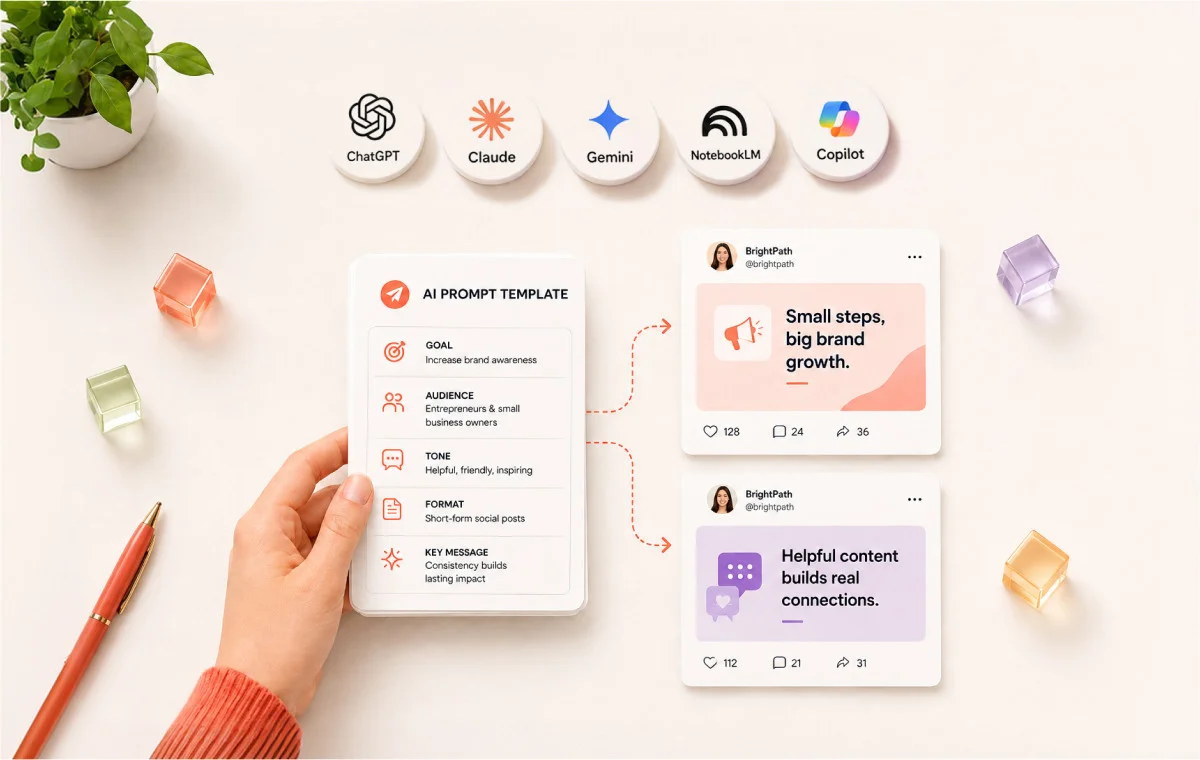
AI writes a week’s worth of social media posts in minutes. You spend the next 20 minutes rewriting them to sound like your brand.
That’s the reality for most marketers using AI today. Writing is faster, but editing has become the bottleneck. The output is often too generic, too polished, or filled with the same phrases everyone else is posting.
The problem isn’t AI itself. And most of the time, it isn’t even the prompt. It’s that every prompt starts from scratch. One person finds something that works, another rewrites it differently, and before long, your team’s content sounds inconsistent again.
The solution isn’t collecting hundreds of prompts. It’s building a repeatable prompting system that captures your brand voice, improves with every iteration, and gives everyone on your team a consistent starting point.
This article shows you how to build a prompting system your team can actually reuse, one that produces consistent, on-brand social media content instead of different results every time.
Why Copy-Pasted Prompts Never Quite Sound Like Your Brand
Copy-pasted prompts fall flat because they carry none of your context. A generic prompt asks a model to guess your audience, your voice, and your goal, so it defaults to the safest, most average phrasing available. That average quality content is exactly what everyone else gets, too.
There is a mechanism behind this. Large language models predict the most probable next word, so without strong constraints they gravitate toward median, high-probability phrasing, the constructions that appear most often in training data. Human writing is irregular and slightly unpredictable. Default model writing is smooth and interchangeable. That gap is why the output reads as fluent but faceless.
Here is the difference in practice, same topic, two prompts:
Generic prompt output:
Context-rich prompt output:
Same feature. One could belong to any company on earth. The other could only be yours.
If you want the broader role of AI in social media to help your brand specifically, the fix starts with what you feed the model, not which model you pick. A better model still averages toward the middle when you give it nothing to anchor on.
The Real Cost: Editing Time, Not Writing Time
The real expense of weak prompting is not the draft. It is the edit. When a caption comes back almost right but not quite, the fixes stack up fast:
- Rewrite the hook so it stops sounding like a press release.
- Cut the hype words (“thrilled,” “next level,” “game-changing”).
- Fix the rhythm so it reads like a person, not a template.
- Add the one specific detail only you know.
Do that across a week of posts, and the time AI saved on the blank page quietly returns as editing. AI tools like ChatGPT can generate up to 2,000 words in minutes, but most of that content still needs a human pass before it’s ready to publish. The AI writes the first draft; the human shapes it into something the brand would actually say.
If every AI draft needs heavy rewriting, the problem usually isn’t the model. It’s the prompt. Give AI more of your brand voice upfront, and you’ll spend far less time editing.
What a Working System Fixes That a Prompt List Can’t
A prompt system is a documented, reusable setup, a brand-voice reference, tested templates, an iteration habit, and a way to measure results, that anyone on your team can pull from to get consistent output. A prompt list gives you words to paste. A system gives you a repeatable process, which is the difference between one good post and a hundred on-brand ones.
Here are key differences:
| A prompt list | A prompt system | |
| Carries your brand voice | No | Yes, encoded once and reused |
| Survives a teammate leaving | No | Yes, it is documented |
| Gets better over time | No | Yes, you feed results back in |
| Tells you what actually works | No | Yes, it is measured |
A working system rests on four properties: it encodes your brand voice, it builds in iteration, it lives in documentation your team actually opens, and it measures what lands. The rest of this guide builds each one, then grades the techniques honestly so you standardize only what earns its place.
Building the System: Encoding Brand Voice into Every Prompt
Encoding brand voice means giving the model a compact, reusable reference of how your brand sounds, then pasting it into every prompt so the output starts closer to on-brand. It is the single move that changes output the most, because voice is the thing generic AI gets most wrong. Done once and documented, it becomes part of a brand’s content strategy instead of a habit stuck in one person’s head.
The goal is not a fifty-page brand bible. It is a short reference the model can hold in a single prompt.
What to Actually Include (Context, Tone, Constraints, Audience)
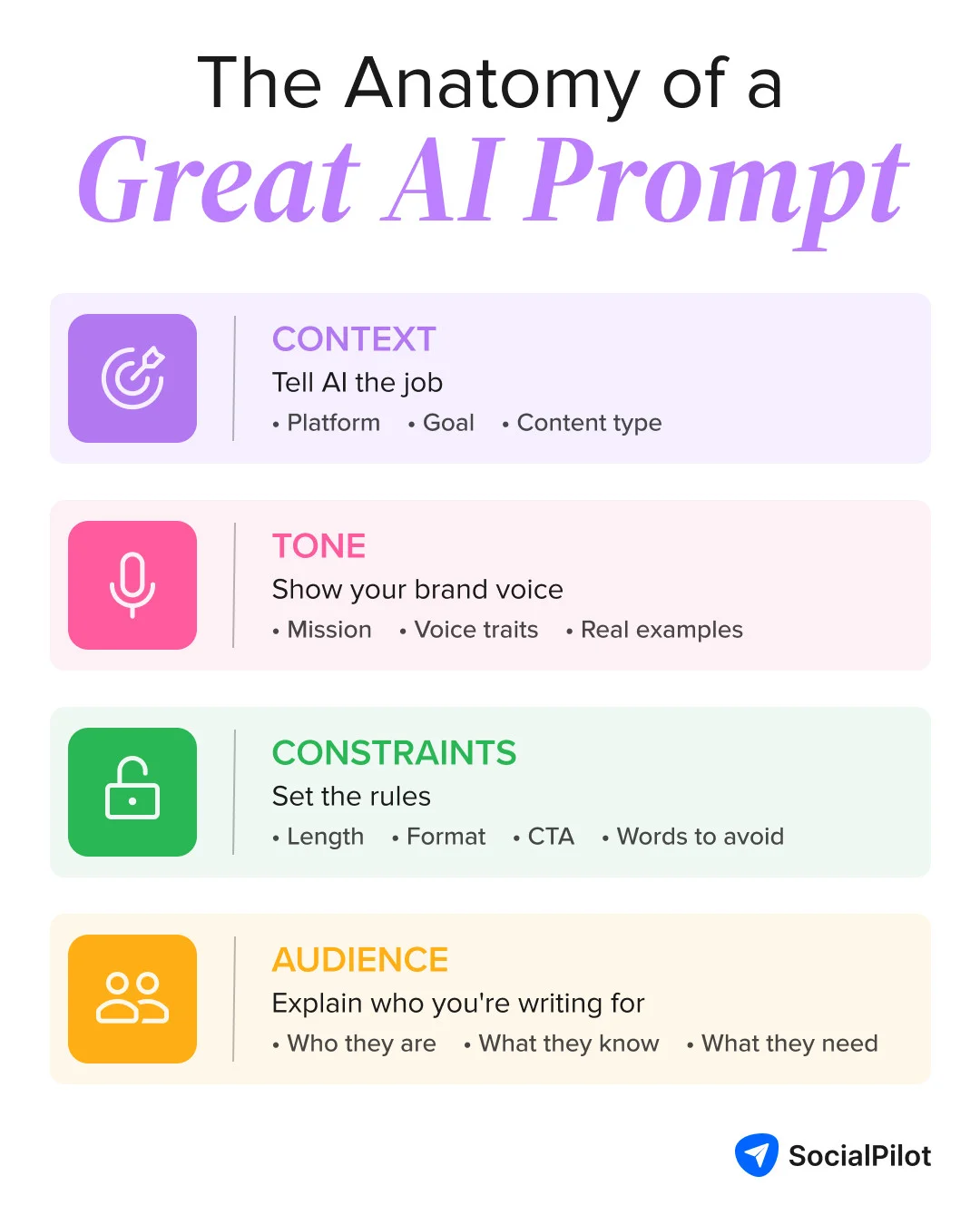
Every strong prompt carries four things. Miss one and the model fills the gap with its own average guess:
- Context: what the post is for, where it runs, and what it should do.
- Tone: your voice attributes, shown rather than described.
- Constraints: length, format, banned words, and any required call to action.
- Audience: who reads it and what they already know.
Tone is where a reusable brand-voice reference earns its keep. Practitioners on Quora converge on a spine short enough to paste into any prompt:
- A one-sentence mission that says what you do and for whom.
- Three to five voice attributes, each with a Do and a Don’t.
- Eight to twelve real sample lines pulled from posts you are proud of.
- A short glossary of preferred and banned terms.
Here is what that looks like filled in for a sample brand, ready to paste at the top of any prompt:
Mission: We help ops teams kill busywork so they can do real work.
Voice attributes:
– Direct: do make plain claims. Don’t hedge with “we think.”
– Dry-witty: a light joke is fine. Don’t use exclamation points.
– Concrete: name the exact task. Don’t speak in abstractions.
Sample lines (match this rhythm):
– “Your Monday status report should not take your whole Monday.”
– “Fewer tabs. Fewer meetings. Same answers, faster.”
– “We deleted four recurring meetings. Nothing broke.”
Preferred terms: ops team, busywork, status report
Banned terms: seamless, world-class, next-level, turnkey
The sample lines matter most. Describing a tone as “friendly but not cheesy” asks the model to interpret an abstraction. Showing eight lines in your real voice gives it a pattern to match.
Show a sample, do not describe the tone, and the first draft lands closer.
A Real Before-and-After: Watching a Prompt Get Refined
No verifiable brand case study exists that isolates results from prompt-technique changes alone, so here is a worked example instead: one prompt refined across three passes for a mid-market project-management SaaS posting on LinkedIn. Watch the input carry more of the brand each round.
Pass 1, the generic ask:
Result: fluent and empty. It opens with “In today’s fast-paced world,” praises the feature in the abstract, and reads like a hundred other product posts. Nothing here is yours.
Pass 2, add context, audience, and constraints:
Audience: operations leads at 50 to 200 person companies who already use our tool for task tracking.
Their pain: they rebuild the same status report by hand every week.
Length: under 120 words. No hype words. Open with the pain, not the feature.
End with a soft question, not a hard CTA.
Result: now it opens on the weekly report grind and frames the feature as relief. Better, but the voice is still house-neutral.
Pass 3, paste the brand-voice reference:
Result: the draft sounds like the brand, dry, plain, specific, no exclamation points. The edit that took ten minutes after Pass 1 now takes one.
What changed across the three passes:
- Pass 1 to 2: added context, audience, and constraints. Biggest jump in relevance.
- Pass 2 to 3: added the voice reference. Biggest jump in sounding like you.
The lesson is not that Pass 3 is a perfect prompt to memorize. It is that iteration is the normal path, and the fastest way to shorten it is to move brand context into the input instead of fixing it by hand on the way out.
The Five Strategic Uses of AI Prompting
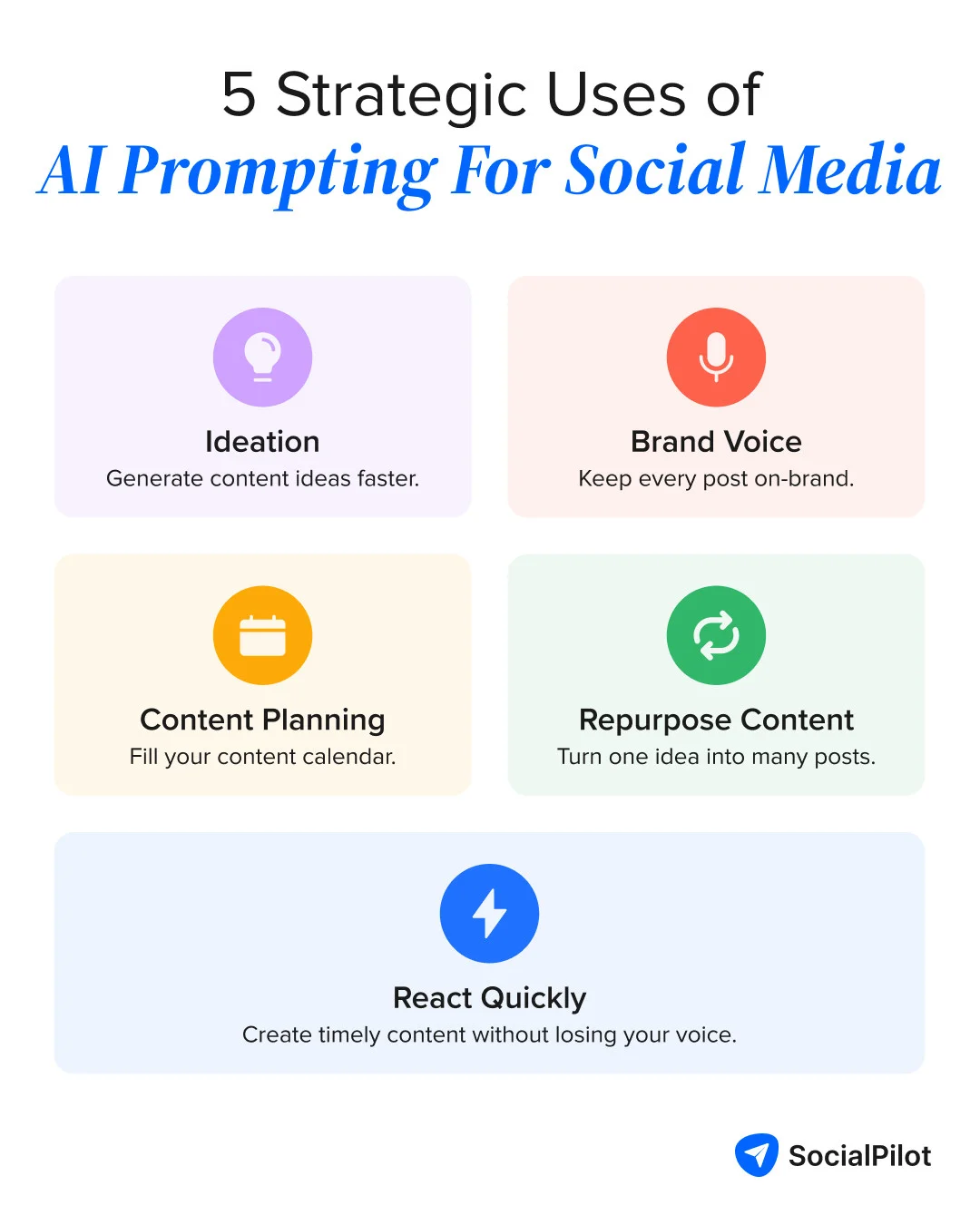
AI prompting earns its place in five strategic jobs:
- Ideation at volume: generating raw material to curate.
- Voice consistency at scale: keeping every post sounding like you.
- Content-calendar throughput: keeping the calendar full without the grind.
- Format repurposing: turning one asset into many.
- Fast, safe reactive content: moving quickly without going off-brand.
Organizing by function, not by content type, is what turns scattered prompts into a system. If you just want raw prompts to paste, a full library of ready-to-use prompts covers that catalog. The point here is different: when to reach for each job, which technique fits it, and how confident you should be that it helps.
Ideation at Volume
Use AI to generate raw material for human curation, not finished ideas. Models are strong at producing many variations fast, and the best technique here is few-shot prompting: give three examples that worked, then ask for more in that vein. Evidence confidence is high, because volume-then-curate plays directly to what models do well.
Prompts to try:
1. “Your Monday status report should not take your whole Monday.”
2. “We deleted 4 recurring meetings. Nothing broke.”
3. “The best project update is the one nobody had to attend.”
Give me 20 more hooks in this exact voice and length.Brainstorm 15 content angles on [topic] for [audience].
Mix formats: myth-busting, contrarian take, quick tip, behind-the-scenes.
No fluff. One line each.
List 10 questions our [audience] is too embarrassed to ask out loud about [topic]. These become post ideas.
Give me 12 “unpopular opinion” posts a [role] would nod along to. Keep each under 15 words.
Turn this one insight into 8 different hooks, each with a distinct emotional angle: curiosity, frustration, relief, surprise.
The discipline is curation. AI supplies the raw ore. You decide what is worth refining.
Voice Consistency at Scale
Use context-rich brand-voice prompts, not generic “act as a social media expert” openers. The technique that works is pasting your real voice reference and sample lines into the request, then asking the model to match and self-check. Evidence confidence is medium, a logical extension of showing examples rather than a lab-proven rule.
Prompts to try:
Keep the meaning. Change only tone and phrasing.
[paste voice reference + 8 sample lines]Here is our voice reference. Rewrite these 5 captions to match it, then flag any line that still sounds off-brand and say why.
Compare this caption against our sample lines. Score it 1 to 5 on “sounds like us” and list the exact words dragging it down.
Write 3 versions of this post at increasing levels of directness. Our voice leans direct, so tell me which version fits best and why.
Take this on-brand post and write 4 more on different topics that would feel like they came from the same writer.
The self-check prompts matter as much as the writing prompts. Asking the model to grade its own output against your samples surfaces the off-brand lines before a human has to.
Content-Calendar Throughput
Use documented templates plus an iteration loop to keep the calendar full without reinventing prompts each week. This is process discipline more than a model trick, which is why evidence confidence is high: reuse and iteration compound across a team regardless of the model. Pair it with a repeatable content workflow so the throughput has somewhere to land.
Prompts to try:
Using our caption template below, fill it for these 5 topics.
Do not change the template structure.
[paste template]
Draft next week’s 5 posts. For each, give me a v1, then a tighter v2 that cuts the filler and keeps only the strongest lines.
Review this week’s drafts as a batch and flag any two that sound too similar, then rewrite one so they do not compete.
Documented templates let a new teammate produce on-brand posts in week one instead of month three. The v1-to-v2 loop is the single habit every credible source agrees on.
Format Repurposing
Use structured reformatting prompts with explicit format constraints. Models reshape one idea into many formats reliably when you spell out the structure, so evidence confidence is medium. This is also where platform norms matter most; a thread and a carousel are not the same shape. For visual-first networks, platform-specific prompt ideas for Instagram go deeper on format.
Think of one webinar becoming a week of content:
- 1 LinkedIn post (the big takeaway)
- 1 six-slide carousel (the steps)
- 4 short-form video scripts (one tip each)
- 3 FAQ captions (the audience questions)
Prompts to try:
Slide 1 is the hook. Slides 2 to 5 are one point each.
Slide 6 is a soft CTA. Max 12 words per slide.Reformat this webinar transcript into 4 short-form video scripts, each 30 seconds, each with a single takeaway and an on-screen text line.
Compress this 200-word post into a 3-tweet thread. Tweet 1 must stand alone as a hook. No hashtags.
Turn these 5 customer questions into 5 FAQ-style posts, each with a plain-language answer under 40 words.
Explicit constraints (slide count, word caps, “no hashtags”) do the heavy lifting. Vague asks produce mush; precise structure produces something you can publish with a light edit.
Fast, Safe Reactive Content
Use lightweight pre-tested templates plus a short quality-control checklist. Speed is where brands post something off-brand or wrong, so the guardrail is the point, and evidence confidence is medium. Test your reactive templates on a calm day so they are ready when a trend breaks.
Prompts to try:
No jokes about anything sensitive. Match our voice reference.
Before a reactive post goes live, run it through a four-point gate:
- Verified? Every factual claim checked against a primary source.
- On-brand? Checked against the voice reference.
- Safe if it ages badly? It would not embarrass you if the trend sours in an hour.
- Second set of eyes? Someone else has seen it.
That gate is also the honest answer to “how much should I edit AI content.” You edit until all four are a yes, no less.
If you want to put these prompting patterns into practice without writing every prompt from scratch, SocialPilot’s AI Pilot helps you generate post ideas, rewrite captions in your brand’s tone, repurpose content for different platforms, and create hashtags, all within your content workflow.
The short demo below shows how it works.
What’s Actually Proven vs. Assumed: An Evidence-Graded Look at Popular Prompt Techniques
Most popular prompt advice is convention, not validated research, and some of it is contradicted by peer-reviewed work. That does not make it useless. It means you should test techniques against your own output rather than treating them as guaranteed wins.
Start with the sources people assume are authoritative. Neither Anthropic’s nor OpenAI’s own prompt-engineering documentation cites empirical studies or benchmarks to justify its technique recommendations; both are prescriptive guidance. Anthropic’s overview even tells you to empirically test prompts against your own success criteria rather than pointing to evidence for the techniques themselves.
The academic picture is honest about its own immaturity. “The Prompt Report,” the most thorough academic survey of prompting to date, states that the field “suffers from conflicting terminology and a fragmented ontological understanding of what constitutes an effective prompt,” and it catalogs 58 text-based prompting techniques (arXiv). When the largest survey in the field opens by admitting the vocabulary is a mess, treat any single technique claim with healthy caution.
Adoption is not proof either. The Social Media Examiner 2025 AI Marketing Industry Report, based on 735 marketers, found that 60% now use AI daily, up from 37% the year before, and 90% use it for text tasks. That measures how many people use AI, not whether any prompting technique improves the output.
Here is the honest scorecard for the techniques you hear about most:
| Technique | What people claim | What the evidence says |
| Role / persona (“act as a…”) | Always improves output | Mixed. Little to no gain on facts; helps creative tone |
| Structured formulas (RTF, CO-STAR) | A proven method | Convention, not research. Useful as a checklist |
| Few-shot examples | Underrated | Broadly supported. Worth standardizing |
| Iterative refinement | Optional polish | Broadly supported. The one habit everyone agrees on |
Role and Persona Prompting: What the Research Actually Shows
The verdict is mixed and task-dependent, not “always assign a role.”
Peer-reviewed work titled “When ‘A Helpful Assistant’ Is Not Really Helpful” finds that adding social-role personas to system prompts does not reliably improve model performance on factual question-answering, and that the effect of any given persona is close to random (arXiv).
Role framing does tend to help creative and style tasks, where tone and direction matter, a nuance drawn out by syntheses from Learn Prompting and PromptHub.
So, the honest split looks like this:
| Task type | Does a role or persona help? |
| Factual, accuracy-driven (answering questions, summarizing data) | Not reliably; the effect is close to random |
| Creative or style-driven (captions, hooks, brand voice) | Often yes; it nudges tone and direction |
“act as a witty copywriter” can be a reasonable tone nudge, but it is not a quality guarantee, and it will not make the model more factually correct. Do not standardize it as a rule that lifts everything.
Structured Formulas (RTF, COSTAR, and Similar): Convention, Not Validation
Structured formulas are useful checklists, not validated science. RTF, CO-STAR, CRISPE, and RACE trace to individual practitioners, vendor blogs, and a government-agency team, not to peer-reviewed research (Parloa’s frameworks explainer traces several of them).
CO-STAR, for instance, comes from GovTech Singapore’s data-science team and was popularized when Sheila Teo won Singapore’s 2023 GPT-4 prompt-engineering competition (her writeup).
That origin does not discredit them. A checklist that covers context, tone, constraints, and audience is genuinely helpful because those are the four building blocks every good prompt needs.
Use the acronym as a memory aid if you like it, but do not mistake it for evidence that it beats a plain, well-structured prompt. The value is the reminder, not the ritual.
Few-Shot Examples and Iterative Refinement: The Techniques with Real Support
These are the two techniques with the broadest support, and not by coincidence. Few-shot prompting (showing the model a handful of examples) and iterative refinement (drafting, then improving on the feedback) are the practices that both vendor documentation and the academic survey consistently point to, and they are the two moves this whole system leans on.
- Few-shot works because it replaces abstract description with a concrete pattern, the same reason pasting eight real sample lines beats describing your tone.
- Iteration works because the first draft is data, not a verdict. The second pass is where quality lives.
If you standardize only two things from this article, make them these; give examples, and always run a second pass.
A Decision Matrix: Matching Technique to Content Type and Platform
Use this matrix to match each strategic job to its best-fit technique and see how much the evidence supports it. Lead with the high-confidence jobs, and treat the medium ones as sensible defaults you should still test on your own output.
| Strategic Use | Best-Fit Technique | Why It Fits | Evidence Confidence |
| Ideation at volume | Few-shot examples + open brainstorm | Models excel at generating many variations from a few strong examples, then humans curate | High |
| Voice consistency at scale | Context-rich brand-voice prompts (paste real guidelines and samples) | Voice is what generic prompts miss most; showing samples beats describing tone | Medium (logical extension) |
| Content-calendar throughput | Documented templates + iterative refinement loop | Reuse and iteration are process discipline that compounds across a team, not model-dependent tricks | High (process) |
| Format repurposing | Structured reformatting with explicit format constraints | Clear output constraints reliably shape structure across platforms | Medium |
| Fast, safe reactive content | Pre-tested templates + a short quality-control checklist | Speed needs guardrails; a tested template plus a checklist keeps fast content on-brand and accurate | Medium |
Two reading notes:
- High confidence sits with the process jobs (ideation, throughput), because they depend on habits that survive model changes, not on a phrasing a model update might break.
- Platform is a modifier on top of technique. The same repurposing technique needs different format constraints for a carousel, a thread, and a short video, so bake the platform’s norms into the constraint line every time.
How to Scale Your AI Prompt System Across Teams
The same four properties (encode voice, iterate, document, measure) apply at every size, but the hard part changes:
- Solo: the struggle is finding time to document at all.
- In-house team: the struggle is holding one voice across many hands.
- Agency: the struggle is holding several distinct voices at once.
Match the effort to the bottleneck you actually have.
1. Solo Marketers and Small Teams
Your bottleneck is time, not coordination, so keep the system light. You do not need an approval workflow. You need one saved document with three things:
- Your voice reference.
- Five to ten tested templates.
- Your banned-words list.
Spend your effort on the voice reference and a small template set, because those shrink your editing tax the most. Skip the heavy process.
The one habit worth enforcing on yourself is the second pass. It is tempting to publish the first draft when you are the only reviewer, but the v1-to-v2 tightening is where your posts stop sounding like a tool wrote them.
2. In-House Teams Managing One Brand Voice
Your bottleneck is consistency across hands. Three people prompting three different ways produce three different voices, and the reader notices.
Two moves fix it:
- One shared, versioned voice reference plus a template library everyone works from, so the system lives in the team, not in one person’s memory.
- Document why prompts change, not just how. A one-line note on what changed and why gives the team the institutional memory that ad-hoc prompting never builds.
Add a light review step for voice, not grammar. A single reviewer checking new drafts against the voice reference catches drift before three slightly-off posts become the new normal.
3. Agencies Managing Multiple Client Voices
Your bottleneck is separation. One master prompt cannot hold five distinct client voices, and the failure mode is a blurred house style creeping into every account. Each client needs its own voice profile, its own sample lines, and its own banned-words list, kept strictly apart.
Often the harder problem is that the client has no tone guide at all, so there is nothing for AI to encode. As freelance-writing coach Ed Gandia points out, agencies frequently work without a client tone guide, which makes building one step zero rather than an afterthought.
Create a dedicated prompt library for every client instead of relying on one master template. Keeping each brand’s voice reference, approved examples, and prompt templates separate prevents styles from blending together and makes it much easier to maintain consistency as you add more clients.
Common Mistakes That Undermine an AI Prompting Strategy
Most failures are not about picking the wrong words in a prompt. They are about treating unproven techniques as guarantees, skipping the steps that actually work, and reusing structures built for older models.
Here are the four that do the most damage.
- Treating role-assignment as a guaranteed quality boost. Adding “act as an expert” and assuming quality rose. As the evidence showed, role prompting does not reliably help factual tasks. Use it as a light tone nudge, never as the load-bearing part of a prompt. Quick test: if you removed the role line and the prompt got worse, the role was not doing the work, your context and examples were.
- Publishing the first draft as-is. AI’s first draft is a starting point, not the final post. A quick second pass to strengthen the hook, remove generic phrasing, and align it with your brand voice is often what separates content that sounds human from content that sounds AI-generated.
- Skipping fact-checking because the output sounds confident. Fluent and accurate are not the same thing. A model writes confident sentences whether or not the claim is true, and a wrong stat in your voice is still wrong. Verify every claim, statistic, date, and product detail against a primary source.
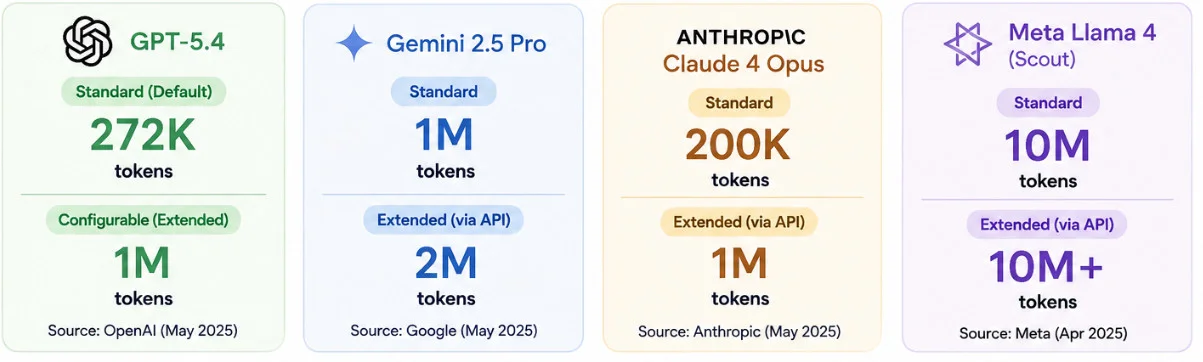
- Using prompt structures built around outdated model capabilities. Many prompting habits from 2023 were designed around small context windows. Today, frontier models have expanded dramatically, GPT-5.4 supports a standard context of 272K tokens with configurable support beyond 1 million tokens, while Gemini models support 1–2 million tokens. A prompt built to aggressively compress context for 2023-era limits is often solving a problem that no longer exists. Revisit any prompting framework you copied a year or two ago and verify that its assumptions still hold.
Building This into Your Content Workflow
A documented prompt system only works if your team actually uses it. The easiest way for it to fail is to leave it in a document that nobody opens while everyone goes back to writing prompts from scratch.
Instead, build your prompts into the workflow where content gets created. Keep your brand voice reference, reusable prompt templates, and review process together so every post starts from the same foundation.
This month, focus on four habits:
- Encode your voice: Create a one-page brand voice guide with examples and words to avoid.
- Iterate: Treat the first AI draft as a starting point, not the finished post.
- Document: Save your best-performing prompts and explain why they worked.
- Measure: Feed your highest-performing posts back into your prompt library as examples.
The goal isn’t to write better prompts once, it’s to make every future prompt better.
If you want to speed up that workflow, SocialPilot’s AI Pilot helps generate platform-specific captions, rewrite posts for different social networks, suggest hashtags, and refine your content before it goes live. Combined with a documented prompting system, it helps your team spend less time rewriting AI output and more time publishing content that sounds like your brand.
Explore SocialPilot pricing to see which plan fits your workflow.





 Join 55,000+ social media managers


