

Your agency is brilliant at social media. Just not your own. It’s the cobbler’s children problem — and it’s costing you clients.
Clients get the strategy sessions, the content calendars, the weekly posting schedules. Your own channels get whatever’s left after client work, which is usually nothing.
Meanwhile, every prospect considering hiring you checks your social presence before they reach out. What they find shapes the conversation before it starts. A dormant profile doesn’t just fail to impress; it sends them somewhere else.
Social media is your industry. Your own channels should be your best case study. This guide shows you how to make them one.
Key Takeaways
- Most agencies post from the wrong account.
- The agencies that look most active online spend the least time on content.
- Your social media isn’t supposed to close clients. It’s supposed to warm them.
- There are 5 types of content a prospect needs to see before they trust an agency. Most agencies post only one.
The instinct is to be everywhere. ❌
The strategy is to be where your clients are making decisions. ✅
Platform choice for agencies follows one rule: show up where your ideal clients spend professional time, not where the algorithm is currently rewarding. For most marketing agencies, that narrows the field quickly.
| Platform | Best for | Content type | Cadence | Worth knowing |
| B2B, SaaS, professional services | Opinions, case studies, hiring updates | 3–5x per week | Post from your founder profile, not just the company page — personal profiles reach 5–10x more people organically | |
| Consumer brands, DTC, creative agencies | Portfolio, Reels, process content | 3–5x per week | Your feed is your pitch deck — it signals design sensibility before a single proposal is sent | |
| SMBs, local and regional businesses | Groups, video, credibility posts | 3–4x per week | Facebook Groups outperform page posts — show up in the right community consistently, without an ad budget | |
| Twitter/X | Real-time industry presence | Hot takes, threads, replies | 3–8x per day | Only commit if someone owns it daily — a three-week gap is visible and costly on this platform |
| TikTok/YouTube | Long-game authority building | Education, breaking down marketing | 1–2x per week | YouTube content earns for years; TikTok needs weekly production — don’t start unless that’s sustainable |
For platform-specific timing, SocialPilot’s guides on best times to post on Instagram, Facebook, and Twitter/X break it down by day and audience.
What to Post: 5 Content Pillars for Marketing Agencies
Here’s the problem with most agency social accounts: they post when they have something to post. A campaign launch. An award win. A team lunch. The result is a profile that looks active during good months and silent during busy ones.
Consistency requires a system. Call it “The Authority Engine” — five content pillars that, together, cover every dimension of what a prospective client needs to see before they trust an agency enough to reach out. Your social media content strategy for client accounts already uses a version of this framework. Apply it to your own agency.
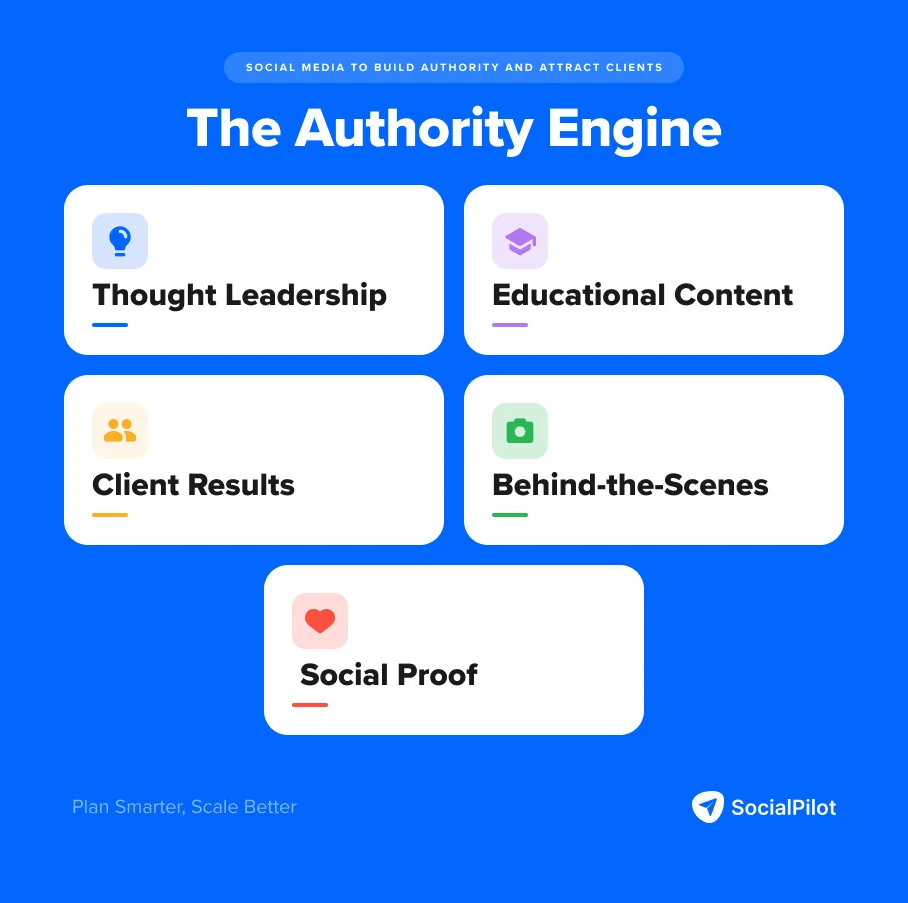
Pillar 1 — Thought Leadership and Opinions
Prospects hire agencies they trust. Trust starts with a point of view.
Posts that take a clear stance on strategy, industry shifts, or common mistakes attract clients who share the same perspective, and naturally filter out the ones who don’t. That filtering is valuable. Naturally, thought leadership is a more trustworthy basis for assessing a company’s capabilities than marketing materials. “Five content best practices” is forgettable. “Why most brands are using influencer marketing backwards” is a conversation starter that also qualifies the audience.
Don’t be neutral on the topics your agency has earned the right to be opinionated about. Fence-sitting reads as having nothing to say.
Pillar 2 — Educational Content
Teach prospects enough to trust you, not enough to do the work themselves.
The sweet spot: content that solves a real problem your ideal client faces, in a way that demonstrates your methodology without giving away the full playbook. A breakdown of how you structured a multi-channel product launch, or a walkthrough of how you approach a social media audit, signals expertise faster than any credential can.
Educational content also has a practical side effect: it shortens sales conversations. Prospects who’ve already read your take on positioning before the first call arrive better informed, and often more ready to move forward. If your team is stretched thin, ChatGPT prompts for social media can help you turn a single insight into a week’s worth of content without adding to the workload.
Pillar 3 — Client Results and Case Studies
Specificity is everything here. “We grew our client’s engagement” moves no one. The agencies that win with this pillar make the numbers do the work.
Growth marketing agency, NoGood’s client results show what this looks like in practice: Inflection AI scaled to over 1 million daily active users within three months of launch. Gelato attributed 200% revenue growth to their campaign work. MongoDB saw a 103.5% increase in LinkedIn engagement. Each result is tied to a named client, a named channel, and a measurable outcome — not a vague claim, but evidence a prospect can hold.
The formula that works: platform or channel + starting challenge + measurable result + the key driver. Keep it tight. The goal isn’t a testimonial; it’s evidence presented in a format that lets the right prospect imagine themselves in the same outcome.
Pillar 4 — Behind-the-Scenes and Culture
Clients buy people before they buy services. Behind-the-scenes content — strategy sessions, creative reviews, team processes, the moment a brief becomes a campaign — builds the trust layer that makes everything else land harder.
This content also solves a problem agencies rarely acknowledge: most prospects have never worked with an agency before and don’t know what it feels like. Behind-the-scenes content shows them. It makes the agency feel like a team rather than a vendor, and reduces the uncertainty that stalls decisions.
A screenshot of a client DM saying “great work” isn’t social proof. A testimonial that names a specific outcome — “In three months, organic engagement went from 5% to 23%” — is. Context and specificity transform a compliment into evidence.
Hawke Media does this well. Their case studies don’t lead with “our client loved working with us.” They lead with numbers: for Clarke Kent Plumbing, they reported Facebook engagements up 972%, Instagram impressions up 2,774%, and new Instagram followers up 1,000% — all from launching and revamping two social channels. Named client. Named platform. Specific numbers. That’s a post that a prospect reads twice.
Contextualize every piece of social proof before posting it. Industry and company size of the client, the challenge before the engagement started, the result after it. Even one or two specific details turns a generic endorsement into a persuasive case.
The most common agency social media strategy is “we’ll post when we have time.” The problem: there is never time. Client deadlines fill the calendar, campaigns overrun, and the agency’s own social presence is always bumped to next quarter.
The fix is structural, not motivational.
Treat the agency as its own client
That means a dedicated slot on the content calendar, a creation session every two weeks, and a real approval process — not a vague intention, but a time block protected from client work the same way a client deadline is. The social media workflow that works for your clients works for your own agency too.
Batch creation is the unlock
A two-hour session every two weeks produces enough content for a full month of LinkedIn or Instagram posts. Plan the themes, draft the copy, record short videos if needed, all in one go. The agencies that look consistently active online aren’t spending more time on content creation. They’re spending the same amount of time more deliberately.
Repurposing multiplies output without multiplying effort
One insight becomes: a LinkedIn post, an Instagram carousel, a short video, a story, and a blog intro. Five distinct pieces of content from a single idea session. The agencies that appear prolific — one post a day, across two platforms — often have a tight repurposing system rather than an unusually high volume of original ideas.
Once content is created, SocialPilot’s Bulk Scheduling and content calendar keep the pipeline moving without daily manual intervention. Schedule an entire month in a single session, set it to publish at the optimal times for your audience, and stay focused on client work throughout the week. The agency’s social presence runs on a system, not on whoever happened to remember to post today.
A realistic platform cadence to plan around:
- LinkedIn: 3-5 posts per week
- Instagram: 3-5 posts per week
- TikTok or YouTube: 1-2 pieces per week (only with dedicated production capacity)
How Personal Branding Helps Agencies Attract More Clients
There’s a structural asymmetry most agencies overlook. Company pages are distribution-limited. Personal profiles are not.
The numbers make the case
On LinkedIn, personal profiles consistently reach 5–10x more people organically than a company page with the same follower count. That’s not an algorithm quirk — it’s a platform design choice that privileges person-to-person connections over brand broadcasting. It isn’t going to reverse.
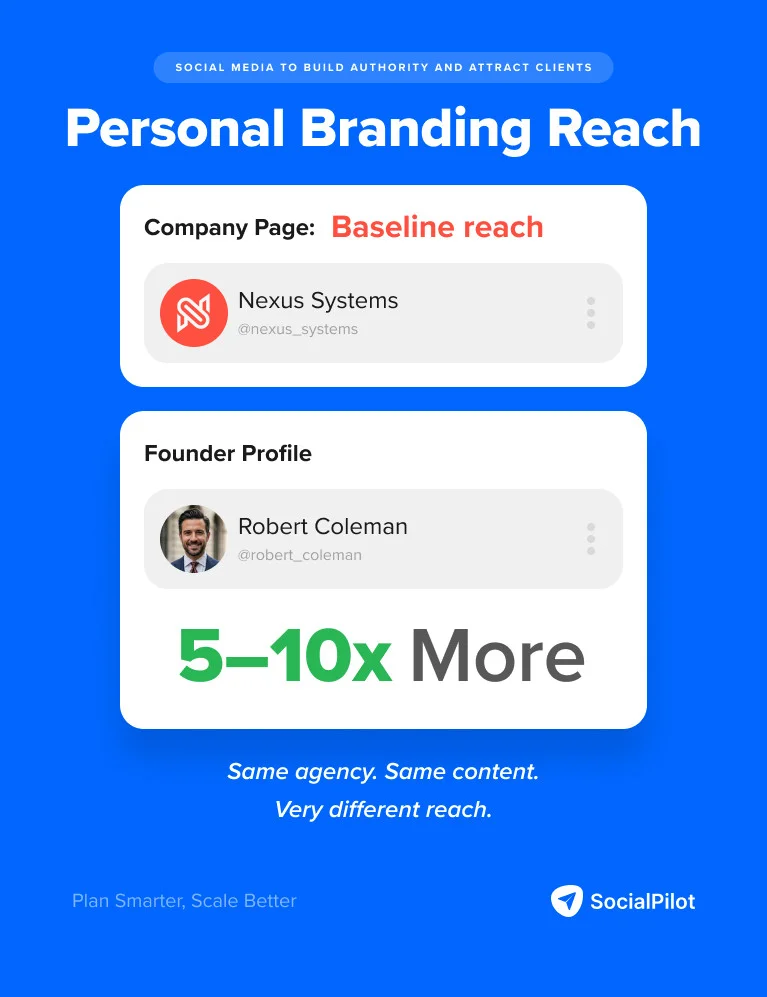
A founder posting consistently — sharing opinions, documenting client work, engaging with industry conversations — generates more awareness and inbound leads than the agency’s company page alone. Not because the content is better, but because the platform is built for personal distribution. This isn’t about becoming an influencer. It’s about being the most visible version of your expertise where potential clients are already looking, consistently enough that when they’re ready to hire an agency, you’re already on the shortlist.
Employee advocacy multiplies this further
Audiences trust peers and employees more than branded content — which is exactly why an authentic post from a team member lands harder than the same message from a company page. A 10-person agency where each member shares one post per week generates 10 times the impressions of the company page alone, reaching entirely different networks in the process.
The key is making it frictionless, not mandatory:
- Pre-draft post options so team members can share with one click, not a blank page
- Clear brand voice guidance so posts feel consistent without being scripted
- No-pressure culture where participation feels natural, not obligatory
Advocacy that’s forced reads as corporate. Advocacy that’s enabled reads as genuine.
Where to start
Two or three founding partners, each posting three to four times per week. Once that’s in place, the company page becomes what it should be — a professional repository for evergreen content and formal announcements, not the primary reach channel. Build the personal presence first. The company page follows.
Most agencies build visibility. Few have a system for what happens after.
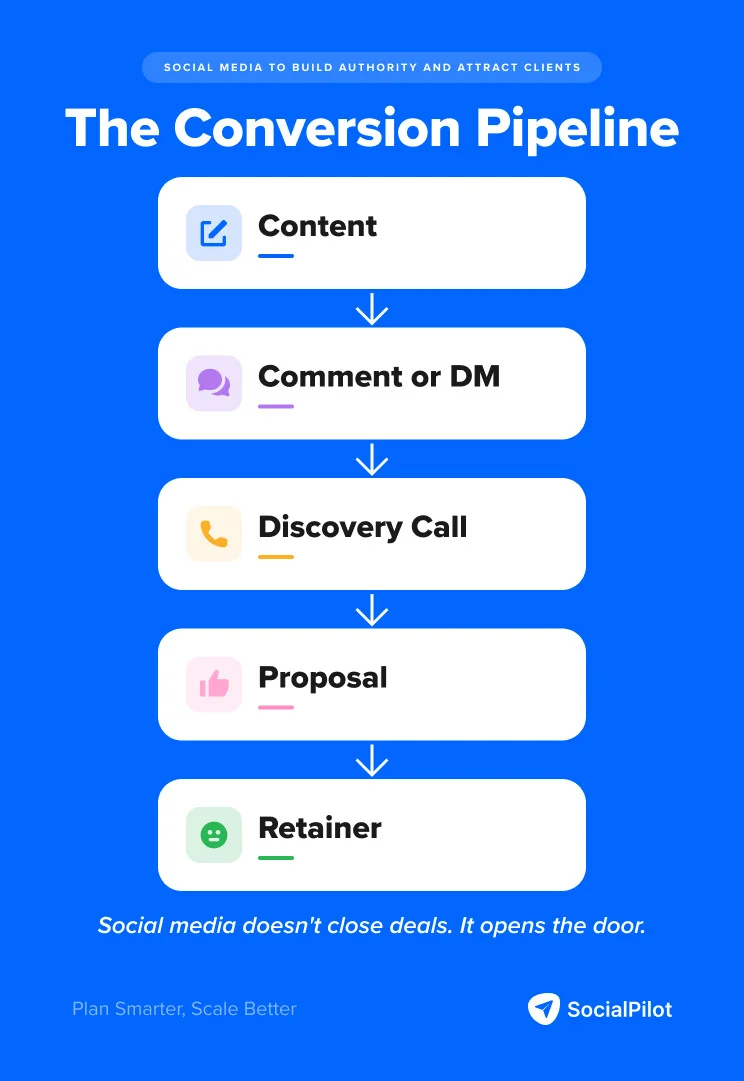
Social media’s role isn’t to close a deal — it’s to create the conditions for a conversation. The pipeline looks like this: content builds familiarity → a post resonates and triggers a comment or DM → the DM becomes a discovery call → the call becomes a proposal → the proposal becomes a retainer. Social media runs the top of that funnel. It doesn’t need to do anything else.
A $500–$1,000 per month retargeting budget, targeting people who’ve engaged with posts or visited the agency’s site, keeps the agency visible to warm prospects while they’re still deciding. It’s not a replacement for organic content, but it shortens the trust-building timeline materially.
Measurement that closes the loop
- Reach and impressions signal how wide the visibility net is
- Engagement rate signals whether the content is earning attention or just taking up space
- Profile visits and DM inquiries signal active buying interest
- Direct attribution — ask every new client “how did you find us?” — confirms whether social is actually feeding the pipeline
Social authority compounds slowly — the first 90 days rarely look like much. The agencies that quit at week six because the pipeline hasn’t visibly shifted are the ones who restart from zero every six months. Give it a full quarter, track the right signals through SocialPilot’s analytics, and then adjust.
Before You Go Back to Client Work
The cobbler’s children problem doesn’t fix itself. Every quarter your agency’s social presence sits neglected is a quarter your competitors are building theirs — in front of the same clients you’re trying to reach.
Potential clients have already read your founder’s posts. They’ve watched your Reels. They’ve formed an opinion before you reach out.
So — is your agency the one they already trust? Start building the system that makes you one. Batch, schedule, and let SocialPilot run it — one platform to plan, publish, and track your agency’s social presence without adding to the workload. Take your free trial today.