

The pitch went well. The client liked the idea.
Employee advocacy, organic reach, trust multiplier. You made the case, and they bought it.
Now you have to build the thing…
If you run social media for agencies or brands, you already know how this channel works in theory. The numbers are real. The logic is sound. What no one tells you is why programs built by people who understand social media still fail within 90 days of launch, and how to build one that does not.
This guide covers the full build: from first cohort to multi-client scale, including what changes operationally when an agency runs the program for a client.
Key Takeaways
- Employee-shared content generates 8x more engagement than brand-published posts
- Low participation is a design problem, not a motivation problem. Rewards and nudges address the wrong root cause
- Start with 8–15 pilot advocates before opening the program company-wide
- Agencies need a repeatable service model to run advocacy sustainably across multiple client accounts
What Is Employee Advocacy
Employee advocacy is the practice of employees sharing brand-approved content on their personal social media profiles to extend a company’s organic reach and credibility.
The business case is never the problem. The execution almost always is.
For teams working to build a LinkedIn marketing strategy that compounds over time, employee advocacy is the highest-leverage organic investment available. Personal profiles consistently outperform company pages on reach, engagement, and trust. The challenge is building a program that employees actually keep running past the first month.
Most advocacy programs collapse within 90 days of launch. Not because employees are disloyal, but because the program was designed around the company’s need to post, not the employee’s experience of sharing.
The Participation Problem (Or the Design One)
The most common employee complaint in stalled programs is not “I don’t want to help.” It is “I don’t know what to post” and “everything pre-approved sounds like it was written by the PR team.”
Participation is a design problem, not a motivation problem.
Gamification, gift cards, and leaderboards treat the symptom. The root cause is that employees are given content they cannot personalize.
As a user puts it on r/socialmedia:

Pre-written posts that cannot be personalized look like corporate copy. Employees with any professional self-awareness will not put their name on something that reads like a press release. The fix is editable content, with a personalization prompt that gives each employee a starting point.
| Content Dump | Content System |
| Brand team writes posts; employees share verbatim | Pre-written drafts with personalisation fields employees edit |
| One version pushed to all employees | Content segmented by role and expertise |
| Approval required post by post | Monthly batch approval; 7-day sharing window per piece |
| Employee receives one notification to share | Employee receives 3 options and picks one |
| No guidance on tone or angle | Every post: “[Add one sentence about your own experience with this]” |
The shift from content dump to content system is the single most important structural decision in the program’s design.
The Leadership Signal Problem
When executives champion the program in meetings but do not post themselves, employees read it as a signal that advocacy is optional. That signal travels fast and quietly.
One practitioner on r/digital_marketing put it plainly:
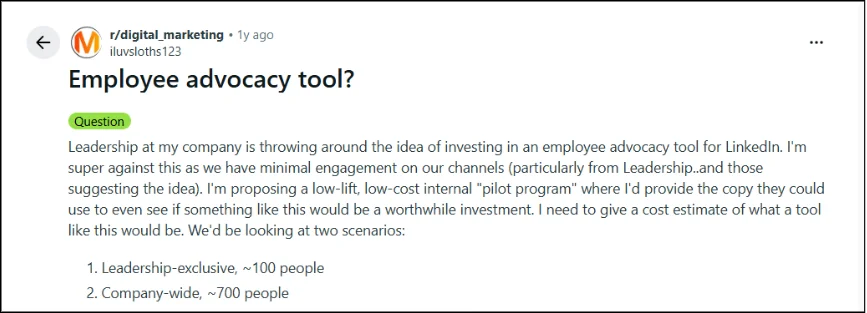
Programs where senior leaders actively participate from the first two weeks see measurably stronger internal adoption throughout the program’s lifetime (DSMN8, 2026). Visible executive participation is not a nice-to-have. It is the structural prerequisite the entire program depends on.
The practical approach for agencies: draft two executive posts per month, delivered ready to approve and personalize in under five minutes. Frame it as executive visibility: a CEO’s LinkedIn post reaches audiences the brand page never will.
The Internal Champion Gap
Generic guides assume someone inside the company is championing the program weekly: sending reminders, surfacing wins, nudging colleagues who went quiet. In practice, that role defaults to a marketing coordinator already managing five other deliverables.
When the coordinator is stretched, reminder emails stop. The content queue goes stale. Participation drops without anyone officially calling the program dead. It does not fail loudly. It fades.
Agencies compensate by designing workflows that require minimum internal bandwidth: scheduled notifications, batch approvals, automated reporting. The agency absorbs the operational load. The coordinator handles two focused hours per week.
What Changes When an Agency Runs It
When a brand manages its own advocacy program, it can mandate participation, build internal culture around sharing, and tie advocacy to performance conversations. When an agency runs it, none of those levers exist.
You cannot email client employees directly. You cannot install tools on their devices without IT approval. You cannot tie participation to career reviews. Every touchpoint with client employees runs through one coordinator. Every decision requires a client-side approval cycle.
Tool budget is a real constraint. Enterprise advocacy platforms run $20–50 per user per month. For 700 employees, that is $80,000 or more annually. Most SMB clients are not prepared for that conversation.
The programs we see work at SMB scale run on the platform the agency already uses for everything else: one scheduling queue, one approval chain, one reporting view. No new procurement. No IT conversation.
The entire advocacy system, from content creation to monthly reporting, must be operable by a client-side coordinator spending no more than two hours per week, with the agency absorbing the rest.
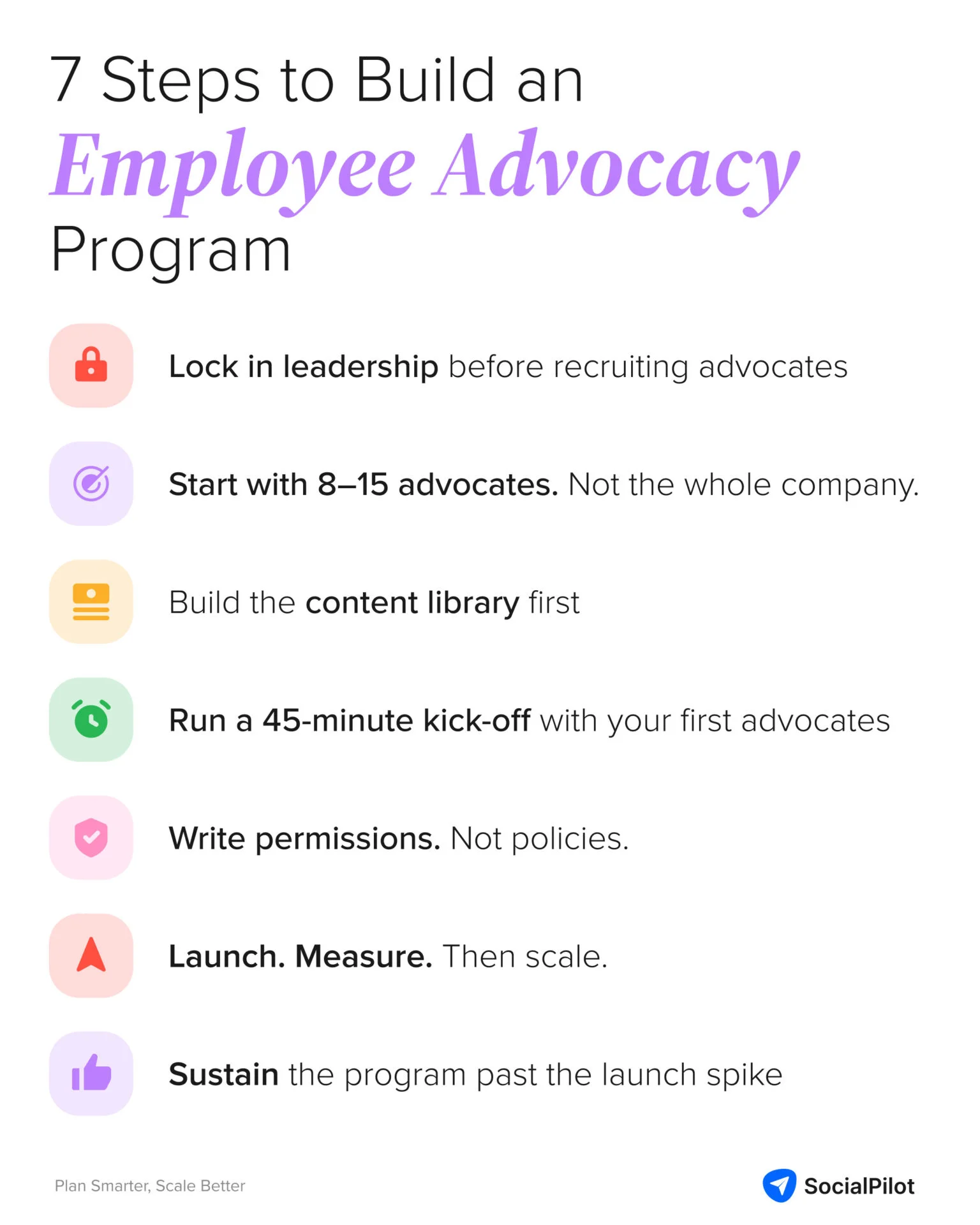
Step 1: Align with client leadership before talking to a single employee.
Secure at least two to three executive post commitments before recruitment starts. The agency drafts the posts; the executive edits and approves in under five minutes.
The framing that gets commitment: not “support the program” but “I’ll draft two posts a month. You approve and personalise in five minutes. Your profile reaches people the company page never will.” Employees’ combined social networks are on average 10 times larger than the brand’s own following (LinkedIn), and employee-shared content generates 8x more engagement than the same post from the brand account (MSLGroup, 2022).
Include executive activation in the client onboarding checklist. It is a prerequisite, not an agenda item. If leadership is not visibly participating in week one, employees will notice.
Step 2: Recruit 8–15 advocates for a pilot cohort, not the whole company.
Identify employees already active on LinkedIn who hold externally credible roles: sales, account management, subject matter expertise. The internal coordinator runs recruitment using a one-page advocate profile template the agency provides. Every touchpoint runs through the coordinator.
A small cohort lets the agency monitor participation closely, collect early feedback, and refine the content system before expanding. Recruiting the whole company on day one means losing most of them by week four with no structural way to understand why.
Step 3: Build the content library before you send the first invite.
The minimum viable library: 20–30 pre-written posts per month, organised by content pillar (company news, industry insights, product updates, team culture), each with a LinkedIn version and a shorter X/Twitter variation.
75% of employee advocates received no formal social media training from their employer (Hinge Research Institute). The content library is that training. Skip it and you are handing employees a channel with no instructions and wondering why they go quiet.
Every post includes a bracketed personalisation prompt: “[Add one sentence about your own experience with this].” Posts are tagged by employee persona (sales, technical, leadership) so the coordinator sends the right content to the right people, not everything to everyone.
Step 4: Run a structured 45-minute kick-off with the first cohort.
Cover: what the program is, what advocates will be asked to share, how often, and what is in it for each participant personally. The argument that converts willing-but-passive employees is not points or gift cards. It is professional brand-building: sharing expert content grows their following and builds career credibility that compounds over time.
Prepare a templated kick-off deck you customize per client in under an hour.
Step 5: Set guidelines that give employees permission, not a policy manual.
A concise one-page document covers approved topics, preferred platforms, how to handle questions or criticism, and what should never go live.
Permission-based framing (here is what you can talk about freely) produces participation. Restriction-based framing produces resentment.
Step 6: Launch the pilot and measure before you scale.
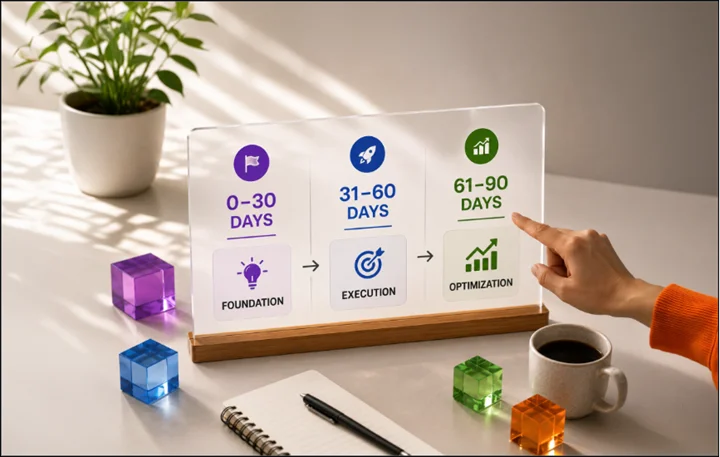
Week 1: Executive activation only. Two to three leadership posts, drafted by the agency, published with minimal friction.
Week 2: The first cohort’s first sharing cycle. Track who posted and follow up via the coordinator with anyone who did not.
Week 3: A five-question feedback loop (what felt easy, what felt awkward, what topics do you want more of).
Week 4: The first reporting moment. Share organic reach and engagement data to make the internal case for expanding the cohort.
Step 7: Design for month three, not just week one.
The launch spike is real and misleading. Every new program generates strong activity in the first two weeks and visible decline by week six.
Brand messages reach 24 times further when re-shared by employees (MSLGroup, 2022). That number does not materialise in week one. Programs that treat the launch as success and the decline as failure never reach it.
Two mechanisms sustain programs past the launch spike. Content variety: rotate in new formats monthly (polls, short-form video prompts, personal opinion posts) so advocates are not sharing the same template every week. Visible recognition: a monthly note to leadership naming the top three advocates and their reach numbers shows participants their work is being tracked.
The agencies that retain advocacy clients past 12 months run month three the same way they run month one. Everything else is a launch campaign.
Running one advocacy program is manageable with strong project discipline. Running five requires an operational system, or it becomes unsustainable within a quarter.
Build a Repeatable Service Model, Not a One-Off Setup
Here is what running three client advocacy programs simultaneously looks like without a system: Client A’s approved post goes to Client B’s coordinator. A hashtag set from Client C ends up in Client B’s caption. The approval reminder for one program lands in the wrong inbox. The monthly report pulls data from all three accounts with no way to separate which number belongs to whom.
That is not a discipline problem. It is a structural one.
The components that make advocacy scalable: a standard client onboarding questionnaire (brand voice, content pillars, posting frequency, platform focus, first cohort size), a templated content library, a pre-configured approval workflow, and a monthly report template the agency edits rather than rebuilds.
The agencies managing 5+ client advocacy programs run all of it through SocialPilot, where each client lives in a completely separate workspace with its own content queue, approval chain, and reporting view. Team-based content workflows keep Client A’s content from ever touching Client B’s account, and the coordinator stays focused on the two hours of internal touchpoints that actually require them.
Keep Brand Voices and Content Separate Across Clients
Each client needs a separate workspace with its own content library, a one-page brand voice guide produced at onboarding (tone, off-limits topics, approved hashtags), and platform-specific templates that cannot bleed across accounts.
This documentation makes it possible to hand a client account to a new team member without a lengthy briefing.
Share counts and impression numbers do not retain clients. Use a three-part report structure: a one-page executive summary with three headline numbers (total organic reach, website sessions from advocacy content, participation rate trend month over month), a platform and content pillar breakdown, and one recommended action for the next 30 days.
Automated report scheduling removes the manual rebuild each month.
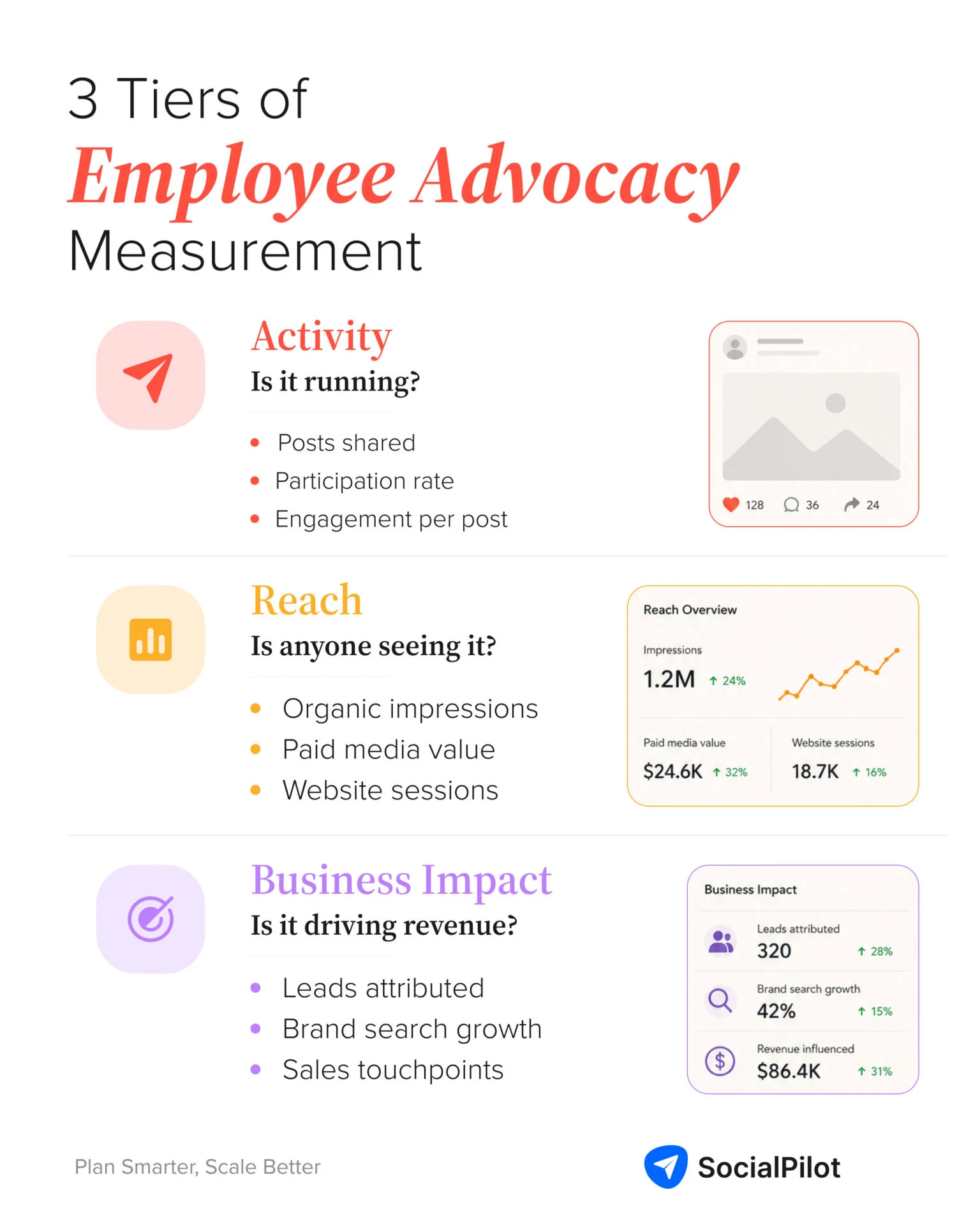
Most advocacy measurement stops at vanity metrics: posts shared, raw impressions, total likes. Those numbers are easy to produce and unconvincing to a client deciding whether to renew. Structure measurement across three tiers. Start configuring them before the first post goes live.
The Three Tiers of Advocacy Measurement
Tier 1: Activity
Posts shared per advocate per month, overall participation rate (the share of enrolled advocates who posted at least once), engagement rate per post type. These confirm the program is operating.
Tier 2: Reach
Organic impressions from employee posts, equivalent paid media value (total impressions multiplied by platform CPM benchmark), website sessions from advocacy-shared links tracked by UTM. These show the program is generating exposure.
Tier 3: Business Impact
Leads or signups attributed to advocacy content, brand search volume trend since launch, appearances in tracked sales cycle touchpoints. These show the program is contributing to revenue.
Most agencies report Tier 1. Agencies that report Tier 3 retain clients.
To track LinkedIn performance metrics accurately across client advocacy programs, consistent UTM tagging from the first post is non-negotiable. Research confirms that employee engagement and willingness to advocate are sustained over time when employees see tangible professional outcomes from participating (Nature/Humanities and Social Sciences Communications, 2025), which means measurement is not just a reporting function. It is what keeps employees sharing.
Configure UTM Tracking Before the First Post Goes Live
This is the most consistently skipped setup step. Standardise the UTM structure in the content library template so every shared link carries tracking automatically:
- utm_source=employee-advocacy
- utm_medium=social
- utm_campaign=[client-name]
- utm_content=[content-pillar]
An un-tracked month is a month of client reporting you cannot produce.
One Program Is a Project. Five Is a Business.
Most agencies who pitch employee advocacy can run the first program. The content is not hard to produce. The strategy is not hard to explain. What they cannot sustain is the operational drag: content rebuilt every client cycle, approvals tracked in separate inboxes, reporting manually assembled the night before the client call.
By month four, the agency is spending more time keeping the program alive than running it. By month six, they have quietly stopped pitching it.
The failure is never the program. It is the absence of infrastructure.
The agencies that turn advocacy into a retained service line build the infrastructure once and run it everywhere. In practice, that means each client lives in a completely separate workspace with its own content queue, approval chain, and reporting view.
SocialPilot’s plans work that way by default: separated workspaces, flat-rate pricing that does not compound with every new account, and automated reporting that does not need rebuilding every month.
The pitch is the easy part. The infrastructure is what makes the service last.



 Join 55,000+ social media managers


