

The X algorithm decides which of the 100 million+ posts published every day actually reaches your screen. If you post and get silence, the algorithm isn’t ignoring you, it’s just ranking someone else higher.
This guide explains exactly how the system works in 2026, what changed recently, and what you can do to get more reach without gaming anything.
Key Takeaways:
- Replies > likes on X, conversations drive reach.
- Native video performs best, especially under 2:20.
- Avoid external links in posts; add them in replies instead.
- Post consistently in one niche to improve recommendations.
- Timing matters: post when your audience is active.
- X is AI-driven now, recommending content based on interests, not just followers.
What Is the X (Twitter) Algorithm?
The X algorithm is a recommendation system that decides which posts to show each user, in what order, and how often. It runs every time you open the app, pulling from over 500 million accounts and surfacing the 20–30 posts most likely to hold your attention.
The algorithm doesn’t just rank posts from people you follow. Roughly half of what you see in the “For You” feed comes from accounts you’ve never interacted with. The system is constantly predicting what you’ll find interesting right now, based on your recent behavior.
Since 2025, X has handed the entire system over to Grok – xAI’s AI model. Grok reads every post, watches every video, and personalizes predictions in real time. The old rules-based system is gone. Everything is now AI-driven.
Latest X (Twitter) Algorithm Updates 2026
Here are the most significant confirmed changes to the X algorithm since late 2025, newest first.
September 2026: No Significant Algorithm Updates
No confirmed ranking or distribution change to the X algorithm was announced for September 2026. The Grok-powered ranking from late 2025 and early 2026 still governs both the For You and Following feeds, and the most recent confirmed change remains July’s mutuals boost. Keep prioritizing replies, native video, and consistent posting in one niche.
Source: X Publishes AI-Powered Algorithm Code – Social Media Today
July 2026: X Boosts Posts From Mutuals in Feed and Replies
On July 13, 2026, X adjusted its ranking to surface more posts from your mutuals, the accounts you follow who follow you back, especially inside reply threads. Head of product Nikita Bier said this signal “was missing from the algo and it made your friends appear less in your replies.” The goal is a more community-driven feed instead of a battleground with accounts you don’t recognize.
We’re rolling out a small tweak to boost visibility of your posts to your mutuals (people who you follow back).
We noticed this data was missing from the algo and it made your friends appear less in your replies. This resulted in the reply section feeling more like a…
— Nikita Bier (@nikitabier) July 13, 2026
What this means for you: Build genuine mutual relationships in your niche. Follow and reply to the accounts you want to reach; once they follow you back, your posts and replies surface to them more often, independent of raw virality.
Source: TechCrunch Article
March 2026: Reply Downvotes Now Shape the X Reply Algorithm
X added a thumbs-down button to post replies, available to X Premium subscribers. When a user downvotes a reply, they choose from five reasons: not interested, incorrect or misleading, AI-generated, spam, or report post.
These signals feed directly into the reply ranking algorithm. Quality, on-topic replies now surface higher in threads. AI-generated spam and misleading content get pushed down. X head of product Nikita Bier described the existing reply ranking as having “no logic, no signal, just garbage.” The feature is restricted to Premium subscribers, around 1% of all X users, to limit bot manipulation.
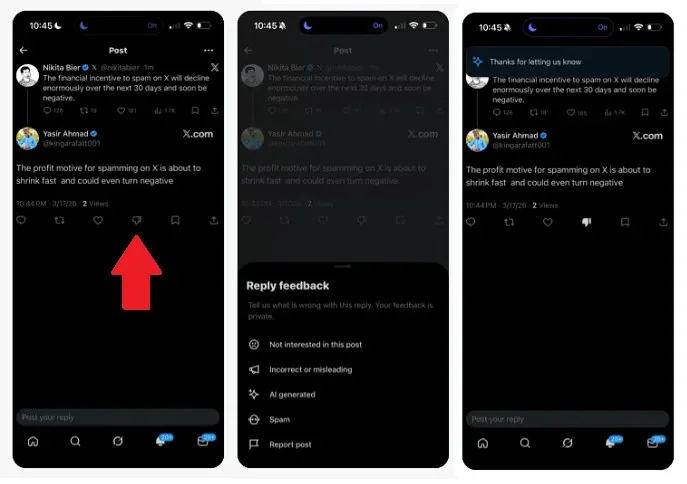
The downvote count isn’t public and doesn’t reduce a post’s like count. It’s purely a training signal.
What this means for you: If you reply to posts, make it specific and genuine. Vague or AI-generated replies now carry real ranking risk. Your authentic replies are also more likely to surface higher as spam gets downranked around them.
Source: X Adds Comment Downvotes – Social Media Today
January 2026: X Open-Sources Grok-Powered Algorithm – Key Signals Confirmed
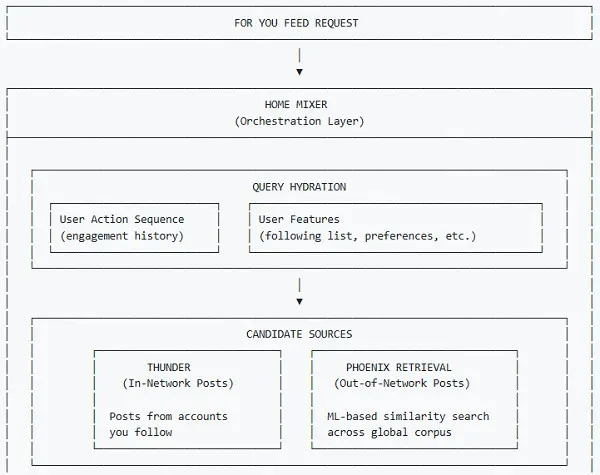
On January 20, 2026, X published its full feed algorithm on GitHub at github.com/xai-org/x-algorithm. This is the first time the complete Grok-powered system has been visible.
Key mechanics confirmed by the code:
- Dwell time and video watch time are weighted more heavily than in previous versions.
- Posts with external links are penalized in reach; the algorithm actively suppresses link posts.
- Creator diversity cap, a per-creator daily limit on how many posts of yours appear in any single follower’s For You feed. Posting frequently doesn’t increase your reach; it dilutes it across fewer viewers per post.
- Muted and blocked relationships reduce your reach beyond just that user. If many people mute or block you, the algorithm treats it as a quality signal and reduces your distribution more broadly.
- Follower count still matters as a positive signal, but it no longer translates to proportional reach because of the diversity cap.
Source: X Publishes AI-Powered Algorithm Code — Social Media Today
November 2025: Grok AI Now Ranks the Following Feed
On November 30, 2025, X ended the Following feed’s role as a chronological timeline. Both the “For You” and “Following” feeds are now ranked by Grok using predicted engagement and relevance.
Previously, you could set the Following feed as your default and bypass the algorithm entirely, seeing posts from accounts you follow in the order they were published. That option is gone as a default. X automatically switched all users to the Grok-ranked Following feed and made “For You” the default timeline for everyone, including users who had previously set “Following” as their default.
A chronological view is still technically accessible in settings, but it’s no longer the default for either feed.
Source: X Now Algorithmically Ranks Posts – Social Media Today
What Signals Does the X Algorithm Prioritize in 2026?
These are the signals that determine how widely your posts travel.
Engagement Quality — Replies Over Everything
The algorithm treats different engagement types very differently. Replies carry the most weight, by a wide margin. A post that sparks a conversation tells the algorithm something a post that collects passive likes does not: that it held someone’s attention long enough to respond.
Reposts and profile clicks also score high. Bookmarks and likes matter, but they’re weaker signals. A post with 50 replies and 10 likes will outrank a post with 10 replies and 500 likes.
Ask questions. Create posts worth responding to. The algorithm rewards content that starts conversations, not content that gets passive appreciation.
Relevance — What You’ve Done Recently
Relevance isn’t just about your interests in general. The Phoenix component scores posts based on your last 128 engaged posts, what you’ve done in the past few days or weeks, not your entire history.
This means the algorithm adapts fast. Spend a few days engaging with finance content and your feed shifts toward finance. It also means your posting topics need to be consistent if you want to reach the same audience repeatedly. Jump between unrelated topics and the algorithm struggles to route your content to the right people.
Recency — Fresh Posts Win
The algorithm strongly favors recent content. Posts from the last few hours get a meaningful boost over older posts, regardless of engagement level. This matters more on X than on most platforms, X’s core identity as a real-time feed means timeliness is baked into the ranking model.
Breaking news, live commentary, and time-sensitive posts benefit most from this signal. Evergreen content that could have been posted anytime is at a disadvantage.
Media and Format — Video First
Video content gets a significant boost, especially native videos under 2 minutes 20 seconds. X’s AI doesn’t just read your words, it watches your videos and reads your images to understand content type and quality.
Posts with images outperform plain text. Threads hold attention longer than single posts. Native video outperforms everything. Posts with external links to YouTube or other video platforms don’t get the video boost, only content hosted directly on X qualifies.
Account Credibility — TweepCred
X’s credibility scoring system (internally called TweepCred) evaluates author reliability, posting diversity, and spam behavior. Premium subscribers (X Blue, Gold, and Gray checkmarks) get a modest ranking advantage built directly into the scoring model.
Being consistent, authentic, and varied in your posting keeps your TweepCred high. Spammy behavior, mass following, repetitive posts, bot-like patterns, drags it down.
How Does the X Algorithm Work in 2026?
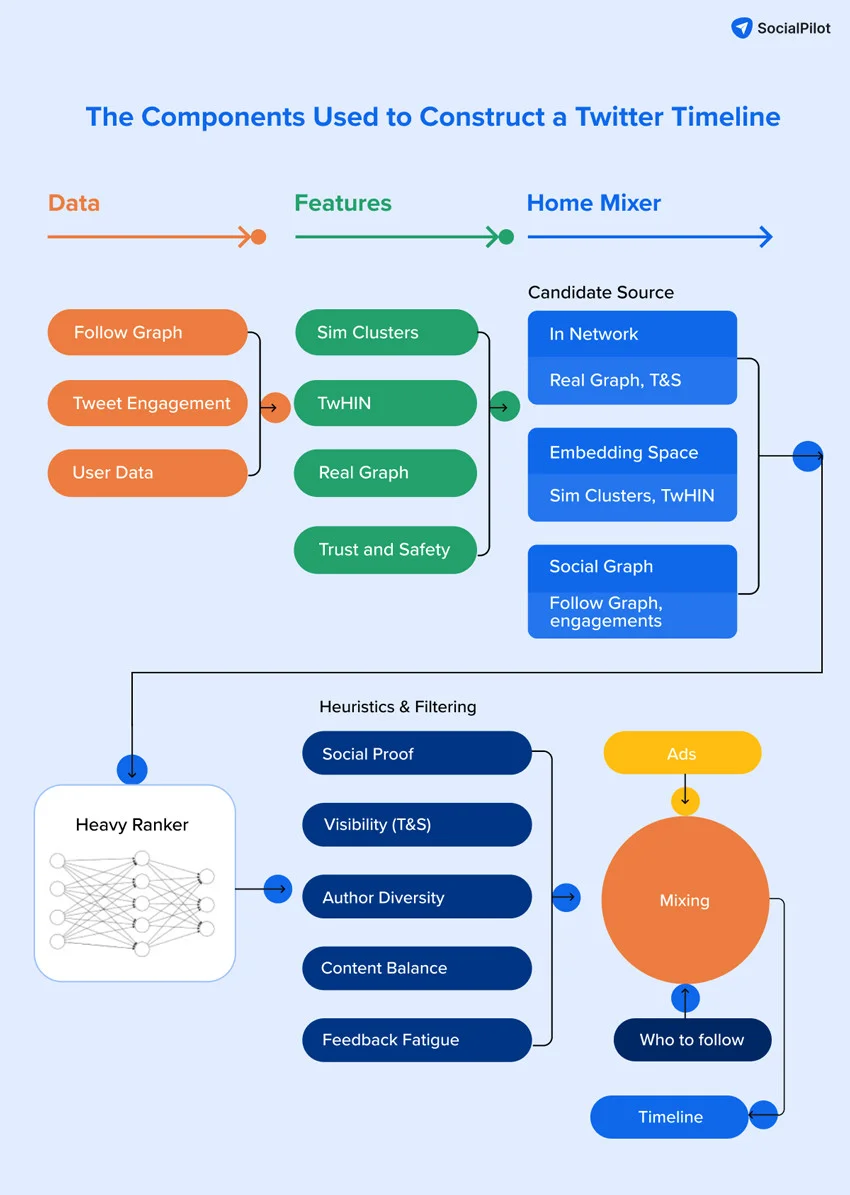
The algorithm works in three stages: find candidates, score them, then filter and mix.
Stage 1: Candidate Sourcing — Building Your Shortlist
The algorithm starts by pulling together roughly 1,500 posts it thinks might be relevant to you. This pool is split roughly 50/50 between two sources.
In-network candidates come from accounts you follow. X uses a component called Thunder to rank these by your past engagement history with each creator. If you regularly reply to someone’s posts, their new posts jump toward the front of your candidate pool.
Out-of-network candidates come from accounts you’ve never interacted with. X uses two methods to find them:
- SimClusters: Grouping users into interest communities (e.g., “indie music fans” or “startup founders”) and surfacing popular posts from those communities.
- Graph traversal: Mapping who interacts with whom to find posts that people similar to you are engaging with.
Grok now evaluates all 100M+ daily posts semantically, understanding meaning and context rather than just matching keywords. A small creator posting about niche topics has a real shot at reaching the right audience — even with zero existing following.
Stage 2: Ranking — Scoring for Relevance
Once the candidate pool is assembled, Grok scores every post based on how likely you are to engage with it. This is called the heavy ranker, and it’s a powerful neural network that processes hundreds of signals in seconds.
The Phoenix component does most of this work. It analyzes your last 128 engaged posts, everything you’ve liked, replied to, watched, or bookmarked recently and builds a real-time model of what you’re interested in right now. The more accurately it predicts your interests, the higher a post ranks.
Key scoring factors the algorithm weighs at this stage:
|
Signal |
What it measures |
Why it matters |
|
Replies |
Someone responds to the post |
The strongest positive signal — weighted far above likes |
|
Reposts |
Someone shares it to their followers |
Major amplification signal |
|
Dwell time |
How long you pause on or read a post |
Tracks genuine attention, not just passive scrolling |
|
Video completion |
How much of a video you watch |
Long watch time sends a strong interest signal |
|
Likes and bookmarks |
Basic positive interactions |
Counted, but weighted lower than replies and shares |
|
Profile clicks |
Tapping through to someone’s profile |
Signals high interest in the creator |
Recency also matters. Grok prioritizes posts from the last few hours. A post that’s six hours old has to work harder to stay visible than one posted twenty minutes ago.
Stage 3: Filtering and Mixing — The Final Pass
Before anything reaches your feed, the algorithm applies a set of filters and balance checks.
Safety filters remove duplicate posts, NSFW content, posts from muted accounts, and anything flagged for policy violations.
Author diversity cap: This is new and important. X limits how many posts from the same creator can appear in your For You feed in a single day. No matter how much someone posts, the algorithm caps their slot to prevent feed domination. This is why posting ten times a day doesn’t give you ten times the reach.
Social proof: If someone you follow has engaged with a post, the algorithm is more likely to show it to you. A repost from a person you trust carries more weight than a repost from a stranger.
User control signals: If you tap “Not Interested” or use Grok’s direct feedback (“Show me less of this”), the algorithm adjusts immediately. These signals stick beyond a single session.
The final feed blends about 50 posts from your in-network and out-of-network candidates, refreshed every time you open the app.
7 Top Twitter (X) Metrics to Prioritize
X has provided some insights into ranking signals. Based on that, the top seven metrics influencing users’ timelines are:
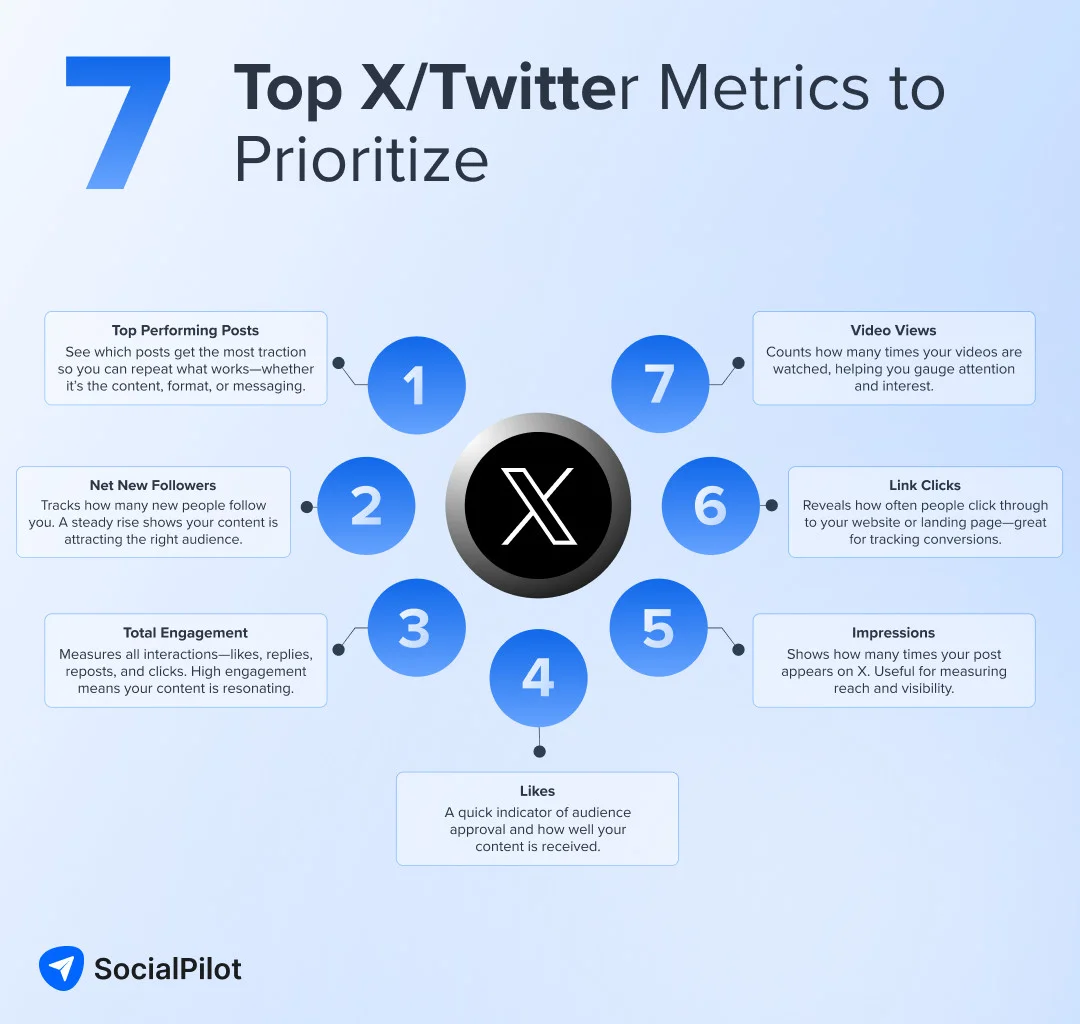
However, understanding these metrics and creating Twitter campaigns around them is only the beginning. To truly succeed, you must grasp how the Twitter algorithm works and recognize its core ranking signals that denote quality.
What the X (Twitter) Algorithm Penalizes
Knowing what to avoid is as useful as knowing what to do.
External links are the biggest trap. The open-source algorithm code confirms that posts containing links to external sites, including news articles, YouTube videos, other social platforms, are penalized in reach. The algorithm is designed to keep users on X. Bare link posts can be suppressed by up to 80% in distribution.
If you need to share a link, put it in the first reply rather than the post body. Your post reaches more people, and anyone interested can find the link in the thread.
Posting too frequently triggers the creator diversity cap. When you post more than X’s per-creator limit per day, each post reaches fewer of your followers, the algorithm distributes your daily slot across all your posts, rather than giving each one full reach. Three well-spaced posts will outperform ten posts crammed into one day.
Getting muted or blocked carries consequences beyond that individual user. If enough people mute or block your account, the algorithm treats it as a signal that your content isn’t wanted and reduces your distribution to other accounts as well. Avoid content that provokes mass mutes, even if it gets short-term engagement spikes.
Low-quality or AI-generated content is increasingly detected and suppressed. The reply downvote system (March 2026) adds a direct reporting path for AI-generated spam. And the algorithm’s own quality filters flag repetitive, template-driven, or thin content.
10 Proven Ways to Improve Reach on X (Twitter)
The X algorithm prioritizes relevance, engagement, and consistency. Use these proven tactics to improve reach, increase visibility, and boost your chances of appearing more often in users’ For You feeds. Here are some practical tips to help you get discovered on X:
1. Post Video — Especially Under 2:20
Native video gets the strongest boost in the current algorithm. Short videos under 2 minutes 20 seconds perform best for initial distribution. Keep it native don’t link to YouTube. Record directly in the app or upload the video file.
Even 15-second clips outperform text-only posts if they hold attention. Watch completion time is a direct ranking signal.
2. Write Posts That Earn Replies, Not Just Likes
Ask direct questions. Make specific claims people want to agree or disagree with. End threads with a genuine prompt. Replies are the most valuable engagement signal in the current ranking model, more valuable than likes, reposts, or bookmarks combined.
A post with 20 replies from real people will go further than a post with 200 likes.
3. Keep External Links Out of the Post Body
If you’re sharing a link, post your main content first, the opinion, the insight, the hook and drop the link in a reply. This way your post reaches its full audience without the link penalty, and anyone who wants the source can find it immediately below.
This is one of the highest-leverage adjustments you can make today.
4. Space Your Posts — Don’t Cluster
The creator diversity cap limits how many of your posts appear in any follower’s feed per day. Posting ten times in three hours doesn’t multiply your reach, it divides it.
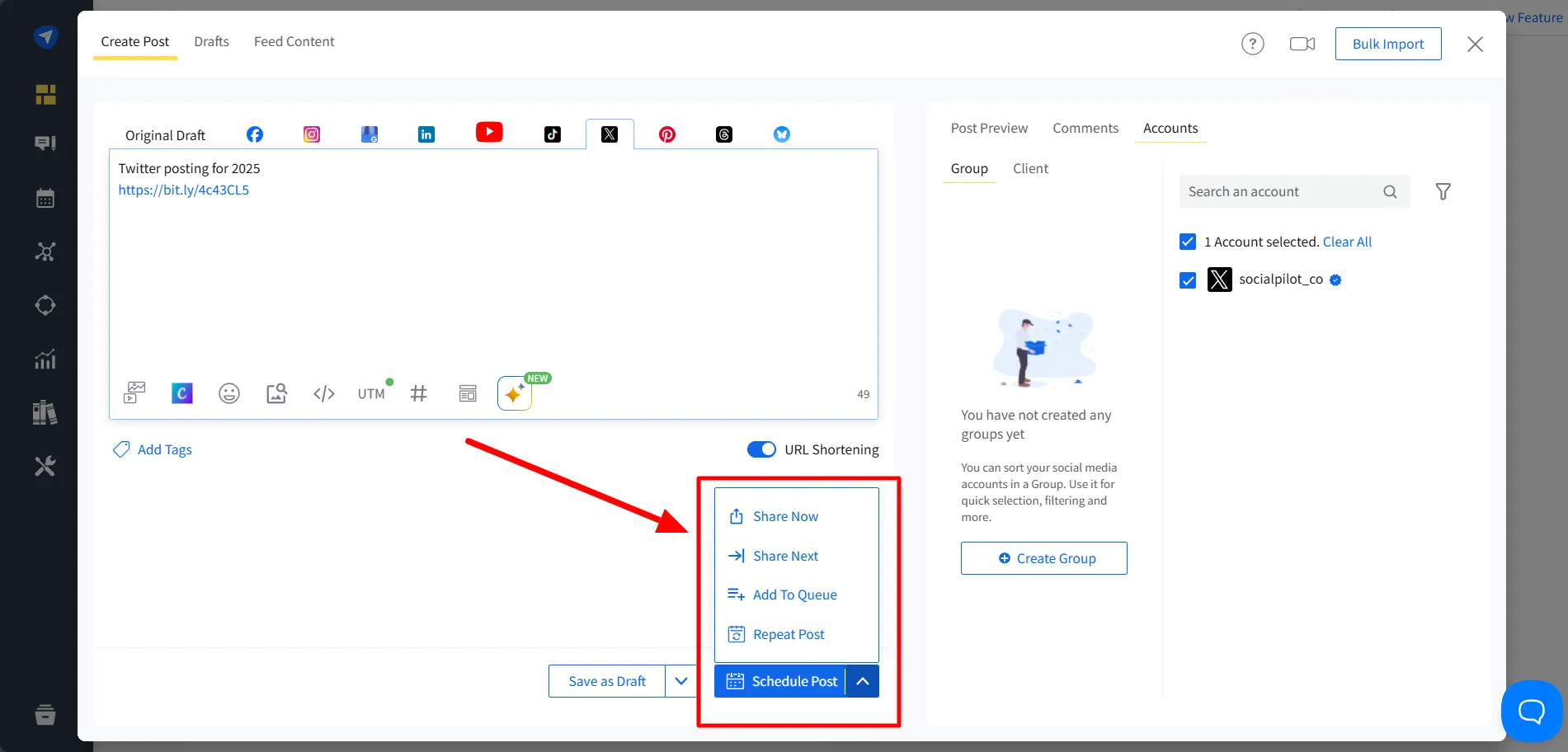
Aim for 3–5 posts per day, spread across your followers’ peak hours. Use a Twitter scheduling tool to space them out without having to be online all day.
5. Post Consistently at the Right Times
Recency is a key ranking signal on X. Posting when your audience is active increases the chances of early engagement, helping your content gain more visibility in the feed.

While early mornings and midday often perform well, your audience behavior matters most. Check your analytics to identify peak engagement times and post consistently during those windows.
Pro Tip:
Use SocialPilot X Analytics to find your best posting times based on audience activity and engagement trends. Pair it with the X scheduling tool to plan and automate posts consistently, helping you stay active and improve visibility with the X algorithm.
6. Stay in Your Niche
The Phoenix component routes your content to people whose recent behavior matches your content’s topic. Posting across wildly different subjects makes it harder for the algorithm to find the right audience.
This doesn’t mean never going off-topic. But if 80% of your posts are about one subject, the algorithm builds a clearer picture of who to show your content to and distribution gets more accurate over time.
7. Write Replies Worth Reading
Since March 2026, reply quality is a direct ranking signal. Premium users can downvote replies flagged as AI-generated, misleading, or spammy. Authentic, specific replies to popular posts are more likely to surface and more likely to send traffic back to your profile.
Don’t reply with a single emoji or a vague “great post.” Add a take, a data point, a question, or a pushback. The algorithm now has a way to tell the difference.
8. Build Engagement Before It Matters
The Following feed change (November 2025) means your followers’ engagement now affects your distribution, even to people outside your network. If your followers don’t engage with your posts, the algorithm concludes the content isn’t worth pushing further.
Focus on audience quality, not just size. A smaller, highly engaged audience will drive more reach than a large, disengaged one.
9. Get Verified — It Still Gives a Ranking Edge
X Premium (Blue, Gold for businesses, Gray for government) is confirmed in the algorithm code as a credibility signal. Premium accounts get a modest distribution boost baked into TweepCred scoring.
It’s not a shortcut to going viral. But combined with good content, verification reduces the friction the algorithm applies to unknown accounts. X Premium starts at $8/month on web. Getting verified also unlocks longer posts, editing, and fewer ads in the For You feed.

10. Use Polls to Drive Dwell Time
Polls keep people on your post longer they read the question, consider the options, and vote. That dwell time is a direct ranking signal. Twitter polls also generate replies from people sharing their reasoning, which compounds the engagement signal.

Use polls when you have a genuine question worth asking, product preferences, opinions on a topic in your niche, predictions. Don’t use them as a trick. The algorithm rewards real engagement patterns, not surface-level ones.
Stop Chasing the X (Twitter) Algorithm
The X (Twitter) algorithm has evolved far beyond a real-time feed. Reach today is shaped by relevance, engagement quality, recency, and content format with replies, native video, and topic consistency carrying more weight than passive likes.
As of September 2026, the core ranking framework is stable, with the most recent confirmed tweak still July 13, 2026’s change that surfaces more posts from your mutuals in the feed and replies. The open-source code release earlier in 2026 was a transparency milestone, not a shift in how posts are ranked.
The biggest shift is toward AI-powered personalization. X increasingly recommends content based on what users are likely to engage with, not just who they follow. That means creators and brands no longer need massive audiences to gain visibility, but they do need content the algorithm can confidently categorize and distribute.
What remains constant is the core principle: create content worth engaging with. Strong opinions, thoughtful insights, useful threads, and posts that spark real conversations consistently outperform low-effort or overly promotional content. The July 2026 mutual-follower update raises the stakes on relationships: engage the accounts you want to reach in your niche, because once they follow you back, your posts and replies surface to them far more often than to strangers.
If staying consistent feels like the hardest part, exploring SocialPilot plans and pricing can help simplify scheduling and publishing so you can maintain a steady presence without constantly being online.



 Join 55,000+ social media managers


