


Open X Analytics and the dashboard gives you 28 days. Exports reach back 90, which is one quarter, and only if you remember to pull the file before the window rolls forward. Nothing older is stored anywhere you can get to it.
That is why most people end up on a page like this one, and it is where the trouble starts, because a lot of what is written about X tools describes products that no longer do what the article says. We started with sixteen tools. Four of them turned out not to qualify at all. Crowdfire has shut its social product down. Audiense folded its Twitter product into a sales-led platform with no published pricing. Black Magic closed on July 1, 2026. And Hypefury, still recommended everywhere as an X growth tool, answers the question on its own pricing page with “Nope! Hypefury no longer supports X” while its homepage still advertises X features.
Twelve tools, four jobs, and every price read off each tool’s own pricing page rather than a review site or someone else’s roundup. We make SocialPilot and it is one of the twelve, scored on the same axes as everyone else.
The Four Jobs That Actually Separate These Tools
Every tool here schedules a post to X. All twelve do it, so it is the floor rather than a reason to choose, and any roundup ranking tools on “can it schedule” is ranking them on nothing.
What varies is everything else. These four are the axes worth reading your own needs against.
Multi-Account Publishing
Running several X accounts from one calendar: bulk upload, refilling queues, and a view that shows every account at once. This is where the all-in-ones pull away from the X-native tools, which are built around a single account and priced that way.
X Thread Composing
Writing a thread as a thread, with automatic splitting at the character limit and a preview of how it will look. General suites treat a thread as several posts in a queue. Two of the biggest names here cannot compose one at all.
Client Access and Approvals
Client logins, a sign-off step before anything publishes, and separate workspaces so one client never sees another’s calendar. The agency layer, and the one that most often forces a tier jump.
Reporting You Can Actually Send
An X report that carries your logo rather than someone else’s, exports cleanly and holds more than the 90 days you can pull out of X yourself. The whole reason to leave native X Analytics.
Which Jobs Do You Actually Need?
You need tools for the jobs you do every month, not all four.
| Your situation | Multi-account | Threads | Client access | Reporting |
| Solo creator, one X account | Skip | Essential | Skip | Nice to have |
| Founder or personal brand | Nice to have | Essential | Skip | Optional |
| In-house team, one brand | Optional | Optional | Optional | Essential |
| Agency, several clients | Essential | Optional | Essential | Essential |
How to Read the Matrix
- Essential means you will hit a wall without it inside a month.
- Optional means it pays for itself only at a certain volume.
- Nice to have means it saves time you may not be short of.
- Skip means the job does not apply to you yet.
Read your row, then read only the sections matching your Essential columns.
The Common Mistake
The expensive mistake is buying a $299 benchmarking platform when what you needed was a thread composer that costs nothing. The subtler one runs the other way: paying for a second subscription because your all-in-one felt thin, when the tier above already covered the gap.
Both come from shopping by category instead of by job. There is a third mistake this page exists to prevent, and it costs people the most: assuming the tool still does what the last article you read said it did. On this topic, a quarter of the tools we set out to compare did not.
Quick Comparison of the Top X (Twitter) Tools
| Tool | Best for | Multi-account | Threads | Client access | Reporting | Entry price |
| SocialPilot | Agencies running several accounts |  |
 |
|
|
$25.50/mo |
| Sprout Social | Big in-house teams with budget | |
 |
|
|
$79/seat |
| Agorapulse | Comment and DM volume | |
|
|
|
$79/user |
| Buffer | One person, a handful of channels | |
|
|
|
Free, then $5/channel |
| ContentStudio | Cheapest real X thread support | |
|
|
|
$19/mo |
| SocialBee | Evergreen content libraries | |
|
|
|
$24.17/mo |
| MeetEdgar | Queues that refill themselves | |
|
|
|
$24.91/mo |
| Typefully | Writing threads worth reading | |
|
|
|
Free, then $99/yr |
| Tweet Hunter | X growth and engagement routine | |
|
|
|
$49/mo |
| Circleboom | Follower analysis and cleanup | |
|
|
|
Free, then $12.99/mo |
| Rival IQ | Benchmarking against named rivals | |
|
|
|
$199/mo |
| Talkwalker | Enterprise listening across the web | |
|
|
|
Quote only |
Covered
a real, native feature the tool does well
Partial
present but limited, an add-on, a higher-tier unlock, or not published
Not covered
you would need a second tool for this job
What This Table Does and Doesn’t Show
Read down the all-in-one rows and one thing stands out. SocialPilot is the only platform here that covers multi-account publishing, client access and client-ready reporting inside a single flat plan — no per-seat multiplier, no white-label add-on, no separate agency tier. Sprout Social and Agorapulse match the coverage and charge per person for it. ContentStudio and Buffer match it on the feature list and then sell parts of it back to you.
Read the Threads column for the second surprise. Sprout Social and SocialBee, two of the largest names here, cannot compose an X thread at all, and both say so in their own help centres.
What the marks cannot show is billing basis, and it moves the answer more than features do. Sprout Social and Agorapulse are sold per seat. Buffer is per channel. Typefully is per brand. Circleboom and Tweet Hunter are per X account. SocialPilot, ContentStudio, SocialBee and MeetEdgar bill flat per plan. Agorapulse goes further and sells X management itself as a quote-only add-on, so its entry price does not settle what X costs at all.
All-in-One Platforms That Handle X
These seven schedule, publish and report across every network. X is one channel among many rather than the whole product. Start here if X is one of several platforms you run.
1. SocialPilot
Flat-priced publishing, client approvals and white-label X reporting for teams running more than one account.
Coverage
- Multi-account
- Threads
- Client access
- Reporting
What it actually looks like: SocialPilot puts one calendar in front of you holding every connected account, filtered by client, with X sitting beside Facebook, Instagram, TikTok, LinkedIn, Threads, Bluesky, YouTube, Pinterest and Google Business Profile. Bulk scheduling takes a CSV of up to 500 posts. Each client gets a separate workspace with its own approval flow, so they sign off on what is queued without seeing another client’s calendar and without anyone sharing a password.
On Capterra, Jess W., a marketing manager in telecommunications, rates it five stars for “excellent value, provides great analytics, bulk scheduling, flexible schedules”, then names a real gap: “you can’t schedule threads on twitter.”
The thread gap is worth answering. AI Pilot will draft an X thread, but there is no dedicated canvas for building one, and Typefully is the specialist if that is your daily job.
It is rated 4.5 on G2 across 846 reviews and 4.4 on Capterra across 373.
Pricing is flat per plan, and that is the argument. Essentials is $30 a month, or $25.50 billed annually, for 7 accounts and 1 user. Standard is $50 or $42.50 for 15 accounts and 3 users. Premium at $100 or $85 covers 25 accounts, 6 users and unlimited client seats, and is where client access and white-label reports arrive. Ultimate is $200 or $170 for 50 accounts and unlimited users.
Nothing here is charged per seat, so a third person on the team costs nothing extra, where the same three people are $597 a month on Sprout Social and $237 on Agorapulse, because both are sold per seat. There is a 14-day trial with no card and no free plan. For the full metric list, see our X analytics breakdown.
| Ultimate | Premium | Standard | Essentials |
$170.00/mo$200
Billed annually (Save 15%)
|
$85.00/mo$100
Billed annually (Save 15%)
|
$42.50/mo$50
Billed annually (Save 15%)
|
$25.50/mo$30
Billed annually (Save 15%)
|
|
Streamline Social Media Management
|
|||
2. Sprout Social
The deepest reporting on this page, sold per seat, and it cannot compose an X thread.
Coverage
- Multi-account
- Threads
- Client access
- Reporting
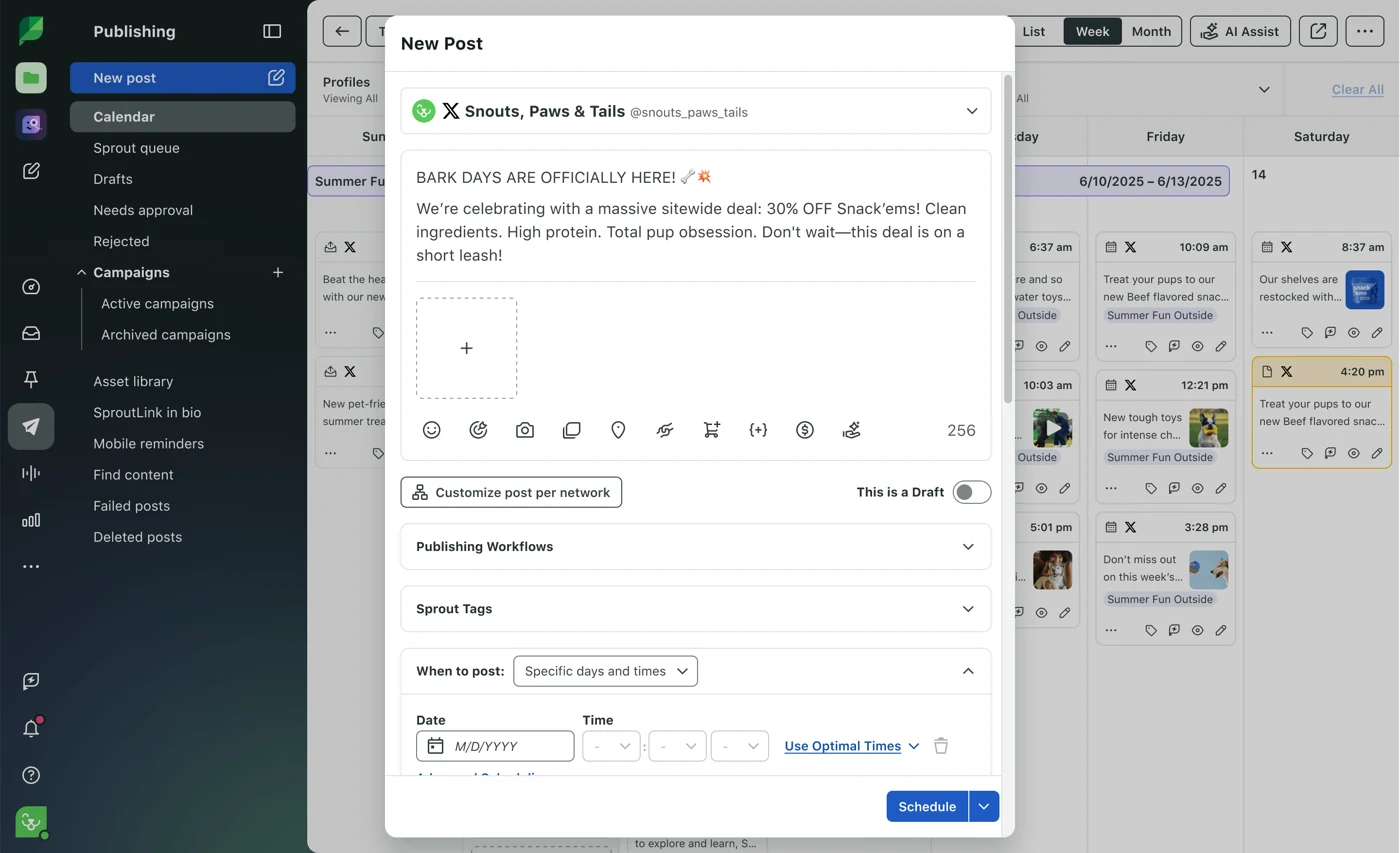
What it actually looks like: Sprout Social is a report-first workspace, polished enough to send to an executive without editing. Profile Performance rolls X up beside every other network, X data goes back a year, and the Smart Inbox pulls X mentions, DMs and replies into one queue. Branded PDF exports arrive on Professional, external approvers on Advanced.
On Capterra, Zach P., a marketing coordinator in education management, gives it five stars: “The reporting tools are top tier and it is incredibly simple to generate visually appealing reports.” Then the catch, same review: “it can get quite expensive if you require several user licenses and have a large number of social handles.”
The thread limit is not an inference. Sprout’s own help centre lists X threads under unsupported post types and says they “must be created within X directly.”
It is rated 4.4 on Capterra across 608 reviews.
Pricing is per seat, which is where it gets expensive. Essentials is $99 per seat monthly, or $79 billed annually, capped at 5 profiles. Standard is $249 or $199, Professional $399 or $299, Advanced $499 or $399. A three-person team on Standard is $597 a month, not $199, and our Sprout Social pricing breakdown runs that out tier by tier. There is a 30-day trial and no free plan.
What running Sprout Social standalone requires: very little on coverage and a lot on headcount discipline, plus somewhere else to write your threads. If the headcount maths does not work, our Sprout Social alternatives roundup covers cheaper routes to the same reporting.
3. Agorapulse
The strongest inbox here, and the only tool on this page that sells X management as a separate quote.
Coverage
- Multi-account
- Threads
- Client access
- Reporting
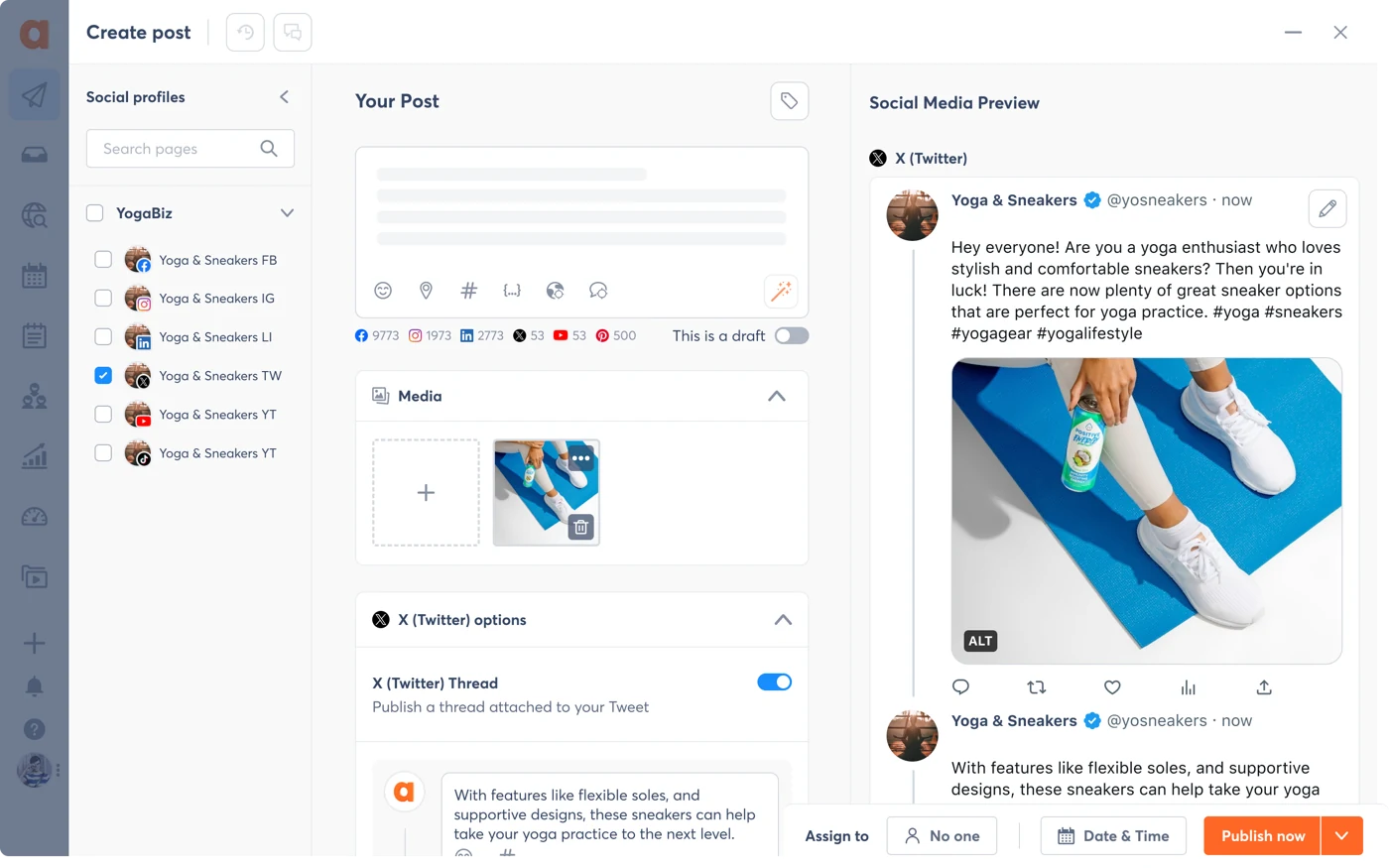
What it actually looks like: Agorapulse builds its inbox as a queue to clear rather than a feed to scroll, with moderation rules, assignment and an audit trail. Threaded X posts schedule natively and retention is published properly at 6, 12 and 24 months by tier.
On Capterra, Dan F., a social media manager in automotive, calls it “one of the best Social Media Scheduling tools I’ve ever used”, then names a concrete miss: “the Calendar View does not have the ability to \”drag & drop\” posts from one date to another.”
The thing to check before you buy is what X costs. The same pricing page that advertises an all-network inbox sells two X add-ons on top: X Lite for publishing posts and threads, and X Plus for moderating X comments and DMs. Neither carries a published price, so the $79 per user figure does not settle what X management costs, and you cannot find out without talking to sales.
It is rated 4.6 on Capterra across 713 reviews.
Pricing is per user, and the X question stays unresolved. Standard is $99 per user monthly, or $79 billed annually, for 10 profiles. Professional is $149 or $119, Advanced $199 or $149. Extra profiles are $15 a month. Above Advanced sits a Custom tier with no figure at all, sold on a Request a demo basis. There is a 30-day trial, and our Agorapulse pricing breakdown works through what the add-ons do to the total.
What running Agorapulse standalone requires: a quote before you can budget, and a separate tool if you benchmark against named rivals. Our Agorapulse alternatives roundup covers tools that price X without a sales call.
4. Buffer
The simplest tool here, the only all-in-one with a genuinely usable free plan, and it publishes X threads.
Coverage
- Multi-account
- Threads
- Client access
- Reporting
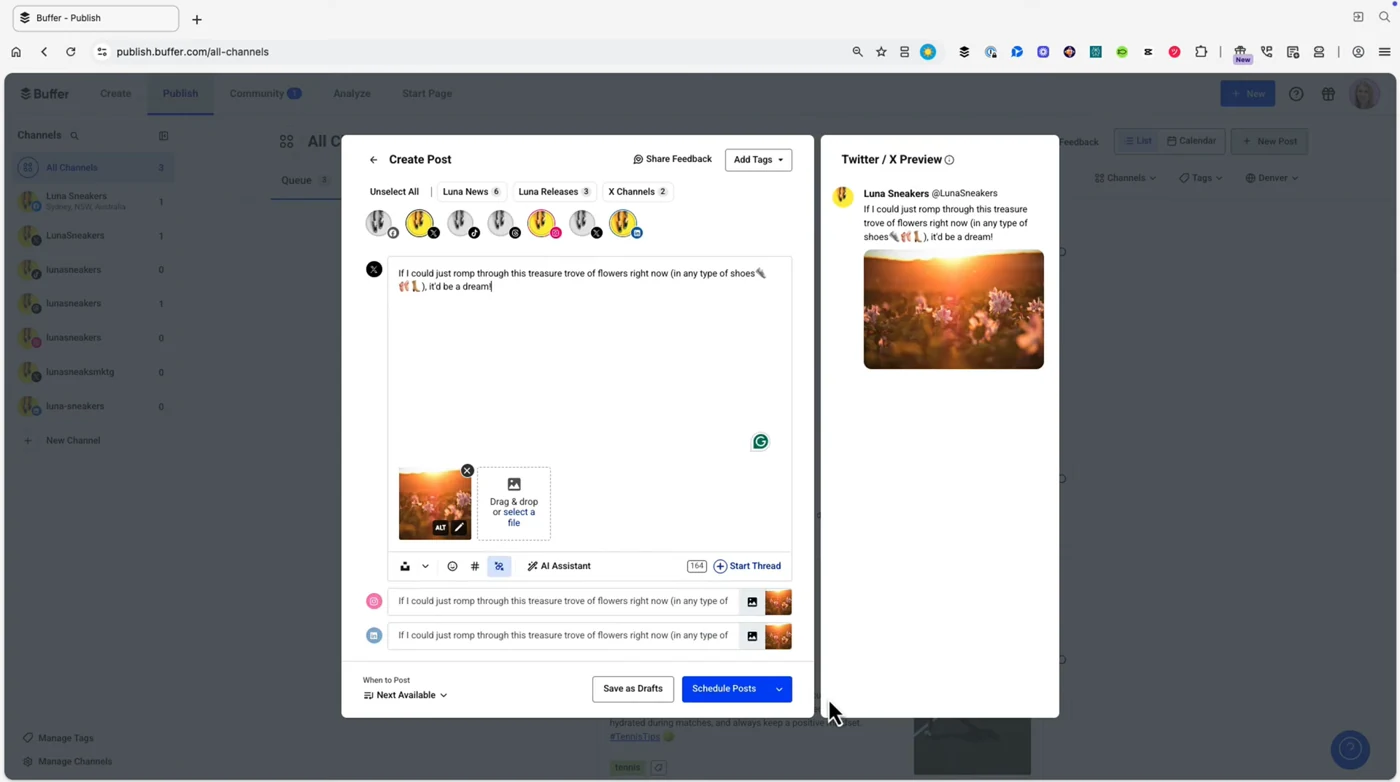
What it actually looks like: Buffer gives you a queue per channel, posting times set once, and a composer that stays out of the way. Threaded posts publish to X, Bluesky, Threads and Mastodon. The free plan covers 3 channels with 10 scheduled posts each. Two X-specific catches: the community inbox handles comments only, and free X profiles are excluded from basic analytics while premium ones are not.
On Capterra, Chris L., a president in information technology and services, rates it five stars: “a good balance of features without being overly complicated or cumbersome to use.” His con is precisely the agency limitation: “As a digital agency, I wish I could organize multiple channels into groups or folders for each client.”
It is rated 4.5 on Capterra across 1,492 reviews, the largest review base on this page.
Pricing is per channel and volume-tiered, unlike anything else here. Free covers 3 channels and 1 user. Essentials runs $6 a month per channel, or $5 annually, for the first 10 channels, dropping to $4 for channels 11 to 25 and $3 for 26 to 50. Team doubles the entry rate at $12 or $10 per channel and adds unlimited members, approvals and branded reports. Our Buffer pricing breakdown shows where the per-channel maths stops being cheap.
What running Buffer standalone requires: another tool for X mentions and DMs, and a different one again for benchmarking. Per-channel pricing also inverts at scale, so 25 channels on Team costs more than several flat plans covering the same accounts. Our Buffer alternatives roundup covers the flat-priced options past that point.
5. ContentStudio
The cheapest tool here with real X thread support and a real X inbox, at $19 a month.
Coverage
- Multi-account
- Threads
- Client access
- Reporting

What it actually looks like: Discovery and publishing share a workspace in ContentStudio, so you browse trending content by topic, push something into the composer and schedule it without leaving. The network table names X explicitly for “posts and threads”, and threads publish on every tier including the $19 entry plan, which no other all-in-one here matches at that price.
On Capterra, Kamran A., a social media expert in construction, rates it five stars for the planning: “the calendar view makes it simple to see everything at a glance and stay organized.” His con is the one to check against your own account count: “The pricing feels a bit steep for what you get, especially once you start needing more advanced features or additional social accounts/users.”
It is rated 4.7 on Capterra across 674 reviews, the highest score here on a base big enough to trust.
Pricing is per plan rather than per seat, and the add-ons do the damage. Standard is $29 a month, or $19 billed annually, for 5 accounts and 1 user. Advanced is $69 or $49 for 10 accounts and 2 users, and is where the inbox arrives. Agency Unlimited is $139 or $99 for 25 accounts. There is a 7-day trial and no free plan. Price the add-ons first: social listening is $99 a month and white-label reporting is $50, so a client-facing setup lands well above the headline.
What running ContentStudio standalone requires: the Advanced tier rather than the headline price if the inbox is part of the job, and the white-label add-on budgeted from day one rather than discovered in month two.
6. SocialBee
Category-based evergreen recycling done properly, and it cannot compose an X thread.
Coverage
- Multi-account
- Threads
- Client access
- Reporting
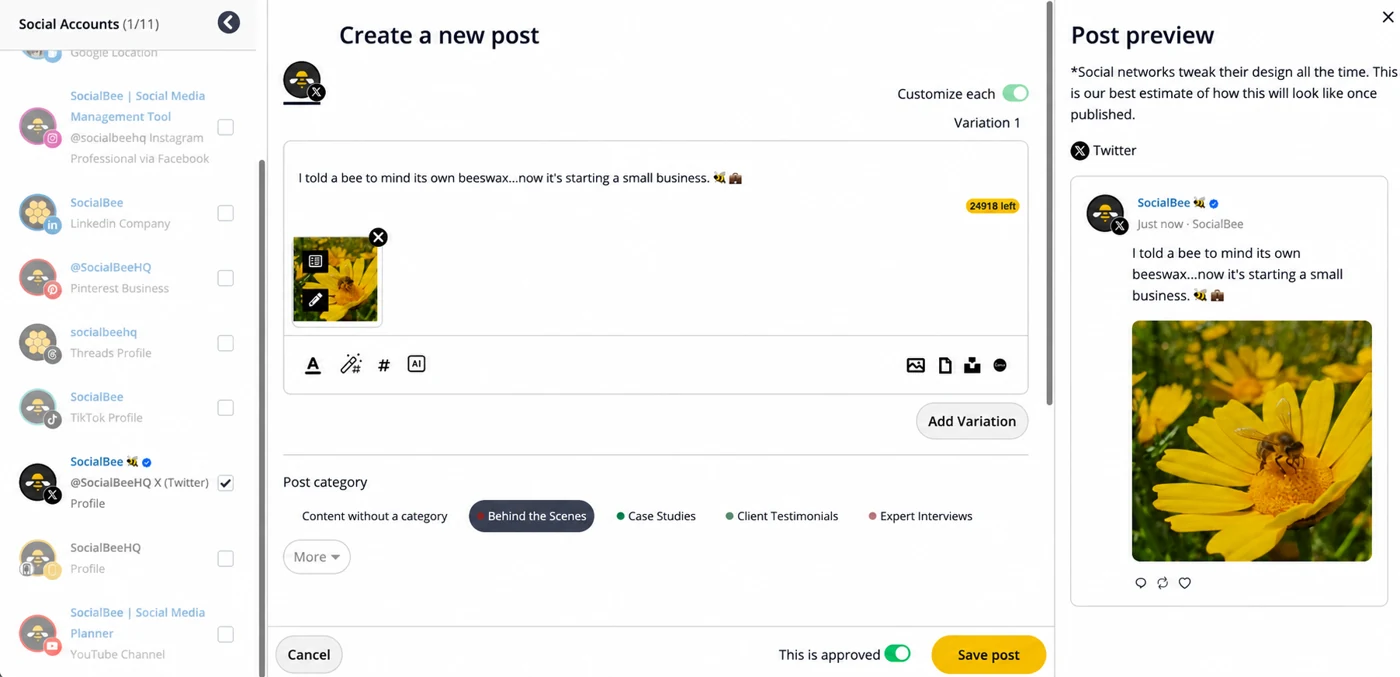
What it actually looks like: You sort content into categories and SocialBee posts from those categories on a schedule rather than draining a flat queue. RSS import, recycling and post expiry sit in the same place, and analytics history runs to 2 years on paid tiers.
On Capterra, Megan B., a freelance copywriter in media production, rates it five stars: “It does what it claims to do and it does it well. It’s affordable compared to some alternatives.” Her con is cosmetic: “the UI, it’s not the prettiest tool available but it works.”
The X limitation is the one to read twice. SocialBee’s help centre says “creating multi-post threads directly from our tool isn’t supported at this time.” Its own site file claims the opposite. We scored the help centre. Verify it during the trial rather than taking either page at face value.
It is rated 4.4 on Capterra across 39 reviews, a thin base for a tool this widely used.
Pricing is per workspace. Bootstrap is $29 a month, or $290 a year, for 5 profiles and 1 user. Accelerate is $49 or $490 for 10 profiles and lifts history to 2 years. Pro is $99 or $990 for 25 profiles and 3 users. There is a 14-day trial with no card.
What running SocialBee standalone requires: somewhere else to write threads, and somewhere else to answer X DMs. If the thread conflict decides it for you, our SocialBee alternatives roundup covers tools that compose them properly.
7. MeetEdgar
A queue that refills itself, priced flat with team seats included, and quiet on almost everything X-specific.
Coverage
- Multi-account
- Threads
- Client access
- Reporting
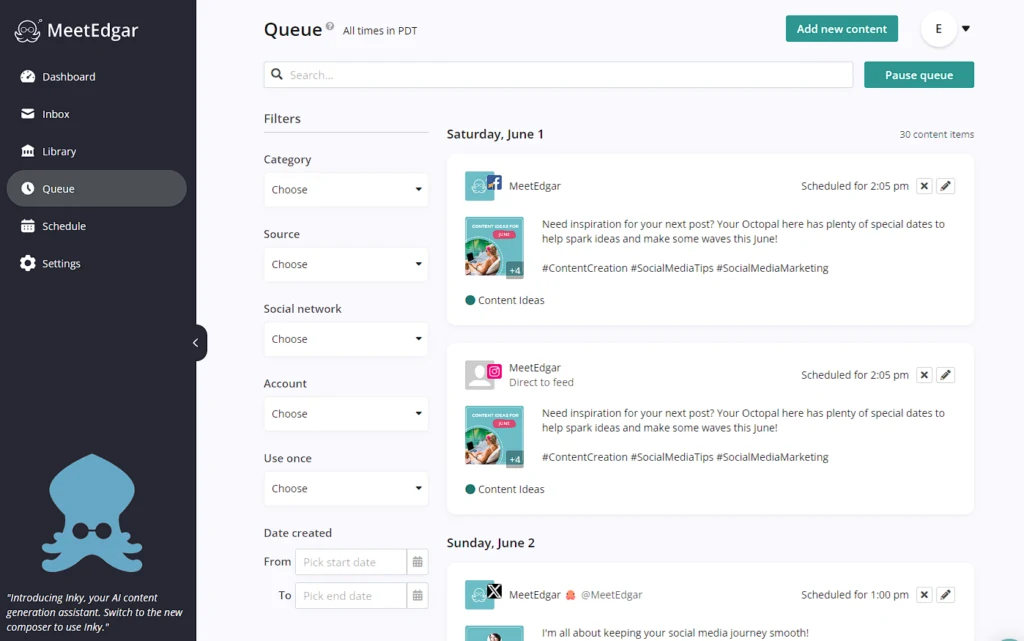
What it actually looks like: You build a library sorted into categories and MeetEdgar pulls from those categories on a repeating schedule rather than emptying a one-time queue. When the queue runs down it refills itself. Publishing reaches ten networks including X, and every plan includes 20 team members at no extra cost, which is the sharpest counter-example to per-seat billing here.
On Capterra, Alexandra N., a CEO in marketing and advertising, rates it five stars for the support: “They get back to you super fast, and have a very active community and many many tutorials.” Eric N., a founder in accounting, names the price floor: “Only one price point–great if you’re big but horrible if you’re just starting out.”
Read the coverage row before the price. MeetEdgar’s X scheduler page lists text, images, videos and links and never mentions threads. Its inbox is documented as covering “only Facebook and Instagram”. No client-facing reporting exists.
It is rated 4.6 on Capterra across 39 reviews, a high score on a thin base.
Pricing is flat per plan rather than per user. Eddie is $29.99 a month, or $24.91 billed annually, for 5 accounts. EDGAR is $49.99 or $41.58 for 25 accounts. There is a 30-day trial and no free plan. It is one of only two flat-priced options in this group, which is what SocialPilot vs MeetEdgar turns on.
What running MeetEdgar standalone requires: a separate tool for X engagement, another for any report a client would accept, and patience with a library you have to build before recycling pays off. Our MeetEdgar alternatives roundup covers tools that add the reporting layer.
X-Native Tools Built for One Platform
These three do X and little else, which is the point. Look here if your problem is writing a thread that holds attention, or understanding who actually follows you.
8. Typefully
The best thread composer here, free to start, and it publishes nothing outside text-led networks.
Coverage
- Multi-account
- Threads
- Client access
- Reporting
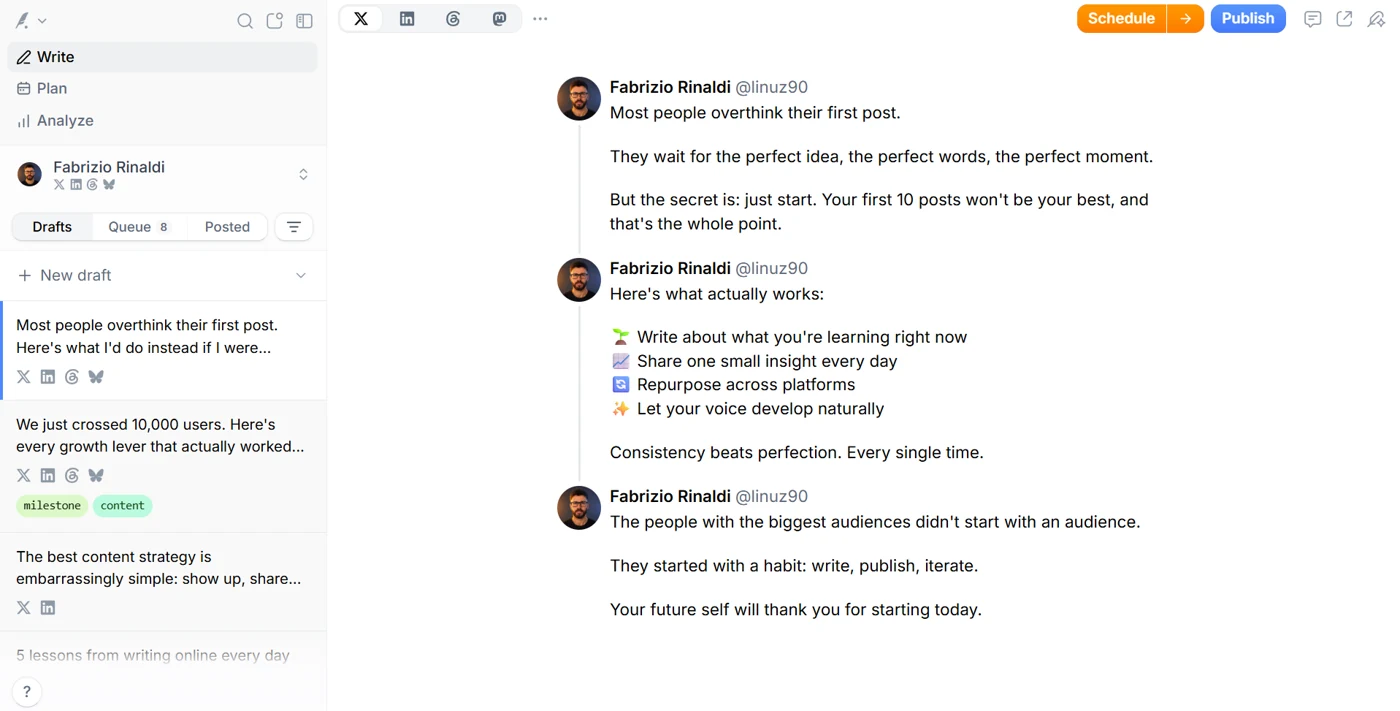
What it actually looks like: For Typefully, the editor is the product. You write in a canvas that shows the thread as it will appear, splits text at the character limit and numbers posts automatically. Free X accounts publish up to 50 posts in a thread at 280 characters each, X Premium accounts up to 50 long-form posts at 25,000 characters. Beyond X it reaches LinkedIn, Threads, Bluesky, Mastodon and Instagram, and nothing else.
On Product Hunt, Harry Zhang, a builder at Timelaps, has used it about two years: “One of the easiest tools for marketers to get started.” His criticism names the boundary: “the lack of support/feature for other, less text-heavy platforms, as it’s more optimized for X.”
Its Capterra listing carries no reviews at all. The 4.7 average quoted elsewhere comes from 22 Product Hunt entries, which publish neither job titles nor per-review stars.
Pricing is per social set, its term for the accounts belonging to one brand, so you pay per brand rather than per account. Free covers 1 set and 10 posts a month with the full composer. Creator is $99 a year, annual only. Business is $20 a month per set, or $216 a year, up to 50 sets. Analytics is the awkward part: the help centre answers “Why am I only seeing the last 30 days of metrics?” by telling you to email support.
What running Typefully standalone requires: everything except the writing. No Facebook, TikTok or YouTube, no approval workflow and no published history, so this is a specialist you add to a setup rather than the setup itself.
9. Tweet Hunter
X-only writing, scheduling and a CRM for the people you want to talk to, built on official X API access.
Coverage
- Multi-account
- Threads
- Client access
- Reporting
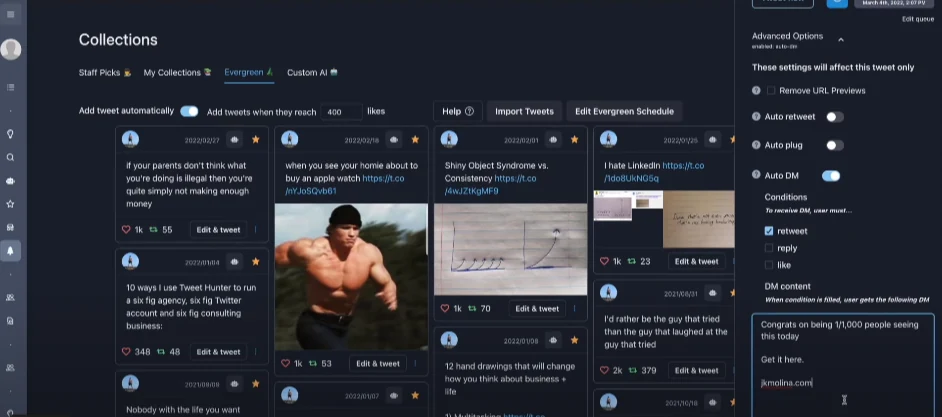
What it actually looks like: Tweet Hunter prices and scopes everything per X account, which tells you how single-minded it is. Thread scheduling with a delay between posts, a library of viral posts Tweet Hunter puts at over 12 million, evergreen recycling, auto-plug, auto-retweet, and an X CRM that builds lists of accounts and works through engagement from them. Its FAQ states it is an official X API partner, which in a category where several tools died with API access is worth something.
On Capterra, Vivek C., a founder in computer software, rates it five stars: “The AI-powered writing suggestions helped me come up with post ideas quickly.” The same review names the limit: “some of the AI-generated content could feel a bit generic and still needed editing.”
It is rated 5.0 on Capterra across exactly one review, which is a data point rather than a rating.
Pricing is per X account, and the discount needs reading carefully. Discover is $29 a month with 1 X account, Grow $49 with 5, Enterprise $199 with unlimited. There is a 7-day trial and a full refund within 30 days. That $29 sits under a limited-time 50% off banner whose countdown is permanently at zero, while its own FAQ says pricing starts at $49. Treat $49 as the real entry point.
What running Tweet Hunter standalone requires: every other platform, since it does X and only X. Its engagement offering is CRM-shaped rather than an inbox, so there is no unified queue of replies and mentions.
10. Circleboom
Follower analysis and account cleanup for X, priced per account and capped by how big your following is.
Coverage
- Multi-account
- Threads
- Client access
- Reporting
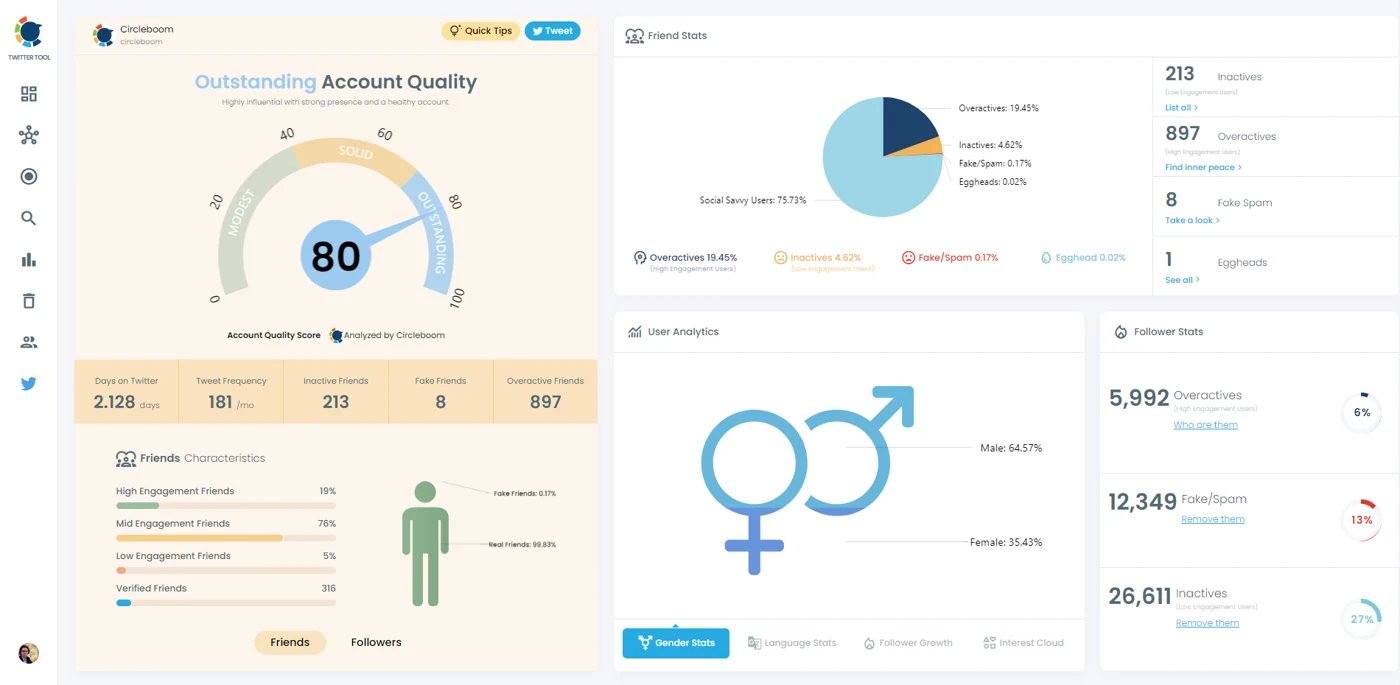
What it actually looks like: Circleboom is the follower-graph tool this category used to be full of. Followers and followings management, who unfollowed me, smart account search, an X list manager, bulk follow and block, and a thread scheduler. Circleboom describes itself as an Official X Enterprise Developer, which is why it still works when most of its old competitors do not.
The sharpest review on Capterra is the one to read first. JM E., an owner in retail, rates it one star: “The customer service is negligent and noncooperative.”
Two things to get right before you pay. Circleboom runs two products with two Capterra listings and different scores, and this entry is Circleboom Twitter. And the caps bite: who followed and unfollowed me work only up to 25,000 followers, not-following-back to 300,000, and searches are metered at 10 a month on Pro.
The Circleboom Twitter listing is rated 4.1 on Capterra across 32 reviews, the lowest score on this page.
Pricing is per X account, gated by follower count. Limited is $29.99 a month, or $155.88 billed annually. Pro is $47.99 or $383.88 billed annually and caps at 25,000 followers. Plus is $58.99 or $479.88 billed annually to 100,000, Premium $69.99 or $563.88 billed annually to 300,000. There is a free tier.
What running Circleboom standalone requires: a scheduler for anything serious, and a different tool the moment you pass its follower ceilings.
Analytics and Benchmarking Tools
These two do not publish anything. They exist to measure, and both are priced accordingly. Look here only if comparing yourself to named rivals is the job you cannot do today.
11. Rival IQ
The strongest competitive intelligence here, at the highest entry price, and it publishes its retention window properly.
Coverage
- Multi-account
- Threads
- Client access
- Reporting
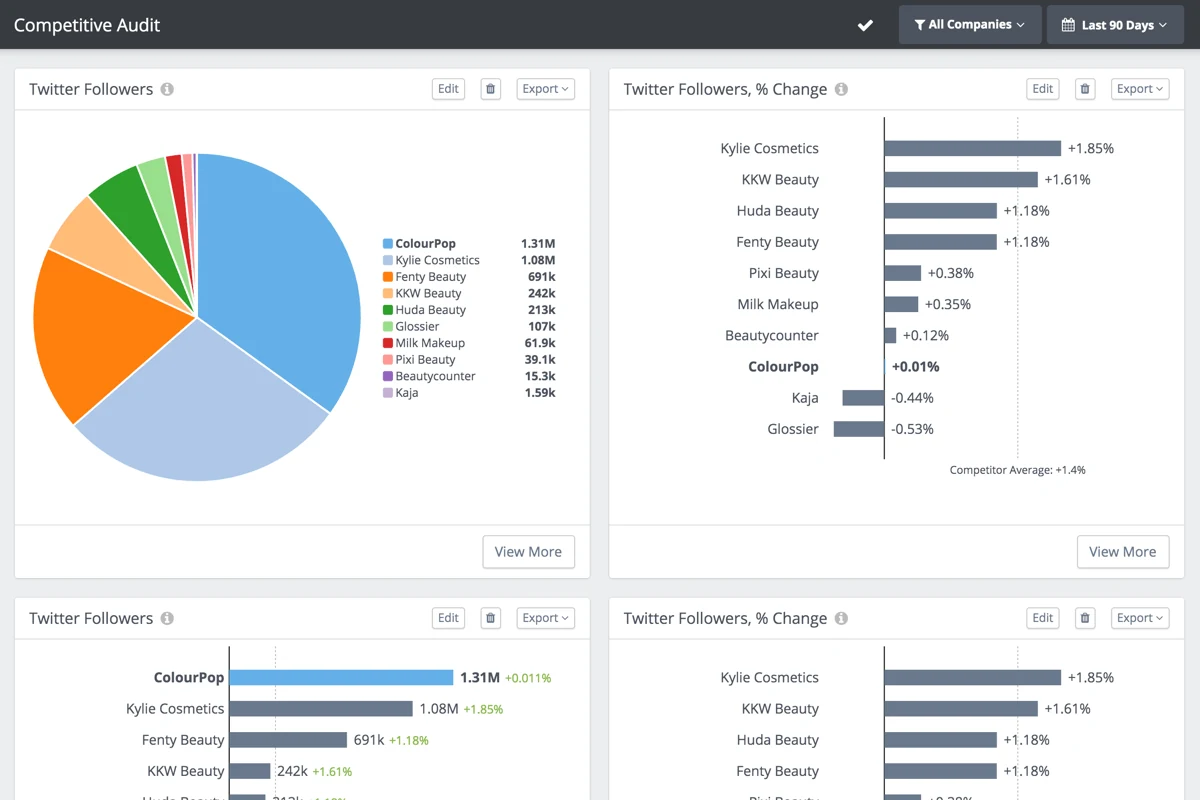
What it actually looks like: You give Rival IQ a landscape of competitor accounts and it audits you against them. X performance arrives as impressions, clicks, video views and replies, with head-to-head views putting your account beside named rivals on cadence and engagement. History is tiered at 6, 12 and 24 months.
On Capterra, Prashant L., a head of social media, rates it five stars: “Ease to switch between competitions social page analysis.” His con is the recurring one: “the costs are quite high and because of that it is out of reach for digital marketing startups/freelancers.” Linda R., a director of digital communications, puts the sharper objection: “if you have sprout or Meltwater, you wouldn’t necessarily need RivalIQ.”
The gating to know about. Competitive X tracking is on every plan, but first-party analytics for your own connected account starts at Engage. If you want Rival IQ to report on your own account, your real entry price is $299, not $199.
It is rated 4.4 on Capterra, but across only 13 reviews, too thin to read as consensus.
Pricing is flat per plan. Drive is $239 a month, or $199 billed annually, for 10 tracked companies and 1 user. Engage is $349 or $299 for 20 companies and 2 users. Engage Pro is $559 or $469 for 40 companies and 5 users. There is a 14-day trial with no card, and no mobile app.
What running Rival IQ standalone requires: everything except measurement. It does not publish, reply or draft, so it sits on top of whatever you already post with.
12. Talkwalker
Enterprise listening across social, news and the wider web, sold by quote, and now a Hootsuite product.
Coverage
- Multi-account
- Threads
- Client access
- Reporting
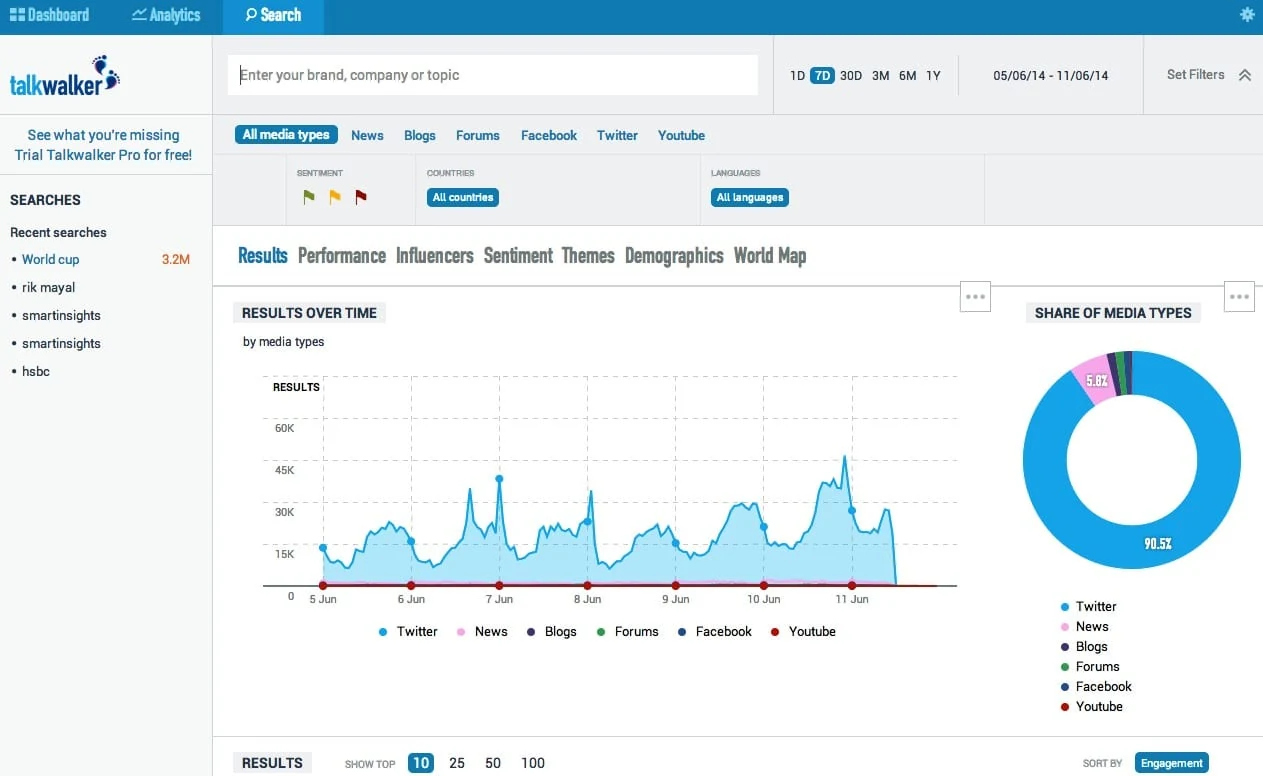
What it actually looks like: Talkwalker sells three tiers named Core, Analyze and Business, differentiated by data volume, topics, history and workspaces. Every tier includes unlimited users. Its reach extends past social into news, blogs, forums, podcasts and broadcast, and the sentiment analysis is a genuinely different capability rather than a dashboard relabel.
On Capterra, Maria B., a social media coordinator, rates it five stars with a condition: “Once you’ve had a proper demo/training on this tool, honestly the sky is the limit.” Her con is the other half of that sentence: “The tool isn’t the most intuitive or user-friendly.”
Two things to know before a sales call. Talkwalker is now part of Hootsuite and rebranded as Lumen by Talkwalker, so search results and invoices may not match. And its X benchmarking is real but had to be established from two separate pages, because the benchmarking page itself never names X.
It is rated 4.4 on Capterra across 24 reviews, thin enough to read as a signal rather than a verdict.
No price is published anywhere. Talkwalker’s pricing page names three tiers and shows no figure for any of them. No free plan, no self-serve trial, only a demo request. Its top tier lists additional historical data without a number, so the retention question cannot be answered before you talk to sales.
What running Talkwalker standalone requires: a procurement cycle, a scheduler alongside it, and tolerance for buying a listening platform when the job might be a $199 benchmarking tool.
Four Tools Other Roundups Still Recommend That No Longer Work on X
These four appear on almost every competing list, priced and described as though you can buy them today. You cannot, at least not for X.
| Tool | What actually happened |
| Crowdfire | Shut its social media product down. Its own site now reads “Crowdfire is evolving” and describes a media platform, not a scheduler. The app subdomain no longer resolves. |
| Audiense Connect | Folded into Audiense Discover, which publishes no pricing at all. The Twitter management product is gone; only analytics remain, sold by quote. |
| Black Magic | Closed. Its homepage carries one line: “BlackMagic is shutting down on July 1, 2026.” That date has passed. |
| Hypefury | Still recommended everywhere as an X growth tool. Its own pricing page answers the question with “Nope! Hypefury no longer supports 𝕏.” Its homepage still advertises X features, which is how the error keeps spreading. |
Two more are absent for a related reason. Followerwonk and Tweepsmap are now the same product, Fedica, under two names.
The pattern is worth naming because it will repeat. Where a tool’s homepage and its pricing page disagree, believe the pricing page.
Where SocialPilot Fits in This List
Our own tool sits in the all-in-one group, alongside Sprout Social, Agorapulse, MeetEdgar, ContentStudio and SocialBee. It is built for teams and agencies that want publishing and client-ready reporting in one place rather than assembled from parts.
Against the four jobs, three are covered natively and one is partial:
- Multi-Account Publishing ✓ One calendar for every connected X account, bulk CSV upload of up to 500 posts, and separate client workspaces rather than a shared queue.
- X Thread Composing ◐ AI Pilot drafts threads, but there is no dedicated thread canvas. Typefully is the specialist, and its free plan means testing that costs nothing.
- Client Access and Approvals ✓ Client logins, approval workflows and unlimited client seats from Premium, inside a plan rather than behind a separate agency tier.
- Reporting You Can Actually Send ✓ White-label X reports from Premium, where Sprout Social publishes no white-label option at all and ContentStudio sells it as a $50 add-on.
The honest summary is that SocialPilot wins this page on economics rather than on any single feature. Every all-in-one here matches it on one job or another. None of them charges the same for a team of three as for a team of one, and that is the difference agencies actually feel.
If replying to X mentions in a single queue is the one job you cannot do without, Agorapulse, Sprout Social and ContentStudio all build their products around it, and this page says so.
Where X’s Own Analytics Gets You, and Where It Stops
Before paying for anything on this page, know what X itself gives you. Less than it used to. The account-level dashboard is now part of X Premium, so on a free account you are working from per-post numbers alone.
What X Analytics Actually Shows
On a free account, tap the bar-chart icon under any post and you see that post’s impressions, likes, replies and link clicks. That is the whole of it, one post at a time.
X Premium adds the account-level dashboard: totals across posts, follower growth, video retention and audience demographics, with 28 days on screen and exports reaching 90. One G2 reviewer put the appeal plainly: “I like how they automatically pull in your top tweets and provide helpful insights into how to perform better.” (Verified G2 review)
Why It Runs Out for Serious Growth
Three limits, in the order people hit them.
- Ninety days, and only if you pay and remember. Premium’s dashboard shows 28 days and exports reach back 90. One quarter-over-quarter comparison is possible, then, provided you export on time every time. Miss a window and that period is unrecoverable, and a year-over-year view is not on offer at all. A three-star G2 reviewer, Jerry Michael V., describes the dashboard view most people live in: “Twitter Analytics only stores data for the past 28 days. This can be limiting for users who want to track their performance over a longer period of time.” (Verified G2 review)
- One account, no comparison. No competitor view, no cross-account roll-up, no client-ready export.
- No second pair of hands. One login. If a colleague posts for the brand, you are sharing a password.
Hit any one of those, or the moment someone asks for a branded report, and a third-party tool is the cheaper answer. Several of them cost less than X Premium and cover all three. For the full metric list, our dedicated X analytics tools guide goes deeper on that one job.
Why Your Tool’s Numbers Will Not Match the X App
This catches most people in the first week, and comparison pages almost never mention it. Your new tool will show different figures from the app. That is not a bug, and knowing why saves an argument with a client.
- Different data surfaces. The app reads X’s internal data. Third-party tools read the public API, which is a smaller surface and got smaller when X repriced it in 2023.
- Different engagement-rate maths. Most tools divide engagement by follower count. X leans on impressions. Same post, two percentages, neither wrong.
- The backfill boundary. A tool that connected today cannot backfill what X no longer serves, so your first month of “history” is not history at all.
- Refresh timing. Tools pull on different schedules, so the same date range can disagree by a point or two.
Pick one source as your reporting truth and stay with it. Comparing this month’s tool figure against last month’s app figure produces a trend that does not exist.
The Free X Tools Actually Worth Using
Four options here are genuinely free rather than trial-limited.
- Per-post stats on X. Free on any account, from the bar-chart icon under each post: impressions, likes, replies and link clicks, read one post at a time. The account-level dashboard is not included and needs X Premium.
- X advanced search. Free to any logged-in account, and genuinely good. Date ranges, specific accounts, keyword combinations and engagement thresholds, reaching far past what the analytics tab retains. Our X advanced search guide walks through the operators worth memorising.
- Buffer Free. Three channels, 10 scheduled posts per channel, one user.
- Typefully Free. One social set and 10 posts a month, with the same thread composer paid users get.
One category to be careful with. Searches for free X tools surface a lot of follower-boosting and engagement-buying services. Those violate X’s rules and none appears on this page for that reason.
How to Choose the Right X Tool
Start With One Job, Not a Category
Name the single job you cannot do right now and let it pick the tool.
- A thread you are proud of points at Typefully or Tweet Hunter, and the first one is free.
- Several accounts on one calendar with a client report at the end points at an all-in-one, and the thing to check is billing basis rather than feature count.
- Replying to X mentions in one queue points at Agorapulse, Sprout Social or ContentStudio.
- Named-rival benchmarking points at Rival IQ or Talkwalker and nothing else here.
Then check how you are billed, because it moves the answer more than features do. Per-seat pricing looks cheap for one person and expensive for four. Per-channel inverts it. Per-X-account inverts it again. Run your real headcount through the arithmetic before you compare entry prices, because entry prices are quoted for a team of one.
Combinations That Actually Work
Most people need one tool. Two pairings come up often enough to name.
- Writer plus scheduler. Typefully for drafting the thread, whatever you already publish from for everything else. The writing half can start free.
- All-in-one plus benchmarking. Publishing and client reports in one place, with Rival IQ alongside when a client asks how they compare.
Managing more than X? The same logic holds across every network, and our social media management tools roundup applies it at that scale. We have run the same comparison for TikTok tools.
How We Checked These 12 X Tools
Every price, tier, account cap, trial length and gating rule here was read off each tool’s own pricing page, not from a review aggregator and not from another roundup. Six of the figures in wide circulation turned out to be wrong, and where a tool’s homepage and its pricing page disagreed, we took the pricing page.
Every quoted review is real, published, reproduced verbatim and linked, with the reviewer named as the source names them. Critical reviews appear for every tool that has them, ours included. Every score is Capterra’s, because it is the one aggregator we could read in full, and the review count runs beside every score rather than behind it. Two tools here have bases too small to mean anything, and both entries say so.
We also checked whether each tool still operates and still supports X. Four came off the roster: Crowdfire discontinued its social product, Audiense Connect folded into Audiense Discover, Black Magic shut down on July 1, 2026, and Hypefury dropped X support entirely. Two more merged into one, because Followerwonk and Tweepsmap are now both Fedica.
What we did not do: run twelve paid trials side by side. This is a pricing, capability and positioning comparison built from each tool’s own documentation and published user reviews. Where a price could not be confirmed, we say so in the entry rather than estimating one.
So, Which One Earns Its Place?
Twelve tools, and not one of them is the answer on its own. The right one is whichever covers the job you cannot do today, which is why the shortlist looks different for a creator writing threads than for an agency reporting to six clients.
If that job is a single thread you want to be proud of, buy a writing tool rather than a platform, and start with the free tier.
If it is several accounts on one calendar, approvals before anything ships and a client report with your name on it, an all-in-one ends the search, and the thing to check before you buy is not the feature list but the billing basis. That is where SocialPilot makes the easiest case on this page: from $25.50 a month, X included at every tier rather than sold as an add-on, client seats and white-label reports inside the plan, and a bill that does not multiply when a third person joins.
Here is the part worth sitting with. X charges for its own dashboard, shows 28 days once you pay, exports 90, and keeps nothing you can reach after that. If you could see two years of your own account instead, what would you actually change?
Frequently Asked Questions
What are Twitter (X) tools?
Third-party products that do something X's own app does not: schedule posts in advance, report on your account without paying X Premium for a dashboard, run more than one account without sharing a password, compose threads properly, or monitor mentions in one queue. Most do one or two of those well rather than all four.
Which is the best Twitter tool?
There is not one, because the category splits by job. For several accounts, approvals and client-ready reporting in one flat-priced plan, SocialPilot from $25.50 a month. For writing threads, Typefully, which has a real free tier. For benchmarking against named rivals, Rival IQ. Anyone naming a single winner is not asking what you need it for.
How much do X tools cost?
From free to around $560 a month, and past that once a listening platform quotes you. Solo creators pay $0 to $50, small teams $19 to $100, and brands needing benchmarking pay $199 to $559. Per-seat platforms sit outside those bands, because one Sprout Social licence alone runs $99 to $499 a month depending on tier.
Can I manage multiple X accounts with one tool?
Yes, and it is the clearest reason to leave native X behind, since it holds one account with no way to grant a colleague access short of sharing the password. Check how the tool counts accounts, because the account limit and the seat count are separate numbers and the marketing is much louder about the first. Buffer charges per channel, Typefully per brand, Circleboom and Tweet Hunter per X account, SocialBee per workspace. SocialPilot counts accounts and users, so seven accounts on the entry plan cost the same whoever is logged in.
Which tool is used to find old tweets?
X's own advanced search, free to any logged-in account. It handles date ranges, specific accounts, keywords and engagement thresholds, and reaches back well past anything the analytics tab will show you.
Why does my engagement rate differ between two tools?
Because they divide by different things. Most third-party tools calculate engagement against follower count, while X leans on impressions. Same post, two percentages, neither wrong. Pick one as your reporting truth.
Are there AI-powered tools for X marketing?
Almost all of them now, though the label covers very different things. Schedulers generate captions and suggest posting times. X-native writing tools draft the thread itself. Listening platforms use AI for sentiment analysis, which is a genuinely different capability. Treat "AI-powered" as a feature description rather than a reason to pick a tool. Ask which task it removes from your week, and whether it costs extra, since several tools meter AI usage in credits.
About the Author