
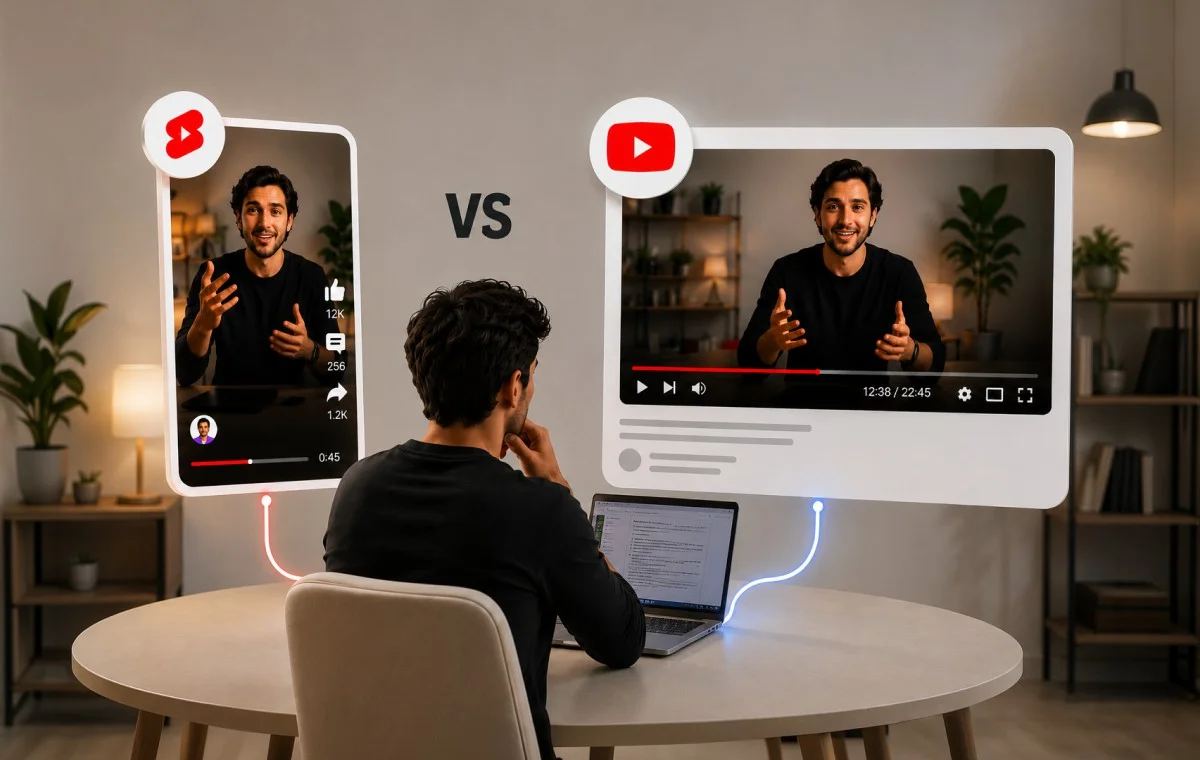
Someone on your leadership team just asked why the brand’s YouTube channel isn’t posting more Shorts. Or maybe it went the other way, and a client wants to know why you’re still investing hours into long-form videos when Shorts get ten times the views for a fraction of the effort.
Either way, you’re the one stuck answering for it. “Everyone else is doing Shorts” isn’t an answer you can put in front of a marketing director or a client with a real budget.
This is the situation most in-house marketing teams and agencies find themselves in right now. You’ve been told to do Shorts because competitors are active there, but nobody has handed you a framework for what Shorts and long-form are each supposed to accomplish for your brand. You’re expected to defend a YouTube Shorts vs long form decision without the data to back it up, while also trying to keep up with a platform that changed its recommendation system twice in the past year.
This article gives you that framework. Here’s what we’ll talk about the YouTube’s recent algorithm changes and what they mean for your discovery strategy. We will also help you create a decision matrix, so you can create a format mix based on your client’s business goals.
What’s the Difference Between YouTube Shorts and Long-Form for Brand Accounts
YouTube Shorts is a vertical video format capped at three minutes, built to appear in its own dedicated Shorts feed where viewers swipe from one video to the next. Long-form video is the traditional YouTube format, typically shot horizontally, with no length cap, designed for viewers who click in with the intent to stay for several minutes or longer.
The difference isn’t just runtime. Shorts and long-form are built to do different jobs inside your YouTube strategy. Treating them as the same content squeezed into different lengths is where most brand channels go wrong.
| YouTube Shorts | Long-Form Video | |
| Orientation | Vertical (9:16) | Horizontal (16:9) |
| Length | Up to 3 minutes; best under 60 seconds | No cap; best at 8-15 minutes for brand accounts |
| Where it shows up | Dedicated Shorts feed, swipe-based | Home feed, search, subscriptions, suggested videos |
| Primary job | Discovery – gets you in front of people who’ve never heard of your brand | Depth – gives you time to teach, demo, or answer objections |
| What the algorithm rewards | Swipe-through rate, replay rate, shares | Watch time, session contribution, viewer satisfaction |
| Revenue share to creators | 45% of a pooled Shorts feed ad fund | 55% of net ad revenue on the specific video |
While Shorts are great for discovery, long-form videos are great for providing depth. Agencies can also build their client’s video content strategy for social media that spans more than just YouTube; this same discovery-versus-depth split holds up across other social media platforms as well.
However, if you are new to the format, check out this guide on how to create YouTube Shorts before you try to fold it into a broader brand strategy, since the setup and algorithm signals for Shorts are different from long-form videos.
What the Data Actually Shows About YouTube Shorts vs Long Form
Here are the numbers that actually change boardroom conversations about this topic, data point first, followed by what it means for your channel.
The revenue split is official, and it’s lopsided.
- The data: YouTube shares 55% of net ad revenue with creators on long-form videos, according to YouTube’s own ad revenue split policy. For Shorts, creators get 45% of a pooled revenue share, split based on their portion of total Shorts views in their region.
- What it means: Even before you look at dollar figures, Shorts revenue is pooled and shared across every eligible video in the feed, while long-form revenue is tied directly to the ads shown on your specific video. That’s YouTube’s own confirmed structure, not a third-party estimate.
The per-view earnings gap is even wider in practice.
- The data: Long-form video with mid-roll ad placements commonly earns $5 to $25 or more per 1,000 views in strong markets, while Shorts typically earn somewhere between one and thirty cents per 1,000 views. YouTube doesn’t publish these exact dollar figures, since RPM (Revenue Per Mille, the amount you earn per 1,000 views after YouTube’s cut) varies by niche, country, and ad competition at any given moment.
- What it means: A single long-form video with 50,000 views can out-earn a Short with half a million views. Keep that in mind for your YouTube long-form video strategy. Shorts view counts alone aren’t a win worth reporting to a client or leadership team, not without the revenue numbers behind them.
Shorts do move the growth needle, just not the whole story.
- The data: If your team’s real question is simply does YouTube Shorts help channel growth, the answer is yes for subscriber count and reach.
- What it means: That growth is weaker on the metrics that actually move a brand goal forward, like repeat viewership and engaged watch time. Put side by side, YouTube Shorts vs long-form video economics aren’t close, and that gap should shape how much weight you put on view count alone when reporting results.
We’ll come back to how often you should be posting each format once we get to the format mix section below, since cadence only makes sense once you know what each format is buying you.
What YouTube’s Algorithm Changes Mean for Your Brand Strategy
If your channel’s home feed traffic has dropped over the past year and you haven’t changed anything about your content, you’re not imagining it. YouTube changed how it ranks and displays both formats twice in recent months, and both changes affect how brand accounts should plan.
The Home Feed Change: Up to 80% Less Long-Form Discovery
YouTube retention strategist Mario Joos, who has worked with channels including MrBeast, documented a significant home feed layout change based on data pulled from over 1,000 channels.
- Where the home feed used to show around six long-form videos across two rows, it now typically shows only two, with short-form content filling out the rest of the space.
- Joos put the practical effect at up to an 80% reduction in long-form recommendations compared to the previous layout.
- Long-form video is shifting toward being a search and subscriber-feed play. People find it because they searched for the topic directly, or because they already subscribed, and it showed up in their feed, not because they stumbled onto it while browsing.
The Ranking Shift: Session Contribution Over Raw Watch Time
Alongside the home feed change, independent YouTube algorithm trackers including vidIQ have reported a shift in how long-form video gets ranked.
- Session contribution, meaning how much a given video extends the average viewing session by leading someone to watch something else afterward, now carries more weight.
- Viewer satisfaction, measured partly through in-app rating prompts, is also being weighted more than raw watch time alone.
- This isn’t officially confirmed by YouTube in a single public statement about the way the revenue split figures are, so treat it as a reported trend rather than a locked-in fact. It does line up with what a lot of teams are seeing: a long-form video sitting on its own doesn’t get the same reach it used to, while videos that are part of a social media content series or that link to something else on the channel hold up better.
What This Means for Your Team
- Don’t rely on the home feed to introduce new viewers to your long-form content anymore.
- Let Shorts carry more of that discovery load instead.
- Build your long-form videos so watching one naturally leads a viewer toward the next, through playlists, end screens, or simply referencing other videos in the series.
Does Long-Form Video Actually Build More Brand Trust? Here’s the Honest Answer
No study or platform-published research directly proves that long-form YouTube content builds more brand trust than Shorts. That’s a real gap in the data, and it’s worth admitting plainly instead of reaching for a comfortable-sounding number that doesn’t survive a fact check.
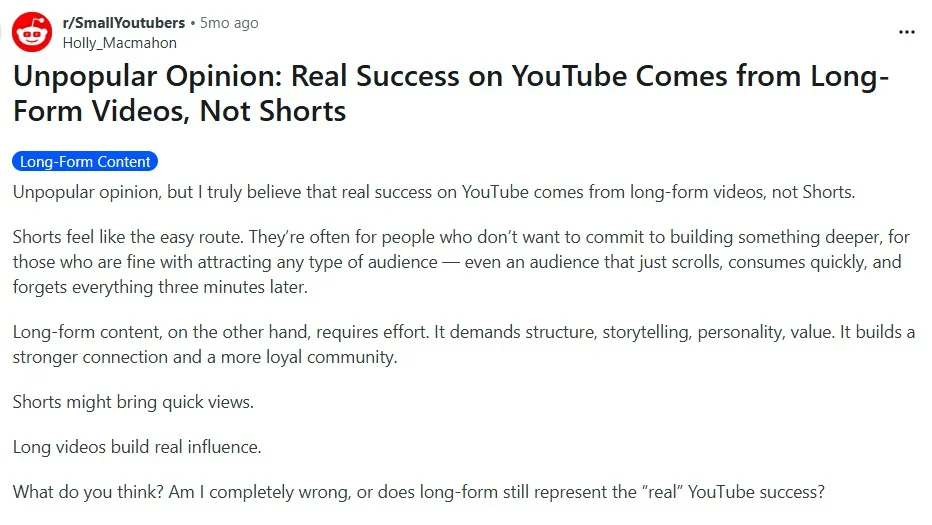
But we came across many claims on Reddit where people believe that real success on YouTube comes from long-form content. Here is one such Reddit thread from r/SmallYoutubers:
We also have some adjacent evidence that points in this direction:
- Watch time as a proxy for familiarity. A viewer who spends ten minutes with your brand’s video has had more exposure to your message, tone, and product than someone who watched a fifteen-second clip.
- Revenue structure as a proxy for audience commitment. Long-form ad rates are higher partly because advertisers are paying for a more engaged, more attentive audience. That’s a real signal, even if it isn’t a direct measurement of trust.
The Connected TV Argument Nobody’s Making Yet
There’s a more concrete argument sitting in plain sight, and almost no brand-focused content has developed it.
- According to a YouTube blog post, views of Shorts on connected TVs grew more than 100% between January and September 2023, and the number of top creators earning the majority of their watch time on TV screens grew more than 400% over the same stretch.
- More recently, Nielsen’s own reporting showed that YouTube captured 13.4% of total TV watch-time in July 2025. This was YouTube’s sixth consecutive month as the top media distributor, ahead of every traditional network and every other streaming service tracked.
Here’s why this matters for brand trust specifically. On a television screen, viewers aren’t scrolling past your video with their thumb hovering over the next one. They’re sitting back, often with fewer distractions, and choosing to keep watching rather than reaching for a remote.
That produces longer sessions and higher completion rates almost by default.
The video below from Streaming Media 2024 Connect talks about “Targeting, Measuring, and Scaling Connected TV Advertising” and it explains how CTV viewing behavior changes the way brands should plan and measure video campaigns.
How Your Brand’s Goals Should Determine Your Format Mix
The question we hear most from marketing teams isn’t whether to use Shorts or long-form. It’s how much of each, and the honest answer depends entirely on what you’re trying to accomplish.
| Brand Goal | Shorts Allocation | Long-Form Allocation | Why |
| B2B lead generation | 30% | 70% | Buyers need depth and proof before they’ll hand over contact details; Shorts alone rarely carry enough context to move someone through a longer sales cycle |
| E-commerce brand awareness | 70% | 30% | High-volume, low-commitment discovery matters more than depth when the goal is simply getting the product in front of more eyes |
| Product education for existing customers | 40% | 60% | Customers already know the brand and need real instruction, which favors longer, more complete videos, though quick tips in Shorts form still help. |
| Employer brand and recruiting | 50% | 50% | A mix of quick culture snapshots and longer interview-style content tends to reach both passive browsers and serious candidates |
Use this as a starting point, not a fixed rule. The right YouTube video format mix strategy for your brand should shift as you gather your own performance data.
This is also where format mix stops being a YouTube-only decision and becomes part of your broader YouTube content strategy for brands, since the ratio you land on should feed back into how you plan every other channel too.
The metric to track matters as much as the ratio itself:
- For lead generation: conversion from video views to form fills or demo requests
- For brand awareness: reach and new-viewer percentage, not total views alone
- For product education: completion rate on your long-form videos specifically, since a high view count on a tutorial nobody finishes isn’t helping your customers
On posting cadence, most SMB and mid-market brand accounts can sustain two to three Shorts per week alongside one long-form video every one to two weeks without straining a small team. That ratio will look different depending on your goal allocation above, but it’s a workable starting point if you don’t already have one.
If you’re weighing this decision as part of a broader push, it helps to have a YouTube marketing strategy already mapped out before you commit to a specific format split.
Managing This Across Multiple Brand or Client Accounts
Everything above assumes you’re making one format-mix decision for one brand. If you’re at an agency or working as a freelance social media manager handling several client accounts, the same framework applies, but with an added layer of complexity.
- Each client likely has a different goal, which means a different Shorts-to-long-form ratio, a different posting cadence.
- The real risk isn’t picking the wrong ratio for one client. It’s applying the same ratio to every account because it’s easier to manage.
- Tracking the mix per account, not just per brand, is what lets you catch that mismatch before a client asks why their YouTube channel isn’t performing the way another client’s is.
This is also where proving the mix is working becomes harder. When a client asks whether the Shorts push you recommended is paying off, you must be able to show format-by-format performance per account, side by side to give them an actual answer.
How to Repurpose Long-Form Into Shorts Without Losing Brand Consistency
Every team we’ve talked to agrees that repurposing long-form videos into Shorts is the efficient way to produce both formats without doubling your production workload. Fewer teams have a repeatable process for doing it. Here’s one that works for brands.
Start by repurposing content for social media – convert long-form videos into short clips using a clear selection process rather than grabbing whatever moment happens to be memorable.
How to Identify Clip-Worthy Moments
Look for three things in your long-form footage:
- A moment where a specific number or result gets mentioned
- A moment where someone states an opinion or makes a claim that could stand on its own
- A moment where the pacing naturally picks up, since a slow build-up rarely survives being cut down to fifteen or thirty seconds
A fifteen-minute video will usually yield three to five genuinely strong clips. If you’re pulling more than that, you’re probably including moments that only make sense with the surrounding context.
Here’s a long-form YouTube video from the “Diary of a CEO,” showing a detailed conversation between Steven Bartlett (the host) and billionaire investor Jeremy Grantham, where they talk about the AI boom and its upcoming impact.
Below is a Short from the same long-form video, where Jeremy is offering financial advice to an average investor in America.
Both are from the same channel, but follow a completely different format and serve different purposes. While the video offers in-depth insights into the views of Jeremy, the Short offers quick, controversial advice that instantly grabs attention.
The Vertical Reformat Workflow
Once you’ve picked your moments:
- Reframe each clip for a 9:16 vertical aspect ratio rather than simply cropping the sides off a horizontal shot, since that crop usually cuts off whatever the original video was showing.
- Add captions, since a large share of Shorts get watched with the sound off.
- Trim the first second, so the clip opens on the hook itself rather than a half-second of dead air.
- Keep any on-screen branding consistent with your main channel, so a viewer who sees the Short and later finds your long-form video recognizes it as the same source.
If you want a visual walkthrough of this exact process before trying it internally, this video on “How To Turn Long Videos Into Shorts (FAST)” demonstrates the reframe-and-caption workflow step by step.
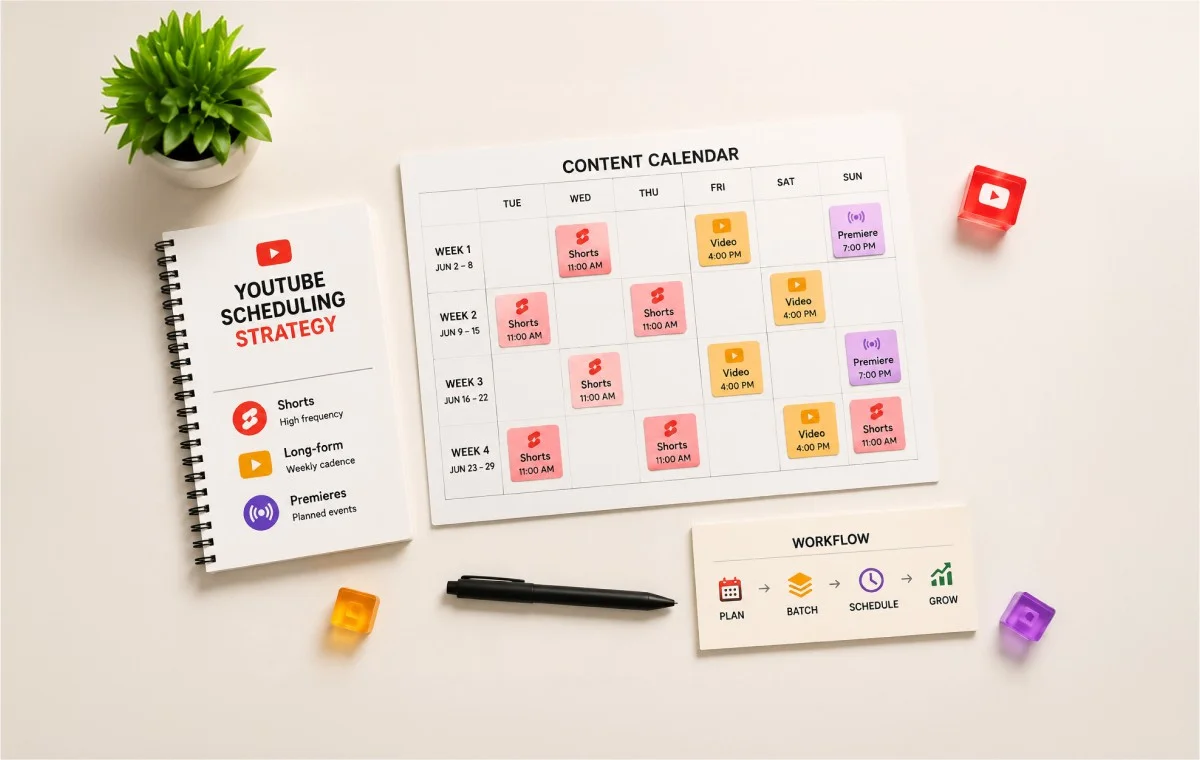
While editing long-form videos into Shorts will take some time and practice, the real operational bottleneck isn’t the editing. It’s keeping both formats on the same calendar so Shorts don’t quietly stop going out the moment your team gets busy with a long-form shoot.
SocialPilot’s YouTube scheduler helps you schedule both Shorts and long-form videos from one dashboard, alongside every other platform you manage, so that you don’t have to constantly switch between the tabs. Put the whole mix on a shared social media content calendar and the format split you committed to stays visible week over week, instead of living only in a spreadsheet nobody opens after the first month.
Getting Your Format Mix Right Starts With a Decision, Not a Guess
The YouTube Shorts vs long-form debate stops being a debate once you separate what each format is built to do. Shorts bring in new eyes. Long-form turns those eyes into people who know your brand. The key here is to pick a ratio that best fits your brand’s purpose.
Start with your goal, build your format mix around it, track the metric that matters for that goal, and revisit the ratio every few months as your channel’s own data comes in.
Once your format mix is decided, the next problem is logistical: keeping Shorts and long-form on schedule across every account you manage, and proving each one is pulling its weight. That’s exactly what SocialPilot’s content calendar and reporting tools are built for. Check out SocialPilot’s plans and pricing to see which one fits the number of accounts and clients your team is already juggling.




 Join 55,000+ social media managers


