
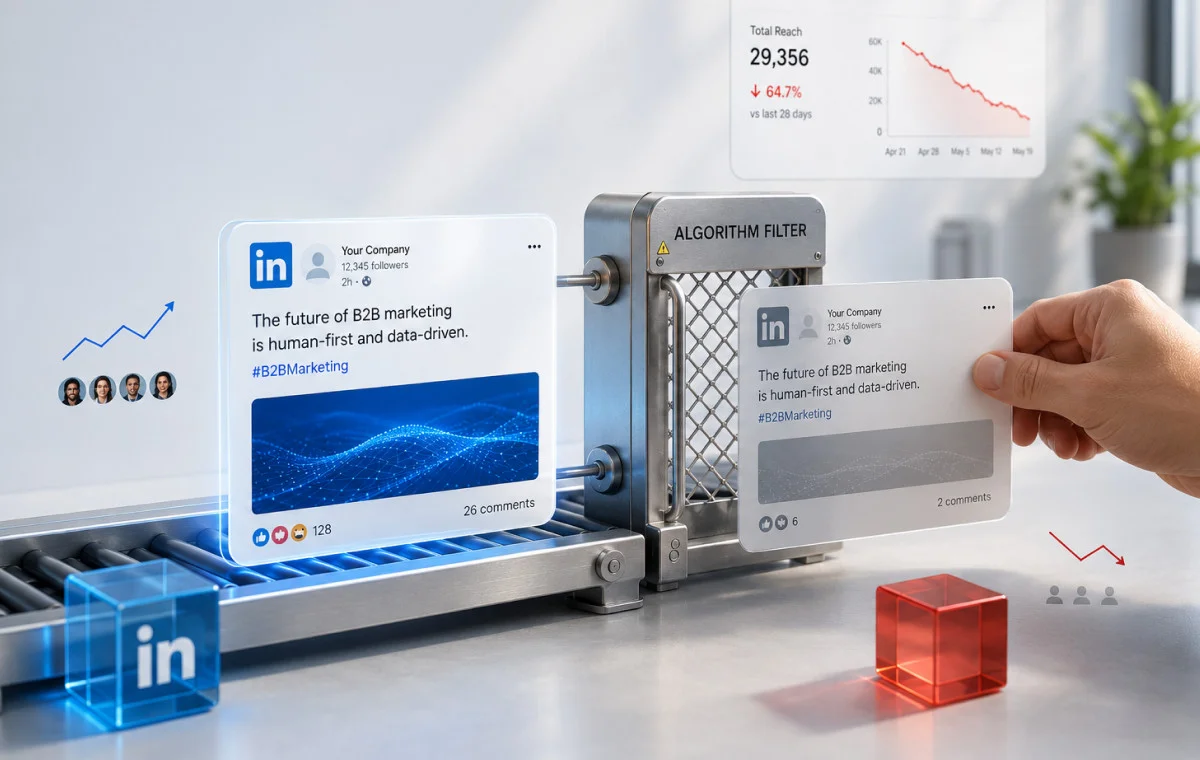
LinkedIn is a platform where corporate and business professionals come to learn, think, and exchange credible ideas. But with over 1.3 billion members, the platform uses a sophisticated algorithm to decide which posts get seen and which ones quietly disappear.
In 2026, LinkedIn’s algorithm rewards focus, credibility, and relevance. The latest updates strongly favor contextual relevance, expertise, and meaningful interaction. If you’ve noticed your reach declining or improving unexpectedly, understanding the algorithm is the fastest way to course-correct.
This guide breaks down exactly how the algorithm works, what changed recently, and what you can do right now to get your content in front of the right people.
Key Takeaways:
- LinkedIn’s 2026 algorithm prioritizes relevance, expertise, and meaningful engagement over viral hacks and vanity metrics.
- Depth Score now matters more than likes — saves, dwell time, thoughtful comments, and private shares carry the most weight.
- LinkedIn’s new AI system, 360Brew, delivers content to the right audience, meaning narrower but more relevant reach.
- Document/carousel posts currently outperform other formats due to higher dwell time and stronger engagement.
- External links, engagement pods, and generic AI content are actively deprioritized by the algorithm.
- Personal profiles outperform company pages for organic reach, making employee advocacy more important than ever for brands.
What is the LinkedIn Algorithm?
The LinkedIn algorithm functions as a set of rules determining feed visibility and content ordering. It filters content based on your connections, interests, relevance, and engagement patterns to personalize each user’s experience.
Unlike a simple chronological feed, it evaluates hundreds of signals to decide what each person is most likely to find valuable and shows them that, in that order.
The algorithm evaluates posts based on three core factors:
- Connection: How closely you’re connected to the person who posted, and how often you’ve interacted with them in the past
- Interest: The topics, industries, and content types you engage with regularly
- Relevance: How well a post matches your professional context, skills, and stated interests
In 2026, LinkedIn’s algorithm focuses less on hacks and more on real user behavior, it evaluates posts based on early engagement, dwell time, comment quality, and conversation depth.
Important LinkedIn Algorithm Updates (September 2026)
LinkedIn’s feed has undergone its most significant technical overhaul in years. Here’s what changed.
September 2026: No Significant Algorithm Updates
No confirmed ranking or distribution change was announced for September 2026. LinkedIn’s September activity was product and marketing content, not a change to how the feed retrieves, ranks, or distributes posts. The March 2026 360Brew LLM feed and the Depth Score priorities still govern distribution, and no new ranking mechanic landed between April and September. Keep writing for saves and substantive comments, and keep external links out of the post body.
360Brew: LinkedIn’s New AI Ranking Foundation
In January 2025, LinkedIn published a research paper describing 360Brew, a 150-billion-parameter AI model built on LLaMA 3, fine-tuned on LinkedIn’s proprietary data. On March 12, 2026, LinkedIn’s Engineering Blog announced its deployment in the live feed.
360Brew replaces LinkedIn’s previous fragmented, rule-based recommendation systems with a single unified AI. It handles over 30 predictive tasks simultaneously: feed ranking, job recommendations, connection suggestions, and ad targeting. Its core advantage is semantic reasoning; it understands post text, profile context, and interaction history to predict relevance far more precisely than prior models.
What this means for professionals and businesses: distribution is no longer broadcast-to-followers. It’s precision delivery to people most likely to find your content genuinely useful. A broad, shallow reach is replaced by a narrower, more relevant one.
Rollout began in summer 2024 and reached 40–100% of platform surfaces by fall 2025.
Depth Score Replaces Engagement Rate
LinkedIn’s ranking signals shifted from rewarding volume (likes, impressions) to measuring depth of engagement through a concept called the Depth Score.
Depth Score factors include:
- Dwell time: how long someone actually reads your post
- Comment depth: whether comments spark threaded discussions or are one-line reactions
- Saves: bookmarking for later signals long-term value
- Private shares: sending a post via DM signals personal relevance
- Scroll behavior: whether users stop or keep scrolling
The weighting shift is significant: saves now carry 5× the algorithmic weight of a like and 2× the weight of a comment. Posts that earn 61+ seconds of average dwell time achieve 15.6% engagement rates, compared to 1.2% for posts skimmed in under 3 seconds.
This explains why posts with lots of likes but shallow comments can underperform compared to posts with fewer reactions but genuine discussion in the thread.
Organic Reach Declined — Reset Your Benchmarks
Reach dropped significantly in 2025 and has not recovered. Richard van der Blom’s Algorithm Insights Report 2025, analyzing over 1.8 million posts across approximately 400,000 profiles, found:
- Views down ~47%
- Engagement down ~39%
- Follower growth down ~42%
This isn’t a temporary fluctuation. Three structural forces are at play: more creators competing for feed slots, paid ads occupying more feed real estate, and 360Brew delivering to smaller but more relevant audiences rather than broadcasting broadly.
The practical implication: update your benchmarks. A post with 200 genuine saves and 30 substantive comments from your exact target audience now outperforms a post with 2,000 likes and 15 emoji reactions, even if the old metrics looked better on paper.
Engagement Pods: Officially Banned and Actively Detected
LinkedIn declared engagement pods a Terms of Service violation and has enforcement teeth to back it up. AI detection systems analyze comment velocity, account relationship patterns, engagement timing, and semantic content to identify coordinated inauthentic engagement with approximately 97% accuracy.
Lempod, the most widely used engagement pod tool, was banned and removed from the Chrome Web Store.
Penalties are progressive: content reach restriction first, then shadow ban, then account warning, then potential permanent suspension. One documented case saw reach drop from 8,500 to 340 impressions overnight following pod detection.
AI-Generated Content Deprioritized
360Brew’s semantic reasoning can detect predictable AI-generated content, posts following generic templates without original professional perspective. Posts identified as “low-effort AI” receive approximately 30% less reach and 55% less engagement than content written in a genuine human voice.
The nuance: using AI writing tools is not the penalty trigger. Publishing content that lacks authentic insight, regardless of how it was produced, is what earns the downrank. Original perspective, specific professional experience, and genuine opinions are what the algorithm rewards.
Company Pages Organic Reach Collapsed
Personal profiles receive approximately 65% of feed distribution. Company pages receive approximately 5%.
Organic reach for company pages dropped 60–66% between 2024 and 2026. Employee advocacy, authentic posts from individual employees about their work, industry insights, and company perspective, outperforms company page content by 561% on a reach-per-post basis.
For B2B brands: company pages still matter for paid advertising and brand credibility, but organic strategy should center on giving employees the content and context to post from their personal profiles.
Expertise Over Entertainment
LinkedIn has seen a 40% increase in users engaging with expertise-focused posts. Posts that share genuine professional knowledge, challenge assumptions with real-world experience, or document hard-won lessons outperform posts optimized for entertainment or reaction volume.
Small Creator Recognition
LinkedIn increasingly promotes quality content from smaller or newer creators who produce consistent, authentic engagement, even when their follower counts are modest. Follower volume is a weaker signal than engagement depth.
Key LinkedIn Algorithm Ranking Signals
LinkedIn evaluates posts across several dimensions to decide who sees them and how far they distribute.
1. Comments
The most weighted signal. LinkedIn doesn’t just count comments, it measures conversation depth and quality. Thoughtful replies that continue a discussion carry significantly more weight than single-word responses. In 2026, the comment section plays a much bigger role in how a post performs. LinkedIn looks at conversation depth and interaction quality, not just volume.
Top 1% creators on LinkedIn reply to comments 741% more often than average creators. The algorithm notices.
2. Saves
LinkedIn added Saves and Sends to post analytics in late 2025, which is the platform telling you directly what it values. A saved post signals long-term, reusable value and it increases a post’s chance of appearing in suggested feeds by over 60% (van der Blom Algorithm Insights 2025, based on analysis of 1.8M+ posts).
The current engagement value hierarchy: comments > saves > shares with commentary > reposts > reactions/likes.
3. Dwell Time
How long someone stays on your post matters as much as whether they click like. The algorithm tracks how long users actually read your content. Posts that hold attention for 30+ seconds consistently outperform posts that generate quick, surface-level reactions.
4. Early Engagement Velocity
The first 30–60 minutes after publishing are the most critical window. Strong engagement in this period signals to LinkedIn that the content is worth showing to more people. Weak early engagement caps the post’s reach regardless of quality.
5. Expertise and Topical Consistency
LinkedIn uses your posting history, profile signals, and engagement patterns to assess your authority on a given topic. Posting consistently in one area builds a recognizable expertise signal that the algorithm uses to distribute your content to professionally relevant audiences. Accounts that build topical consistency see significantly higher sustained reach.
How Does the LinkedIn Algorithm Work?
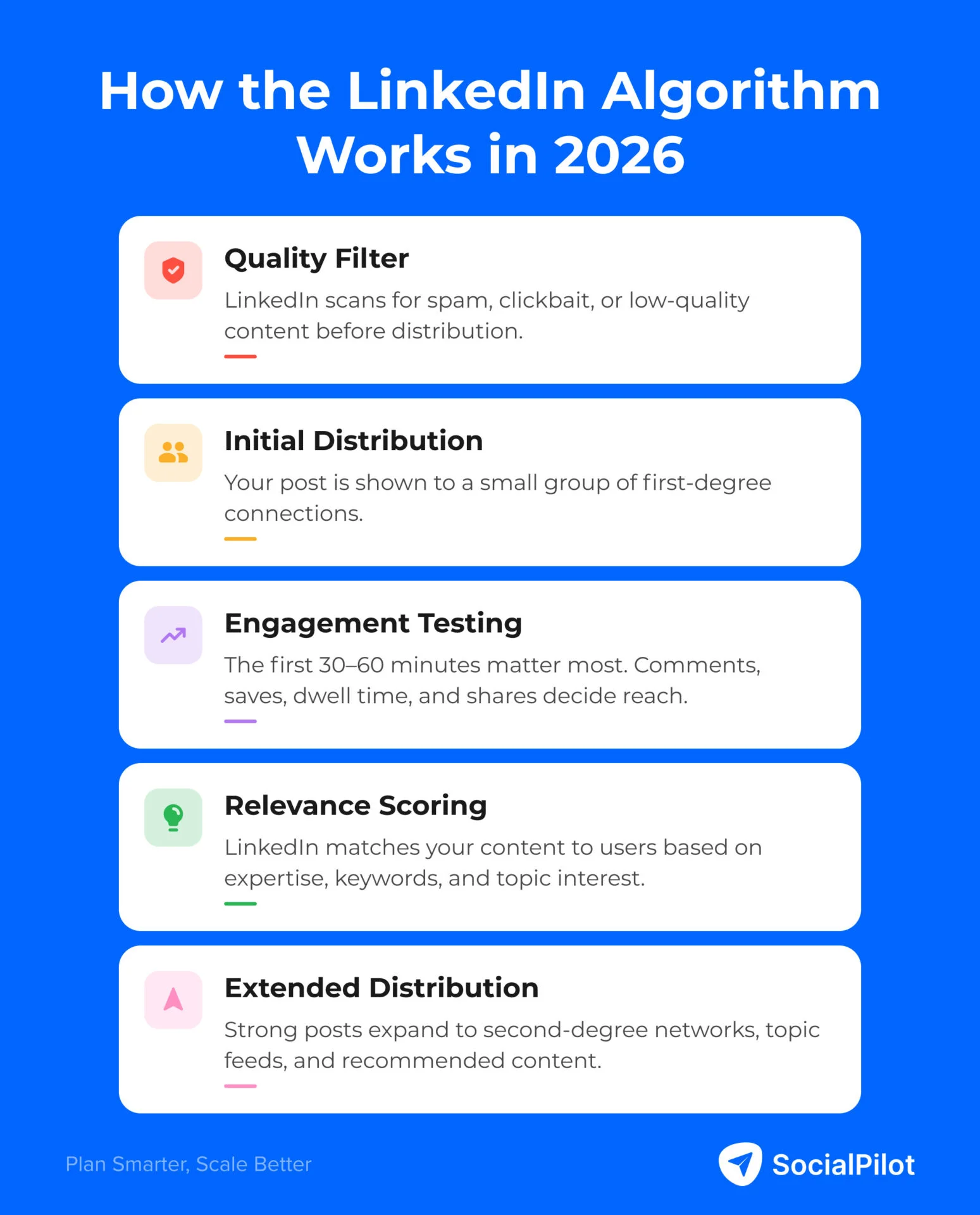
Every post you publish goes through a multi-stage distribution process.
Stage 1: Quality Filter
The moment you publish, LinkedIn’s automated systems check your post for spam signals, policy violations, and low-quality content markers. Posts that fail this check are suppressed or shown to a much smaller audience.
Stage 2: Initial Distribution
Your post is sent to a small slice of your first-degree network, typically the connections most likely to engage based on past interactions.
Stage 3: Engagement Testing
LinkedIn measures early reactions in the first 30–60 minutes: comments, likes, shares, saves, and dwell time. Strong signals at this stage push your post to a wider audience. Weak signals keep it contained.
Early engagement is non-negotiable. LinkedIn constantly filters, scores, and re-ranks content based on the engagement it gets in the first few hours after publishing.
Stage 4: Extended Distribution
Posts that pass the engagement test reach more of your network, second-degree connections, and topic-based feeds. With LinkedIn’s new LLM-based feed (March 2026), high-relevance posts can now also surface for users completely outside your network, based purely on topic alignment.
What Content LinkedIn Algorithm Prioritizes
Not all formats perform equally in 2026.
Document posts (PDF carousels) are currently the highest-performing format, averaging 6.60% engagement, the highest of any LinkedIn content type. The algorithm rewards the high dwell time carousels generate as users swipe through each slide. Optimal length: 8–12 slides. Shorter carousels with higher completion rates outperform longer ones where users drop off early.
Question-based posts drive comments, which carry the most algorithmic weight. A genuine question aimed at a specific professional audience generates more discussion than open-ended prompts.
Timely industry insights, posts that offer a specific take on a current professional topic or trend. The new LLM-based feed is especially good at surfacing expert-level takes to relevant audiences beyond your immediate network.
Short native video outperforms linked video. Keep under 3 minutes for optimal distribution. LinkedIn’s algorithm gives clear preference to content that keeps users on the platform.
Text-only posts with strong hooks still work when they spark genuine conversation.
What Gets Penalized
- External links: Posts with links to websites outside LinkedIn receive approximately 60% less reach than equivalent posts without links. The algorithm prioritizes on-platform content. The “link in comments” workaround has also been substantially patched, LinkedIn now detects bridge behavior where a post funnels users to a comment containing a link.
- AI-generated content without original perspective: Fully AI-generated posts receive approximately 2.8x less reach and nearly 5x less engagement than human-written posts (van der Blom Algorithm Insights 2025). Content that reads as AI-produced but adds no original insight is actively deprioritized.
- Engagement bait: Asking for likes, comments, or reactions without a substantive reason. LinkedIn’s algorithm detects these prompts and reduces distribution.
- Comment pods and automation: Coordinated engagement from pods or automation tools is flagged and penalized.
11 Tips to Work With the LinkedIn Algorithm in 2026
1. Optimize Your Profile
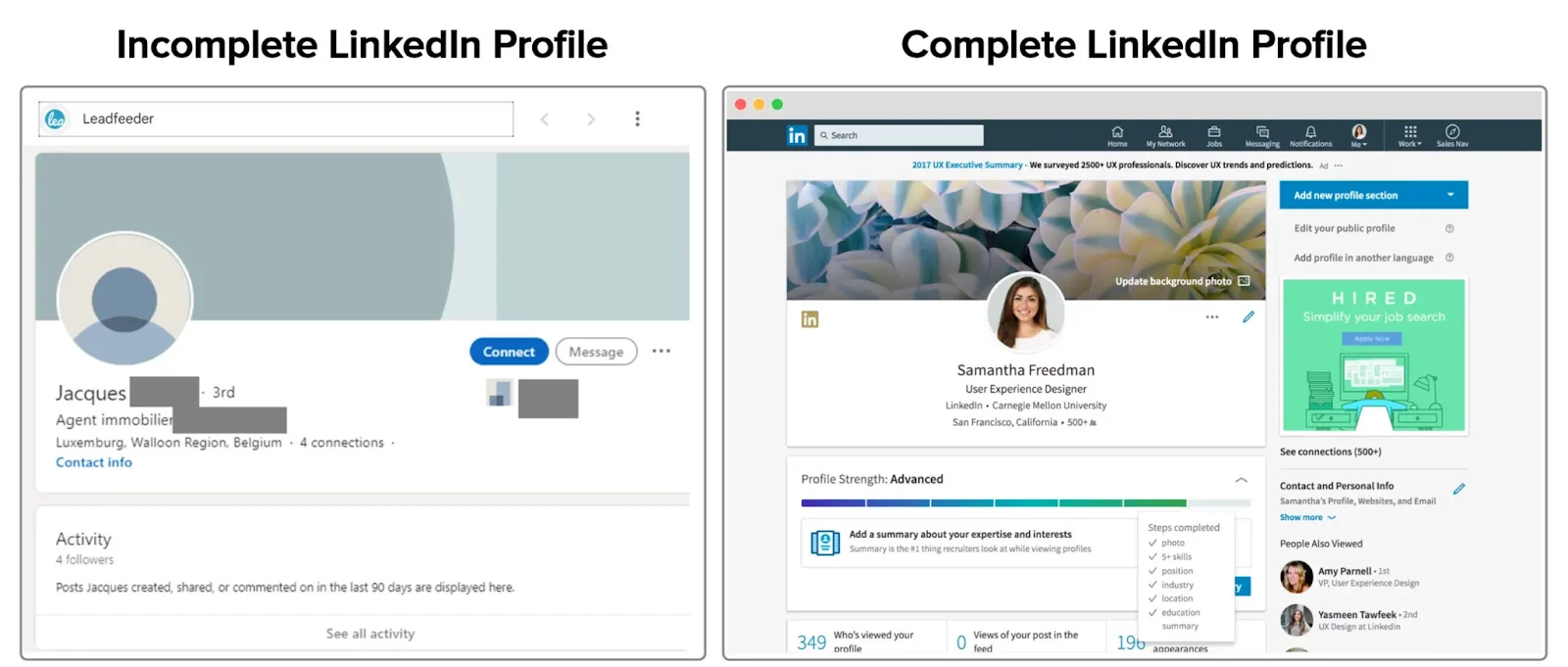
Complete profiles receive 30 times more weekly views than incomplete ones. The algorithm uses your profile to contextualize your content, a strong profile increases relevance matching across all your posts.
Essential elements:
- Professional profile picture
- A headline that describes the specific value you provide (not just your job title)
- A detailed summary that reads like a person wrote it
- Skills that reflect your actual expertise (chosen from LinkedIn’s 41,000+ options)
2. Optimize for Comments, Not Likes
Comments drive more depth signal than likes. LinkedIn networking strategies that earn genuine comments: sharing personal stories with a specific dilemma, presenting real-world friction with an open-ended question, challenging a common assumption in your industry with your own experience as the evidence.
End posts with a question that has no obvious right answer. “What do you think?” earns fewer responses than “What’s a rule in your industry you’ve broken that worked out?”
3. Post When Followers Are Active
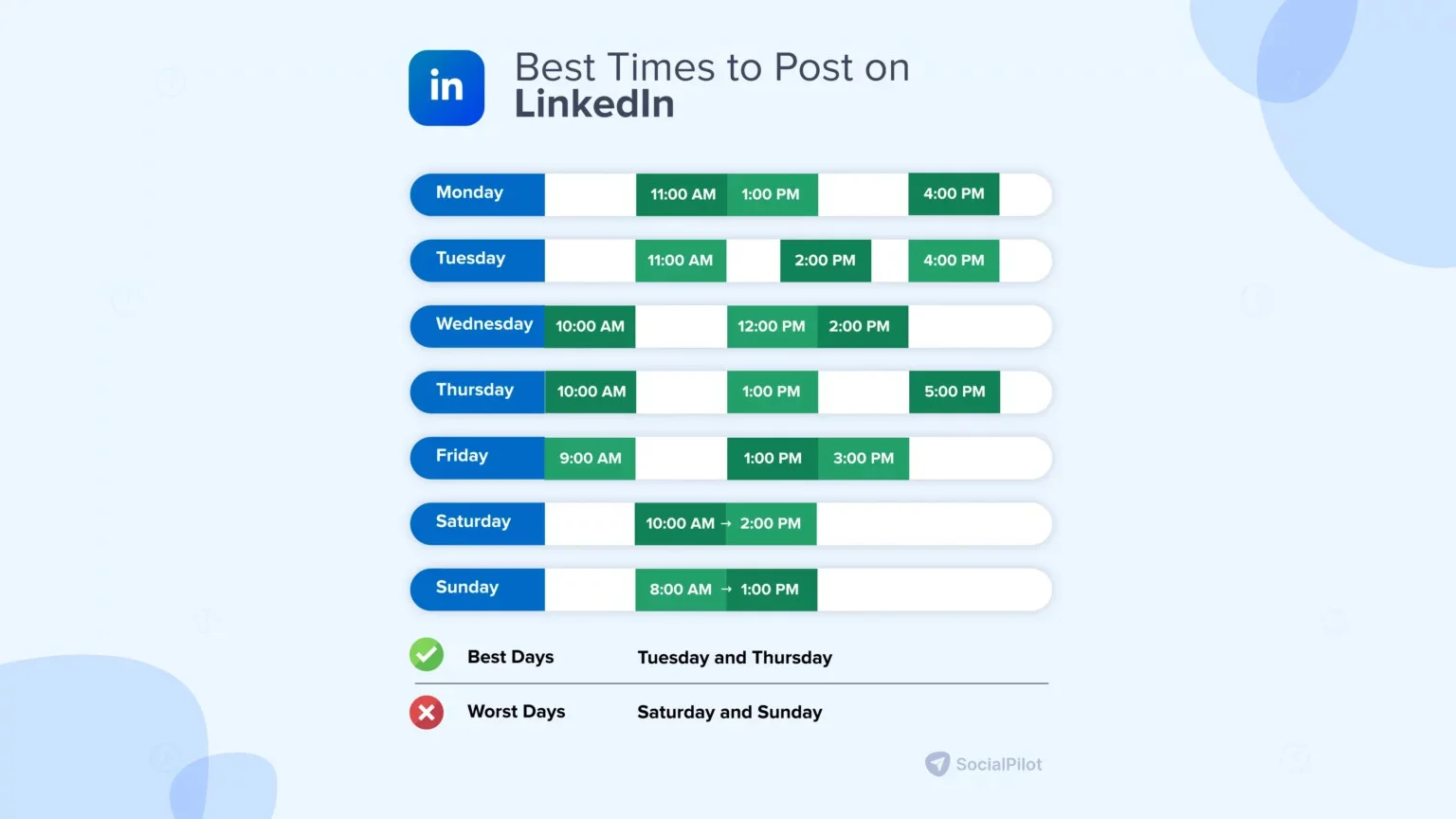
The first 60 minutes determine whether a post lives or dies. Posting during your audience’s active hours maximizes early engagement quality and gives the testing stage the signals it needs to expand distribution.
Check your LinkedIn analytics for when your specific audience is most active and check best times to post on LinkedIn rather than relying on generic time windows.
Posting 2–4 times per week builds audience expectations and algorithmic familiarity. The algorithm treats consistent creators as reliable sources of value in your niche.
Viral posts are rare and unpredictable. Steady, reliable posting builds compounding reach over time more reliably than chasing a single breakout moment.
5. Use Different Content Formats
Format diversity reaches different audience segments. Current performance by type of social media post formats:
- Documents/carousels: Highest engagement at ~6.6%; generates the longest dwell time; 8–10 slides with clear visual storytelling work best.
- Text posts: Strong for personal stories, insight-driven takes, and industry observations, performs when the authentic voice is clear.
- Native video: Declining in overall reach but longer videos outperform short clips; avoid leaning on this format alone.
- Newsletters: Bypass the feed algorithm entirely, delivered directly to subscribers via email and push notification; best format for guaranteed reach with your most engaged audience.
- Question-based posts: Effective for comment volume when the question is genuinely interesting to your specific professional audience.
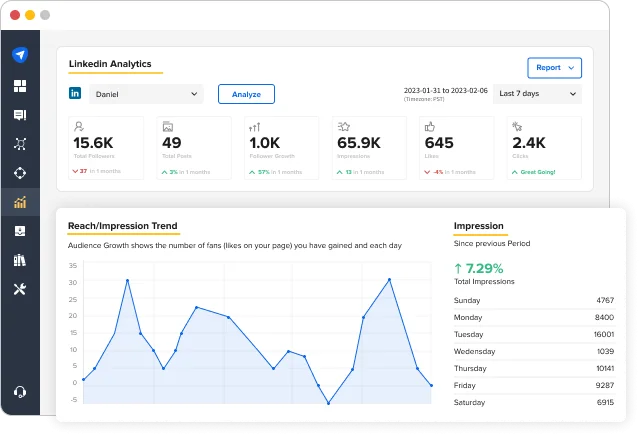
To understand what works for you, try SocialPilot’s LinkedIn analytics feature, which provides a clear understanding of content performance using KPIs and a relevant matrix.
6. Add Value in Comments Strategically
Top 1% creators reply to comments 741% more frequently than average creators [Source]. Responding to comments extends the post’s active life and generates additional Depth Score signals.
First comments with supplementary data, a related story, or a direct question to the commenter keep threads alive. Avoid generic acknowledgments, they register as low-quality engagement.
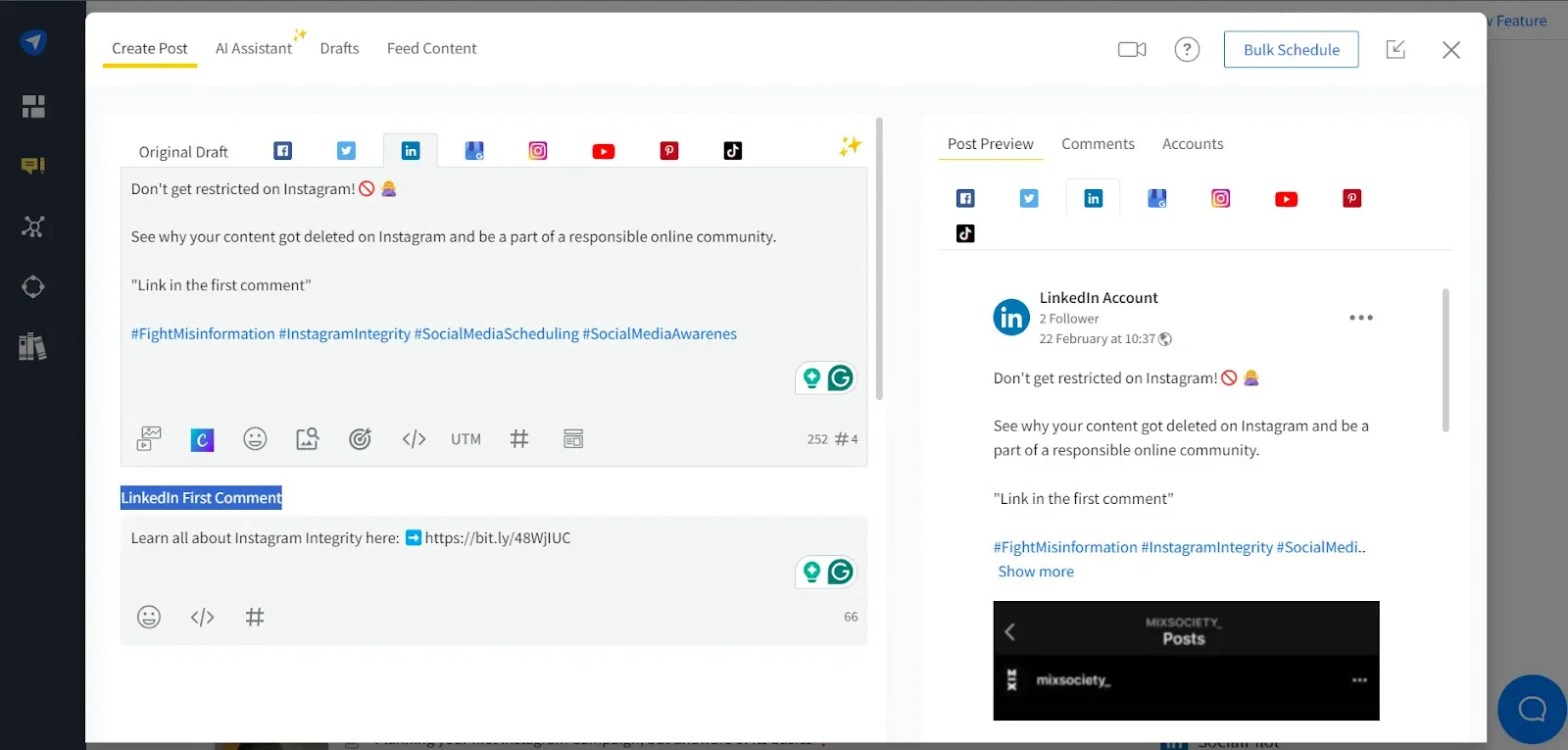
Those using SocialPilot’s social media post scheduler, can schedule their first LinkedIn comment along with their post.
7. Promote Your Posts
Tag specific people when the content is directly relevant to their work, not as a broadcast tactic. Tagging someone who then ignores your post sends a weak signal; tagging someone who replies substantively sends a strong one.
Cross-promote on other platforms with a specific hook, not just “new post on LinkedIn” give people a reason to click through and engage.
Limit hashtags to 1–3, chosen for contextual relevance to your post’s topic, not for trending volume. Posts with more than 3 hashtags have historically seen reach reductions, and hashtags now have diminishing influence on distribution compared to 2023–2024.
360Brew’s semantic understanding of content topic has reduced the algorithm’s dependence on hashtag signals, keyword relevance in your actual post text matters more.
Free AI LinkedIn Hashtag Generator
Get tailored LinkedIn hashtags that amplify your reach and boost professional engagement.
Here is the Generated Result
9. Be Strategic with External Links
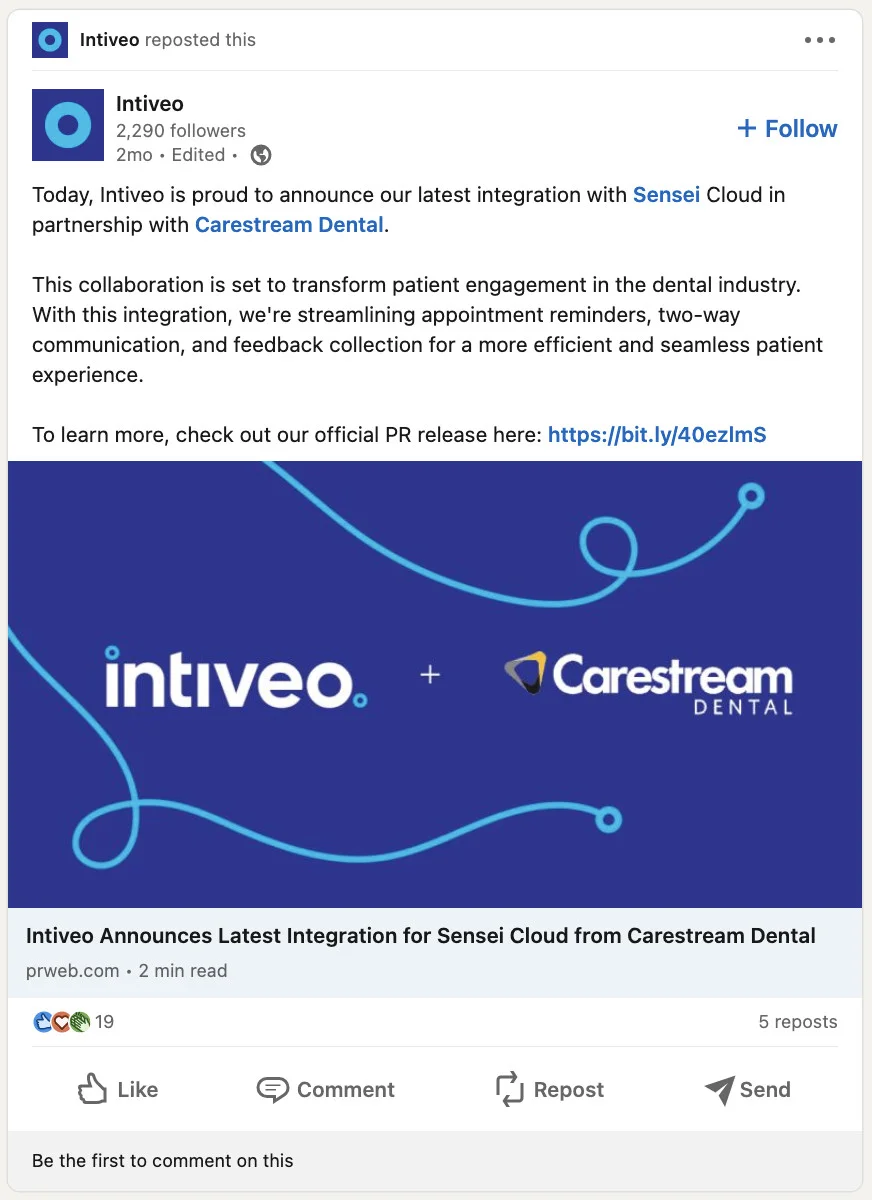
External links now reduce post reach by approximately 60% [DigitalApplied]. LinkedIn’s algorithm suppresses content that tries to pull users off-platform.
The first-comment workaround, placing your link in the first comment instead of the post itself, was patched in early 2026. The algorithm identifies this “bridge behavior” and applies the same penalty.
What actually works:
- Post your insight, story, or argument natively, in full, without the external link
- If the link is essential, add it in a follow-up comment well into the discussion, not as the first comment
- Use LinkedIn’s native formats (carousels, documents, newsletters) instead of directing to external blog posts; publish the content on LinkedIn directly
Saving external link distribution for ads or direct messages preserves your organic reach on regular posts.
10. Space Posts to Maximize Reach
Publishing too frequently divides algorithmic attention across posts before any single one completes its testing and delivery cycle.
Recommended cadence: 2–5 posts per week for personal brands; maximum 1 per day for company pages, according to our analysis. Allow each post’s testing window to complete before publishing the next.
Have you ever wished for a magical tool to shape your LinkedIn posts just right?
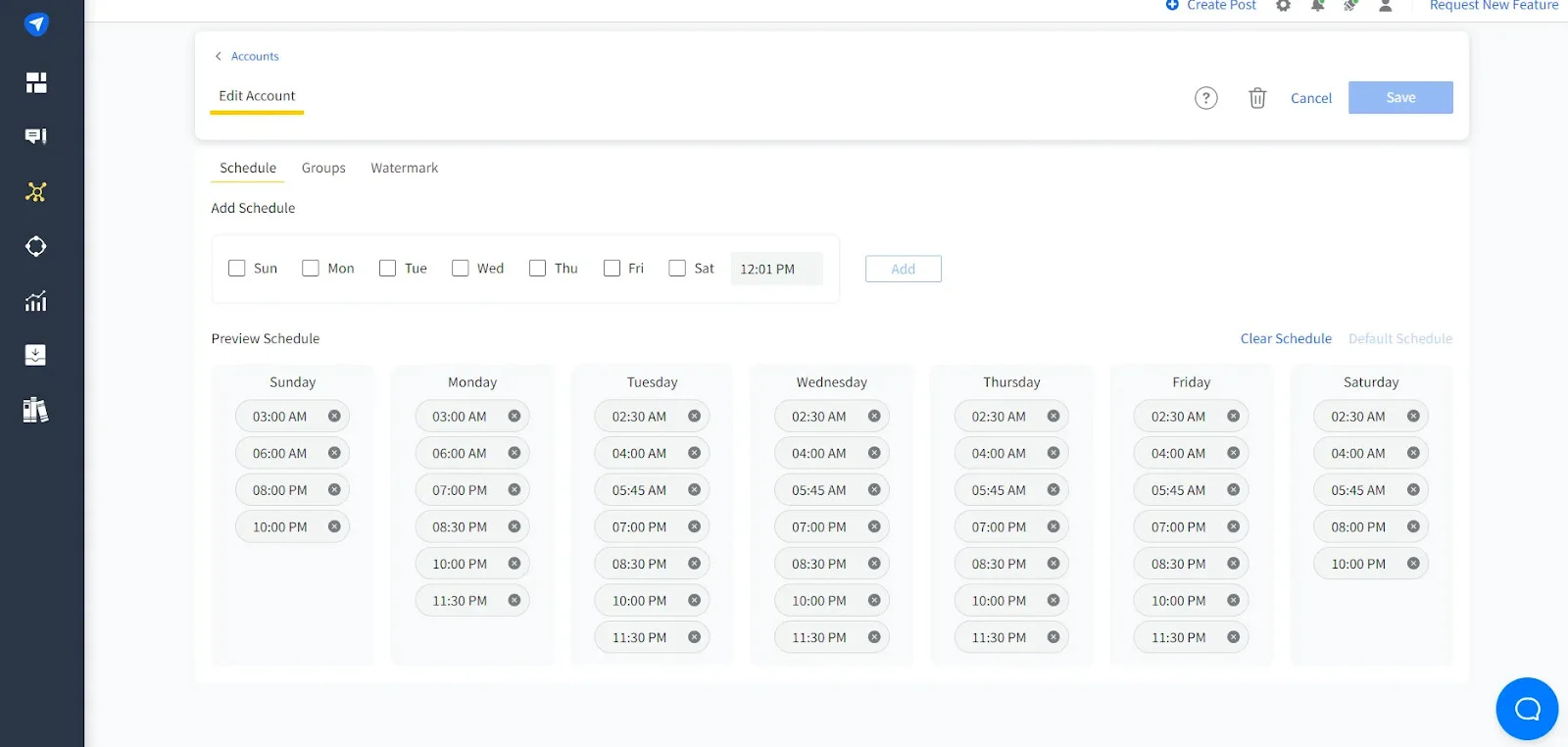
With SocialPilot’s LinkedIn scheduler, maintaining optimal gaps between your LinkedIn posts is a breeze. Whether finding the perfect time slot or experimenting with different posting times, our platform simplifies the process.
Just select your preferred time slots in the content planner, and voila! Your posts will be automatically published at the ideal intervals, ensuring maximum reach with minimal effort.
11. Follow Regular Engagement Practice
Active platform participation strengthens your engagement signals beyond your own posts. Commenting thoughtfully on others’ content, with specific observations, not generic affirmations, builds the interaction patterns the algorithm uses to contextualize who you are and what topics you’re relevant to.
Avoid: “Great post!”, “Totally agree”, or one-word reactions. These register as low-quality signals and don’t build your authority in any topic cluster.
Adapting to the New LinkedIn Algorithms in 2026
The 2026 LinkedIn algorithm rewards one thing above all else: content that makes people stop, read, think, and respond.
As of September 2026, that core logic is unchanged. No new ranking or distribution change was confirmed between April and September 2026, so the March 2026 360Brew feed and the Depth Score priorities below still hold.
360Brew’s semantic AI means the platform now understands professional context well enough to tell the difference between genuine expertise and surface-level optimization. Depth Score means saves and substantive comments move your content further than a flood of likes ever did.
The playbook is simpler than it sounds: know who you’re writing for, share what you actually know, make it easy for them to respond, and let the algorithm do the rest. Consistency, authenticity, and relevance aren’t just platitudes; they’re the signals the system is now directly measuring.
Moreover, integrate SocialPilot into your LinkedIn strategy to streamline your scheduling and maintain consistency on LinkedIn. SocialPilot also helps you with the best posting time and offers you insights to refine your LinkedIn strategy. Start your 14-day FREE trial today!



 Join 55,000+ social media managers


