Facebook may no longer dominate headlines, but the numbers still matter.
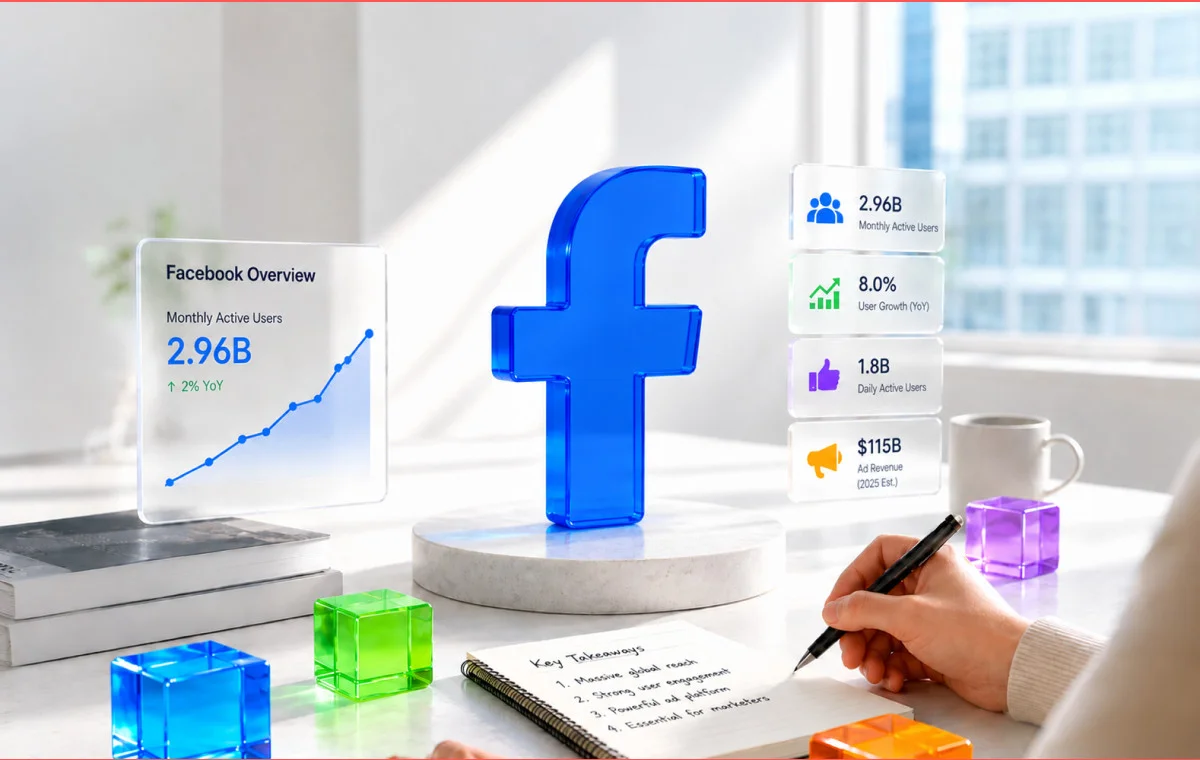
In 2026, Facebook remains largest social media platform, with 3.07 billion users and a massive advertising ecosystem [Statista]. But user behavior, engagement patterns, and ad performance continue to evolve.
These Facebook statistics reveal how the platform is changing from audience growth and engagement trends to advertising reach, video consumption, and marketer adoption.
Whether you’re planning campaigns, allocating budget, or tracking social trends, these numbers offer a clearer picture of Facebook in 2026.
Facebook User Base: Key Statistics for 2026
Even as new niche platforms emerge, Facebook remains the largest player in social media. For marketers, its sheer scale provides a level of reach that no other platform can replicate.
- Facebook has 3.07 billion monthly active users (MAUs) as of 2026, a 2.6% year-over-year increase. [Statista FB users]
- Facebook has 2.11 billion daily active users (DAUs). [Meta Q4 2024 Earnings (SEC Filing)]
- Facebook’s DAU/MAU ratio stands at 68.7%, meaning roughly 7 in 10 monthly users log in every day. [Meta Q4 2025 Earnings]
- 98.5% of Facebook users access the platform via mobile. 81.8% use Facebook exclusively on smartphones. [Statista user FB]
- Meta’s Family Daily Active People (DAP) spanning Facebook, Instagram, WhatsApp, and Messenger, reached 3.58 billion in Q4 2025, a 7% year-over-year increase. [Meta Q4 2025 Earnings]
- Meta’s Family DAP reached 3.56 billion in March 2026, up 4% year-over-year. [Meta Q1 2026 Earnings]
- 71% of US adults say they use Facebook, making it the second most widely used social platform in the US after YouTube. [Pew Research Center]
- 1.8 billion people use Facebook Groups every month. [Meta investor]
- 200 million businesses use Meta‘s family of apps including Facebook, Instagram, WhatsApp, and Messenger, every month. [Meta Q4 2025 Earnings]
Demographic Breakdown: Age, Gender, and Regional Facebook Statistics
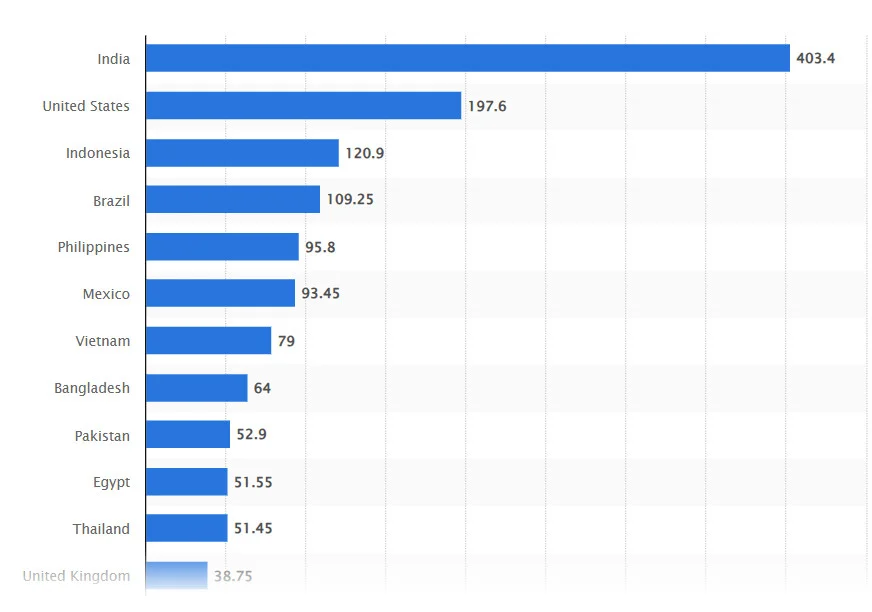
By country:
- India leads Facebook’s global audience with 403 million users. The United States has 197.5 million Facebook users. Indonesia have 121 million users. [Statista FB users by Country]
By age:
- In the US, adults aged 25–34 make up 24.2% of Facebook users, the platform’s largest US age segment. [Statista FB users’ distribution]
- Male users aged 25–34 account for 18.5% of Facebook’s global ad audience; female users aged 25–34 account for 12.7%. [Statista FB age data]
- 57% of US adults aged 65 and older use Facebook, according to Pew Research’s November 2025 survey. [Pew Research Center SM use]
- 80% of US adults aged 30–49 use Facebook, the highest adoption rate of any age group. [Pew Research Center SM use]
By gender:
- Globally, 56.7% of Facebook users are men and 43.3% are women. [DataReportal FB stats]
- In North America, 53.4% of Facebook users are female. In Southern Asia, only 27.6% of Facebook users are female. [DataReportal FB stats]
Gen Z behaviour:
- Gen Z spends nearly 60% of their time on Facebook watching video content. Over 50% of Gen Z users watch Facebook Reels every day. [Reuters article]
Facebook Marketing Stats: Advertising Performance and Trends
- 28% of marketers cite Facebook as the platform delivering the highest ROI, the top ranking among all social platforms. Instagram ranked second at 22%, followed by YouTube at 12%. [Statista SM Platform use]
- The average Facebook Ads conversion rate (CVR) for lead campaigns is 7.72% across all industries in 2025, down slightly from 8.67% the previous year. [WordStream]
- Top-performing industries for Facebook CVR: Restaurants and Food (18.25%), Attorneys and Legal Services (10.53%), and Education (10.05%). [WordStream]
- Furniture is the lowest-converting category at 3.77% CVR for Facebook lead campaigns. [WordStream]
- For Meta’s full-year 2025: ad impressions grew 12% while the average price per ad rose 9% year-over-year. [Meta Q4 2025 Full-Year Earnings]
- Meta generated $201 billion in total revenue in full-year 2025, a 22% increase year-over-year, with advertising accounting for over $196 billion of that total. [Meta Q4 2025 Earnings]
- US social commerce sales are projected to surpass $100 billion in 2026. [eMarketer]
- Facebook ads reached 2.28 billion users in January 2025, covering 39.4% of all adults aged 18 and older worldwide. Facebook’s ad reach grew by 93.3 million people (+4.3%) in the 12 months to January 2025. [DataReportal FB stats]
- Meta’s full-year 2025 advertising revenue reached $196.18 billion with Q4 2025 alone contributing $58.23 billion, a 21% year-over-year increase. [Meta Q4 2025 Earnings]
- Meta’s Q1 2026 revenue hit $56.31 billion, a 33% year-over-year increase, driven almost entirely by advertising. [Meta Q1 2026 Earnings]
- In Q1 2026, Meta’s ad impressions grew 19% year-over-year while the average price per ad rose 12%. [Meta Q1 2026 Earnings]
- US and Canada average revenue per user (ARPU) reached $78.20 in Q4 2025, up 14.3% from $68.44 in Q4 2024. [Meta Q4 2025 Earnings]
- More than 4 million advertisers now use Meta’s generative AI creative tools, including background generation, image expansion, and text variation. [Meta Q4 2025 Earnings]
- Advantage+ Shopping campaigns deliver a 17% lower cost per purchase on average compared to manually managed campaigns. [Meta Business]
- Meta’s AI-powered ad solutions exceeded a $60 billion annual run rate as of Q3 2025. [Meta Q3 2025 Earnings]
Engagement Statistics: Interactions and Post Types
- The average Facebook post engagement rate is 0.15%. [socialinsider FB benchmark report]
- The average Facebook engagement rate increased for Status posts (from 0.15% to 0.20%) and Reels (from 0.13% to 0.18%) between 2024 and 2025, while Album, Image, and Link posts remained unchanged, with Album content maintaining the highest engagement rate at 0.18% in both years. [socialinsider FB benchmark report]
- Video posts deliver 40% higher retention rates among the 25–34 age group. [eMarketer]
- US users spend an average of 31 minutes per day on Facebook. [eMarketer USA users]
- Facebook Stories reaches 2.05 billion users every day. [SQ Magazine]
Facebook Reels Statistics
- Reels are played over 200 billion times daily across Facebook and Instagram, announced by Mark Zuckerberg on Meta’s Q3 2025 earnings call. [Meta Q3 2025 Earnings]
- Meta Reels has an annual advertising run rate of over $50 billion, per Mark Zuckerberg on Meta’s Q3 2025 earnings call. [Meta Q3 2025 Earnings]
- Users share 3.5 billion Reels every day across Facebook and Instagram combined, a figure Meta shared through its official business channels. [Meta for Business Article]
- Nearly 1 in 10 daily Reels views now come from content created in Edits, Meta’s video editing app, a figure that almost tripled in a single quarter. [Meta Q4 2025 Earnings]
- Reels was the only content format on Facebook to register an engagement uplift in Q1 2026, according to Buffer’s analysis of 52 million social media posts. [Buffer State of Social Media Engagement 2026]
- Using vertical video in Reels ads results in a 4.8% lower cost per action. And, vertical video also drives a 5.1% higher click-through rate, [Meta Reels Ads Research]
Facebook Marketplace Statistics
- Facebook Marketplace has over 1 billion monthly active users, making it one of the most widely used peer-to-peer commerce surfaces on the internet. [Meta investor article]
- 1 in 3 Facebook users interacts with Marketplace listings every month. [Capital One Shopping Research]
- The top three best-selling categories on Facebook Marketplace are furniture, clothing and accessories, and electronics. [Capital One Shopping Research]
- 51.2% of consumers who shop on social media say their most recent social purchase happened on Facebook Marketplace, giving it the largest share of social commerce. [Capital One Shopping Research]
Facebook for Creators: Statistics
- Facebook paid nearly $3 billion to creators through its monetization programs in 2025, a 35% year-over-year increase and the platform’s highest annual creator payout on record. [CNBC / Meta Article]
- 60% of Meta’s $3 billion in 2025 creator payouts went to Reels, with the remaining 40% split across Stories, photos, and text posts. [TechCrunch Meta Monetization]
- The number of creators earning more than $10,000 per year on Facebook grew by over 30% year-over-year in 2025. [Meta Creator Report 2026]
- In March 2026, Meta launched Creator Fast Track, a program paying established creators from Instagram, TikTok, and YouTube a guaranteed monthly income to post on Facebook: $1,000/month for 100K+ followers, $3,000/month for 1M+ followers. [Meta Creator Report 2026]
- Meta unified all creator revenue streams, in-stream ads, Reels ads, subscriptions, Stars (tips), and performance bonuses into a single Content Monetisation Program (CMP) in 2025. [TechCrunch Meta Monetization]
What the Latest Facebook Statistics Reveal
Facebook isn’t slowing down. With Reels generating $50 billion in ad revenue annually, Meta’s AI investments reshaping ad delivery, social commerce crossing the $100 billion mark in the US, and creator payouts hitting a record $3 billion in 2025, the platform is evolving fast.
For marketers, the signals are clear: video-first content, Reels placement, and AI-optimized targeting are where returns are concentrated. The brands winning on Facebook in 2026 are the ones treating it as a full-funnel channel, not just an awareness play.
Managing that kind of consistent, cross-format presence is where SocialPilot helps, letting you schedule, publish, and track Facebook content alongside every other channel without switching between tools.