

Facebook stopped counting itself.
Sometime after 2023, Meta quietly stopped reporting how many people use Facebook. So every “Facebook has 3 billion users” stat you have read since is quoting a figure the company itself retired in 2023.
That should bother you, because you are about to spend real money on these numbers. Budget. Targeting. Whether Facebook even earns a slot in your year plan.
Here is what the recycled trend lists miss. Facebook is not dying. It is being rebuilt in plain sight. Meta is pouring billions into videos through its Creator Fast Track program, and pushing hard into commerce and verified identity, all aimed at an older, wealthier audience, while the platform gets harder to measure and pricier to reach.
These five shifts are not random. They are one deliberate move. See it once, and every Facebook headline reads differently.
Five shifts below. Each checked against Meta’s own numbers. Each ending in a decision that is yours.

1. The Video Reallocation
Facebook’s biggest bet in 2026 is short video. Reels is now the platform’s growth engine, and Meta is paying cash to feed it.
For the cross-platform picture, see our take on broader social media trends.
$50B+
Reels annual revenue run rate inside Meta
Source: Meta Q3 2025 earnings call, Oct 29, 2025
Reels Is a $50 Billion Business Now
On its Q3 2025 earnings call, Meta said Reels runs at an annual rate of over $50 billion. That is not a feature. It is one of the biggest video businesses on the internet, living inside Facebook.
Reach is chasing the money. Facebook now surfaces twice as many same-day Reels as it did in early 2025, Meta said on the same call. Fresh short video gets pushed harder than anything else on the platform.
And Meta is buying the supply. It paid creators nearly $3 billion in 2025, up 35% year over year, with 60% of that going to Reels.
Meta Is Buying Short-Form, Not Growing It
Read the strategy, not just the spend. In March 2026, Meta launched Creator Fast Track, paying big creators $1,000 to $3,000 a month, for three months, to post Reels on Facebook. The target: people already winning on Instagram, TikTok, and YouTube.
You do not pay to import a format that is already winning on its own. The subsidy is an admission. Facebook’s native short-form supply cannot keep up with the demand Meta manufactured, so Meta is renting proven talent to close the gap.
That gap is your opening. We will not re-explain ranking here, because how the Facebook algorithm works covers the mechanics. The point is blunter: the platform is starving for good short video, and it rewards whoever supplies it.
What This Means for Your Content Mix
Stop cross-posting links. Start shipping video. If Facebook is still a dumping ground for blog links and stock photos, you are publishing against the current.
Shoot vertical, sound-on, hook in the first two seconds. Post often, because same-day surfacing rewards whatever is fresh. Three rough Reels a week beat one polished one a month.
- Publish clean and native. A scheduler like SocialPilot posts without another platform’s watermark and lets you plan the cadence ahead, so every upload stays eligible for the same-day boost.
- If you have ever considered paying a creator, this is the quarter to do it. Meta is subsidizing the market, and that will not last.
2. The Measurement Blackout
You cannot benchmark what Meta refuses to publish. Since 2023, there is no official Facebook user count and no Facebook-specific reach figure. Just a blended number that buries Facebook inside three other apps (Instagram, WhatsApp, and Messenger).
3.60B
Family Daily Active People (June 2026); no Facebook-only figure since 2023
Source: Meta Q2 2026 results, Jul 29, 2026
Facebook Hasn’t Reported Its Own Numbers Since 2023
The last real Facebook figure was 3.07 billion monthly users, in December 2023. Starting in early 2024, Meta scrapped Facebook’s user metrics entirely.

So that “3 billion users” stat is not current. It is a fossil. Accurate for 2023, quietly recycled ever since, and nobody citing it tells you the date.
One more number to distrust: the “2.04 billion Facebook Groups users” figure making the rounds has no traceable Meta source. Treat it as fiction until someone produces one.
Why Meta Hides Facebook Inside a “Family” Number
Today Meta reports one audience figure, Family Daily Active People: Facebook, Instagram, WhatsApp, and Messenger counted together. In its Q2 2026 results, that hit 3.60 billion for June 2026.
You cannot pull Facebook back out of it. One person active on any app counts once. Great growth story for investors, useless for reading Facebook alone. For the wider stat picture, see our Facebook statistics roundup.
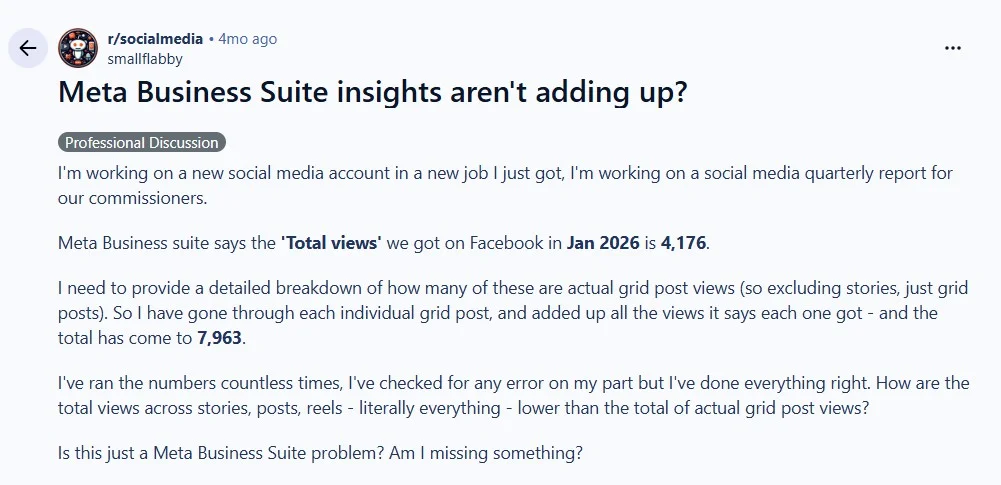
It gets worse inside your own dashboard. In April 2026, a social media manager on r/socialmedia posted:
What This Means for How You Measure
Throw out the industry benchmark. It no longer exists. Measure Facebook against your own past, not an average nobody can define.
And watch your costs, because reach is getting pricier. As per Meta’s Q2 2026 report, price per ad rose 12% year over year, on top of a similar jump the quarter before. Same budget, less reach.
Build your reporting on numbers you own:
- Reach rate, tracked monthly, not as a one-off screenshot.
- Cost per result, judged against your funnel, not a blog’s average.
- Saves and shares, the signals that survive algorithm changes.
Watching that trend line by hand gets old fast. A scheduler like SocialPilot pulls your Facebook reach, engagement, and ad cost into one analytics dashboard, so you track your own numbers month over month instead of hunting for a benchmark that no longer exists.
3. The Generational Realignment
Facebook didn’t die. It grew up. The teenagers left. Their parents stayed, and their parents have money.
80%
of US adults aged 30 to 49 use Facebook, its highest-usage group
Source: Pew Research, Americans’ Social Media Use 2025, Nov 20, 2025
Adults 30 to 49 Are Facebook Now
Pew Research found in 2025 that 71% of US adults use Facebook, peaking at 80% among 30-to-49-year-olds. About half check in daily.
That is the group with mortgages, kids, and disposable income. For most businesses, that is not a leftover audience. That is the buyer.

The Teens Left. The Money Didn’t.
The young are mostly gone. Only 32% of US teens use Facebook, down from 71% a decade ago.
But “teens left” and “Facebook is dead” are different sentences. The platform lost its cool and kept its wallet.
This also explains Meta’s next move. You build a commerce business for an older, richer audience, which is exactly where Marketplace comes in.
What This Means for Targeting
Before you cut Facebook, check who actually buys from you.
- Sell to adults 30 to 49? Facebook is not a channel you tolerate. It is where your customers are, and you may be under-invested.
- Sell to teenagers? The data backs your instinct. Spend elsewhere.
Home services, finance, insurance, healthcare, higher-ticket retail, and most B2B buyers sit squarely in that 30-to-49 band. If that is you, stop apologizing for Facebook.
4. The Authenticity Push
Meta is now paying to prove you are human. In July 2026 it launched a free verification badge, aimed straight at the flood of AI-generated everything.
Free
Facebook Verified selfie-video badge, launched July 24, 2026
Source: Meta Newsroom, Jul 24, 2026
A Free Badge That Proves You Are Real
On July 24, 2026, Meta launched Facebook Verified, a free badge earned with a selfie video. Record it once; Meta matches it to your photos, and it follows you across Marketplace, Dating, Groups, and Profile.
Free is the word that matters. This is not paid Meta Verified, and there is no subscription. Meta wants everyone verified, which tells you how worried it is about fake accounts.

Why Meta Cares Now
The timing is not random. AI-generated profiles, images, and reviews are blurring what is real, and nobody buys from a Marketplace seller who might be a bot. Trust is what makes commerce work, and Meta is racing to protect it.
One number to correct while we are here: the “$690 million in Meta Verified revenue” claim is wrong. That figure is a blended WhatsApp-and-Meta-Verified line from Meta’s earnings reports, not Meta Verified alone.
What This Means for Trust
Get verified the moment you are eligible. In a feed filling with synthetic accounts, a proven-human badge is cheap credibility.
- Expect verification to become a soft trust signal in Marketplace and Groups, the way a blue check once decided who got believed.
- Label your own AI-assisted content honestly. As scrutiny rises, getting caught passing off synthetic work will cost more than the disclosure would have.
5. Marketplace’s Quiet Scale-Up
While everyone debated whether Facebook still matters, Marketplace became one of the biggest stores on earth. In 2026, Meta started treating it like one.
430M
items listed on Facebook Marketplace every month, globally
Source: Meta Newsroom, Jul 24, 2026
430 Million Listings a Month
In its July 2026 announcement, Meta put 430 million items and 44 million vehicles on Marketplace every month. It also shipped a standalone Seller app with AI listings, a unified inbox, and inventory tools.
Young adults are piling in, and here honesty matters. Meta said 1 in 4 young-adult daily users shopped Marketplace in late 2025 (US and Canada); by mid-2026 it was 1 in 3 (US only). Real growth, but different measuring sticks, so we show both.
Why Meta Is Betting on Commerce
Marketplace is where the other four trends cash out. Meta has an older, higher-spending base, and it launched the Seller app and the verification badge in the very same breath.
Commerce and trust shipped together, on purpose. A verified-identity layer makes a peer-to-peer marketplace safe enough to spend on. Every piece feeds the next.
What This Means If You Sell Things
- Sell physical products? Test Marketplace this quarter. Especially if your buyers are 30 to 49.
The friction is mostly gone. The Seller app writes listings, centralizes messages, and tracks stock. Start with your best movers, price for bargain-hunters, and treat fast replies as part of the sale.
A caveat, because sellers already there will tell you: Marketplace is not eBay. Buyers ghost. Everyone haggles. Like this seller on r/smallbusiness

- Sell services or digital goods? This one matters less. Put your energy into video and targeting instead.
What These Facebook Trends Mean for Your Strategy
Line the five up and one strategy falls out. Facebook is consolidating around video, commerce, and verified identity, aimed at an older, high-value audience, while making its own reach harder to see.
The Trends Are Feeding Each Other

Video and the blackout push the same way: reach is moving to Reels just as it gets harder to prove and pricier to buy.
- The aging audience explains the commerce bet. You build Marketplace for people with money, not teenagers.
- Trust and commerce launched together. The badge exists to make the bigger store safe.
Follow the money and it is obvious. Meta is monetizing a mature, loyal audience harder: paying to keep it watching video, charging more to reach it, and building a store for it to spend in.
Act on This First
Two moves pay off immediately. Chasing all five at once is how you stall.
- Move budget into native Facebook Reels now, while Meta is still subsidizing distribution.
- Rebuild reporting around your own numbers, because the benchmark is gone and costs are climbing.
For the execution details, a complete Facebook marketing guide walks the setup.
What Can Wait
- Verification: roll with it when you are eligible. No need to force it.
- Marketplace: only urgent if you sell physical goods. If you do not, note it and move on.
The five trends and what to do about them
| Trend | Core verified stat | Source | What to do |
| The Video Reallocation | $50B+ Reels run rate; 2x same-day Reels | Meta Q3 2025 call | Move budget into native Facebook Reels |
| The Measurement Blackout | 3.60B Family users; ad price +12% YoY | Meta Q2 2026 results | Track your own reach and cost, not a benchmark |
| The Generational Realignment | 80% of adults 30 to 49 vs 32% of teens | Pew Research, 2025 | Match spend to whether your buyers are 30 to 49 |
| The Authenticity Push | Free selfie-video verification badge | Meta Newsroom, Jul 2026 | Get verified; prepare for authenticity scrutiny |
| Marketplace’s Scale-Up | 430M items listed monthly; Seller app | Meta Newsroom, Jul 2026 | Test Marketplace if you sell physical goods |
Running all of this by hand, shipping video weekly, watching your own numbers, tracking five moving trends at once, is a grind. If you want one place to schedule, publish, and measure it across Facebook and many other platforms, explore the SocialPilot plans.



 Join 55,000+ social media managers


