
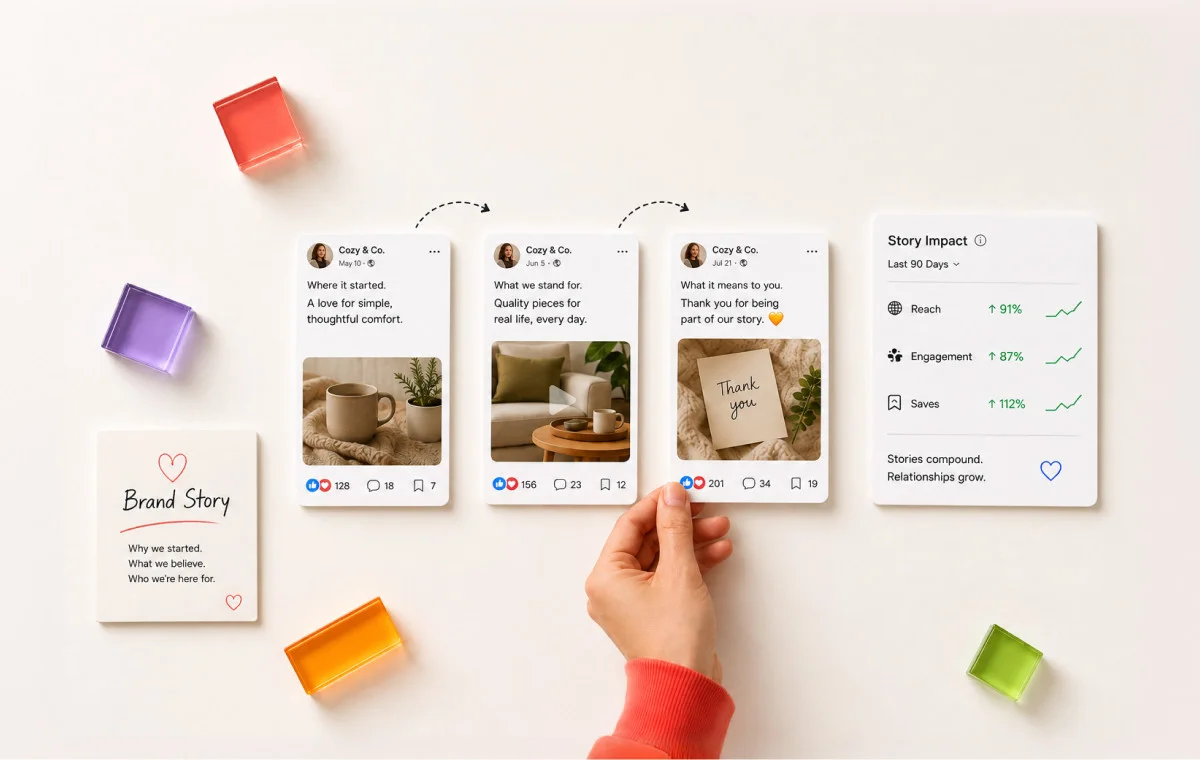
When people say, “social media storytelling,” they don’t mean the Stories bar at the top of Instagram or Facebook. This piece is about narrative technique: the way you structure a post, a caption, a video, or a whole content calendar, so it reads like a story instead of an announcement. It has nothing to do with which button you tap to publish.
That distinction matters because you’re not here to write one good story post. You’re the person who was asked by the leadership to justify a heavier investment in storytelling, maybe a dedicated writer, a recurring series, a real framework instead of a campaign-by-campaign scramble. Every article you’ve found so far treats storytelling as inspiration, but neither helps you build a budget case. You need to know when storytelling behaves like a compounding asset instead of a lottery ticket, and you need a way to prove it later, in a number, not a feeling.
That’s what this piece is for. We’ll separate what’s genuinely validated in storytelling psychology from what convention dressed up as science, name a narrative structure built for social feeds, and show you how to measure whether a story is working.
Storytelling Is a Brand Asset, Not a Content Tactic
You’ve probably already got a story post that outperformed everything else you published that month. That’s not proof storytelling is a brand asset yet. It’s proof one post worked once.
The Difference Between a Story Post and a Brand Narrative
People often treat a story post and a brand narrative as one and the same, and that’s the reason why their storytelling never compounds. Here’s how these two differ:
Story Post
- A single piece of content with its own beginning, middle, and end (a before-and-after, a founder’s rough first year, a behind-the-scenes moment)
- Works fine on its own, so the success is judged post by post and every new post resets with the next campaign brief.
Brand Narrative
- The throughline that makes ten posts, spread across a year, feel like chapters of the same book.
- Narratives depend on accumulated context, and it’s success is judged by whether a follower recognizes the same voice and themes across posts.
The test is simple. Pull three of your last ten story-style posts. If a follower saw them out of order, would they recognize the same voice, the same recurring themes, the same “world” the brand lives in? If not, you’ve been publishing story posts, not building a brand narrative.
Why One-Off “Storytelling” Content Rarely Compounds
One-off storytelling content gets treated like a campaign: brief, brainstorm, shoot, publish, move on. There is nothing about this that carries forward. The next quarter starts from zero again, with a new brief and no memory of the last story.
A brand narrative compounds because each new post can lean on what the audience already knows. A reference to an earlier chapter land as recognition. That’s the real difference between a tactic and an asset: an asset gets more valuable the longer you hold it, and a story only gets more valuable if the next one builds on it.
When Storytelling Is (and Isn’t) the Right Strategic Lever
Not every goal on your calendar this quarter needs a story. Some need a clear, fast, factual post, and reaching for narrative when you need a direct answer just slows you down.
Objectives Storytelling Actually Serves
Storytelling earns its place when the objective is to change how someone feels about the brand, not just what they know about a product. That’s the short list of objectives storytelling marketing can serve:
- Building brand recall in a crowded feed, where a recognizable narrative voice cuts through faster than a generic announcement
- Shifting perception, when the story you tell repositions the brand entirely, like an origin story that reframes “boring” as “the hard part everyone else skipped”
- Deepening loyalty with an audience that already buys, by giving them an ongoing narrative to check in on rather than a static feed of promotions
- Making a complex offering feel human, particularly in B2B and healthcare, where a direct pitch reads as sterile
When Direct, Non-Narrative Content Is the Better Choice
Storytelling is the wrong lever in a specific, recognizable set of situations. Reach for a direct, non-narrative post instead when:
- The message is time-sensitive, a service update, a price change, or a same-day announcement people need to act on now
- A claim has to be precise, a factual, verifiable statement that shouldn’t be softened or dressed in narrative language
- The audience needs a fast answer, not context, like support information or a policy update
- The goal is correcting the record, where any narrative framing reads as spin instead of clarity
CrowdStrike hit all four of these at once during its July 2024 global outage, when a faulty software update crashed millions of Windows systems worldwide. CEO George Kurtz posted directly on X within hours: the issue was identified, a fix was already deployed, and, most importantly, “this is not a security incident or cyberattack.”
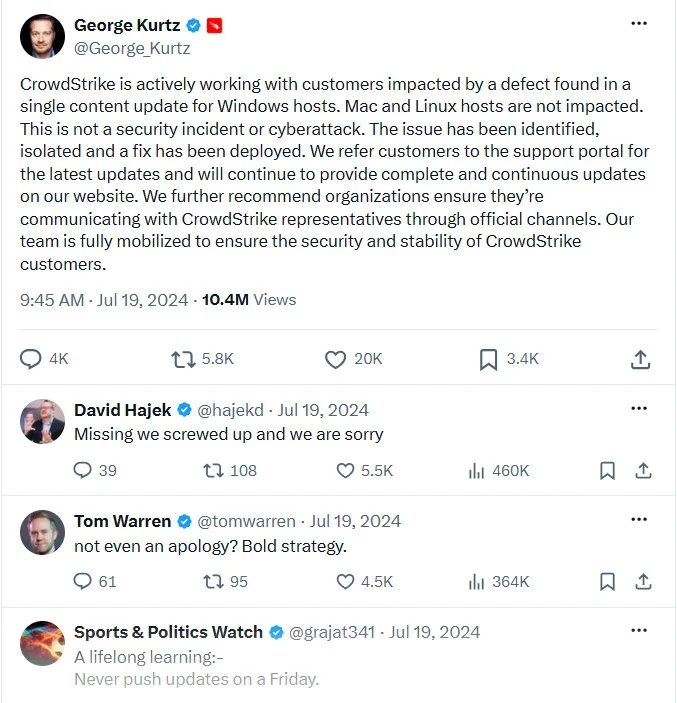
No story, no framing, just the exact facts people needed while speculation was still spreading.
That’s the model that brands must follow. Below we have another example from a brand that posted non verifiable claims on social media and got itself into legal trouble.
Poppi, the prebiotic soda brand, is a recent, concrete example of what happens when that second point gets ignored. Back in 2022-2023, their marketing language was “Be Gut Happy. Be Gut Healthy.” This was also printed on their cans and was used across their social presence, and this was the basis of the lawsuit that was filed against the company in 2024.
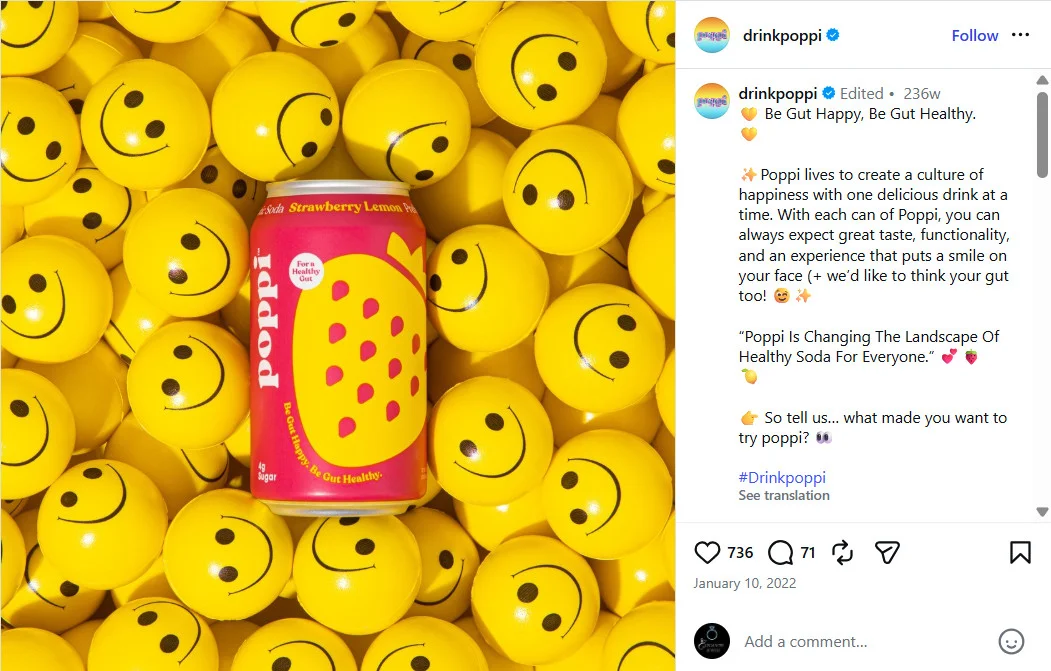
The class-action lawsuit filed against Poppi argued its “gut health” marketing overstated what two grams of prebiotic fiber per can could actually do, and the brand settled for $8.9 million in 2025.
The real problem wasn’t the founder story or the wellness content. It’s that a health claim, one that could actually be checked true or false, got told like a story with the exact facts and limits that kind of claim needs. The lesson generalizes: a claim that has to be precise should be stated precisely, not narrated.
Storytelling strategy, in other words, is a choice you make deliberately for specific objectives, not a default tone for every post. If you’re still deciding how storytelling fits against your other content types, start by analyzing your social media content strategy, that is where that decision belongs.
Mapping Story Types to the Funnel
You don’t need one story format. What you need is the right story type for where someone is in their relationship with the brand.
Origin and Founding Stories for Awareness
An origin story works at the awareness stage because it gives a stranger a reason to remember you beyond the product category. Loop Earplugs is a clean, current example: its founders built the company after suffering hearing damage from years of concerts and festivals, and that origin still anchors its content years later.
The company has now scaled to more than 14 million customers and roughly $220 million in 2024 revenue. The YouTube video below shows the founders of Loop Earplugs narrating their origin story.
The story isn’t decoration on top of the product. It’s the reason the product exists, which is exactly what makes it worth repeating at the awareness stage.
Transformation and Customer Stories for Consideration
By the consideration stage, the reader isn’t wondering what you are anymore. They’re wondering if this works for someone like them. Notion builds a real customer-story series around that insight: instead of a polished product demo, it features actual companies narrating one specific problem their own team solved, in their own words.
Figma‘s entry in that series walks through how its design teams replaced scattered documents with a single shared wiki inside Notion, structured as a small before-and-after instead of a feature list.
The series sits alongside a real, verifiable milestone. Notion’s own announcement confirms it crossed 100 million users, up from roughly 1 million just before the pandemic. A transformation story does persuasion work a feature comparison can’t, because a prospect can see themselves inside somebody else’s before-and-after.
Ongoing Narrative and Community Stories for Retention
Retention-stage storytelling isn’t about winning someone over anymore. It’s about giving an existing audience a reason to keep showing up. Jellycat‘s Fish & Chips pop-up experience at Selfridges in July 2024, built on the brand’s earlier viral “Jellycat Diner” concept, turned existing fans into repeat participants in an ongoing bit rather than passive followers of a feed.
For instance, the video below from Jellycat’s Instagram announces a new seasonal menu drop.
The community keeps returning because the narrative keeps giving them something new to be part of, not because any single post asked them to buy again.
Building a Narrative Identity That Compounds Over Time
You already have recurring themes in your content, even if nobody’s named them yet. The question is whether you’re using them on purpose.
Recurring Characters, Themes, and Motifs
Duolingo‘s Duo is the clearest active example of a narrative identity built on purpose. The owl isn’t just a logo. It has an ongoing rivalry with Google Translate, running romantic subplots, and a documented personality arc that fans track between posts.
When Duolingo staged Duo’s death in a Tesla Cybertruck accident in February 2025, the stunt worked specifically because years of accumulated “lore” gave the death, and the resurrection two weeks later, something real to pay off.
This “Dead Duo” stunt pulled in 1.7 billion organic social impressions in just two weeks. Furthermore, the worldwide global downloads of Duolingo on Android spiked 38% the day after the campaign kicked off, and their monthly active Android users jumped 25% year-over-year globally.
You don’t need a mascot to do this. A recurring theme, always framing a launch as “what our users asked for,” always returning to the same three brand values in different situations, works the same way. It gives the audience a pattern to recognize, and recognition is what makes a story land faster than the last one did.
Keeping a Brand’s Story Consistent Across a Team
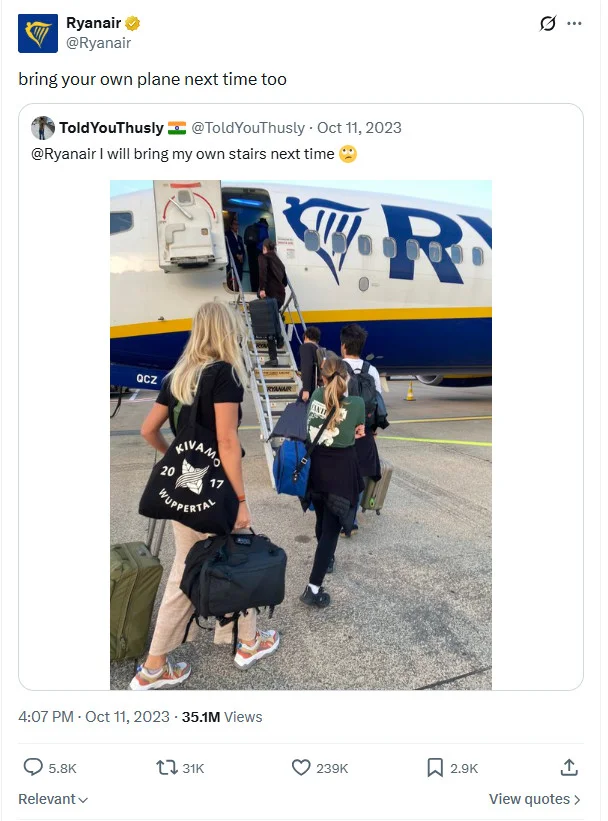
The risk grows as more people touch the account. Ryanair is a useful case here specifically because its irreverent, reply-and-roast voice has held for decades while the people running the account have inevitably changed.
One real example of the voice in action is here: the airline replied to a passenger’s photo of narrow boarding stairs, captioned “I will bring my own stairs next time,” by suggesting they bring their own plane too.
Skift’s reporting on Ryanair’s marketing team talks about their brand voice in detail. What keeps their voice consistent isn’t one indispensable writer, it’s a shared, documented sense of exactly how far the voice can go and what the brand would and wouldn’t say.
This is only possible if a brand clearly defines their brand voice on social media. Have a style guide for tone, a running list of “canon” details that any writer on the team can follow and check before publishing.
Matching Your Storytelling Approach to Your Brand’s Stage and Type
Your brand’s stage changes which story type is worth telling first, and skipping that match is one of the more common reasons a storytelling investment underperforms.
| New Brand | Established Brand | B2B Brand | Agency (Multi-Client) | |
| Primary Focus | Establishing a first, clear origin story | Evolving an existing narrative without breaking continuity | Translating transformation and customer stories into a professional register | Maintaining distinct, non-blending narratives per client |
| Best-Fit Story Type | Founding and origin stories, awareness-stage | Ongoing narrative and community stories, retention-stage | Transformation and customer-outcome stories, consideration-stage | Varies by each client’s funnel position; standardize the process, not the story |
| Key Risk | Overclaiming an origin story before it’s earned | Letting the narrative go stale or contradict earlier chapters | Defaulting to dry, story-free case studies out of caution | Client voices blending together under deadline pressure |
| Common Mistake | Borrowing a generic framework instead of finding the actual story | Treating every campaign as a fresh start instead of a new chapter | Assuming B2B audiences don’t respond to narrative at all | Applying one narrative template across every client account |
New Brands Establishing Their Origin Story
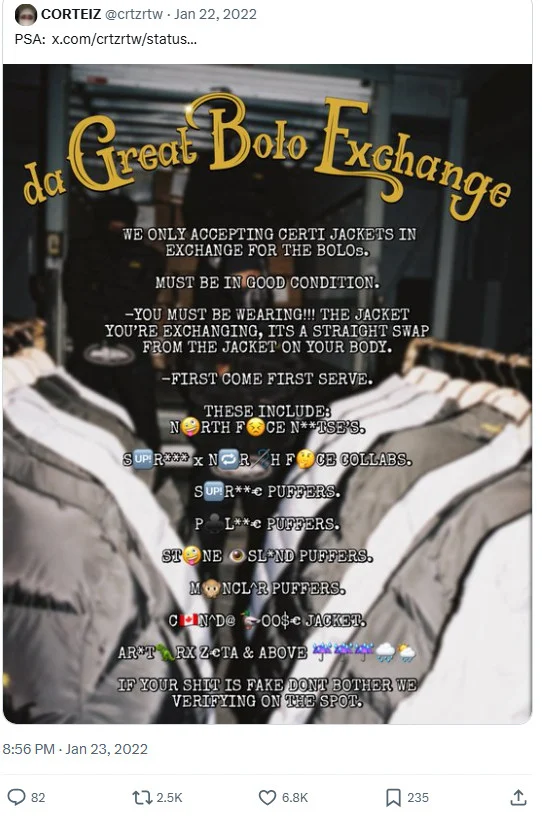
Corteiz, the streetwear label built partly on its own founder-friction lore (Nike originally challenged the brand’s name over its resemblance to the Cortez sneaker line) and on recurring stunts like inviting fans to trade in jackets for a limited drop, is a useful new-brand model precisely because it isn’t enterprise-scale.
It built a cultural moment the way large brands do, on a fraction of the budget, by treating its origin friction as the story instead of hiding it. In January 2023, its “Da Great Bolo Exchange” stunt had fans trade jackets from bigger, pricier brands for an unreleased Corteiz piece, then donated the swapped jackets to a homeless charity.
Here is one of their Twitter post about the Great Bolo Exchange trend.
The mistake new brands make here is reaching for a generic founder-story template before the specific, checkable details of their own origin are even nailed down.
Established Brands Evolving an Existing Narrative Without Breaking Continuity
Scrub Daddy‘s smiley-face sponge mascot is a sharp example of evolving a narrative without breaking it. The brand didn’t reset its identity when it moved from a Shark Tank success story into a TikTok-native comedy account with millions of followers.
It kept building on the same mascot and the same self-aware tone, and let the character get weirder and more meme-literate over time instead of starting over with a new campaign concept each quarter.
An established brand’s biggest continuity risk isn’t running out of new story ideas. It’s contradicting a detail from an earlier chapter that engaged fans actually remember.
B2B Brands: Different Story Types, Same Underlying Principles
B2B audiences respond to narrative exactly like anyone else does. They just expect the register to match the room. Ramp‘s “CFO” stunt, hiring actor Brian Baumgartner to play the role and livestreaming his first day processing expense reports from a glass box in Manhattan, is a useful case precisely because it didn’t come from a founder-emotion story either.
It came from taking a genuinely boring pain point, manual expense reporting, and building a character-driven bit around it that finance audiences immediately recognized.
The story type shifts, stunt over origin, specificity over sentiment, but the underlying mechanism, a reader recognizing a real frustration inside someone else’s bit, works the same way it does in consumer marketing.
Agencies Managing Distinct Narratives Across Multiple Brands
An agency’s problem isn’t finding one storytelling framework. It’s preventing five client accounts from sounding like the same account with a different logo.
Solving this problem requires a documented voice profile per client, specific words the brand would never use, a running list of the client’s own canon details, and a review step that checks new content against that profile before it checks the writing alone. The tell that it’s slipping: a client asks why their brand suddenly sounds like a different account you also run.
What’s Actually Proven vs. Assumed: An Evidence-Graded Look at Popular Storytelling Formulas
A lot of storytelling advice online sounds like fact. Most of it isn’t. Some of it is real science. Some of it is just a guess that got repeated so many times it started to sound true. Here’s exactly which is which, one concept at a time.
The Real Psychology: Narrative Transportation
Narrative transportation is what happens when a story pulls you in so far that you stop questioning it. Your attention narrows, the images in your head get vivid, and you resist the story’s point of view less than you normally would. That’s the real science behind why storytelling works at all.
What’s proven:
- Green and Brock (2000) first identified and named this effect.
- A 2024 review of 95 studies, by Thomas and Grigsby in Psychology & Marketing, confirmed it again: a story that really transports someone can change their attitude, what they say about a brand, and whether they buy.
- Lund, Cohen, and Scarles (2018) found people don’t just watch a brand’s story on social media, they add their own posts and comments to it.
- Researcher Ruth Page’s book, Stories and Social Media, shows social platforms (short posts, timestamps, replies) change how a story gets built in the first place.
What’s assumed (not proven):
- That any one formula, Hero’s Journey included, is what actually produces this effect. The research proves the general mechanism is real. It doesn’t prove any specific method causes it.
- That Lund’s finding applies to every industry. Their study only covered travel and tourism brands. It’s a good sign for other categories, but nobody has tested it outside travel yet.
Hero’s Journey, StoryBrand, and Other Heuristics: Useful Analogies, Not Proven Methods
Hero’s Journey, StoryBrand, and Pixar’s “story spine” are all story templates: step-by-step outlines meant to make sure your story has a proper shape.
What’s proven:
- These templates work as drafting tools. They give you a checklist so a story doesn’t come out feeling broken or incomplete.
- Hero’s Journey came from screenwriting, and StoryBrand and the story spine came from general business communication, not marketing research.
What’s assumed (not proven):
- That using one of these makes your marketing perform better. No controlled study has ever tested that.
- That they’re “settled” methods just because they show up, unchanged, across dozens of marketing articles with a few social media examples bolted on.
Debunking the “5 C’s,” the “5-5-5 Rule,” and Before-After-Bridge
Three more terms get repeated online like they’re proven storytelling science. None of them are.
What’s proven:
- The “5-5-5 rule” is a real, genuine content-mix schedule: five educational posts, five entertaining posts, five promotional posts, in rotation.
- The “22 times better” memory stat is false, but smaller, real numbers exist in its place: a 1969 study found roughly 7 times better recall, and Chip Heath’s classroom demos in Made to Stick found roughly 12 to 13 times.
What’s assumed (not proven):
- That the “5 C’s” is one agreed-upon framework. At least four incompatible versions circulate online, with no named academic originator and no outcome data behind any of them.
- That the 5-5-5 rule has anything to do with storytelling. It’s a posting-cadence rule. Storytelling is, at most, one way to fill the entertaining or promotional buckets.
- That “Before-After-Bridge” has a confirmed inventor. It’s commonly attributed to copywriter Bob Bly, but that attribution isn’t confirmed by any primary source, and no study backs the framework itself.
- That “stories are remembered 22 times better than facts” is a real, sourced number. It isn’t. Don’t repeat the 22.
A movie gets two hours. A sales letter gets forty pages. Your post gets a few seconds. So stop borrowing their structure. Use one built for yours: Hook, Compress, Invite.
Hook: Win the First Three Seconds
The hook is the very first thing someone sees, and it has to matter right away, a real problem, a real result, a real reason to keep watching. No warming up first. If you could delete your first sentence and the post still makes sense without it, that sentence wasn’t a hook. Cut it.
If you want ready to use formulas instead of starting from scratch, here are some proven Instagram Reel Hooks that are worth a look.
Compress: Tell the Whole Story, Fast
Every real story has three parts: something happens, something goes wrong, then it gets fixed. Compress means keeping all three parts, just shorter. A 30-second video can hold a full story. So can three slides. The mistake isn’t going short, it’s trying to cram five parts into a three-part space and hoping people fill in the rest. They won’t.
Invite: Let People Finish the Story With You
Invite means you leave a gap on purpose so people can jump in: ask a question, ask for their own version, or leave a detail people will want to guess about in the comments. A 2018 study on travel brands found people don’t just watch a brand’s story, they add to it. That study only covered travel brands, but it’s a strong sign this works elsewhere too.
Wendy’s did this well with #NationalRoastDay. They posted one line: “drop the ‘roast me’ below.” Then their audience wrote the rest of the content for them.
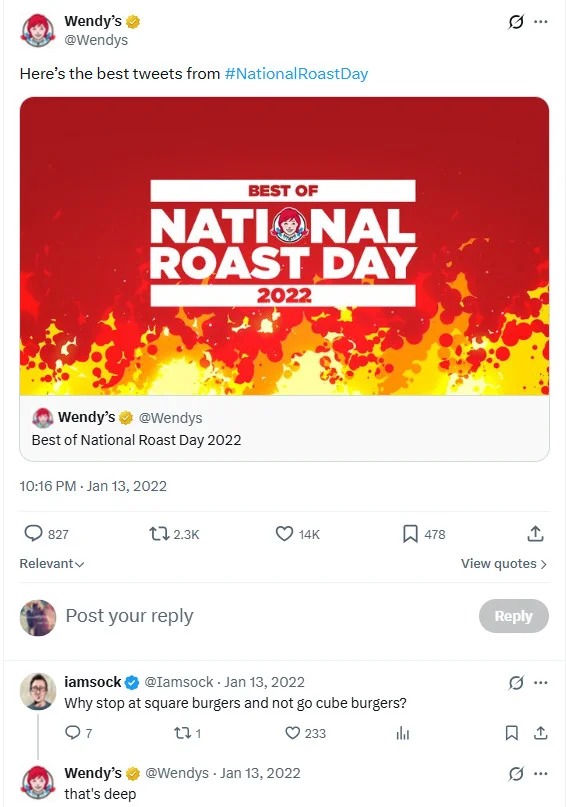
That’s Invite working exactly as intended: the brand opened the door, and people walked through it.
Storytelling Platform by Platform: Where the Same Story Changes Shape
The same story looks different depending on where you tell it. Copy one script onto every platform, and it will fail on most of them. Here’s what actually works, one platform at a time.
Instagram and Facebook: Visual Narrative, Stories, and Reels
On Instagram and Facebook, the picture or video does the work. The caption’s only job is to point people toward it, not explain it.
Liquid Death, the canned beverage brand behind sparkling water, iced tea, and other drinks, builds its whole identity this way: a skull, a dark joke, barely any text needed to know exactly whose post it is. Here’s one such reel from their Instagram.
Stories and Reels reward the same idea: let the image carry the story, and only use the caption to point, never to explain.
TikTok and Short-Form Video: Compressing a Story Into Seconds
TikTok gives you the least time of any platform here, and the biggest reward if you use that time well. e.l.f. Cosmetics turned one small idea, “Eyes. Lips. Face.,” into an original song and a challenge that became one of the most-watched branded moments TikTok has ever had, billions of views, from a single, repeatable idea. Here’s a video from e.l.f.’s TikTok account.
The lesson here is not to squeeze a big idea into a short video. Shrink the idea first, until it actually fits.
X and Threads: A Consistent Voice, Not Just Words
On X and Threads, a story can run almost entirely on text, as long as the same voice shows up every single time. Steak-umm, a frozen steak brand, built a surprising following by tweeting honest, thoughtful takes instead of typical food-brand jokes. Here’s an example.
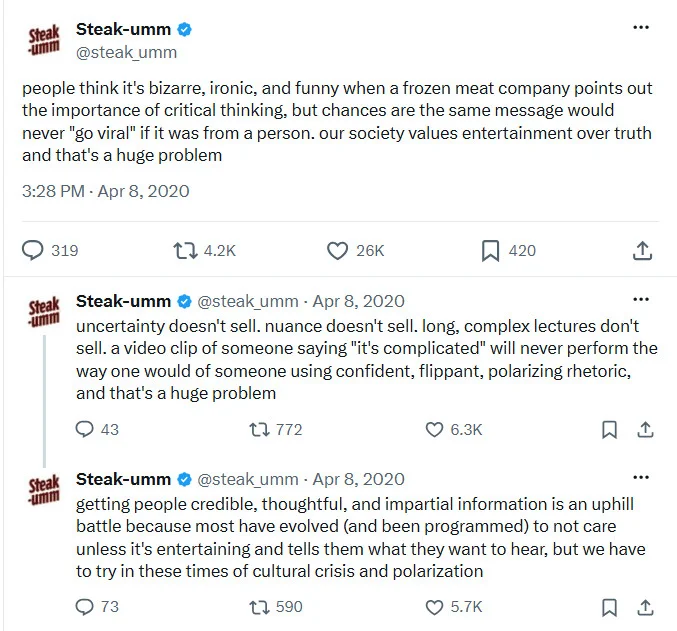
The tweet isn’t selling anything. It’s just consistent, and that consistency is exactly what makes people remember it.
LinkedIn: A Real Problem, Told Plainly
LinkedIn rewards a specific, real story over a polished one. Gong, a sales software company, posts about one real customer problem at a time instead of generic praise for itself. Here’s a real example about a customer who kept losing important details every time a deal changed hands between salespeople, and how that got fixed.
That one specific, relatable problem is what makes someone stop scrolling, not a big claim about being “the best.”
YouTube: Room for a Full Story
YouTube is the only platform here with room for a story that actually needs several minutes to land. Apple makes short films, not ads, for exactly this reason. It has a popular YouTube series called “The Underdogs: Apple at work” and the video below shows it’s most recent video, “Blue Screen of Death” (Oct 2025).
It follows the same recurring characters through a real work problem, a screen-freezing outage hitting every PC at their first trade show, while their own Apple gear keeps working right through it. The trade-off: far fewer people finish an eight-minute film than a five-second video. That’s fine. This format was never about reach. It’s for the people who actually stay and watch the whole thing.
YouTube is also the best home for creating social media episodic content series, since it’s the one platform where people actually expect to come back for the next episode instead of scrolling past it.
Measuring the Story and the Brand Narrative
Stop guessing whether a story worked. Ask two different questions instead: did this one post work as a story, and is the whole story getting bigger over time. Most advice out there only tries to answer one of those, if that.
Did This Post Work as a Story? (Completion, Saves, Watch-Through)
A like doesn’t tell you much. These three things do:
- Completion rate: Did people who started watching or reading actually finish it? That’s the closest thing to proof your story held their attention all the way to the end.
- Saves and shares, not just likes: A save means “I want to come back to this.” A share means “someone else needs to see this.” Both mean more than a like.
- What the comments actually say: Comments that mention a character, a detail, or a callback mean the story landed. Comments that don’t mean it was just content.
One clear way to measure this: Before you post, decide the one thing you want the story to do. Then compare a batch of story-style posts against a batch of regular posts, using the same numbers. Don’t judge one post on its own.
The video below shares some more tips on how to calculate the ROI of a story on social media.
Once you’ve got these numbers, the next challenge is putting them in front of a client who wants proof, not just a feeling. Learning how to present social media ROI to the clients is the right way before you move forward.
Is the Narrative Compounding? (Recall, Recognition, Repeat Engagement Over Time)
A story that’s working shows small signs before it shows big ones. BERA AI’s research calls this the difference between signs that show up early, like people remembering and recognizing your story, and signs that show up late, like actual sales.
If your story is really building, more people should remember specific details, recognize your recurring characters, and keep coming back, month after month, not week after week.
Here’s the simple version, no expensive tool needed: pull the engagement numbers for your story-format posts and your regular posts, side by side, over the same stretch of months, and see which one is actually holding up better. A tool like SocialPilot’s analytics can show that comparison across every platform in one place, instead of you jumping between five different apps to piece it together by hand.

If you’re honest, you’ll spot at least one of these in your last year of posts.
Treating Storytelling as a One-Off Post Instead of an Ongoing Asset
Here’s the tell: your best story post from six months ago never got a sequel. Content strategist Justin Welsh makes this point well: the best pieces of content keep working for you for years, not just once. Treat that post as chapter one instead of a lucky win, and it becomes something you can build on instead of a number you can’t repeat.
Borrowing a Framework Without Adapting It to the Format
A structure built for a movie or a long sales letter won’t just shrink to fit a 30-second video. One real example proves it: the same content, posted the same way everywhere, only worked on the one platform it was built for.
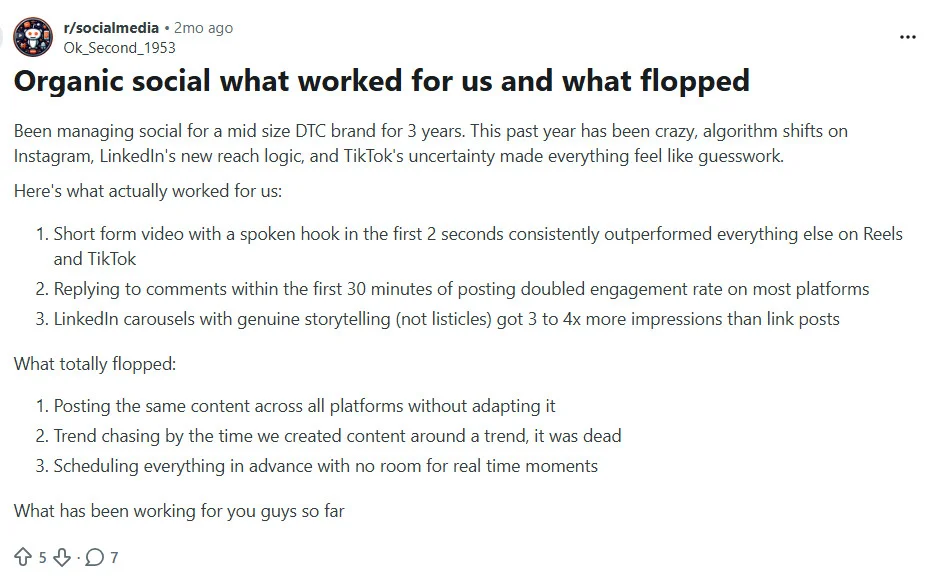
The idea wasn’t wrong. Copying and pasting it everywhere was.
Recycling the Same Five Brand Examples Everyone Else Uses
Read ten “best brand storytelling examples” lists back-to-back, and you’ll see the same five or six old names every time. If your own examples are the same ones every competitor already uses, you’re not proving anything. You’re just showing you read the same articles they did.
Never Checking Whether the Story Actually Performed as a Story or Compounded as a Narrative
The real mistake isn’t measuring wrong. It’s not measuring at all and calling it “too hard to track.” Ryan Barker, founder of the brand-measurement platform BERA, makes this point directly: too many companies still treat their brand as a cost, not one of the biggest assets they own.
Skip the two questions above, and you’re left defending your storytelling budget with nothing but a feeling.
Building This Into Your Content Strategy
You now have enough to decide whether storytelling gets built into the content roadmap as infrastructure, or stays campaign-by-campaign. But the operational risk at this stage is coordination. A narrative identity only stays consistent if everyone touching the calendar – writers, designers, whoever approves the final post, can see the same running list of canon details and the same voice guide before something goes out.
A shared content calendar with a visible publishing history gives a team that continuity instead of relying on one person’s memory of last quarter. Pick one recurring theme or character worth building on for the next two quarters, put the measurement approach in place, and treat the two together as the real investment.
Try out this workflow using SocialPilot and if the cost of trying is the open question, SocialPilot’s pricing is worth a look before you assume it’s out of budget.




 Join 55,000+ social media managers


