
Running a cleaning business means your work speaks for itself the moment you walk out the door. Getting someone to let you through the door in the first place is a different problem entirely, and that is exactly where social media for cleaning businesses either earns its keep or wastes your evenings.
You are probably already posting some before/after photos, maybe a review here and there, a shot of your kit before a big job. You get a handful of likes from people who will never call you, and nothing moves. The work is good. The posts look fine. But the calendar stays the same.
This guide is not about which platforms to join or how many times to post per week. It is about why before/after content and reviews work specifically for cleaning businesses in a way they do not work for most other industries, and how to build a simple weekly system around both that turns followers into actual bookings. If you are already posting and still not getting calls, the problem is not your content. It is what is missing around it.
Why Most Cleaning Businesses Post Without Getting Bookings
This question shows up constantly in small business communities. A cleaning business owner in London posted this on r/smallbusiness two months ago and got 43 replies:
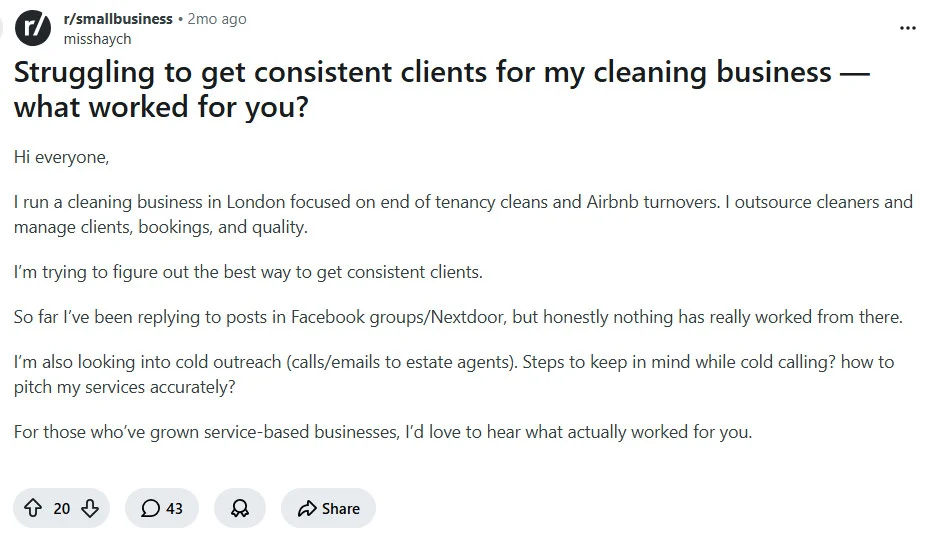
She is active, she is trying things, and nothing is converting. That gap is not a content problem. It is a system problem.
Social media activity and a social media booking system are two different things. Most cleaning businesses have the first without the second. You can have a strong social media presence and still have zero bookings if there is no location in the caption, no path for a viewer to take the next step, and no CTA telling them what to do.
Posting Activity vs. a Booking System: What the Difference Actually Looks Like
Here is what posting activity looks like: you share a photo of a clean bathroom, add a few hashtags, and wait. Here is what a booking system looks like: the same photo has your city in the caption, a direct call to action at the end, and a link in your bio going straight to a booking page.
One is a photo. The other is a customer acquisition tool. The only difference between them is the framework you build around the content.
Creating accounts on Facebook, Instagram, and TikTok at the same time, then posting sporadically across all three, produces three half-active profiles that together look less credible than one well-maintained account.
A potential client who finds your Instagram and sees three posts from seven months ago does not feel confident calling you. Pick one platform, build a consistent presence on it, and add a second only when the first is generating real inquiries.
When someone is deciding whether to invite a stranger into their home, they look at your social media the same way people check a restaurant before making a reservation. A dormant profile reads as a business that may no longer be operating, or one that doesn’t take itself seriously enough to maintain a basic presence. Neither impression leads to a phone call.
For most residential cleaning businesses, Facebook or Instagram will generate more actual bookings than TikTok. Both platforms have older, more locally rooted audiences who are actively looking for home services. Start with one, get it working, then decide whether to expand.
Google Business Profile (GBP) is a free local listing that puts your business in front of people searching “cleaning service near me” before any social media profile does. Set up and verify your GBP before spending time on Instagram or Facebook.
Fill in your service area, hours, photos, and a direct booking link. Everything you post on social media will eventually send people somewhere to book, and your GBP is the most direct destination for that traffic.
Where Cleaning Clients Actually Scroll: Residential vs. Commercial Audiences
Residential clients, specifically homeowners and renters between 30 and 55, spend the most time on Facebook and Instagram. Commercial clients such as office managers and property managers are more reachable on LinkedIn. For a solo residential cleaner, Facebook and Instagram are where the work is.
Facebook vs. Instagram vs. TikTok: Honest Trade-offs for Small Operators
| Platform | Best for | Core audience | Booking conversion | Learning curve |
| Local reach, word of mouth | 35–55 homeowners | High (Messenger + DMs) | Low | |
| Before/after visuals, Reels | 25–45 renters, homeowners | High (DMs + bio link) | Medium | |
| TikTok | Brand awareness, reach | 18–35, broad | Low (global, not local) | High |
If you are under 40 and your clients are younger, start with Instagram. If your clients are mostly established homeowners in the 35 to 55 range, start with Facebook. For full setup walkthroughs, the Instagram marketing guide and the Facebook marketing guide cover each platform’s specific steps.
The One-Platform Rule and When to Add a Second
Give one platform 90 days of consistent posting before touching a second. Consistent means two to three posts per week, every week, with a booking path attached. If you are getting profile visits, DMs, and booking inquiries after three months, you can consider expanding. Before that point, splitting your attention makes both profiles worse.
Your profile is the first thing a potential client sees after clicking on your post. Before you publish another piece of content, make sure it answers three questions in under ten seconds:
- What do you do,
- Where are you located, and
- How does someone book you.
Make sure to add these four profile elements:
- Name and bio: Include your city and a one-sentence description. “Residential house cleaner in Denver, CO. Recurring cleans, deep cleans, and move-out cleans.” is enough.
- Link in bio: One link, pointing directly to a booking page or scheduling tool.
- Profile photo: Your face or your team in uniform, not a logo. Cleaning is a trust industry, and a real face builds trust faster than any graphic.
- Contact or book button: On both Instagram and Facebook, enable the direct message or booking button so a visitor can act when they land on your page.
Instagram and Facebook-Specific Setup Most Cleaning Businesses Skip
On Instagram, add your city to the “Name” field, not just the bio text. This makes your account discoverable in location-based searches. On Facebook, fill in the “Services” section completely and enable the Reviews tab. Facebook surfaces local service businesses more prominently when the profile is fully built out.
Pinning Your Best Posts and Creating a First-Impression Content Set
Pin three posts to the top of your profile: your most dramatic before/after, your strongest client review, and a short introduction post or video showing you at work. These three posts answer the three questions every first-time visitor has: does this person do good work, can I trust them, and who are they.
What to Post: Content Pillars That Get Cleaning Businesses Booked
The content that drives bookings for cleaning businesses is not the same content that drives bookings for a gym, a restaurant, or a retail brand.
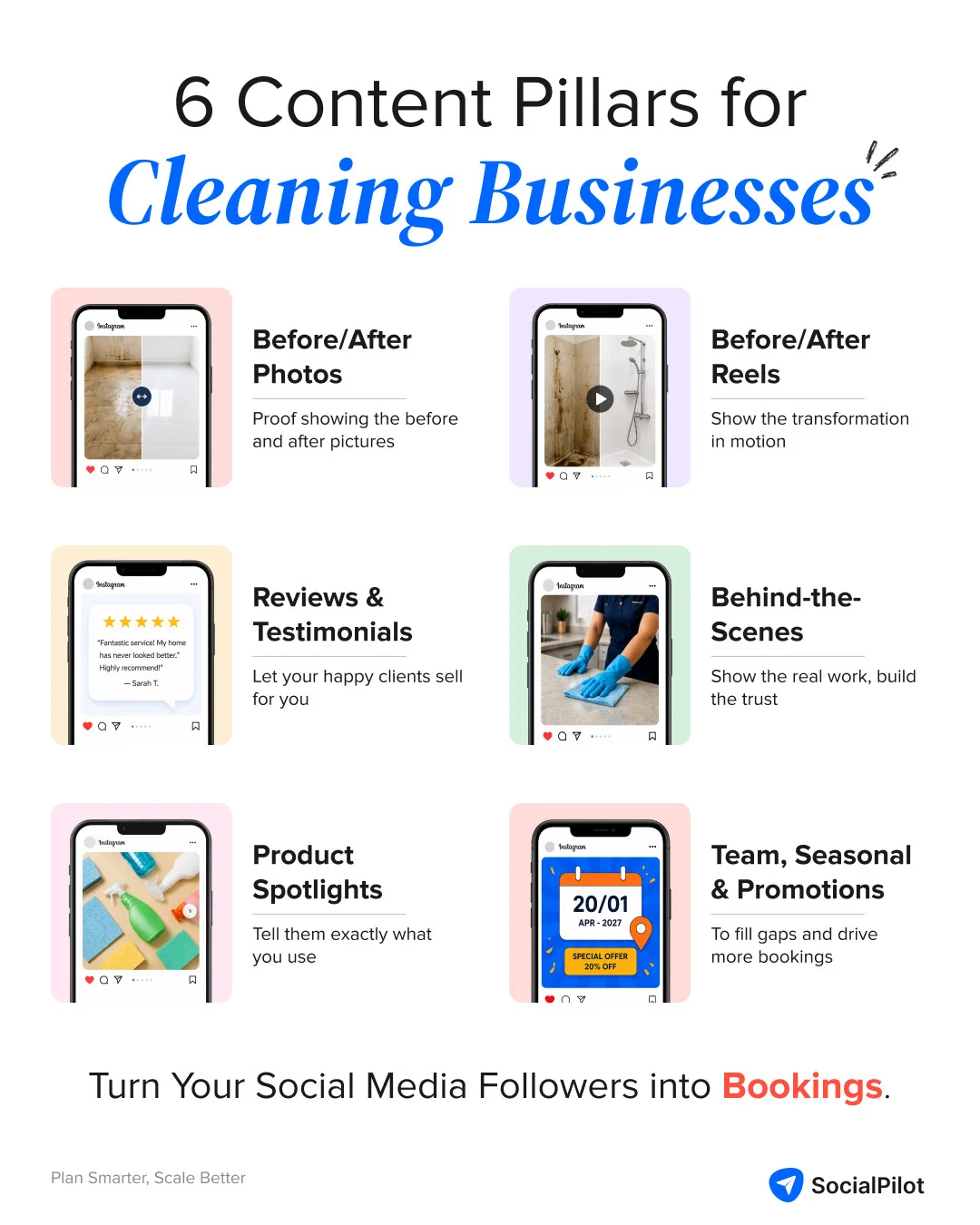
Here are some content pillars that are best suited for such businesses:
1.Before/After Photos
Before/after content is any post showing the state of a space before and after your cleaning service. You do not need a professional camera or any special equipment. Use your phone, shoot in natural light, and stand in the same spot for both photos so the comparison is direct.
The before photo matters more than the after. A genuinely dirty grout line, a grimy stovetop, or a heavily soiled floor creates the kind of contrast that makes someone stop scrolling. A mildly untidy room with a tidy after is forgettable.
Clean Rush Miami‘s before/after carousel below captures this principle for an Airbnb turnover clean. “BEFORE: Post check-out chaos. AFTER: Ready for check-in.” The caption invites potential clients to message “TRANSFORM” and the conversion path is built directly into the post.
Why it works for cleaning businesses:
- Clients need visual proof before trusting a stranger with their home. A dramatic transformation is the closest thing to a test clean they can see without booking you.
- Before/after posts get saved and shared more than almost any other format in home services, which extends your reach without any additional effort.
- Location-tagged before/after’s appear in local search results on Instagram and Facebook, putting your work in front of people in your service area who are actively looking.
2. Before/After Video: Reels and the CleanTok Opportunity
Before/after video content on Instagram Reels consistently outperforms static photos for organic reach. The #CleanTok category has accumulated billions of views and proves there is an enormous appetite for cleaning transformation content. The caveat for a local cleaning business is that TikTok’s algorithm optimizes for global engagement, not local discovery.
Use Instagram Reels for both reach and local conversion, and add TikTok once your Instagram rhythm is established.
The format that drives the strongest engagement is visceral proof of the transformation: dirty before, clean after, shown in real time. GoCleanCo, run by Sarah McAllister in Calgary, grew from 10,000 to over 1.7 million Instagram followers by leading with this kind of honest, unglamorous before content reels. The dirtier the before, the more powerful the after.
GoCleanCo’s bathroom transformation post below shows the format at its most effective. The before shows genuinely soiled shower glass, the after is striking, and the contrast does all the work without any production.
Why it works for cleaning businesses:
- Video captures the process in a way a photo cannot. Viewers see dirt being removed in real time, which is more convincing than a side-by-side still image.
- Reels are pushed to non-followers through the Explore and Reels tab, meaning every video has a chance to reach people in your area who have never heard of you.
- The “satisfying clean” format triggers saves and shares organically, the two signals that carry the most weight with Instagram’s algorithm for service businesses.
3. Reviews and Testimonials
A five-star Google review that sits only on your GBP listing is a missed opportunity. Take that review, drop it onto a simple branded graphic in Canva (white background, your logo, the star rating, a short quote), and post it to Instagram and Facebook.
This takes five minutes and turns something you already earned into a piece of trust content that reaches people who have never searched for you on Google.
Real Cleaning Services, UK often post their client testimonials as social content. The reel below features several five-star reviews praising their team members and the booking process. A named cleaner plus a named client makes it feel real rather than generic.
Why it works for cleaning businesses:
- Potential clients trust other clients more than they trust any business. A review post hands the sales conversation to someone who already took the trust leap you are asking them to take.
- Naming a specific cleaner in a review post answers the “who is coming to my home” question directly, which is the deepest anxiety in residential cleaning.
- Review graphics perform especially well in Stories, where they reach your existing followers at no cost and prompt direct replies from people who are already warm to your service.
4. Behind-the-Scenes and Process Content
Show yourself working. A short clip of you prepping your kit before a job, wiping down a surface in a methodical pattern, or packing out at the end of a shift builds a kind of trust that a polished transformation photo cannot. It shows a real person who cares about how they do the work.
@nottheworstcleaner_ shared a reel going behind the scenes of a kitchen cleaning transformation, showing exactly what happens before and during the clean – the prep, the process, the effort. No voiceover, no product pitch. Just a real cleaner doing the work. It earned 31,600 likes because viewers could see what the job actually involves.
Why it works for cleaning businesses:
- Showing your process answers the unspoken question every potential client has: “Do they actually know what they are doing?” Methodology content is the answer.
- A face on the screen reduces the anxiety of letting a stranger into a home more than any written description of your qualifications can.
- Process content attracts the highest-quality followers because people who engage with it are genuinely interested in your service, not just entertained by the visual.
5. Product and Supply Spotlights
Post about the specific products you use and explain why. “We use [product] on grout because it breaks down mineral deposits without leaving a film on the tile surface” is not a niche detail. It signals that you have thought carefully about your process, and homeowners who care about what goes into their homes want to know what you are bringing through the door. This content type also generates saves and shares, which extend your reach without any additional production effort.
@carecleaning, a professional cleaning account with 631K followers, posted a carousel of the exact products she brings to every client home, with the caption: “I own a cleaning company… and if I were cleaning YOUR house, this is exactly what I’d bring in my caddy.” The post generated 845 comments, with followers tagging the word “CLEAN” to receive her full product list.
Why it works for cleaning businesses:
- Product posts generate saves at a higher rate than most other formats because people bookmark them for future reference, keeping your account visible over time.
- Naming specific products differentiates you from competitors who use vague language like “eco-friendly products” without any specifics.
- It opens the door for product-related questions in comments and DMs, which are natural starting points for a booking conversation.
6. Team Posts, Seasonal Promotions, and Cleaning Tips
When you do not have a strong before/after from the week, these three types fill the schedule without going off-brand.
- Team introduction posts are trust content.
- A seasonal checklist is shareable content that puts your name in front of people who have not considered booking yet.
- A time-limited promotion is direct conversion content.
None of these require a photographer, a studio, or a marketing budget. For a broader bank of content formats organized by goal and platform, this guide on social media post ideas is a useful reference.
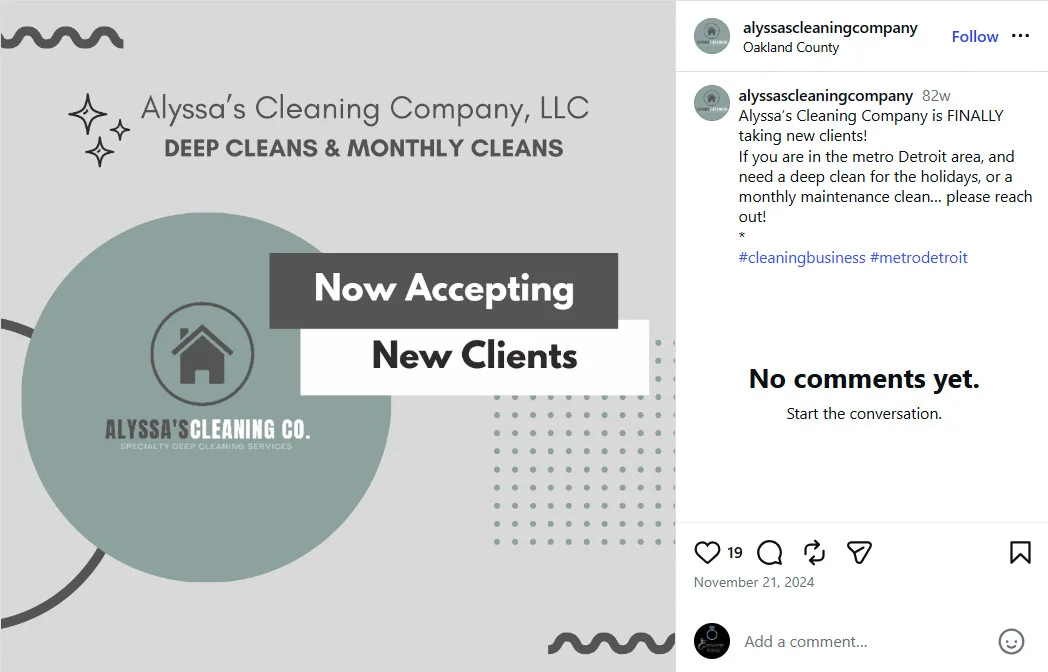
Alyssa’s Cleaning Company, a solo operator based in metro Detroit, posted this seasonal announcement when she opened her calendar for holiday deep cleans. It is specific about location, specific about timing, and ends with a direct invitation to reach out. One post, zero production cost, clear booking intent.
Why it works for cleaning businesses:
- Introductory and team posts resolve client hesitation. A name and a face attached to the business converts passive followers into active inquiries.
- Seasonal posts attract homeowners who are already in a “need a cleaner” mindset, making them the highest-intent audience your content will reach that month.
- Promotional posts with a deadline create urgency without pressure, especially when framed around limited slots rather than a percentage discount.
Hashtags work best when layered across three categories:
- Industry tags like #CleaningBusiness and #ProfessionalCleaning,
- Location tags like #[City]Cleaning and #[City]MaidService, and
- Service tags like #DeepClean and #MoveOutCleaning.
Use five to ten per post rather than thirty. Always tag your location separately on every post. This is how both Instagram and Facebook surface your content to people searching locally.
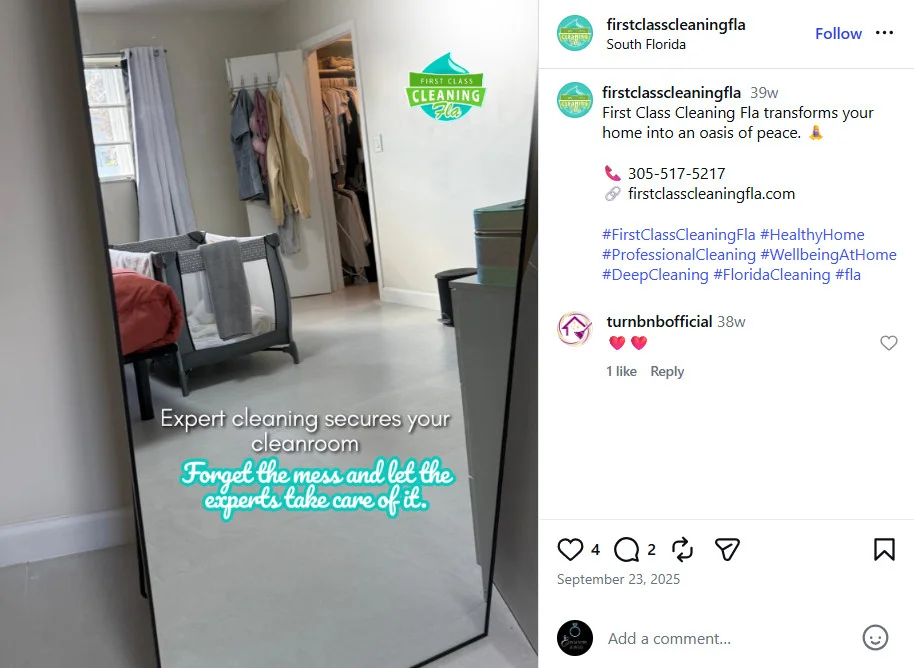
@firstclasscleaningfla runs a residential and commercial cleaning service in South Florida. Their posts consistently use a tight mix of industry tags (#ProfessionalCleaning, #DeepCleaning), location tags (#FloridaCleaning), and lifestyle tags (#HealthyHome) – all tagged to South Florida. The result is a profile that shows up when someone in their service area searches for a cleaner, not just when people search a global cleaning tag.
If you are not sure which hashtags to use for your specific service and city, SocialPilot’s free Instagram hashtag generator gives you a ready-made set based on your content.
Free AI Instagram Hashtags Generator
Take your Instagram game to the next level with SocialPilot’s AI-powered Instagram Hashtag Generator.
Here is the Generated Result
For a deeper look at how hashtag strategy affects reach and discovery, the hashtag marketing guide covers the mechanics behind what actually moves the needle.
How to Turn a Follower into a Paying Client
Great content attracts followers. A booking path converts them. Without a clear mechanism moving a viewer from “I like this post” to “I want to book this person,” every post generates interest that goes nowhere.
Four Things to Check if Your Posts Get Likes but Not Calls
Before changing your content strategy, run through this first:
- Location context: No city in the caption, no location tag – a viewer who wants to book you has no idea where you are. Add your city or neighborhood to every post.
- Call to action: Every caption needs one instruction at the end. “Book via the link in our bio” or “DM us to check availability” is enough.
- Dramatic contrast: The bigger the visible difference, the stronger the post. Find the grimiest surface before you start, and lead with that.
- A trust signal: Add your first name, the neighborhood you worked in, or a one-line client reaction. This makes the post read as real work from a real person, not a stock photo from a faceless business.
The CTA Formula for Every Caption
End every caption with one action. Rotate between these:
- “Book via the link in our bio”
- “DM us to check availability in [city]”
- “Send us a message and we will get back to you today”
One clear instruction gets followed. Three instructions get ignored.
The Booking Path: Link in Bio and Why Posts Without One Don’t Convert
Your link in bio should go directly to a booking page, not your homepage. A homepage presents options. A booking page removes them. Use Calendly, a Google Form, or a dedicated booking tool, and link to it from your bio. Without it, you are relying on a viewer to remember to Google you later. Most won’t.
What to Say When Someone DMs You
Speed matters. A potential client who DMs you and hears nothing back within a few hours will often contact a competitor instead. Keep this ready to paste into any inquiry:
“Hi [Name], thanks for reaching out! I’d love to help with your home in [area]. My next available slots are [date] and [date]. You can book directly here: [link], or I can give you a quick call if that’s easier. What works best for you?”
A quick reply with a clear next step will inspire them to take action.
The Batch Workflow That Makes Consistent Posting Realistic
Consistency for a solo cleaning operator does not mean posting every day. It means your profile looks active and credible when a potential client finds it. Two to three posts per week is the right target, and you can produce all of them in under 20 minutes once a week.
Step 1: Capture Content During the Job (5 Minutes)
At every job, take three photos before you leave: the grimiest surface in the space before you start, the same surface after you finish, and one in-progress shot of you at work. Save everything to a dedicated folder on your phone labeled “Content.” That folder becomes your weekly post bank.
Step 2: Batch-Write and Schedule One Week of Posts in a Single Sitting (10 Minutes)
Once a week, open your content folder, choose three photos, write three captions, and schedule them for Monday, Wednesday, and Friday. Each caption must have:
- one sentence about the job,
- one line of context about what made it notable, and
- one call to action.
If the blank caption box is where you get stuck, SocialPilot’s AI Pilot turns a one-line job description into a ready-to-post caption – with hashtags included. Paste in “deep clean of a bathroom in Austin, grout was heavily stained, first-time client” and it generates a caption built for the platform you’re posting to.
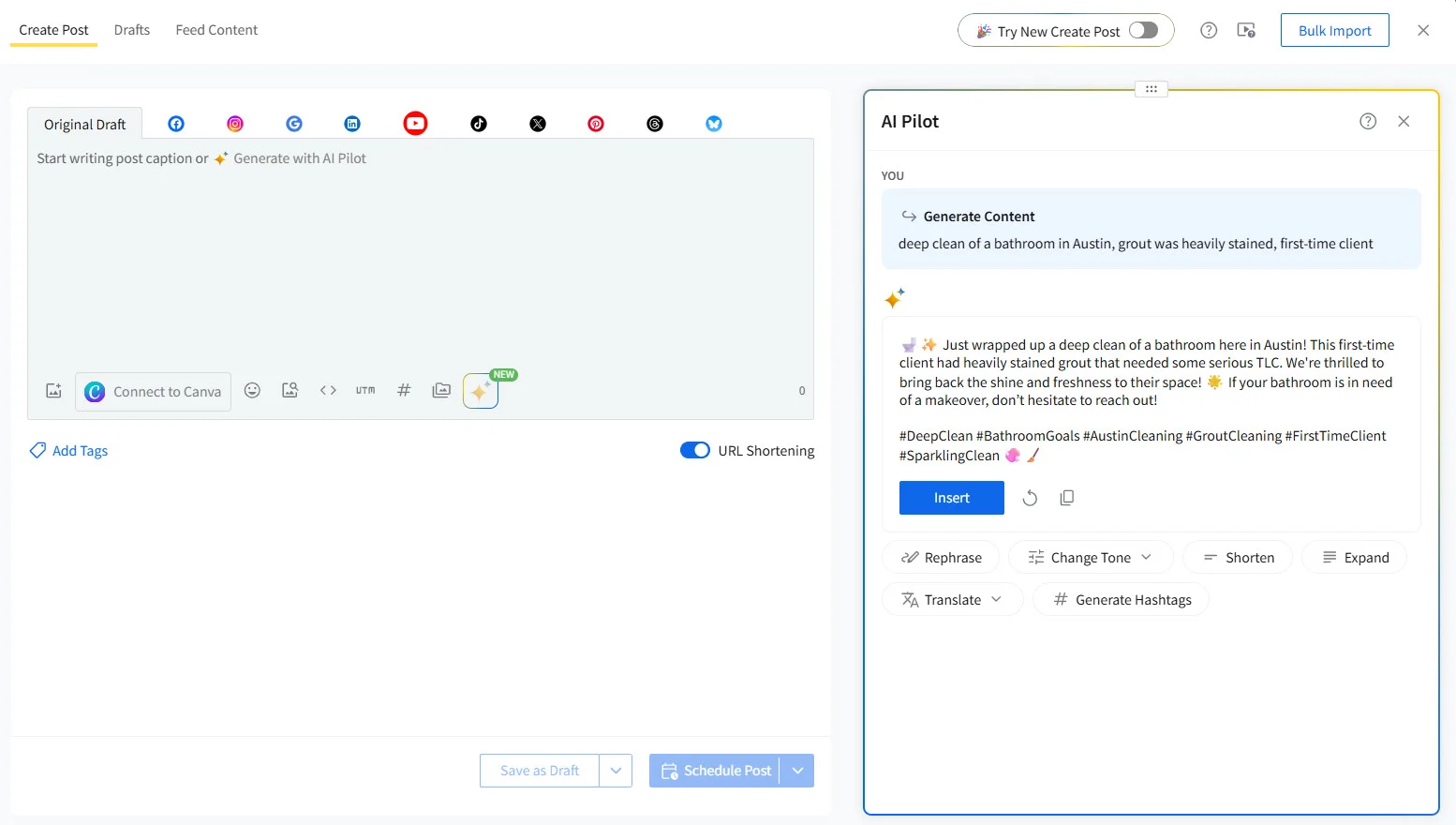
Once your captions are written, SocialPilot’s scheduler publishes them to Instagram, Facebook, and your Google Business Profile in a single session. Your whole week of content goes out without you touching it again.
If you want a structured template for planning your content week, the social media content calendar guide walks through building one in under 20 minutes.
In the same batch session, check your Google Business Profile for any new reviews. Screenshot the best one, open Canva, drop it onto a branded template, and save it as your Wednesday or Friday post. Three minutes of work removes the “I don’t know what to post” problem for at least one slot every week.
Step 4: Respond to Comments and DMs, Then Close (2 Minutes)
At the end of the session, reply to any comments or DMs from the past week. A comment left unanswered for more than 24 hours signals unresponsiveness. If you are managing Instagram, Facebook, and Google Business Profile separately, SocialPilot’s Social Inbox pulls all your messages and comments into one feed, so you are not jumping between apps.
Keep replies short and end each one with an invitation to book or ask a follow-up question.
What to Measure After 30 Days
The only social media metrics worth tracking in the first 90 days are the ones directly connected to bookings. Follower count and likes tell you about content performance, not business performance.
Profile Visits: Are People Finding You?
Profile visits show how many people clicked through from a post to your profile to learn more. A post with high reach but low profile visits means the content was not compelling enough to generate curiosity. A post with lower reach but high profile visits means it landed with the right audience, even if it did not travel far.
Link Clicks to Your Booking Page: Are They Converting?
This is the most important number for a cleaning business. If profile visits are growing but link clicks are not, the issue is your bio or your booking page, not your content. Use the built-in analytics on your booking tool, or shorten your link with Bitly to track click-through separately.
DM and Message Volume: Is the Content Generating Inquiries?
Count inbound DMs and messages each week. If this number stays flat over 30 days of consistent posting, revisit your CTAs and your content types. Growing engagement alongside flat DM volume usually means you are creating content people enjoy but not content that makes them want to hire you.
The businesses that consistently get booked through social media are not posting every day, running ads, or dancing on TikTok. They are posting two or three times a week, using before/after photos that show real work, turning every five-star review into a piece of trust content, and making sure every post has a location and a clear next step.
That system is repeatable, it takes under 30 minutes a week, and it compounds over time.
If you want to run that system without the manual work of switching between apps, writing captions from scratch, or remembering to post – SocialPilot’s plans start with a free trial. You get AI-assisted caption writing, cross-platform scheduling, and Google Business Profile publishing in one place. No long-term contract, no steep learning curve.



 Join 55,000+ social media managers


