

The contract is signed. The invoice is sent. And now you’re staring at a blank document that’s supposed to become a strategy, a content plan, and a working relationship with a real client who is expecting results.
Nobody prepares you for this part.
63% of customers say the onboarding experience shapes whether they continue with a service, not at renewal time, but from day one (Wyzowl, 2020). Knowing how to create content is what got you here. Knowing how to run client engagement is what determines whether you’ll still be here in six months. Two different skills. Most people only learn the second one after losing the first client who expected them to already have it.
The first 90 days are where that decision gets made. Build it right and you have a client who renews, refers, and expands scope. Build it on the fly and no amount of good content holds the relationship together once the cracks show.
This is a week-by-week system for those 90 days: what to do, in what order, and why each step earns the next.
Your 90-Day Client Onboarding Roadmap: Phase by Phase
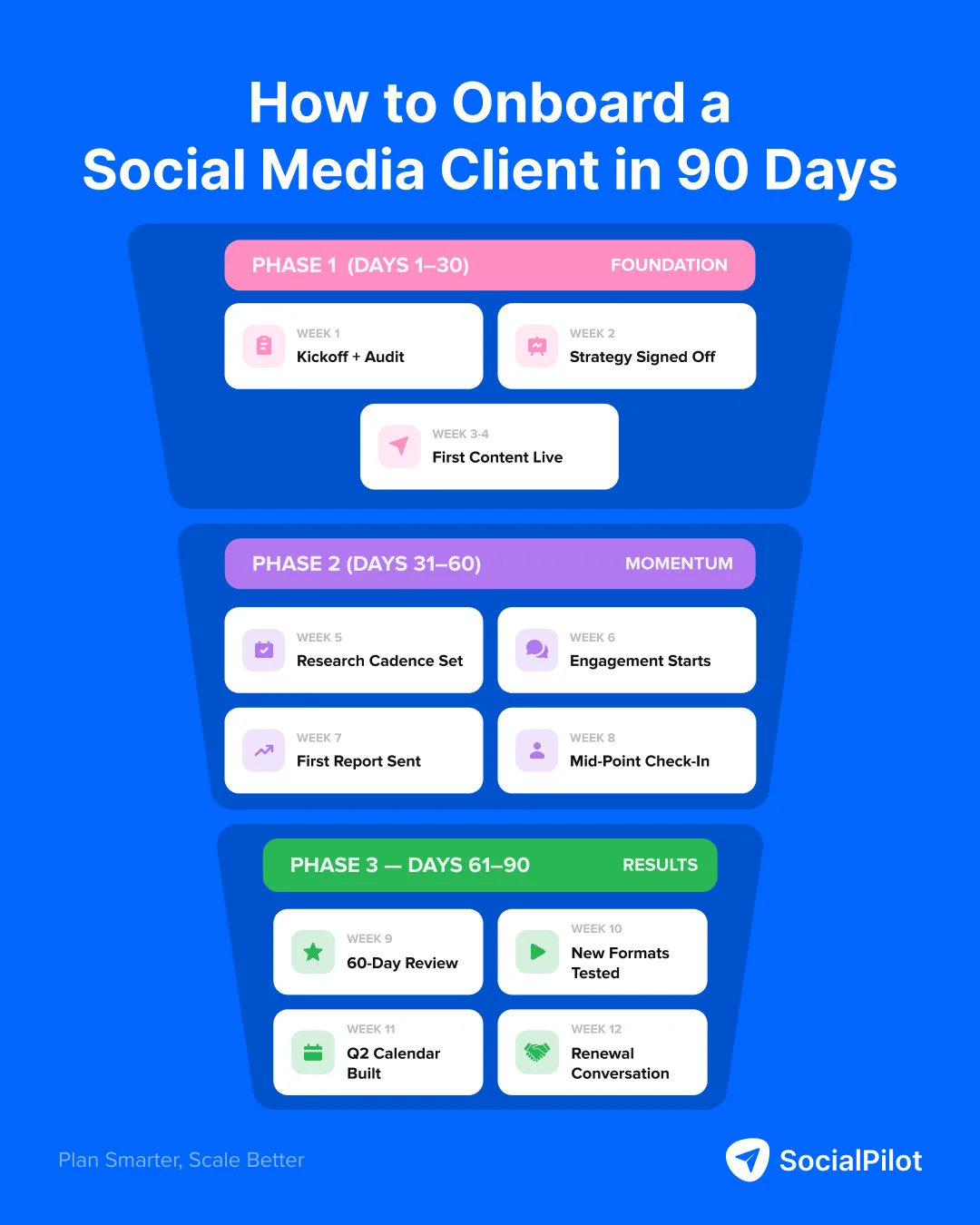
One distinction before the roadmap:
The audit you ran to win this client is not the same as the audit you run during onboarding. The sales audit surfaced pain points and closed the deal. The intelligence audit builds the formal baseline every 30-, 60-, and 90-day review conversation depends on. Skip it because you already ran something similar and you lose the starting point you need to prove anything has moved.
The sales audit closes the deal. The intelligence audit runs the engagement.
Days 1–30: Lay the Groundwork
Phase 1: The most expensive mistake in a new client relationship happens in this phase, before a single piece of content goes live. Not because the work is bad. Because the foundation was skipped.
Month one is not about posting. It’s about building the infrastructure the next six months will run on. The agencies that retain clients longest invest heavily here, not in hours, but in intentionality. A week one done right saves three months of corrections. Everything that goes wrong in month two almost always traces back to something that was rushed or skipped in week one.
Week 1: Access, Discovery, and First Research Pass
Before any creative work begins, three things need to be in place: the client needs to understand how this engagement works, you need everything from them to do the work, and you need to start gathering the intelligence the strategy will be built on.
Day 1–2
The onboarding deck goes out before the kickoff call. Its job is to eliminate every “how does this work?” question before it gets asked. When the client opens it, they should know exactly what happens when, what you need from them, and what success looks like at each stage. Most client friction in the first 90 days is a misaligned expectation problem, not a content problem. The onboarding deck fixes this before the first call happens.
What the onboarding deck covers:
- Who they’ll be working with and how to reach each person
- How the process works: research through approval through scheduling
- The 30-60-90 day roadmap and what to expect at each stage
- What you need from them, and by when
- How the approval workflow works, including turnaround expectations and what happens if they miss a deadline
- Communication channels and response times
- What success looks like in month one, and what it doesn’t look like yet
The questionnaire follows. It goes deeper than any brief covers: not just who the audience is, but what that audience actually struggles with. Not just which platforms the client is on, but which ones they should stop being on. Not just competitors, but who they genuinely admire and why.
One agency owner in this r/agency thread described exactly this approach:
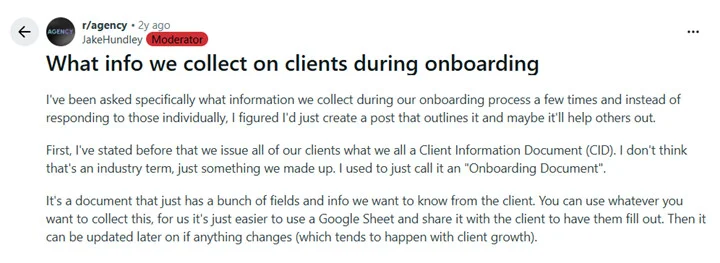
The questionnaire:
- Business goals, not just social goals: what does success look like for the business in six months?
- Target audience: who they’re reaching, what those people care about, what frustrates them
- Brand voice: how the brand sounds, what it would never say
- Non-negotiables: topics, angles, or formats that are off-limits
- Competitors to watch and aspirational accounts
- Social media history: what’s been tried, what worked, what didn’t
- Involvement preferences: how hands-on the client wants to be in approvals and creative decisions
- Revenue range: not to qualify them, but to set a baseline you can point back to at the 12-month mark
- How locals refer to the area: the language your audience uses about where they live often outperforms generic copy in every niche
Access and assets:
- All social media account logins or admin access granted
- Brand assets collected: logos, fonts, color codes, brand guidelines
- Analytics and ads account permissions
- Existing content library, if one exists
- Competitor list confirmed
Day 3–5
The kickoff call closes the gaps. Not a ceremonial welcome, a working session: any questionnaire answers that need unpacking, the roadmap walkthrough, KPI agreement, and anything still outstanding on access before you leave the call.
- Dig deeper on anything unclear from the questionnaire
- Walk the client through the 90-day roadmap
- Agree on KPIs, reporting cadence, and communication channels
- Collect any remaining access before ending the call
Day 6–7
The audit and research start in parallel this week. Neither needs to be finished. Week one is for gathering. Week two is for concluding. Seven days of observation produces a sharper conclusion than two.
Begin the social media audit:
- Pull platform performance data: follower count, engagement rate, posting frequency, reach
- Download top and bottom performing posts from the last 90 days
- Flag immediate red flags: inactive accounts, inconsistent branding, negative comments, platforms the client shouldn’t be on
Begin audience and market research:
- What questions is this client’s target audience actually asking in comments, Reddit threads, YouTube videos, and industry forums?
- What content is driving real engagement for similar businesses right now?
- What formats are converting followers into customers in this niche specifically?
- Identify 3–5 direct competitors and 3–5 aspirational accounts: what’s working, what isn’t, what gaps exist?
Week 2: The Intelligence Audit, Content Pillars, and Strategy Sign-Off
Week two is where gathering becomes concluding. The audit gets finished and formally presented. The content pillars get agreed on in writing. The strategy gets locked. By the end of this week, nothing strategic should be left open.
Day 8
The audit is a deliverable, not internal notes. When you present it to the client, it becomes the official record everything gets measured against at 30, 60, and 90 days. Without it, you have no starting point, which means you can’t prove progress. The agencies we work with that skip this step almost always regret it at the 60-day review when a client says “I can’t see the difference from when we started.”
Platform performance:
- Follower count and growth trajectory per platform documented
- Average engagement rate per post compared to industry benchmark
- Posting frequency: how often, which days, which times
- Reach and impressions trends over the last 90 days
Content analysis:
- Content types catalogued: formats, topics, tone
- Top performing posts identified and reasons documented
- Worst performing posts and common patterns noted
- Brand voice consistency evaluated across all platforms
Visual consistency:
- Logos, colors, and fonts consistent across platforms
- Profile photos, cover images, and bio quality assessed
- Visual identity checked against how the brand presents itself everywhere else
Audience data:
- Demographics recorded: age, location, interests where available
- When the audience is most active
- What content they engage with vs. scroll past
Competitor comparison:
- Client’s presence compared to 3–5 direct competitors on the same platforms
- Where competitors are outperforming and why
- Gaps the client isn’t currently capturing
Red flags to surface immediately:
- Reputation issues or negative comments requiring action
- Platforms the client is on but shouldn’t be
- Inactive accounts creating a poor first impression
- Branding inconsistencies that will undermine new content
Day 9–10
Content pillars follow directly from the audit and research. Not from intuition. Not from what worked for a different client. This is the first major strategic decision, and nothing gets created until it’s agreed on in writing. A client who approves pillars verbally and then questions content in week three is a pillar sign-off problem, not a content problem.
For each pillar:
- The topic category: what it covers
- The purpose: educate, convert, build trust, or drive engagement
- The post split: how many posts per month
- Platform fit: which pillar works best on which platform and in which format
Day 11–14
Strategy lock-in:
- Brand voice document built: tone, language, how the brand sounds on each platform
- KPIs set that actually matter: reach, engagement rate, link clicks, leads. Not just follower count.
- Reporting cadence agreed: weekly async updates, monthly deep-dives
- Approval workflow set up in SocialPilot so the client knows exactly how review works from day one
If research surfaces something unexpected: a more complex competitor landscape, an audience that looks different from what the questionnaire described, push strategy sign-off to the start of week three. One extra week building on complete information beats three months of content built on the wrong assumptions.
Weeks 3–4: The First Batch Cycle
Pillars are agreed. Strategy is signed off. Everything that comes next, for this client and every client after, follows the same repeatable production cycle: research brief, brain-dump, captions, visuals, approval, schedule. Call it The Batch Cycle. Run it the same way every time.
1. The Research Brief
Before any idea is generated, pull 3–5 observations from the audience and market research: what’s trending in the niche, what competitors are doing, what the audience is actively asking. This brief is the creative brief. Nothing in the batch gets created without it.
2. The Brain-Dump
Thirty to 45 minutes of unfiltered idea capture per client against the agreed pillars. The discipline: capture ideas throughout the week as they come: a comment on a client’s post, a trending topic, a question the audience keeps repeating. Drop them into a dedicated content repository as they appear so nothing is lost by batch day. The brain-dump isn’t where ideas come from. It’s where you organise what you’ve already been collecting.
3. Captions
Write by pillar across all formats, not platform by platform. Keep drafts deliberately rough at this stage. Polish happens at approval. Tone variation per platform gets applied once the core copy is written, not during. Version confusion in the approval round almost always traces back to drafts being written in too many places at once.
4. Visuals
Start with the brand kit and templates, not a blank canvas. Pre-select stock images before opening the design tool. Work in format batches: all carousels together, all single images together.
5. Approval
Send posts to the client for review with a clear deadline and a direct way to comment on individual posts. Walk the client through the first round as a collaborative session, not a one-way submission. This sets the tone for every approval that follows. How you structure these early approvals shapes whether the process holds as your client roster grows.
6. Scheduling
Schedule everything before closing out the week. Use a scheduling tool to bulk upload with metadata: client, platform, format, pillar. Set optimal posting times. SocialPilot’s scheduling handles this across every client account from one place. The caption left to write later is the post that doesn’t go out.
First posts go live before day 30.
Close week four with a brief async client update:
- What went live: number of posts, platforms, content types
- Early signals: top performing post, anything surprising
- What’s coming in the next two weeks
- Any decisions needed from them before the next batch
Days 31–60: Execute and Analyze with Intelligence
Phase 2: The foundation is set. The content is running. Now the real test begins: whether you can use what the data is telling you, week by week, to make the next batch sharper than the last.
This is where most agencies coast. They’ve built the process and they run it on autopilot. The Research Cadence, introduced this week, is what separates agencies that compound results from agencies that plateau after the first batch.
Week 5: The Research Cadence and Second Batch
Establish The Research Cadence before anything else. Every Monday, before touching any content:
- Niche trends: What content is gaining traction in this client’s niche right now? What formats are starting to move?
- Competitor check: What are direct competitors posting that’s performing? Not to copy. To stay ahead.
- Audience signals: What are people commenting, asking, and engaging with? Comments are research. Questions are content ideas.
- Platform shifts: Any algorithm changes or new features worth testing?
Output: a short brief of 3–5 observations that informs the batch before a single caption is written.
Second batch follows The Batch Cycle with one addition: apply every signal from batch one. What performed, what didn’t, what to adjust.
Before the batch starts, set up a content repository if you haven’t already: a dedicated space, whether a shared doc, a folder, or a content library tool, where ideas land throughout the week as they happen.
A comment on a competitor’s post, a trending format, a question the audience keeps repeating.
The batch day isn’t where ideas come from. It’s where you organise what you’ve already been capturing. Tools like CoSchedule, Planable, and SocialPilot’s Content Library all serve this purpose. Consistency is the only requirement: the repository feeds the batch, not the other way around.
Week 6: Engage, Monitor, and Build
The content is live. Attention shifts to the signals it generates.
How to Stay on Top of Every Comment and DM
- Respond to all comments and DMs within 24 hours
- Flag anything that needs the client’s input before responding
- Note recurring questions or complaints: content ideas and product feedback simultaneously
At agency scale, comment volume compounds fast. A client with four active platforms can generate 50–80 interactions a day, and every unanswered comment is a signal the algorithm and the audience both register. How agencies manage comment volume across multiple clients becomes directly relevant as soon as you’re running more than two accounts simultaneously.
Community Building Tips for the First 60 Days
- Proactive engagement: show up in the right niche conversations, not just on the client’s own posts
- Identify 5–10 accounts for consistent engagement: potential collaborators, complementary businesses, influential voices the audience follows
What to Watch in the Data This Week
- Which posts from batch two are gaining traction in the first 48 hours?
- Any content type consistently underperforming across both batches? Flag it now. Don’t wait for the formal check-in.
- Any platform where reach is dropping? Early sign of a frequency or format issue.
Week 7: First Monthly Report and Third Batch
Pull the 30-day data. Not to report. To understand. What got traction and why. What flopped and what it reveals about the audience. What you’re changing and why.
What to Include in the Monthly Report
- Platform performance vs. agreed KPIs
- Top 3 posts and specifically why they worked
- Bottom 3 posts and what they reveal about audience preference
- Content mix: how much of each pillar posted vs. planned
- Audience growth and engagement rate trends
- What changes next month and why
- One concrete recommendation the client should act on
The monthly report is a document the client reads before your call, not one you walk them through during it. A branded, client-ready report sent 24 hours before the meeting changes the entire dynamic. Building a white-label reporting process that runs without manual effort every month is worth setting up from the first client, not the fifteenth.
Third batch brief builds entirely from 30-day data: the first brief built on real signals, not research assumptions. Adjust the pillar split based on what performed.
Refine tone where engagement has been lower than expected.
Run the full Batch Cycle: captions, visuals, approval, scheduling, adjusted this time by what the data has told you.
Week 8: The Mid-Point Client Call
Book this as a video call, not an email. Week eight is where the relationship actually stabilizes or starts to fracture. The 90-day review gets all the attention, but this call determines whether you even get there.
- Cover KPI progress, what’s working, what’s being adjusted, what’s ahead in days 61–90
- Disappointing results? Set the timeline clearly: month one is baseline, month two is signal, month three is trend. Make this concrete.
- Client wants to change strategy? Acknowledge it, assess it against the data. Don’t agree just to avoid conflict. The data is your leverage.
- Book the 90-day review before this call ends. Not “we’ll find a time.” A confirmed date before you hang up.
Days 61–90: Prove the Value
Phase 3: By day 60, you’re not operating on assumptions anymore. Two months of real audience data. Two rounds of approval feedback. A clear picture of what earns attention and what doesn’t.
The agencies that retain clients past 90 days don’t just deliver better content. They show up to the 90-day meeting with something the client couldn’t have built themselves: an understanding of their specific audience that took three months of consistent research to earn. That understanding is what turns a 90-day engagement into a long-term retainer.
Week 9: The 60-Day Review and Fourth Batch
Full 60-day performance review:
- Compare day-one audit baselines to day-60 numbers across every metric
- Identify the top 3 content types driving results: double down in the next batch
- Cut what isn’t working. No lengthy conversation required. Stop doing it and replace it.
Fourth batch draws from the richest source material of the entire engagement: 60 days of audience signals, niche observations, and performance data. Adjust pillar percentages based on the data, not the week-two agreements. Introduce content angles gaining traction in the niche that the client hasn’t touched yet. Double down on the visual formats that consistently outperformed.
Week 10: Test and Push New Ideas
- Introduce one or two new content formats based on what the data supports, not gut feel
- Test reactive and trending content alongside the batched foundation
- Use days 1–60 data to make the case for new ideas with the client
- The Research Cadence continues without interruption
Week 11: Lock the System and Prepare for the 90-Day Presentation
- Build the content calendar framework for the next quarter
- Tighten the approval workflow based on 60 days of real-world feedback
- Document what works: brand voice additions, top-performing formats, best posting times per platform
- Set up recurring reporting so the monthly report runs without manual effort
- Send the 90-day presentation invite this week, with a brief agenda attached
Week 12: The 90-Day Presentation: How to Run the Meeting That Determines Everything
Most agencies walk into this meeting to review what happened. The ones that retain clients walk in to show what they’ve learned and propose what comes next. These are fundamentally different conversations, and the distinction determines whether the client renews.
Prepare an argument, not a deck
The week before, build a case, not slides:
- What do you now know about this client’s audience that nobody else does?
- Which content angles consistently drove action over 90 days?
- Which formats outperformed direct competitors?
- What opportunities are visible in the data that the client hasn’t acted on yet?
The intelligence audit committed to building this layer. This meeting is where you make it visible.
Open with the audience, not the metrics
Don’t lead with follower counts. Lead with what you’ve learned:
“Here’s what your audience actually responds to, and here’s the specific content angle that drove the most action in the last 30 days.”
When a client hears something specific and true about their own audience, the conversation shifts. Not “are we getting value?” But “how do we go further?”
Show the research layer
Most clients don’t realise there’s a research operation behind the content. They think they’re paying for posts. Make the work visible. Walk them through the weekly competitor monitoring, the trend analysis, the audience signal tracking. When a client understands they’re paying for intelligence-led strategy rather than scheduled content, the value of the engagement changes entirely.
Bring the proposal
Come with a specific proposal for months 4–6. Don’t wait to be asked. The conversation that locks the retainer:
- Here’s what we’ve learned about your audience in 90 days.
- Here’s what’s working and why.
- Here’s what the next quarter looks like if we go deeper.
- Here’s what it costs.
The Client Communication Rhythm That Builds Trust
Silence breeds doubt. Most agency owners communicate reactively: when something needs approval, when a report is due, when the client follows up first.
A Databox and ZenPilot survey of more than 300 agencies found communication and managing expectations are the top drivers of client satisfaction, ahead of results and pricing (Databox, 2023). Regular communication builds trust even when the work is routine.
Weekly (async, brief). A short message confirming what’s live, what’s performing, and anything coming up that needs their attention. Five minutes to write. Signals that someone is actively watching their accounts. Sets the tone that this agency is proactive, not reactive.
Monthly (formal report). Full performance review against KPIs. What changed, what you’re doing about it, one concrete recommendation. Send it before the call so the client has had time to read it. This is a document, not a conversation.
At decision points (proactive flag). Any time something needs the client’s input before work can progress, flag it immediately with a clear ask and a deadline. Don’t hold it for the next scheduled check-in. Delays here compound.
Week 8 (video call). The only mandatory live conversation between the kickoff and the 90-day presentation. Not a status update. A strategic conversation about what the data is showing and where the next 30 days are heading.
A client who always knows what’s happening has no reason to doubt.
The Mistakes That End Client Relationships Early
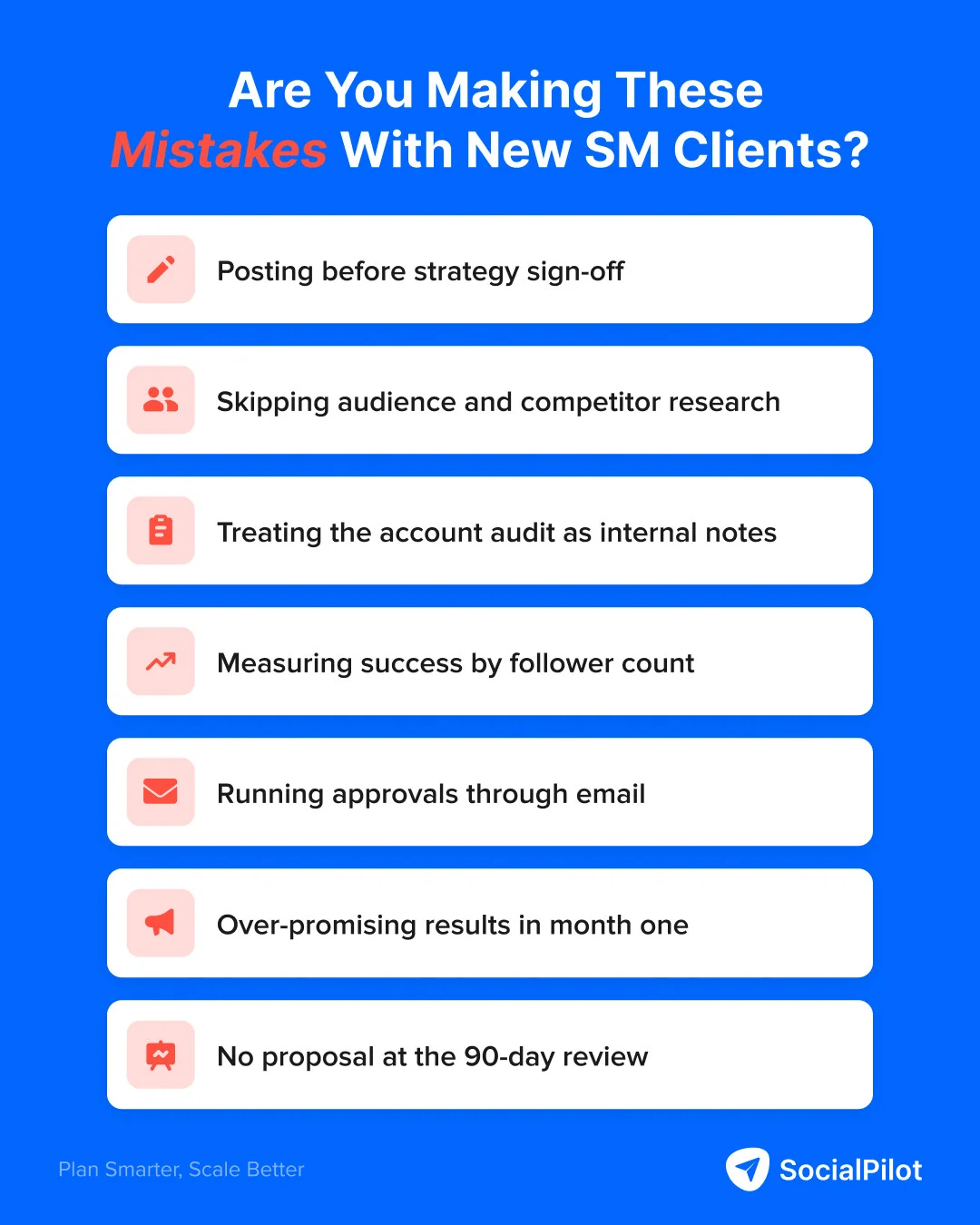
Starting to post before pillars are signed off. A verbal yes is not a sign-off. Three months of wrong content follows.
Skipping audience and competitor research. Content can look professional and still fail if it’s not built on understanding this specific audience.
Not treating the audit as a formal deliverable. No baseline means no proof of progress at any review conversation.
Setting KPIs around follower count. Report on reach, engagement rate, link clicks, and leads. Not vanity metrics.
Running approvals through email. Version confusion, missed deadlines, and no record of what was actually approved. How agencies handle draft management starts with getting the approval channel right.
Dropping The Research Cadence once content is flowing. Content stales within two batches. The cadence is not optional after month one.
Two clients in the same niche starting to sound identical. Each client needs a documented brand voice anchor before batch work begins.
Over-promising results in month one. Social media compounds over time. Set that expectation in week one, in the onboarding deck, before the first post goes live.
Treating the 90-day review as a metrics report. It’s the most important meeting of the first year. Walk in with an argument, not a deck.
Waiting until week 12 to book the 90-day review. Book it at the mid-point call in week eight. Scaling the approval process as you add more clients starts becoming relevant the moment this client renews.
Build It Once. Run It Forever.
The first 90 days are the only time you build this foundation from scratch. The audit you present, the pillars you sign off, the approval system you put in place, the communication rhythm you establish: these are not onboarding steps. They’re the architecture of a relationship that either holds or doesn’t.
When the 90-day presentation comes around, you can show a client exactly what you’ve learned about their audience, which content angles are moving the needle, and what the next quarter could look like. That’s not a retention conversation. That’s just the natural next step of a relationship that was built right.
Do this once, and you have a system. Do it for every client, and you have an agency that doesn’t lose clients quietly, months into an engagement, to problems that were visible in week two.
Every stage of these 90 days runs cleaner when it lives in one place. SocialPilot gives agencies the workspace to manage client approvals from week two, schedule content from week three, deliver branded reports from week seven, and stay organised across every account as the roster grows. See how it’s priced for agencies.





 Join 55,000+ social media managers


