

Don’t accept the idea that slow client approval workflows are a client problem. It’s the most natural conclusion available, and I’ve reached it myself on a Friday afternoon with a post sitting unanswered since Monday. It’s also the one conclusion guaranteeing nothing changes.
Here’s the version most agency people will recognize. You emailed a draft on Monday. You followed up on Thursday. You texted on Friday morning. Now it’s Sunday evening, you’re writing the third follow-up, and the post was supposed to go live yesterday.
The client isn’t the variable. We work with professional service firms, accountants, solicitors, charities, and the people signing off our content are running the business at the same time. I also sit on the other side of this. I handle the social media and PR for the Harrogate District Chamber of Commerce, so I’m sometimes the volunteer holding up somebody else’s schedule, and I can tell you the reason is almost never indifference.
The reason is the process.
Send a request with no deadline, make it awkward to answer, and attach no consequence to silence, and silence is the rational reply.
You’re not an outlier for losing time to this either. In Ziflow’s State of Creative Workflow report, run with the American Marketing Association, almost half of respondents (48%) said they spend at least five hours a month chasing feedback.
How Client Approval Workflows Invite the Chase
Think about the last approval you waited on. Did you send an email with a draft attached, a Slack message pointing at a Google Drive folder, or a WhatsApp message with a screenshot? I’ve sent all three, and each one fails in its own way.
Whichever it was, the answer to why you waited is sitting inside the question.
There are four ways a process invites the chase. They compound, and most agencies are running at least two at once.
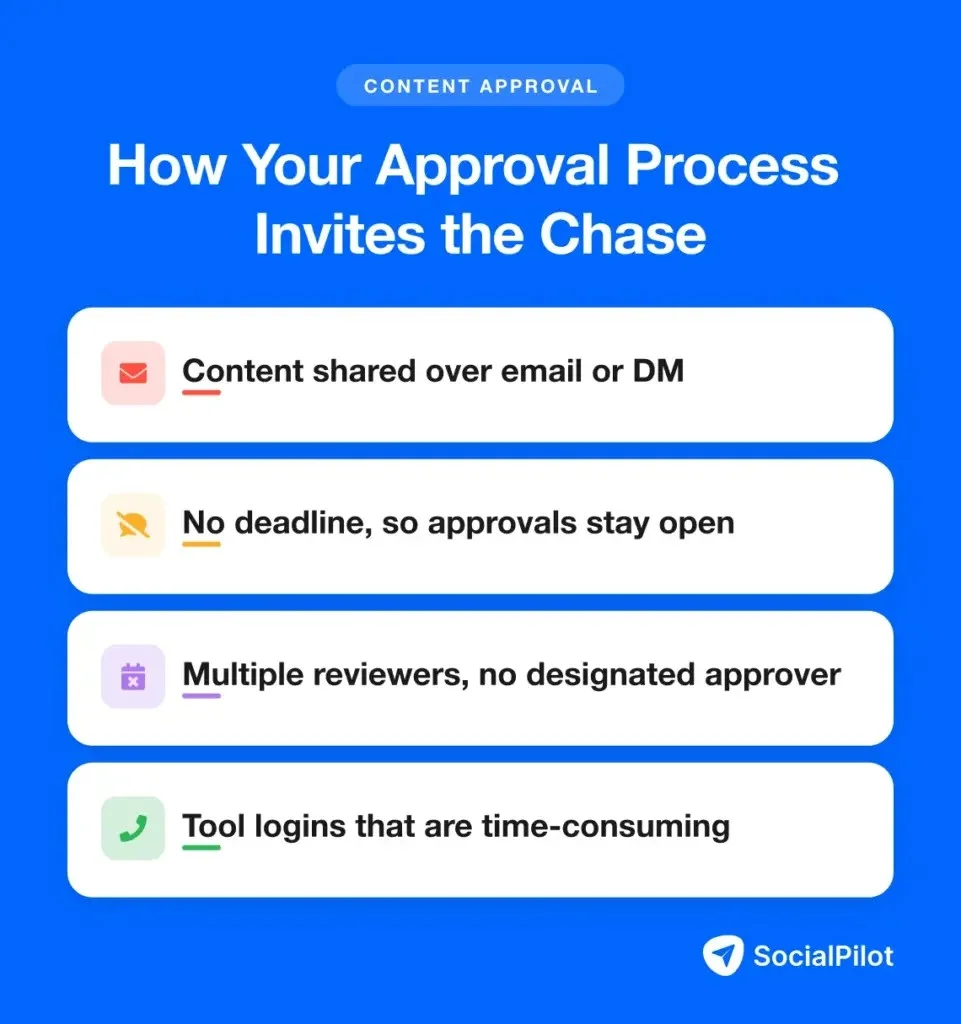
You draft the post and send it by email. The client replies in an old thread, giving feedback on the wrong version. Your designer updates the post and drops it in Slack. A colleague copied on the earlier email replies with another change. You schedule what you believe is the approved version.
I’ve watched this one cost more than the other three combined, because the failure stays invisible until it isn’t. Nobody knows the wrong version went out until the client spots it.
The cause is plain. There’s no single place where a post lives, gets reviewed, and gets approved. Feedback arrives on whatever channel the client happens to have open, and nobody writes down the final call.
When I compare notes with other agency owners, this is the one that comes up first, and it always comes up in the same two halves. Clients lose the request somewhere in their inbox, and nobody can say afterwards what was approved, when, or by whom. I’ve never heard those two complaints separately. They’re the same failure described from either end.
The five minutes I allow for an approval later in this piece is the clean version, where somebody answers. This is the other kind. Drafting the handoff message, following up on the silence, finding the reply in the wrong thread, reconciling the feedback, and confirming which version was actually signed off, all for one post.
Broken Process 2: No Deadline, So the Approval Stays Open Indefinitely
Send content for approval without a deadline and you’ve made a request, not set an expectation. I got this wrong for a long time, on the theory a deadline would feel pushy aimed at somebody paying us. It took me an embarrassing number of missed slots to work out I had the politeness backwards.
Here’s how it goes. The client answers four days later and expects your calendar to absorb it. The trend has passed. The launch has slipped. When you explain the slot has gone, it lands badly, because from where they’re sitting they did respond, and I’ve never once won that conversation.
You are not alone in this one. Content Marketing Institute’s 2025 B2B benchmarks found 33% of marketers naming workflow and content approvals as a challenge, down from 41% the year before. It is improving, slowly, and it is still one of the likeliest things to be standing between your work and the audience.
With no window, the client sets your schedule. A request without a deadline is one more item on a list, competing with tasks carrying actual consequences, and it will lose to all of them.
Broken Process 3: Multiple Stakeholders, No Designated Approver
We’ve watched this one assemble itself in slow motion. You add the marketing coordinator as approver. Then the founder wants to see everything. The office manager has thoughts on brand voice. Three people now receive the request and none of them believes they’re the one who ends it.
The coordinator sends edits. The founder sends different edits. The office manager flags something neither of them mentioned. You revise, resubmit, repeat.
What I hear from other agency owners is that the exhausting part was never the work. It’s the overhead around the work, and the version of it people describe most often is feedback arriving from more people than anyone invited.
This is the one I’d fix first if I could fix only one. It is the same failure that shows up when nobody owns a client account internally, just pointed outward.
When everybody can comment and nobody owns the decision, you’re not collecting feedback, you’re chairing a meeting.
And you’re the bottleneck, not the client, because you’re the person managing the group.
Broken Process 4: The Client Has to Log In to a Tool They Don’t Use
I’ve done this myself, and I suspect you have too. You set up an approval system and send the invite. They ignore it and text you instead. You process the approval informally to keep things moving, and the system you paid for quietly stops existing.
Clients don’t avoid your approval portal because they dislike it. They avoid it because it’s one more password for a site they open once a month. I’ve yet to hear a client say so out loud. They just keep texting.
The sharpest version of this I’ve heard from another agency owner is that approvals break the moment the client feels friction, and that the setups which survive are the plainest ones. One link, no login, an obvious approve button. Anything needing its own onboarding is already too slow.
The real cost isn’t the friction. It’s the missing record. When approvals happen over text, you have nothing to point at three weeks later when a client says they never signed off on a caption.
Why It Worked at 3 Clients and Breaks at 20
No single bad decision caused any of this. It drifted, which is why I’ve never met an agency owner who could name the week it broke.
Email and quick approval texts worked when we had three clients, and they worked well enough that nobody thought to change them. That’s the trap. Nothing gets changed while nothing seems broken.
Here’s the arithmetic. Every social media post needs approval before it goes live. Three posts per client each week across four channels is 12 approvals per client, per week. Thirty-six approvals across three clients is manageable. Two hundred and forty across 20 clients is not.
At roughly five minutes per approval, counting the request, the reminders, and confirming the right version:
| Clients | Approvals/week | Time per approval | Hours lost weekly | Hours lost monthly |
| 3 | 36 | 5 min | 3 hrs | 12 hrs |
| 10 | 120 | 5 min | 10 hrs | 40 hrs |
| 20 | 240 | 5 min | 20 hrs | 80 hrs |
At 20 clients, half the working week goes to managing approvals. Price that at $50 an hour and it’s $4,000 a month, near enough $48,000 a year, and that’s before the hidden cost of client approvals that never shows up on a timesheet at all. The loss isn’t slow clients. It’s a process with no capacity for the number of clients you now have.
This is why agencies at 15 to 20 clients don’t feel busy, they feel like they’re going under. The same threshold shows up elsewhere in the business, in content quality and in profit margin, which is usually the sign that the problem is structural rather than personal.
Where Do the Rules Actually Get Set?
Almost every fix below depends on something agreed before the first post goes out, and almost nobody agrees it. We didn’t, for a long time. I’d assumed the rules would settle themselves once everyone found a rhythm.
Approval rules get set at onboarding or they get set during an argument. There isn’t a third option.
Four weeks into a retainer, chasing a sign-off, asking for a named approver and a 48-hour window reads as a complaint about the client. Asked in week one, alongside brand guidelines and account access, the same question reads as a process.
I’ll be straight about the trade-off, because I’ve been on both sides of it. This conversation is mildly awkward with a new client who’s keen to get going. I’ve still never found it as awkward as the one in month three where you explain why a campaign post missed its date.
We put four questions into the onboarding conversation and we don’t start publishing until they’re answered.
- Who Signs Off. One name. Not a department, not a job title shared by three people.
- Who Covers Them. A named deputy, agreed in advance, for holidays and sick days.
- How Long They Have. Ours is 48 hours from the request landing.
- What Happens At the End of the Window. Publish, postpone, or flag. Decide it per content type before you need it.
The fourth is the one people skip, and it’s the one doing the work.
A deadline with no stated consequence isn’t a deadline.
Structural Fixes for These 4 Broken Client Approval Workflows
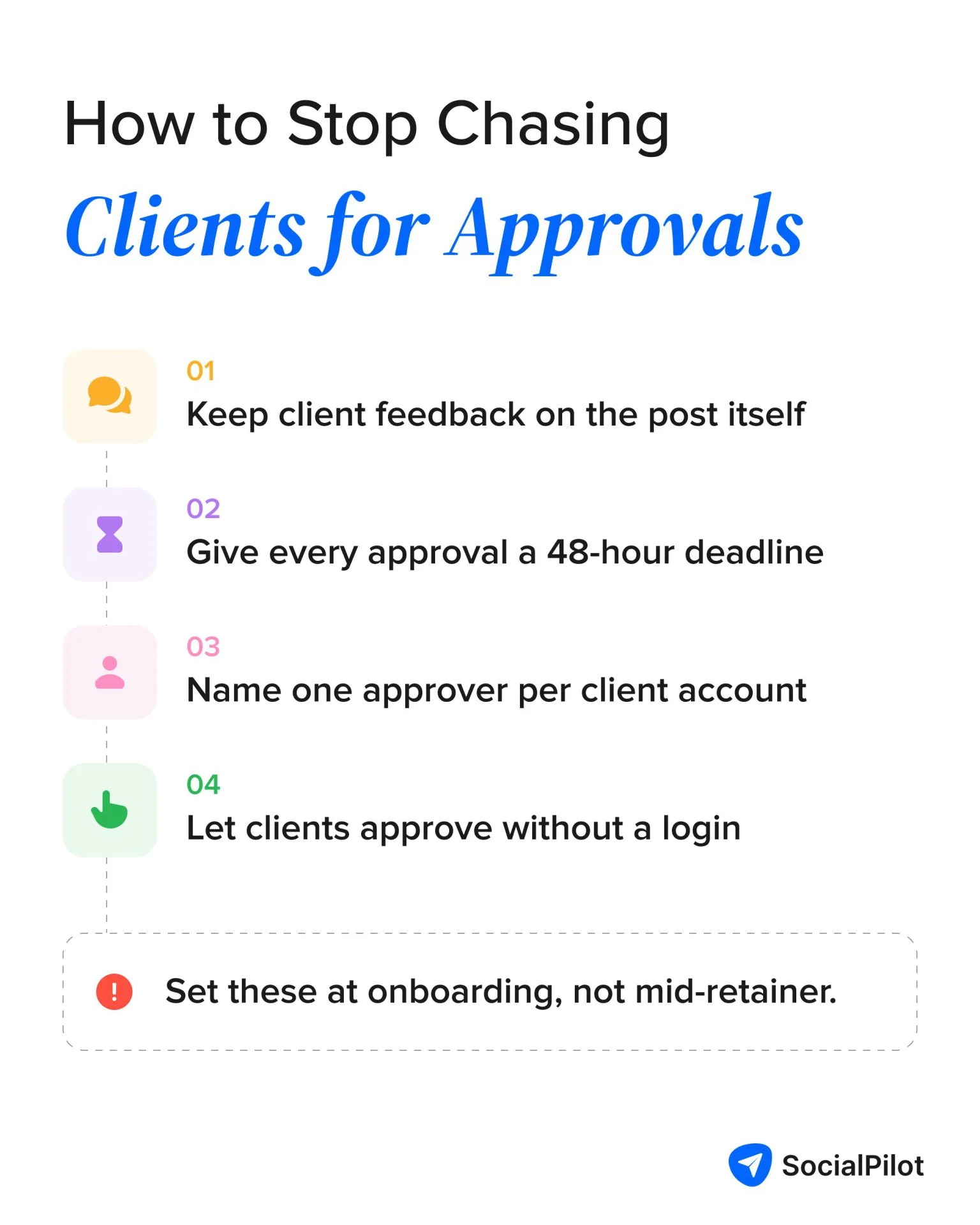
When approvals stall, the instinct is a more polite follow-up or a different channel. I’ve written that follow-up more times than I’d care to count.
Neither touches the cause. The polite follow-up is still a request with no deadline. The new channel adds one more place to lose the trail. The elaborate portal gets abandoned at the first login screen.
What works is making each failure structurally impossible. Before the list, one thing worth saying, because lists like this imply everything on them matters equally. They don’t.
Fixes two and three cost nothing but a conversation, and between them they’ll recover most of your time. Fixes one and four are what you buy software for. If your budget is zero this quarter, do three and two and stop reading.
Stop sending social media content out and collecting responses wherever they land. Every edit, question, and approval belongs with the post itself.
The way we heard it put, and it matched what we found, is that email approvals on versioned work descend into chaos, as pointed out by this user in r/Entrepreneur:
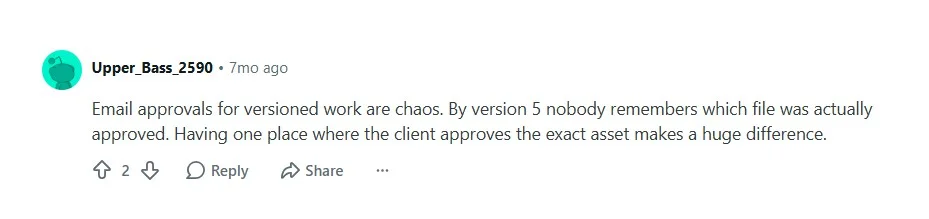
What we noticed after moving client comments onto the post inside SocialPilot wasn’t speed. It was the end of the “which version is this” conversation. The thread, the version history, and the final approved draft sit on one object, so nobody digs through email to work out what was signed off.
Whatever you run this on, check one thing above all others. Is the comment attached to the post, or merely near it? A comments tab beside a content calendar is not the same thing as feedback tied to a specific version of a specific post, and plenty of people buy the first believing they bought the second.
2. Set a 48-Hour Approval Window and Enforce It
Every request needs a deadline, and the deadline needs an ending. The version of this I keep hearing from other agency owners is that email was never built for approvals, and that what fixed it for them was dull and specific: a version number, one approval link, and a date. Like this user in r/Entrepreneur mentions:
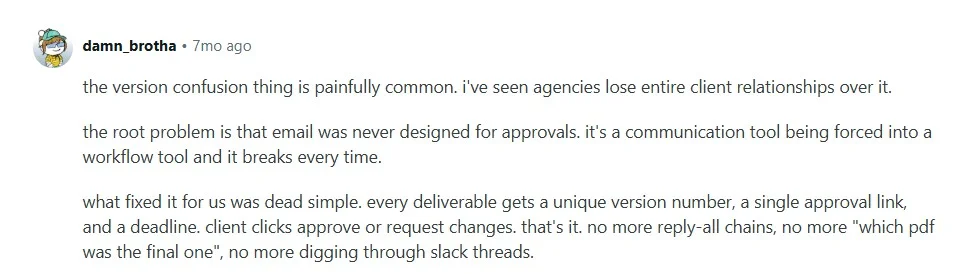
If the client hasn’t decided inside the window, the post publishes, postpones, or gets flagged, according to whatever you agreed at onboarding. That’s the entire mechanism.
An auto-approve setting does the enforcing so you don’t have to chase. Ours is a toggle on the client’s permissions, and with it on, a post still waiting on approval publishes one hour before its scheduled time.
That sounds alarming until you notice what it changes. Clients stop treating approval as optional once silence has an outcome.
I was against this setting when we first looked at it, because it sounded like publishing without permission. What changed my mind is where the permission comes from. It’s granted once at onboarding, not post by post.
I’d still put a limit on it. We turn it on only for content types where publishing unreviewed is genuinely safe, and anything carrying a claim, a price, or a third party’s name stays required.
3. Designate One Approver Per Account
One person with sign-off authority. Not a committee.
Others can comment. Only one person closes it. In our accounts this is what ended the dynamic where three people give conflicting feedback and none of them can say the word finished.
The objection I hear is the client won’t agree to it. In my experience they agree readily, because the committee isn’t serving them either. What they resist is being told who it should be. Let them pick.
4. Remove the Login Requirement Entirely
Approvals happen on text messages because the portal asks for a password.
Take the password away and the behavior changes on its own.
The clearest statement of this I’ve seen came from a freelancer in this r/SocialMediaManagers thread, who cared enough about the problem to go and build his own approval tool. What he landed on wasn’t a feature list. It was that the tool only works if it removes friction for the client, not just for you.
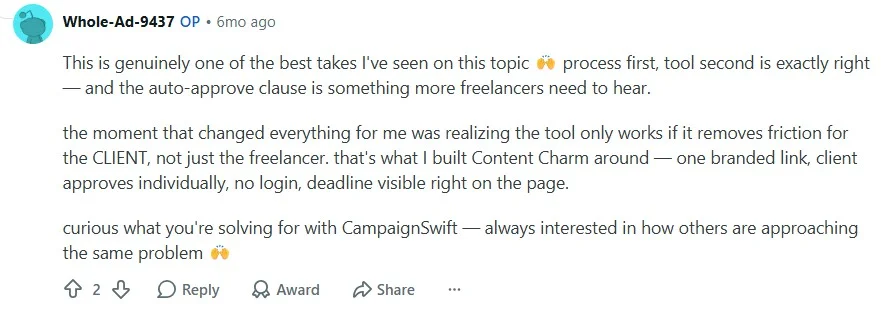
That’s the whole test, and most portals fail it. They remove friction for the agency and add it for the client.
We send each client a single branded link tied to their pending content, using SocialPilot’s Approvals On-The-Go. No account, no password on their side. They open it on a phone between meetings and approve, which is the same effort as answering the text, except this version leaves a record.
SocialPilot’s own walkthrough runs under two minutes and shows the client side of it, which is the part worth seeing.
If we had to cut back to a single paid feature, I’d protect this one. Everything else on the list can be held together by discipline. This one can’t.
Three things to check if you’re comparing options:
- Does the link work without an account?
- Does it produce a timestamped record you could show a client later?
- Does it survive being forwarded, because it will be forwarded?
What Replaces What
| What’s broken | Replace with | What changes |
| Email and DM sharing | Feedback tied directly to the post | No version drift, clear audit trail |
| No deadline | 48-hour window enforced by the system | The calendar stays yours |
| Multiple stakeholders | One designated approver, set at onboarding | One person, one mandate, one answer |
| Login-required portal | Emailed link, zero-login approval | Client approves from their phone, no account needed |
Two of those four need software doing the enforcing. Here’s how five widely used tools compare on the capabilities involved:
| Capability | SocialPilot | Planable | ContentStudio | Hootsuite | Buffer |
| Comments attached to the post itself | ✅ | ✅ | ✅ | ✅ | ✅ |
| Publishes automatically when the window closes | ✅ | ❌ | ⚠️ | ❌ | ❌ |
| One named approver per client account | ✅ | ✅ | ✅ | ✅ | ❌ |
| Client approves with no account and no password | ✅ | ⚠️ | ✅ | ❌ | ❌ |
Three of the five support both post-level commenting and no-login client approval, and all three let you assign a designated approver per client account.
Pricing models are worth checking before you shortlist, because they differ in a way mattering at agency scale. Some tools price per workspace or client account, so the cost tracks your client count as you grow. Others sell unlimited agency plans at a flat rate.
As of September 2026, SocialPilot’s Premium plan is $85 a month on annual billing and $100 month to month, and ContentStudio’s Agency Unlimited is $99 annually and $139 month to month. Neither model is wrong. Work out which one your growth curve favors, then compare on the same billing period, because the headline figures rarely are.
Where To Start If You’re Fixing This
What you do next depends on what you have to spend, so I’ve put it in that order.
With no budget at all, you can still fix half of it.
- Name one approver per client.
- Agree a window and a consequence.
Both are conversations rather than purchases, and between them they close the two failure modes doing the most damage.
With the free tools already on your desk, you can go a step further. A shared document per client, with a version number and a comment thread, is worse than a proper system and better than email. The condition is the part I’d hold people to: everybody has to accept the document is the only place feedback counts.
The threshold where paid software earns its place is easy to spot. When your weekly approval volume passes roughly a hundred social media posts, or when you can’t answer “who approved this, and when” without searching three apps, manual coordination has stopped being the cheaper option.
When you do compare tools, four questions cover it:
- Is the comment attached to the version, or just nearby?
- Can the client respond without an account?
- Does the system act on its own when the window closes, or does it only notify you?
- Does it produce a record you’d be comfortable putting in front of a client three weeks later?
We use SocialPilot for this, and I’ll say plainly why. The no-login approval link was the only change that altered what our clients did, rather than what we did. Everything else we changed made us faster at chasing. That one stopped the chasing.
Plenty of tools handle the rest well, so the shortlist matters less than people think. Pick the one your clients will actually open, which in my experience is rarely the one with the longest feature list.
The Only Part of This You Control
The chase feels like a client problem because the client is the one not responding.
The silence is the symptom. The process is the cause.
The process is also the only part of this you control, which is what makes it worth spending a Monday on. Everything above is a version of the same move, and I’d summarize it as deciding the thing in advance, in writing, with somebody’s name on it.
So if you take nothing else from this, take the conversation. One name and one deadline, agreed at onboarding, costs nothing, and it’s the piece we’d put first if we were building the agency again. It’s worth doing properly whatever you end up running it on.




 Join 55,000+ social media managers


