
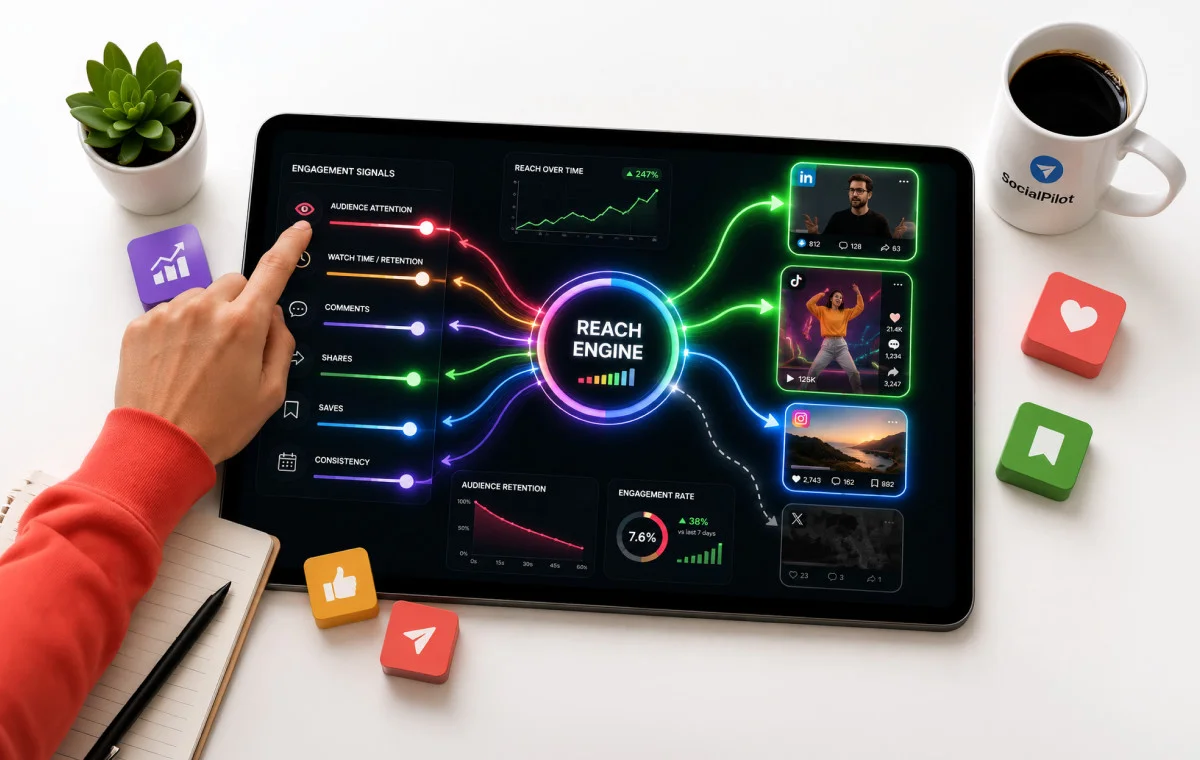
Learn how to navigate and beat social media algorithms in 2026 with platform-specific strategies, actionable tips, and AI-driven tools to boost visibility, engagement, and content performance across all major channels.
As of August 2026, social media algorithms are more intelligent and predictive than ever, determining what users see across their feeds based on relevance, engagement, and user behavior.
As a social media marketer, agency, or small business, understanding how these algorithms work is critical for increasing visibility and driving engagement. Algorithms no longer just rank content; they anticipate what will resonate with each user.
In this blog, we’ll dive deep into the latest algorithm updates across major platforms and provide actionable insights that will help you create strong social media marketing strategies and navigate new changes to stay ahead of the competition in a rapidly evolving social media landscape.
Key Takeaways:
- Social media algorithms in 2026 prioritize engagement, especially saves, shares, watch time, and meaningful interactions.
- Follower count matters less, as platforms now recommend content based on user interests and behavior.
- Original content gets rewarded, while reposted or low-value content sees lower reach.
- Each platform has different ranking signals, making platform-specific strategies essential.
- High-quality, engaging content is the key to improving reach and staying visible in 2026.
Every social media algorithm runs on the same three ideas. Learn these and you won’t need to memorize each platform’s signal list – the signals change often, but the principles don’t.
1. Engagement Signals
The algorithm predicts what you’ll engage with next by watching what you already do. But not every interaction counts the same.
The sub-signals that carry the most weight:
- Saves — the viewer wants to come back to it later.
- Shares and DM sends — the post was worth passing to a friend (the strongest signal on Meta apps).
- Watch time and completion — people stayed to the end.
- Comments — real back-and-forth, not one-word replies.
- Likes — still counted, but now the weakest of the group.
2. Content Personalization
Reach is matched to interests, not followers. A post shown to the right small audience beats a post shown to a big but uninterested one.
What decides the match:
- Topic fit between your post and what a viewer usually engages with.
- Early engagement velocity — how fast the post earns saves and shares in the first minutes.
- Look-alike behavior — people who act like your existing fans get shown your content.
3. Recency
Fresh posts get a look, but being recent alone won’t carry a weak post.
What recency depends on:
- Post age — newer content is surfaced first.
- Engagement speed right after you post.
- Your posting consistency — steady posting keeps you in rotation.
The signals that matter most are often the hardest to see. Platforms don’t publish their full ranking criteria, and the signals they do announce publicly are rarely their most powerful ones. Here’s what the data and engineering disclosures from 2025-2026 reveal:
- DM shares are now the highest-weighted engagement signal on Meta platforms. When someone sends your post to a friend via direct message, that signals the content was worth a personal recommendation. On Instagram, a single DM share is worth significantly more than a like in the distribution algorithm.
- The algorithm penalizes accounts that repost others’ content [source]. Instagram now uses an originality classifier to detect recycled content. If you consistently repost, your account gets suppressed from recommendations.
- Your engagement rate matters more than your engagement volume. 200 genuine interactions from a relevant audience moves more content than 2,000 passive likes from a disengaged one.
- Follower count is no longer a reliable proxy for reach. LinkedIn, TikTok, Instagram, and Facebook all shifted in 2025-2026 toward interest-graph distribution, meaning your content can reach people who’ve never followed you, and can be suppressed for people who have.
Here are the confirmed algorithm changes, organized by month with the newest first. The last three months (June, May, April 2026) cover every confirmed change, even small ones, broken out by platform. Earlier months list the major shifts only. Updated for June 2026.
August 2026: No Significant Algorithm Updates
No confirmed ranking or distribution mechanic changes were detected across the major platforms (Instagram, Facebook, LinkedIn, TikTok, X, YouTube, Pinterest, and Threads) for August 2026 as of August 7, 2026. This entry confirms the article was reviewed for the current month.
X Prioritizes Posts and Replies From Mutuals
On July 13, 2026, X updated its For You ranking to give more weight to mutuals—accounts you follow that also follow you back. Posts and replies from mutuals can now rank above those from strangers, even when the latter have higher engagement. According to Head of Product Nikita Bier, this signal was previously missing from the ranking system.
What this means for you: Focus on building genuine two-way relationships. Replies, follow-backs, and regular interactions with peers and customers can improve your visibility within your niche.
Source: TechCrunch X’s Mutual Content
TikTok: EU Challenges TikTok’s For You Recommendations for Teen Accounts
On July 24, 2026, the European Commission issued preliminary findings that TikTok’s For You feed recommends content from 16–17-year-old users to strangers, which it says may violate the Digital Services Act. The Commission has proposed limiting recommendations of minors’ content to connected users only, but no final decision or platform change has been implemented yet.
What this means for you: If you manage accounts for teen creators or under-18 audiences in the EU, prepare for potential reductions in non-follower reach if TikTok adopts the proposed changes.
Source: EU Commission
Instagram switched on “Your Algorithm” for everyone who uses the app in English. People can now open Feed, Reels, or Explore, see the exact topics shaping their recommendations, and add or mute topics by hand. Those choices feed straight into what they get shown next, so your audience is partly telling Instagram what to send them, as About Instagram explains.
What this means for you: Pick one clear topic and stick to it. When your posts match a topic someone asked to see more of, you land in their feed.
Facebook now checks who posted a video first. It fingerprints each clip, and if your Page mostly reposts other people’s content, your reach in recommendations falls. Posts inside active Groups still get a boost because Facebook treats Groups as high-intent spaces, per Social Media Examiner.
What this means for you: Post video you actually made and be the first to post it. If you run a Page, build an active Group next to it for extra reach.
TikTok
Oracle is still rebuilding TikTok’s US recommendation system on US-only data, and that work runs through mid-2026. While it retrains, the For You feed keeps shifting, so reach that worked last month may not hold this month, as CNBC reports.
What this means for you: Check your own TikTok analytics every week and adjust. Don’t trust old reach benchmarks while the model is still changing.
Other major platforms had no confirmed ranking changes in June month.
TikTok
After the US ownership deal closed in January, Oracle kept retraining TikTok’s US recommendation algorithm on US-only data, and by late May the new model was actively reshaping the US For You feed. The retrain also drew Senate questions about data safeguards. This is based on news reporting, with the work ongoing through mid-2026, per U.S. News.
What this means for you: Treat your US reach as a moving target right now. Re-test formats and posting times instead of assuming what worked before 2026 still works.
April 2026: Instagram Stops Recommending Aggregator Content
On April 30, 2026, Instagram confirmed it will no longer recommend photos and carousels from aggregator accounts in Explore and other discovery spots. If most of your posts over a rolling 30-day window are reposts, Instagram labels you an aggregator and stops showing your posts to non-followers. Your existing followers still see your content as normal, per Social Media Today.
What this means for you: Post content you made yourself. Original photos, carousels, and how-to series still count, but reposting cuts your reach to new audiences in Explore.
March 2026: LinkedIn Rebuilds Feed Ranking with an LLM-Based Interest Graph
On March 12, 2026, LinkedIn replaced five separate ranking systems with one model built on a large language model. It reads what your post is actually about and shows it to people interested in that topic, instead of leaning on who you’re connected to. Breaking-industry posts now surface within minutes, while engagement bait, recycled “thought leadership,” and misleading video-plus-text posts get pushed down, per LinkedIn Engineering.
What this means for you: Post from your personal profile, and keep your headline, bio, and topics consistent so the model files you under the right subject. Write for saves and three-sentence-plus comments, not likes.
X Updates
On January 20, 2026, X published its For You ranking code and confirmed the old recommendation system was replaced by a Grok-based model. The model now learns what’s relevant straight from how people engage, with no hand-tuned rules, and X says it will post public algorithm updates every four weeks, per TechCrunch.
What this means for you: On X, an AI model now reads engagement patterns to rank posts. Stay on a clear topic and earn quick early replies and reposts, because the model uses those first signals to decide how far your post travels.
TikTok Update
The TikTok US joint venture closed on January 22, 2026. Under the deal, Oracle received a licensed copy of the recommendation algorithm and began retraining and running it on US-only user data inside its US cloud. The US For You feed started shifting to this US-only model right away, per CNBC.
What this means for you: Expect US distribution to be driven by a US-only data model. Re-test what works for your US audience rather than assuming pre-2026 reach patterns still hold.
December 2025: Meta and YouTube Shift to Interest-Graph, Original-First Distribution
Several big changes landed together at the end of 2025.
Instagram fully turned on its originality classifier, cutting accounts with 10 or more reposts in 30 days out of recommendations.
More than 40% of Feed posts started coming from accounts users don’t follow, chosen by Meta’s AI rather than your friend list.
YouTube
YouTube split the Shorts recommendation engine off from long-form, so how your Shorts do no longer helps or hurts your long-form videos.
TikTok
TikTok moved to follower-first distribution and raised the completion-rate bar for wider reach to roughly 70%.
What this means for you: On every major platform, reach is earned through good content and fast early engagement, not follower count. Make original posts, hook people in the first few seconds, and create content worth saving or sending to a friend.
All social media platforms have algorithms that comprise various ranking signals. You can never determine all these ranking signals, but you can surely mold your content strategy to win your share of visibility on social media.
Here are some platform-specific ranking signals to keep in mind for every social media platform.
1. Facebook Algorithm
Facebook is the leading social media platform, with 2.28 billion users around the world. With that number, it is crucial for brands and marketers to win the Facebook algorithm and reach a wider audience.
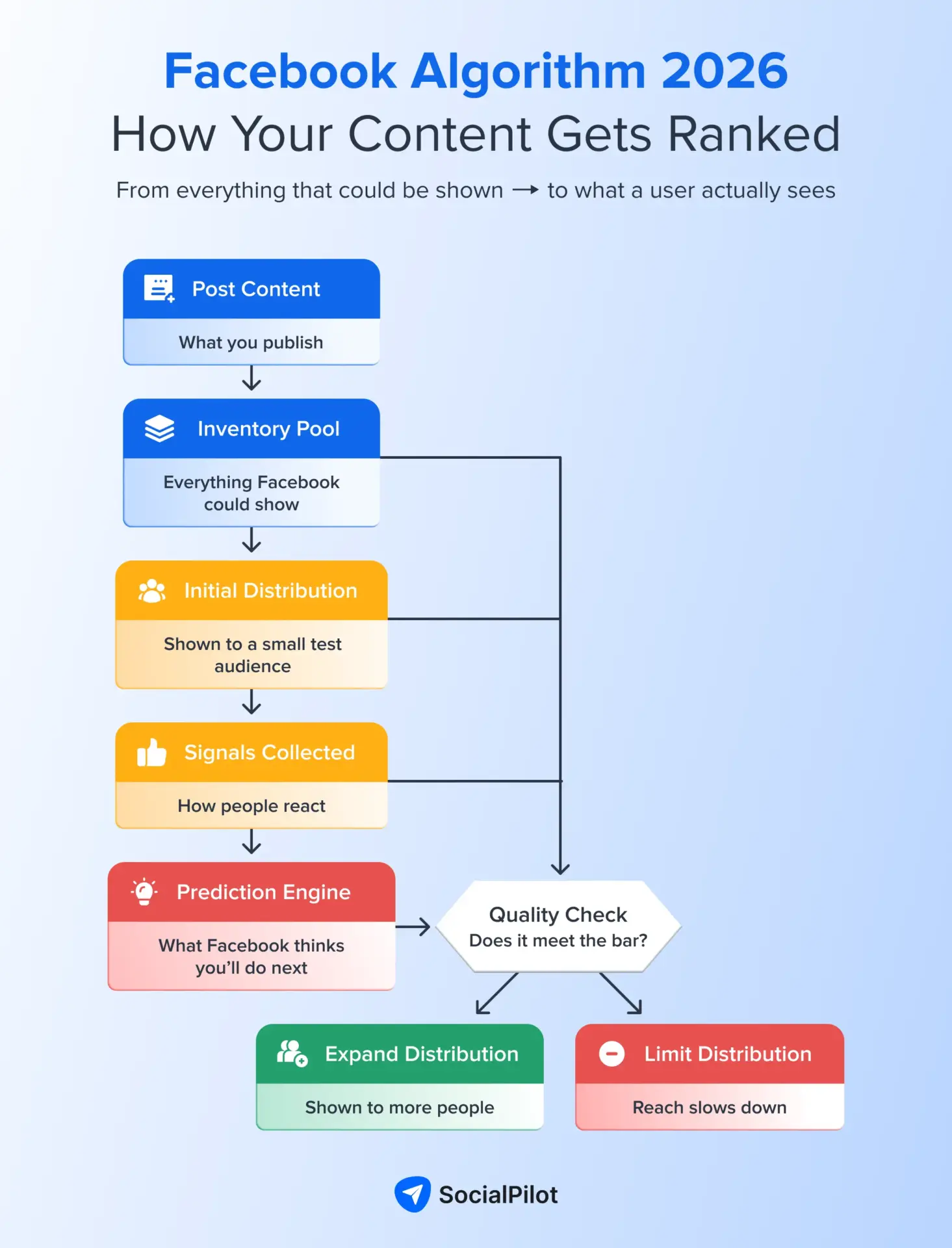
So, here are some ranking signals to take into account while creating your marketing strategies:
- Friends and Followers: Facebook prioritizes content from users’ friends and followed pages.
- Engagement: Posts with high engagement (likes, shares, comments) get boosted, signaling popularity.
- Content Type: The algorithm promotes content types you interact with most (e.g., Reels or videos).
- Content Quality: Authentic, informative content is favored. Meta uses fact-checkers to downgrade posts with false information.
- Location and Language: Facebook personalizes feeds based on your region, displaying local content or trending topics relevant to your area.
- AI Recommendations: As of late 2025, over 40% of Facebook Feed posts come from accounts users have never followed, recommended purely by Meta’s AI based on interest signals. This means your content can reach entirely new audiences without paid promotion, but only if it earns strong early engagement: saves, shares, and watch completion.
To learn more about how Facebook prioritizes content on users’ feeds, check out our detailed guide on the Facebook Algorithm that helps you optimize your posts.
2. YouTube Algorithm
YouTube is capable of keeping its users hooked for hours, thanks to its ranking signals, which are as follows:
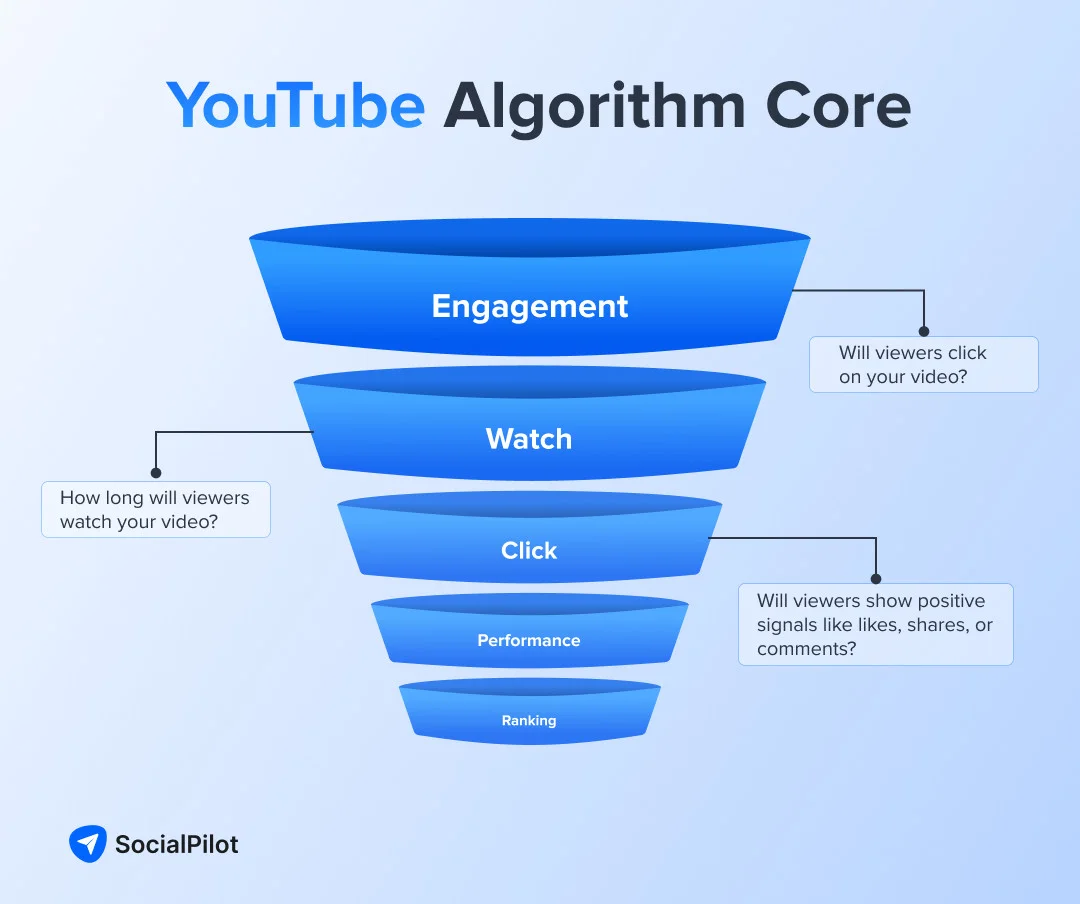
Important Factors:
- Watch History: YouTube algorithm recommends videos based on your past views, tailoring suggestions to your interests.
- Video Performance: Content with high likes, views, and click-through rates gets prioritized.
- Context: YouTube also promotes videos that are often watched together or related to the current video.
- Watch Hours: Longer watch time boosts video ranking. The more time viewers spend watching your video, the higher its chances of ranking.
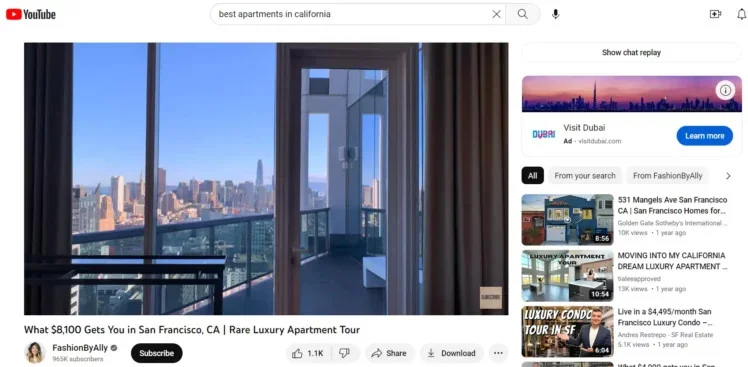
- Shorts vs. Long-Form: As of late 2025, YouTube runs separate recommendation engines for Shorts and long-form content. Shorts are ranked on swipe-through rate, loop rate, and early shares. Long-form is ranked on watch time, CTR, and audience retention. Performance in one format no longer affects distribution in the other.
AI-Driven Personalization:
YouTube uses AI to deliver personalized recommendations based on experience, expertise, trustworthiness, and authoritativeness.
The platform also actively filters out misleading content and promotes authoritative, credible videos, ensuring users see content they can trust.
3. Instagram Algorithm
Instagram no longer uses a single algorithm. The platform runs separate AI-powered ranking systems for Feed, Stories, Reels, and Explore, each with its own signals and logic.
Instagram Feed and Stories
The Feed and Stories prioritize content from accounts you follow, alongside suggestions based on your activity.
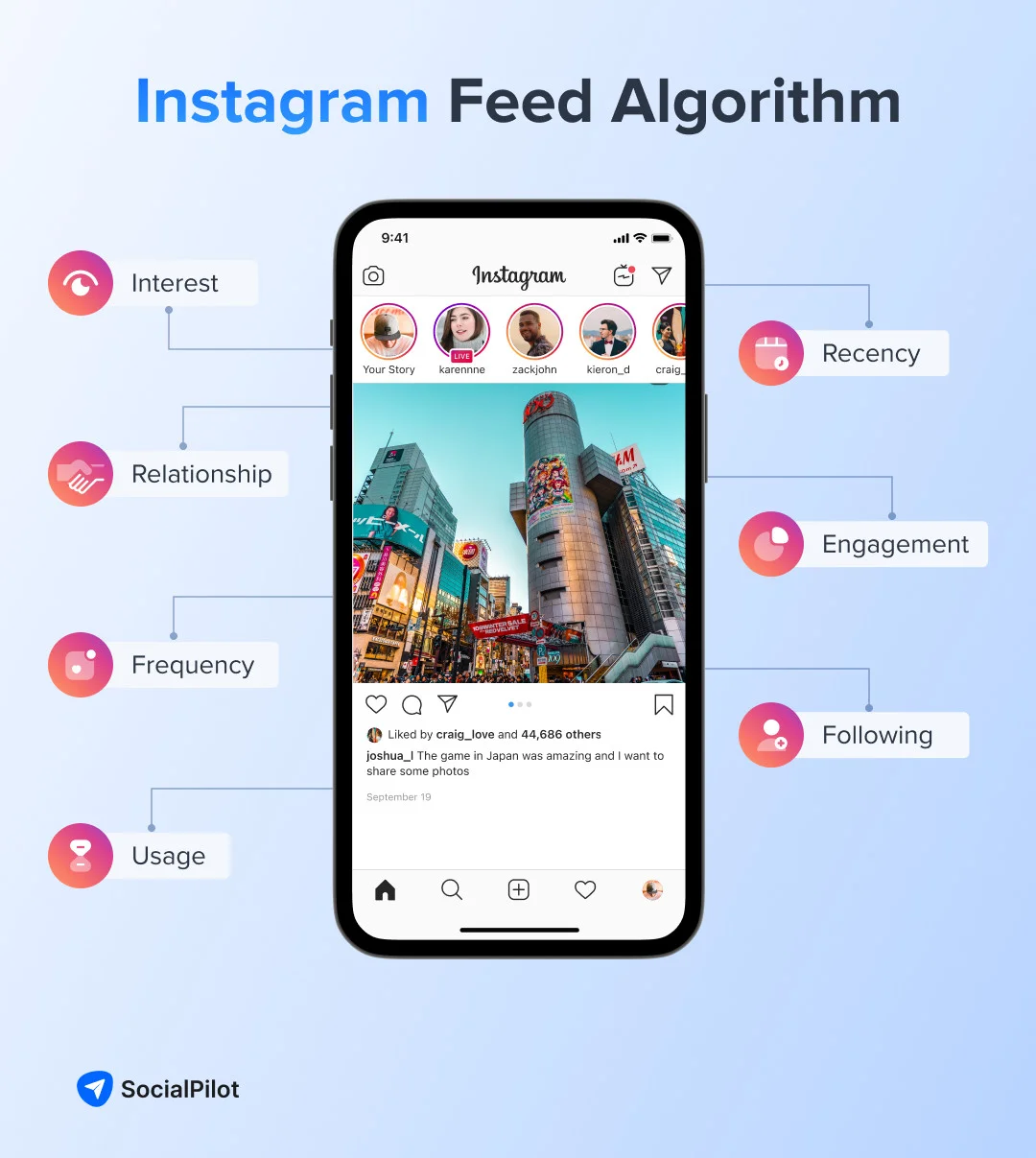
The Instagram algorithm plays a significant role here by ranking content based on various factors. These ranking factors include:
Feed Factors:
- Your Activity: The more you engage with specific accounts, the more likely similar content will appear.
- Post Information: The number of likes, shares, comments, and the post’s timing play a role in visibility.
- Profile Info: How frequently you engage with a profile influences its content ranking.
- DM Shares: Since late 2025, sending a post to a friend via DM is the highest-weighted engagement signal on Instagram. It signals to the algorithm that your content was worth a personal recommendation.
- Originality: Instagram now applies an originality classifier to all content. Original posts receive significantly more distribution than reposts. Accounts that post 10 or more reposts within 30 days are excluded from Explore and Reels recommendations entirely.
Instagram Explore
The Explore section offers new content recommendations based on your recent activity, what you’ve liked, commented on, and engaged with.
Example: If you like content from creator @XYZ, Instagram will suggest content from creator @ABC, especially if other users who liked @XYZ’s content also engaged with @ABC.
Instagram Reels
Reels is all about entertainment. The Instagram Reels algorithm ranks Reels based on:
- Whether you watch them to the end
- Whether you engage (like, comment, share)
- Whether you visit the audio page, indicating that you may create your own Reel
- Whether you send the Reel to someone via DM, the highest-weighted signal since late 2025
Reels also prioritize smaller creators, making it easier for them to gain visibility.
4. Twitter/X Algorithm
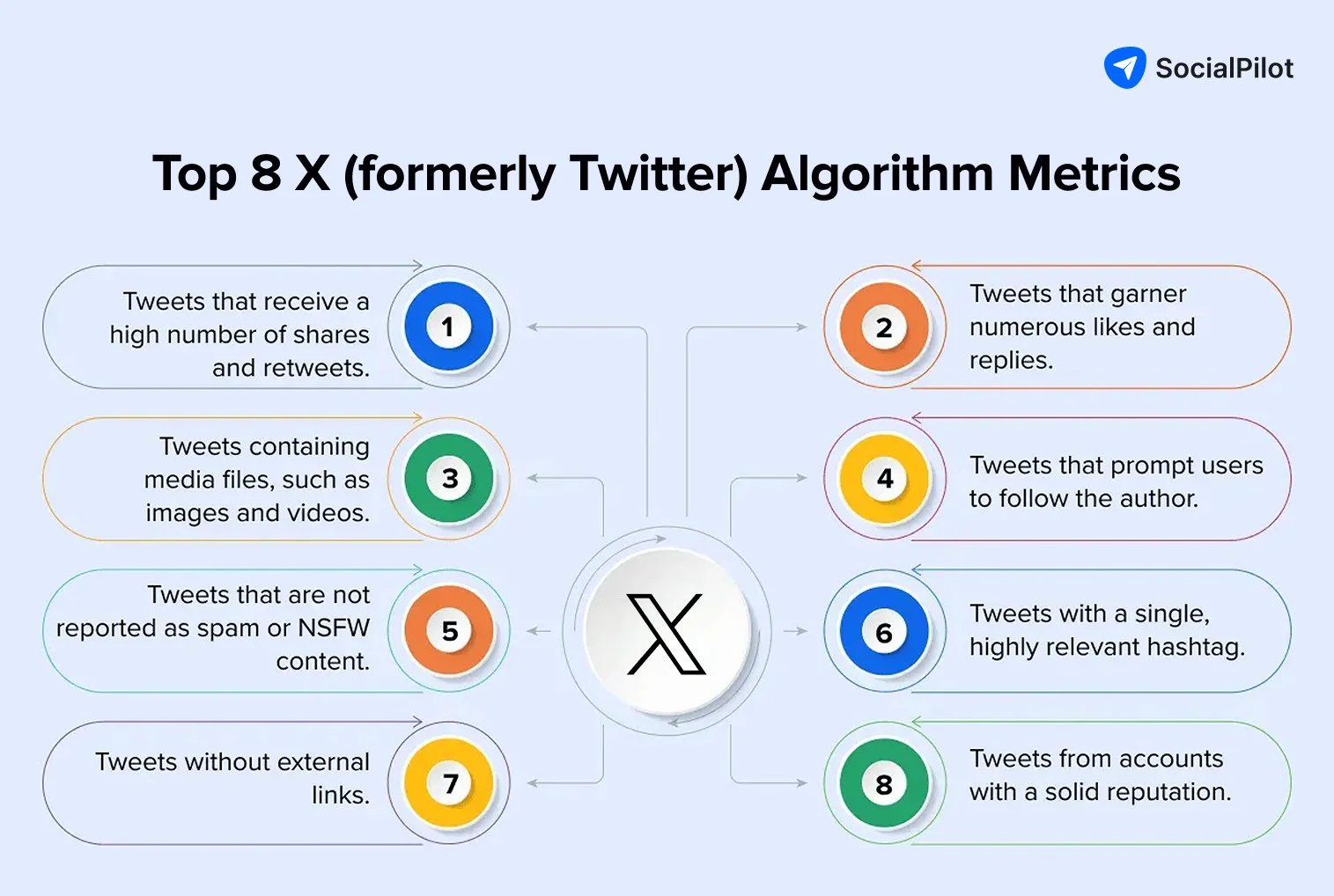
Twitter’s algorithm uses several ranking signals to rank content on its platform. These ranking signals include:
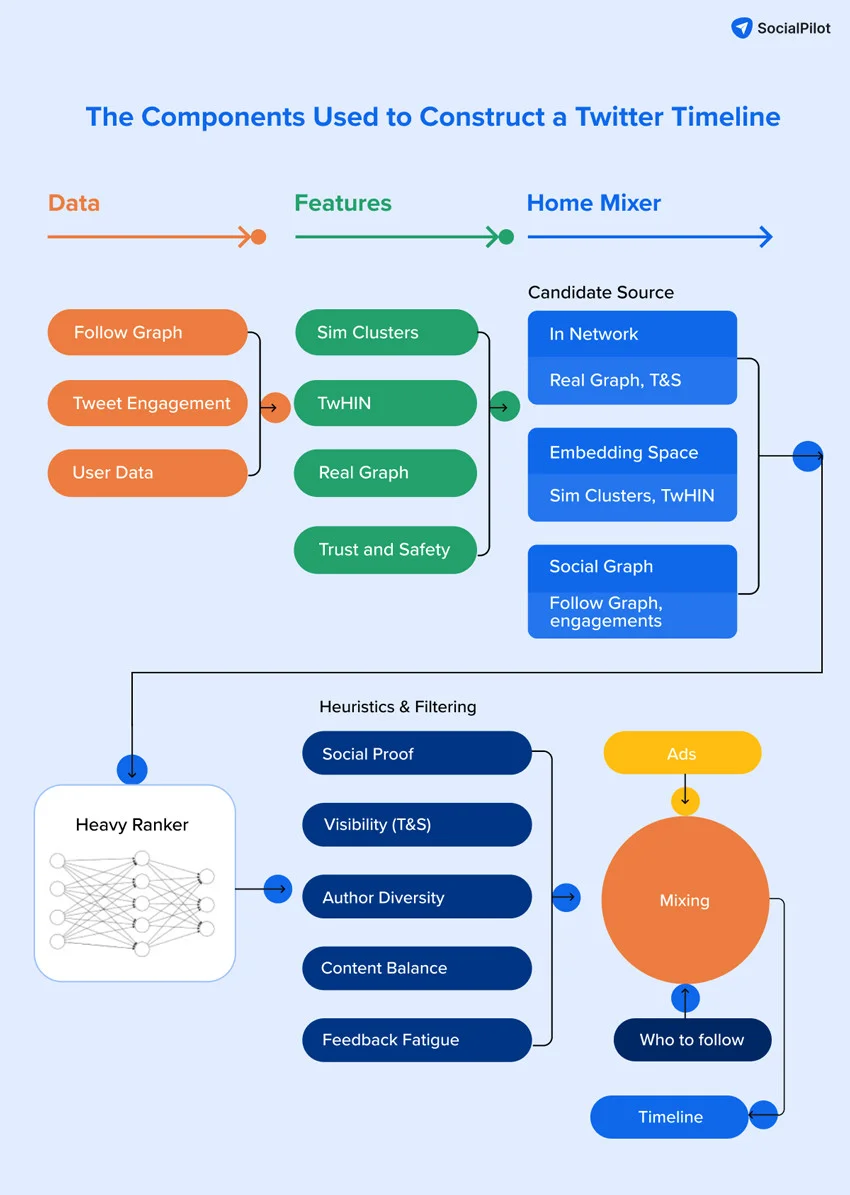
- User interactions: It includes accounts and the tweets you frequently engage with.
- Recent topics: Twitter also gives preference to recent topics that make it to the “What’s Happening” sections. On the other hand, location affects what shows up in trends.
- Popularity: Twitter also considers the current popularity of a topic, trend, or tweet, including the level of engagement and activity from users in your network.
- Recency: Twitter’s algorithm also emphasizes recency when determining which tweets to show in a user’s timeline. As a general rule, Twitter prioritizes recent tweets in a user’s timeline, with newer tweets appearing higher up and pushing older tweets down.
- Grok-Based Ranking: Since January 2026, X’s For You feed runs on a Grok-based transformer that learns relevance from your engagement patterns instead of hand-tuned rules. Post on clear topics and earn fast early engagement to signal relevance.
5. LinkedIn Algorithm
LinkedIn’s algorithm was rebuilt in early 2026. The new system uses a large language model to read content semantically and match it to users based on topic interest, not just professional connections.
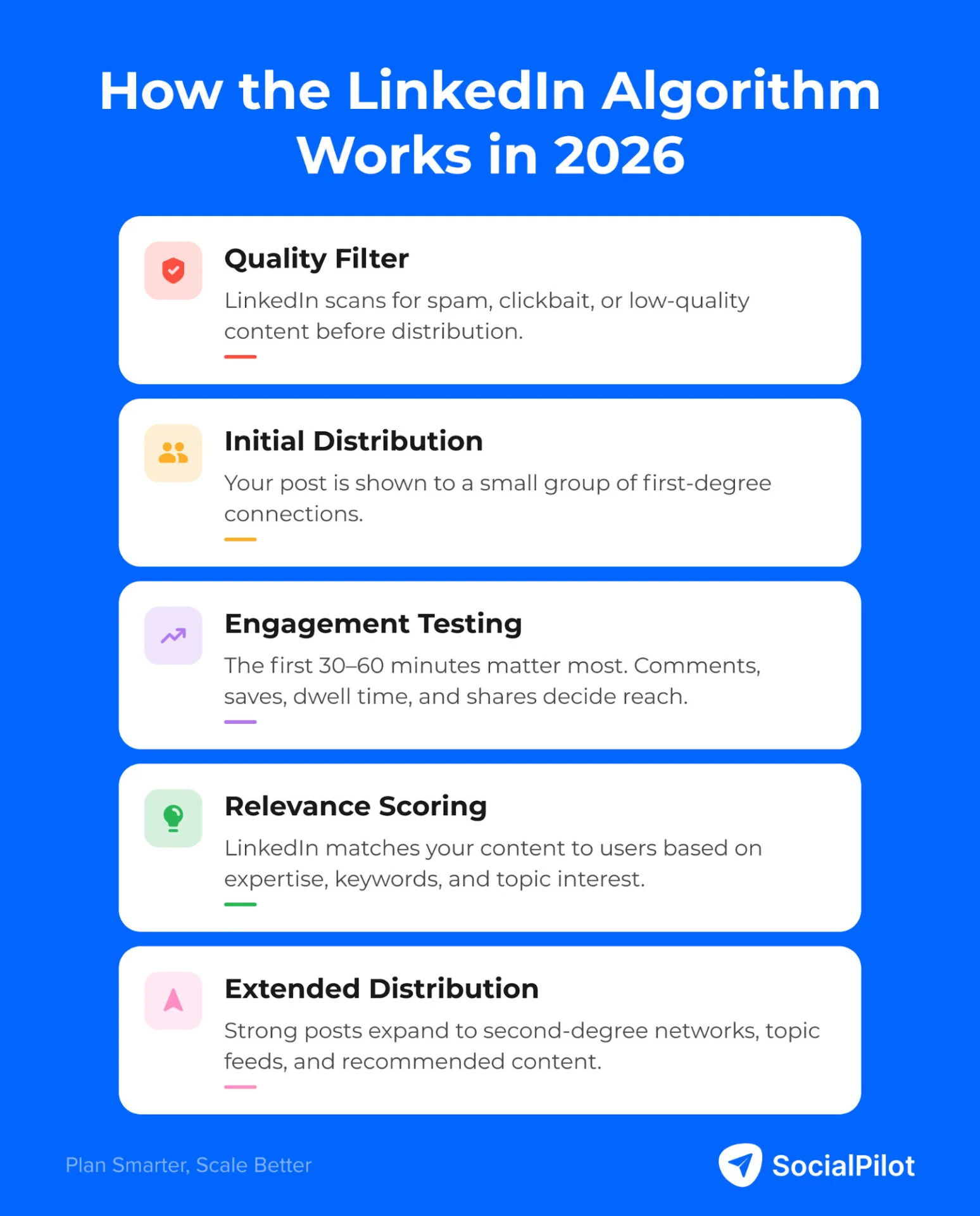
Here are the current LinkedIn ranking signals:
- Topic-Interest Match: The LLM-based system categorizes your content by topic and surfaces it to users interested in that topic, regardless of whether they follow you. Your profile headline, bio, and content must align to the same topic for maximum distribution.
- Saves: The strongest engagement signal since the March 2026 rebuild. A save carries 5x the algorithmic weight of a like.
- Substantive Comments: Comments of three or more sentences carry 8-15x the weight of a reaction. Short comments carry almost no weight.
- Early Velocity: Approximately 70% of a post’s total reach is determined in the first 90 minutes. Posts that get quick, quality engagement get pushed to broader audiences.
- Personal Profile vs. Company Page: Personal profiles now account for an estimated 65% of feed allocation; company pages account for roughly 5%.
6. TikTok Algorithm
TikTok’s algorithm changed significantly in late 2025. Key ranking signals now include:
- Video Information: TikTok ranks videos based on metadata like hashtags, captions, sounds, and effects to understand content type and relevance for the “For You” page.
- Past Interactions: The algorithm analyzes user behavior such as likes, shares, comments, and follows to tailor content to individual preferences.
- Account and Device Indicators: Factors like device type, language, country, and content categories help TikTok optimize your feed.
- Geographic Relevance: TikTok considers location and trends (e.g., local challenges or sounds) to show more regionally relevant content.
- Follower-First Distribution: Since late 2025, new videos are first shown to your existing followers, not a random pool of interest-matched strangers. If followers complete, share, or save the video, TikTok distributes it to a broader audience. Follower engagement quality is now a gateway to wider reach.
- Completion Rate: The threshold for broader distribution has moved to approximately 70%, up from around 50% in 2024. Shares and saves outweigh likes in the ranking hierarchy.
7. Pinterest Algorithm
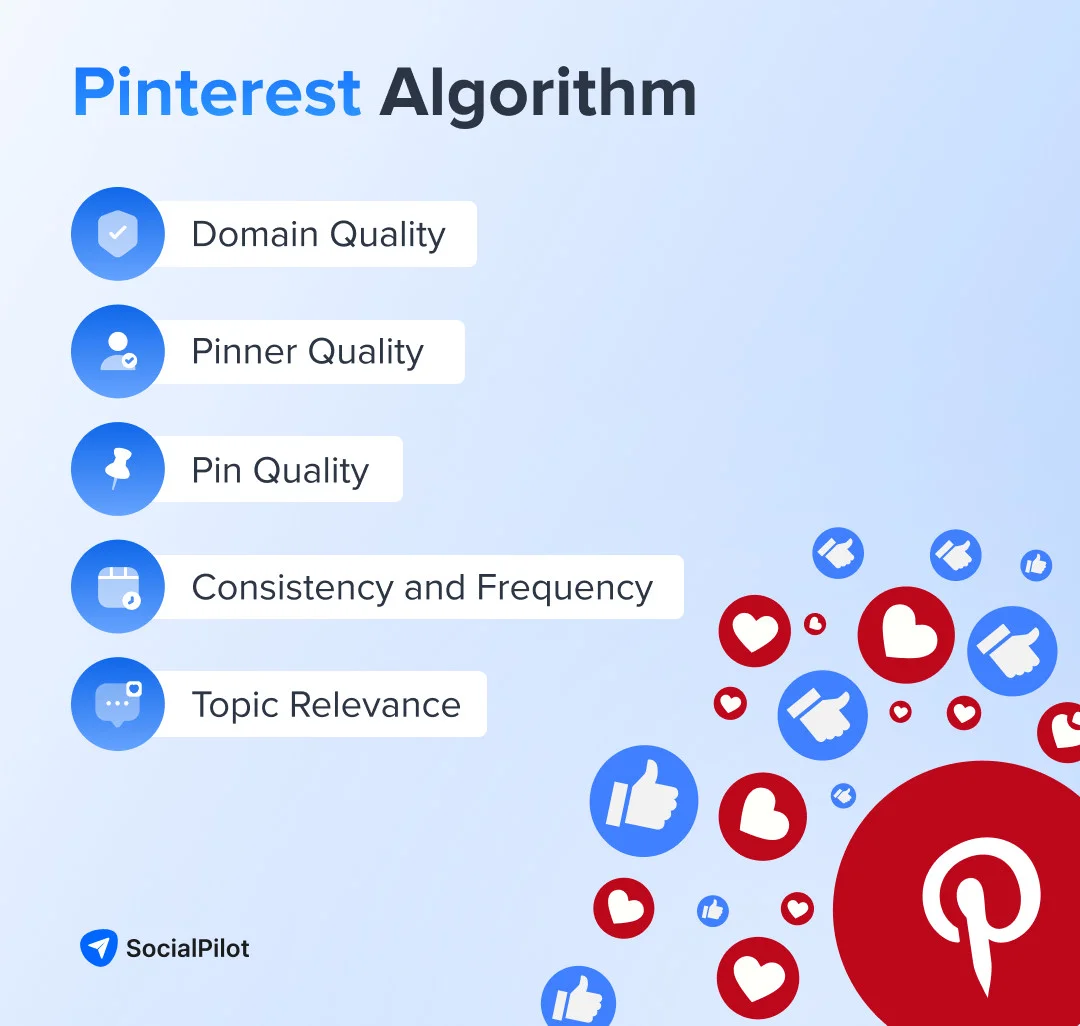
Pinterest works a tad differently than other platforms in terms of algorithms and focuses on these major ranking signals:
- Domain Quality: Prioritizes content linked to reputable websites, with popular websites gaining higher visibility.
- Pin Quality: Visual appeal and informativeness of pins play a crucial role in engagement.
- Pinner Quality: Active pinners with high-quality, engaging content rank better.
- Consistency and Frequency: Regular pinning boosts visibility and engagement.
- Topic Relevance: Pins that match user interests and search queries perform better.
8. Thread Algorithm
The thread algorithm is designed to show content that will interest users. This algorithm system is powered by artificial intelligence and uses AI ranking signals. Being a part of Meta and Instagram, every piece of content on the Threads App must follow the Instagram community guidelines.
The Threads algorithm adheres to several ranking signals, such as:
- User Control and Intentions: On Thread, the user’s experience is backed by the content they are interested in and are more likely to engage with. Their preferences are constantly analyzed based on the content they interact with and what preferences they have set in the application settings.
- Author’s Instagram Profile: Engagement and presence on the Instagram App also count when the Thread algorithm pushes your content to audiences.
- Post Performance: When the Thread algorithm pushes your content to your followers, it reads their response, and based on the feedback and engagement, it pushes it to a wider audience; thus, your post’s popularity and performance matter on Thread.
Mastering Algorithms for Long-Term Success
To succeed on social media in 2026, mastering algorithms is key. Focus on creating high-quality content, boosting engagement, posting at the right times, and staying on top of trends. Experiment with formats and refine your strategy based on performance metrics.
As of August 2026, the direction is clear across every platform: interest-graph distribution, original-content priority, and AI-driven recommendations decide who sees your posts, not your follower count.
Tools like SocialPilot make it easier to manage your social media, offering AI-driven posting times and detailed social media analytics to keep you ahead of algorithm changes.
Ready to elevate your strategy? Check out SocialPilot’s plans and find the perfect one for you.



 Join 55,000+ social media managers


