


Twitter Spaces can be a great way to connect with your audience, answer their questions, and build a community around your brand.
But if you’ve never hosted one before, figuring out where to start can be a little confusing. Twitter is now X, the interface has changed, and many older tutorials no longer match what you see in the app.
So, how do you start a Space, invite speakers, or get more people to join the conversation? And how can you make these live audio sessions useful for your business?
This guide covers it all. We’ll walk you through how to use Twitter Spaces (now X Spaces), from hosting and scheduling your first session to managing speakers and finding practical ways to use Spaces for your business.
What Is Twitter Spaces (X Spaces)?
Twitter Spaces, now called X Spaces, is X’s live audio room. A host opens a public conversation, up to 13 people can speak at once, and there’s no limit on how many people listen (X Help Center).
So how do Twitter Spaces work? Think of a live podcast with the door left open: the host decides who gets a mic, and listeners drop in and out as they like.
You don’t need a big following to host one, either. X’s help page lists no follower minimum for starting a Space.
Do Twitter Spaces Still Exist?
Yes. X’s help page describes Spaces as a working feature: anyone can join, listen and speak in a Space on X for iOS and Android, and you can listen in a Space on the web (X Help Center).
Only the name has changed. Plenty of people still search for “Twitter Spaces”, while X now calls it X Spaces. The doubt is fair. Twitter became X, the menus moved, and older guides still point to screens that are gone.
X Spaces App vs Web: Where You Can Host and Join
This table clears up most of the confusion:
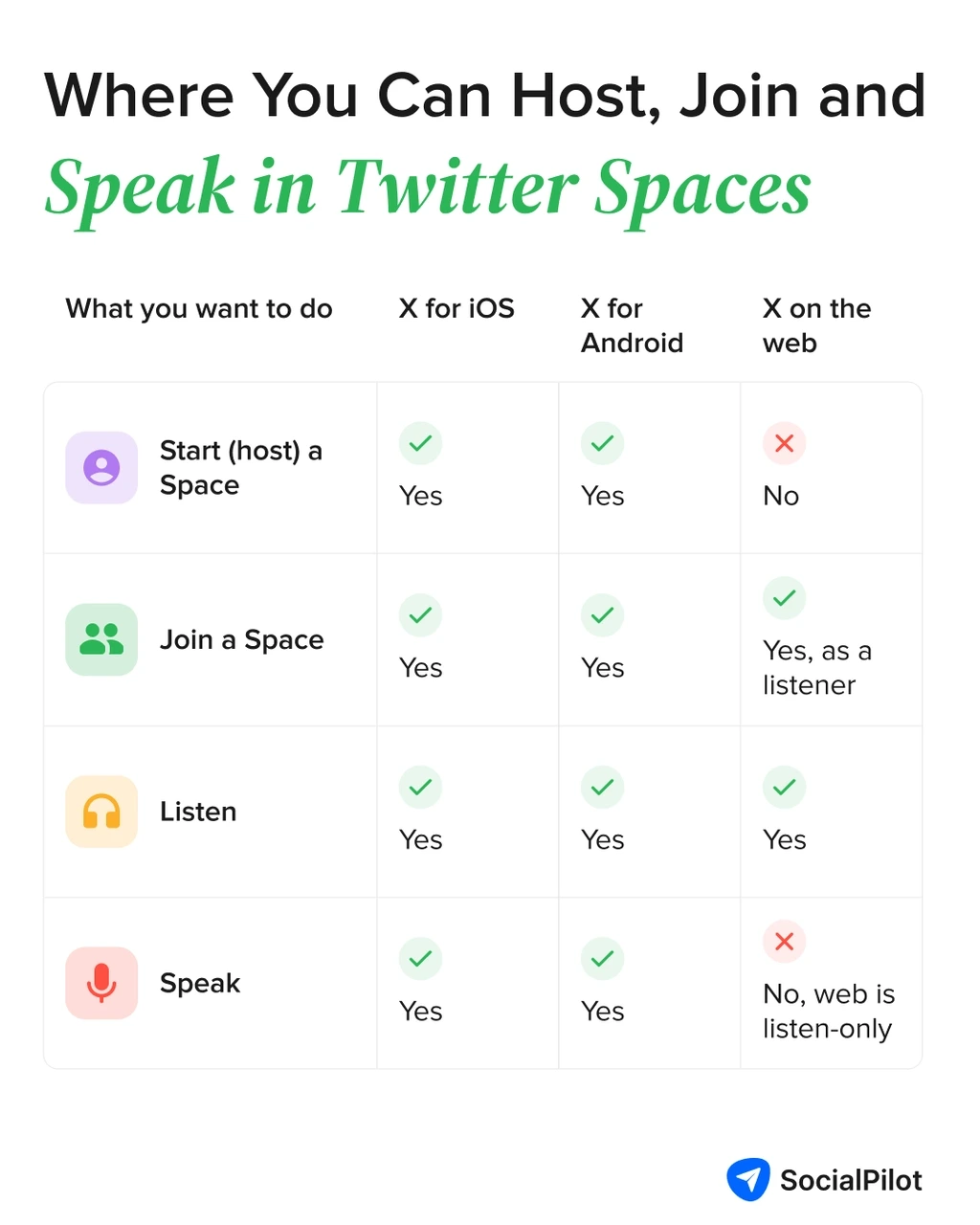
At a laptop, you can sit in on any public Space. To host or take a mic, pick up your phone.
Why Are Twitter Spaces a Big Deal for Marketers?
A Space puts your voice, live, in front of people who chose to show up, which no post can do for your brand.
Listeners hear how you think and get unscripted answers to their questions. You need a phone and an hour, not a studio, and the trust you build is hard to get from a feed.
If you’re still working out where X fits, start with our guide to using Twitter for your business.
1. Twitter Has a Massive and Diverse Audience Reach
Whether X is still worth your time is a fair question, and the answer starts with who’s actually on it. According to Pew Research Center’s fact sheet, 18% of U.S. adults say they ever use X, down from 21% in Pew’s 2025 survey.
That’s a smaller room than X’s reputation suggests, but the mix is where it gets useful. Pew’s 2026 survey shows X skews young and male population:
| U.S. adults | Share who say they use X |
| Ages 18 to 29 | 31% |
| Ages 30 to 49 | 20% |
| Ages 50 to 64 | 17% |
| Ages 65 and older | 7% |
| Men | 23% |
| Women | 14% |
Treat those numbers as a filter. If your buyers are under 30, a Space puts you in a room they still use. If they’re mostly over 65, your hour is better spent elsewhere.
Putting your brand’s name on a live room? Our guide to getting verified on X is worth a read first.
Spaces on Twitter arrived with the Clubhouse rush, and you know how that went. The hype faded, but the listening habit didn’t.
Edison Research’s Infinite Dial 2026, based on a January 2026 survey, found that 58% of Americans aged 12 and older listened to or watched a podcast in the last month, the highest share the study has recorded.based on a January 2026 survey, found that 58% of Americans aged 12 and older listened to or watched a podcast in the last month, the highest share the study has recorded.
Your audience already gives an hour at a time to voices it trusts. A Space is the live version of that hour, on a platform your followers use anyway.
3. A Great Avenue to Build Community
Going live on video means lighting, a background and a shirt without a coffee stain. A Space needs only your phone and your voice, so you could host one while folding laundry.
That low bar changes things for your listeners, too. With no camera in the room, a Space feels like a conversation, and that feeling is what turns a one-off audience into regulars who recognize each other’s voices.
How to Use Twitter Spaces
You can come at Spaces from two sides: host your own from the X app on iOS or Android, or join someone else’s from the app or the web.
Hosting takes a name, a choice between starting now and scheduling, and a decision about recording. How long it runs is up to you, since X’s help center doesn’t list a time limit. Joining takes one tap on a Space or its link.
How to Start a Twitter Space
Open the X app on your phone, because starting a Space on the web isn’t possible. On iOS, X’s help center says to long press the post composer and select the Spaces icon, or use the Spaces tab at the bottom of the timeline (X Help Center). Name your Space, then start it right away or schedule it.
Step by step on iOS:
- Open the X app and go to your home timeline.
- Long press the post composer and select the Spaces icon, or tap the Spaces tab at the bottom of the timeline.
- Name your Space, and since it’s public, make the name tell a stranger what you’ll talk about.
- Start now, or select “Schedule for later” and pick a date and time.
- You start with your mic off. Tap the mic to unmute yourself, and turn on Allow mic access so the speakers you invite can talk.
On Android, X’s help center describes the same path:
- Open the X app and go to your Home timeline.
- Long press the post composer and select the Spaces icon, or tap the Spaces tab at the bottom of the timeline.
- Name your Space and start it.
One catch before you plan around it. X rebuilt its Android app in July 2026, and the new version launched with support for Spaces still being added (TechCrunch). If the Spaces icon doesn’t appear when you long press the composer, update the app or host from an iPhone instead.
How to Schedule and Record a Twitter Space
To schedule, select “Schedule for later” after you name the Space and pick a date and time. X lets hosts schedule a Space up to 30 days in advance and have up to 10 scheduled Spaces (X Help Center). Use the days before each one to announce the topic and time in a post.
If you might want the audio later, decide on recording before you go live, because X has hosts make that choice before the Space starts. The rest works like this:
| When | What happens |
| Before the Space starts | You, as host, choose whether to record it |
| After the Space ends | You can download the recording through X's "Your X Data" tool |
| Up to 30 days after it ends | X keeps the audio for review |
| Up to 120 days in total | X keeps the audio if a violation is found |
Source: X Help Center
How to Manage Speakers, Co-Hosts, and Listeners
X caps the number of voices in a Space but not the size of the audience:
| Role | How many |
| Host (you) | 1 |
| Co-hosts | Up to 2 |
| Speakers | Up to 10 |
| Total who can speak at once | 13 |
| Listeners | No limit |
Pick your two co-hosts before you go live and give each a job, like keeping the conversation moving or watching your announcement post for questions. Line up speakers in advance too, so you aren’t filling ten slots on the fly.
Finding those speakers is the hard part when you’re new to hosting. One Reddit user on r/Twitter thread suggested doing the groundwork in other people’s rooms first:
“Build a following, attend other people’s spaces and participate in them, interact with people on Twitter about the topics that you’re interested in and be active in communities. That way you will find speakers easier”.
By the time you host, the people you’d ask to speak already know your voice.
Spaces are public, so anyone can come in and listen. To fill the room, send the link in a direct message to the people you most want there, or post it for your followers.
How to Find and Join Spaces on X
Most Spaces will reach you as links, either posted on your timeline or sent to you in a DM. Open one in the X app for iOS or Android, or on x.com in a browser, and you’re in as a listener. On iOS, the Spaces tab at the bottom of your timeline is another place to look.
That’s also how to join a Twitter Space from a laptop: open the link and listen, then switch to your phone if you want to speak.
A Few Ideas to Use Twitter Spaces for Business
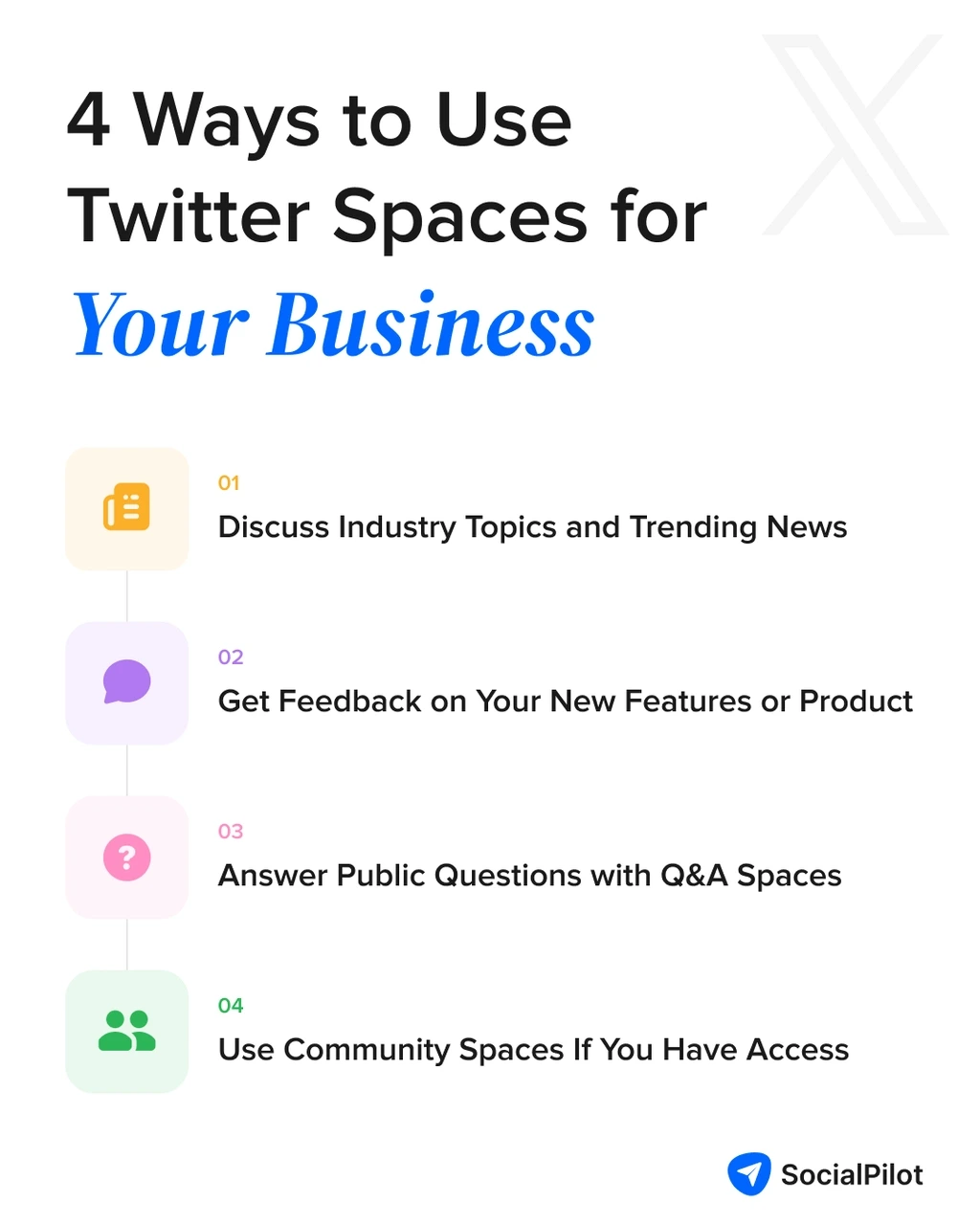
Before you host anything, decide what the hour is for, and give each Space one job. These four play to what a live room does better than a post.
1. Discuss Industry Topics and Trending News
Your audience wants to know what a change in your industry means for them, ideally before someone else explains it. When news breaks, host a Space on what happened, why it happened and who it affects.
With room for two co-hosts and 10 speakers alongside you, you can build a small panel of people who know the topic and let them disagree a little. Listen as much as you talk, because the questions show you how your audience is reading the change and where your product fits into it.
2. Get Feedback on Your New Features or Product
Ask customers out loud about the feature you’ve just built, because a survey can’t always tell you whether they’ll like it. Invite people who already use your product often, walk them through what changed and let them react in their own words.
You get honest reactions in real time, plus the follow-up questions you’d never have thought to put in a form. If you recorded the Space, download the audio and pull their exact words into your product notes.
3. Answer Public Questions with Q&A Spaces
A spoken answer carries tone that a typed reply loses. Run a Q&A Space when you launch something, or bring in an expert from your industry and let your audience question them directly.
Collect questions in the replies to your announcement post a few days ahead, so the first ten minutes aren’t silence. You can pair it with other social media promotion ideas, such as a giveaway for people who attend or a crossover Space with a partner account.
A short recap afterward that answers the questions you ran out of time for is one of the simpler ways to boost Twitter engagement around a launch.
4. Use Community Spaces If You Have Access
If you run or moderate an X Community, check whether you can host a Community Space. Community Spaces are available only to “some” Community admins and moderators on iOS and Android, X’s help center says, so not everyone will see the option (X Help Center).
For the members who already show up in the Twitter communities you’ve been building around your brand, a Community Space is a natural next step. Without the option, a regular public Space with its link posted in the Community does much the same job.
Why Can't I See or Host a Space?
Usually it’s the device. X’s help center says starting a Space on web “is not possible”, so x.com in a browser won’t show a start option, and you can only listen there (X Help Center). To host, use the X app on iOS or Android (Community Spaces are limited to some admins and moderators).
It’s an easy mistake to make. You can join and listen to Spaces on the web, so it feels as if hosting should be there too.
Protected Posts Block Hosting
X says “Accounts with protected posts are not able to create Spaces” (X Help Center). If you’ve protected your posts so only your followers see them, make them public again before you try to host. Check this first, because switching devices won’t fix it.
You Can Listen on Web but Not Host
On x.com, a Space link opens as a listening session, which is all X’s help page says you can currently do in a Space on the web. To speak in someone else’s Space, open the same link in the X app on your phone.
Hosting Needs the iOS or Android App
X’s help page says people on iOS and Android can start a Space, and it lists no follower minimum, so your follower count isn’t the problem. If Spaces still doesn’t show up in your app, run the usual general checks (these aren’t fixes X documents for Spaces): update the app, make sure you’re signed in to the right account, and restart it.
Can’t see Community Spaces? That’s normal, since X makes them available to some Community admins and moderators only.
Hosting a Space takes time, but getting people to attend and keeping the conversation going afterward takes some planning, too. You need to promote the session, find ways to reuse the recording, and understand which posts are getting attention.
This is where a social media management tool like SocialPilot can help. It gives you a few ways to manage the content surrounding your Spaces without adding more manual work:
- Plan announcements and reminders: Schedule posts about your upcoming Space in advance using SocialPilot’s X scheduler. You can also plan announcements for LinkedIn and Facebook from the same content calendar instead of managing each platform separately.
- Get more mileage from your recording: Download your Space recording through X’s “Your X Data” tool and turn useful moments into tweets or threads. AI Pilot can help draft these posts, which you can edit and schedule throughout the week.
- Understand what resonates with your audience: Use SocialPilot’s X analytics to track impressions, engagement, and link clicks on your promotional and follow-up posts. This helps you see what caught your audience’s attention and make better decisions for your next Space.
If you plan to host Spaces regularly, SocialPilot pricing includes a 14-day free trial that needs no credit card, so you can schedule the promotion for your next Space before deciding.
Final Thoughts on Using Twitter Spaces
Twitter Spaces give you a simple way to have real-time conversations with your audience without the setup or effort that comes with going live on video.
Whether you want to discuss industry trends, answer customer questions, get product feedback, or build a community around your brand, there’s plenty you can do with it.
You don’t need a huge following or a perfect setup to get started. Pick a topic your audience cares about, invite a few relevant speakers, and give people a reason to join the conversation. The more value you offer, the more likely listeners are to come back for your next Space.




 Join 55,000+ social media managers


