
I’ve had the same conversation with enough shop owners now that I can usually see it coming before they finish the first sentence. Someone tells me they know they should be doing more with social media. They just haven’t gotten around to it, or they tried it for a few weeks last year and let it slide.
I never push back on that part. What I tell them instead is that they’re already sitting on the one thing most businesses spend months trying to manufacture: proof. You fix real cars, in front of real customers, every single day. Social media marketing for auto repair shops isn’t about inventing content. It’s about pointing a phone at what’s already happening in your bay.
Despite this the 2022 Ratchet+Wrench Industry Survey found that 20 percent of shop owners have no social media accounts at all, and 23 percent reported doing no marketing whatsoever, across a survey of nearly 570 shops. What this means is that one in five shops has opted out of the cheapest, easiest way to reach the people.
I used to think search marketing was the ceiling for a local shop, since everyone in town searching “auto repair near me” is fishing the same small pond. I don’t think that anymore. Social media doesn’t have that ceiling. One customer sees something real about your shop, and the platform hands that to people who already trust that customer’s judgment. That’s word of mouth, just running at a different speed.
Why Shops Actually Stall Out
Nine times out of ten, when a shop owner tells me they’ve “tried” social media and it didn’t work, the real story isn’t strategy. It’s one of a small handful of specific, personal reasons that never make it into a marketing plan:
- The shop doesn’t feel presentable enough to put on camera
- Filming feels like one more thing annoying an already-busy team
- Some technicians genuinely don’t want to be on camera, and that’s fair
- Nobody’s sure what’s actually worth filming on an ordinary Tuesday
- There’s no time left in the day once the bays are full
Most of these are people problems.
We made an early call at 47 Consulting that shaped everything else: treat those five reasons as the actual starting point of the work, not obstacles to argue a shop owner out of. Saurav and I agreed on that decision before we’d written a single content calendar for a client, and it’s held up every time since.
Here’s what this covers:
- What to point the camera at
- How to turn reviews into something you’re actively building, and
- A posting rhythm you can actually hold.
If you run more than one location, or you’re weighing this against a full auto repair shop marketing budget that includes print and paid search, everything below still applies. It’s just one slice of the larger plan.
Most repair shops only need to be excellent on two platforms, not present everywhere. Social media marketing strategies for auto shops often fail because of spreading too thin across six platforms and not from picking the “wrong” one. I map this out the same way for every shop I sit down with, so here’s that same list, with a real shop worth looking at on each platform.
1. Facebook
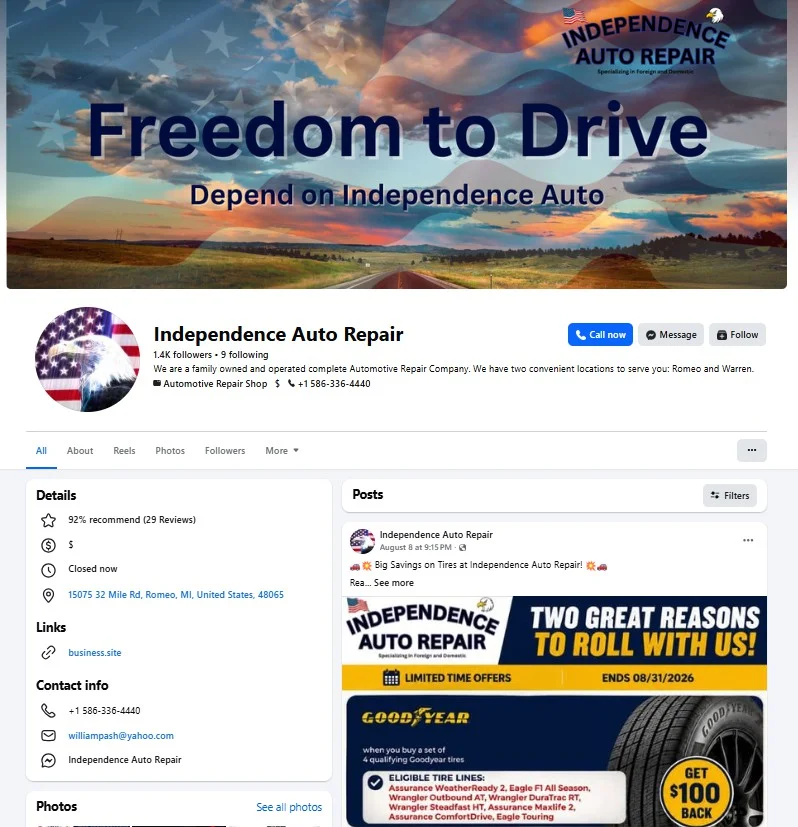
Still the default for a reason. This is where local customers already are, and where your Google Business Profile reviews live alongside it. Independence Auto Repair, a family-owned shop with two locations in Romeo and Warren, Michigan, is worth a look, over 1,400 likes and a 92 percent recommendation rate across their reviews, which is a result of: steady Facebook marketing over the years, not one big campaign.
2. Instagram
The natural home for before-and-after photos and short technician clips, the two formats this piece keeps coming back to. Auto Mechanic Shop, Inc. in Winter Park, family-owned and full-service since 2005, is a good account to look at generally, just over 2,000 followers and 193 posts at last check, they built their following by steadily posting behind the scenes from their auto repair shop.
3. Google Business Profile
Not technically social media, but it behaves like it, and it’s where a browsing customer decides whether to call. Setup your Google Business page (if you haven’t already) and treat your posts there as an extension of whatever you’re already putting on Facebook, and keep your hours and services current, since that’s often the deciding factor between two shops with similar reviews.
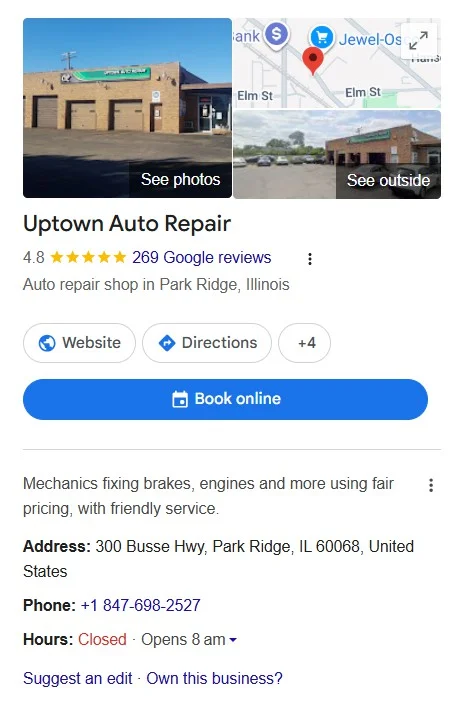
Uptown Auto Repair, a family-owned NAPA AutoCare Center in Park Ridge, is worth studying here, they have a total of 269 Google reviews and a 4.8-star average. That kind of volume only happens with a shop asking for reviews on purpose, for years, not occasionally.
4. YouTube
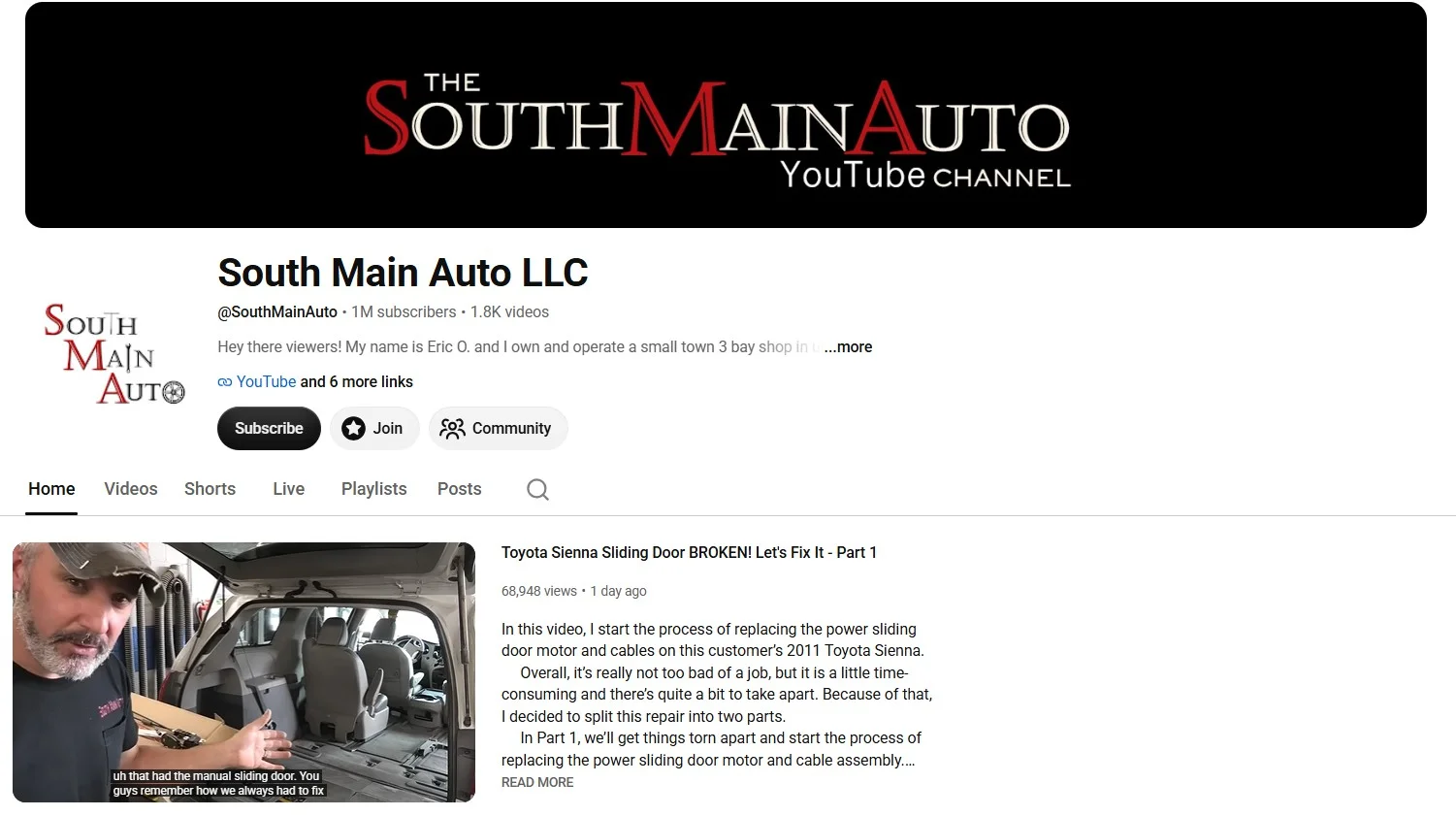
YouTube marketing is worth it only if you’re already filming repairs for Instagram and don’t mind the longer form edit. South Main Auto is the clearest proof of what this looks like at scale: a small-town independent shop that’s posted well over 1,800 full diagnosis-to-repair videos on real customer cars, no staging, no script, and built a following near a million subscribers doing it.
5. TikTok
In my opinion, marketing on TikTok is situational. If your team already has someone comfortable on camera and enjoys the format, it can extend the same before-and-after and technician content further. Skip it if that’s not true, forcing it wastes the one resource you don’t have, which is time.
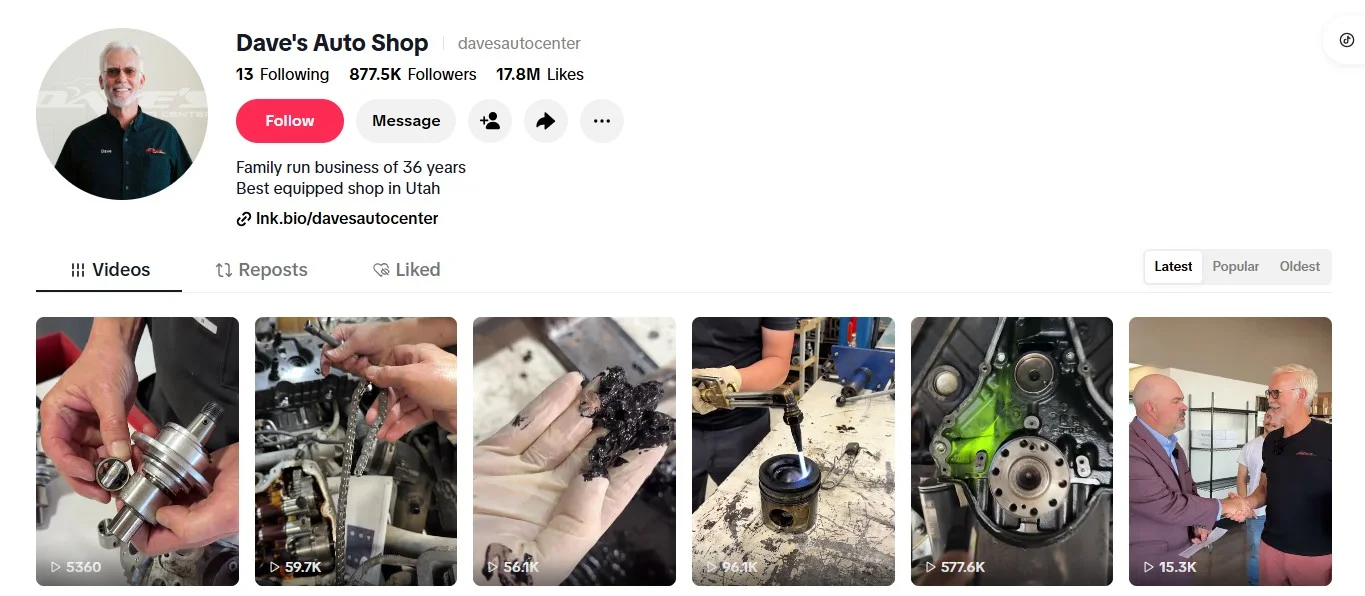
Dave’s Auto Center in Centerville, a family-owned diesel and auto shop running since 1990, is a fair reference point. Their own website links to this exact account as theirs, and the content is the same shop-floor diagnostic and engine-build footage this section is describing.
6. LinkedIn
Low priority for a single-location shop talking to local drivers. Most of the activity here is B2B (parts suppliers, fleet accounts), not local customers walking in the door, and that’s a read I’ve made from working with shops directly, not something I pulled from a survey.
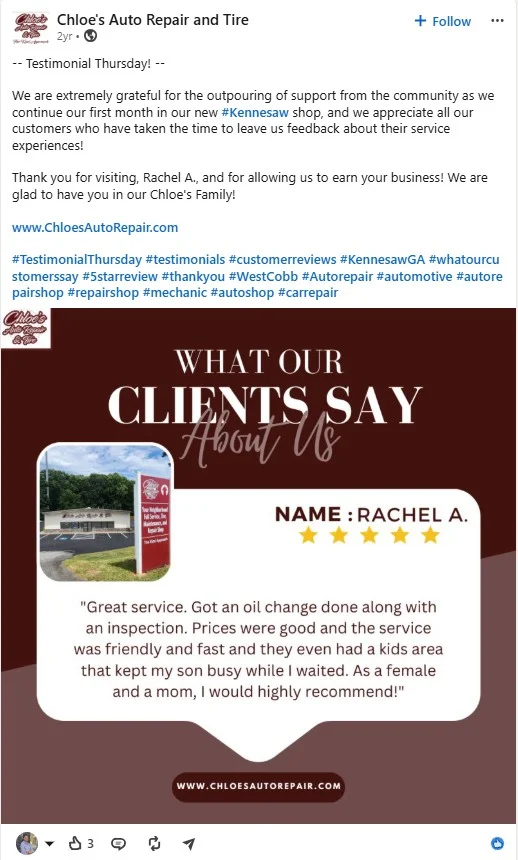
Chloe’s Auto Repair and Tire shows what a modest, well-used page looks like: a Testimonial Thursday post marking their Kennesaw location’s first month open, thanking the community and naming a specific customer by name.
7. Nextdoor
Not in most industry surveys, but worth a mention if your area uses it heavily. It behaves like Facebook’s hyper-local cousin, and reviews there carry real weight with neighbors, since most posts surface only within a few miles of your actual address.
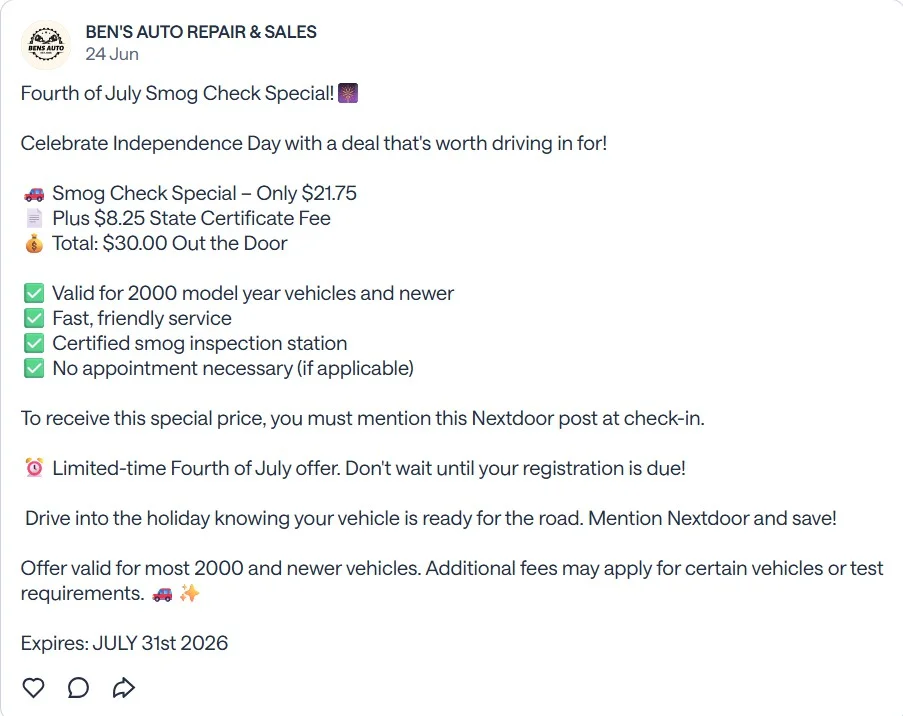
Ben’s Auto Repair & Sales, family-owned in Richmond since 1968, keeps live specials posted there (a $59 oil change, a $30 smog check) right alongside neighbor recommendations praising them for not upselling, exactly the kind of hyper-local trust this platform rewards.
For scale, Mitchell1’s 2018 survey of over 60,000 independent shops found that 65 percent used social media at all, and 96 percent of those chose Facebook. That’s dated now, not current behavior, but in my opinion Facebook, Instagram and GBP still hold the position in the trade.
The Three Content Pillars Every Repair Shop Should Build On
Once the platform question is settled, the next one is what to actually post. I’ve watched enough shops try this and stall that I keep coming back to the same three things, every time. They’re not the only social media content pillars that work, but they’re the three I’d build a shop’s entire presence around before touching anything else.
1. Before-and-After Repair Photos
Before-and-after photos are the single most repair-shop-specific content format available, and almost nobody builds a real system around them. I’ve seen that authentic photos and video consistently outperform anything that looks stock or staged.
The habit that actually works is boring on purpose. Shoot the “before” the moment the car’s on the lift, before anything’s been touched: the corroded part, the leaking hose, the worn brake pad next to a new one for scale. Shoot the “after” from the same angle, same distance, same lighting if you can manage it. The side-by-side sells itself. You don’t need commentary.
Duran Detail Auto Body in Visalia, 28 years into this business, has one of the cleaner examples of this I’ve seen. Here is before and after content from their page, showcasing a total transformation of a car, from old to new. Such real, and unstaged before-and-after posts work better than any stock photos on Instagram.
What Goes in the Caption
Skip the generic caption. Three specific things beat a paragraph of marketing language:
- Name the actual part or system (“the serpentine belt,” not “an issue”)
- Say what would have happened if it hadn’t been caught
- Blur or crop the plate and VIN before it ever leaves the shop’s phone
This is also the one spot where I’ll admit we lean on a shortcut ourselves. When a client’s repair clip is headed to TikTok or Reels, we’ll run it through SocialPilot’s free AI Caption generator first, feed it the part name and what almost went wrong, and it hands back a perfect caption.
Free AI Instagram Caption Generator
Generate scroll-halting Instagram captions with our AI-powered Instagram Caption Generator.
Here is the Generated Result
However, this tool won’t know your shop’s voice better than you do, so make sure you give the caption a good read before posting. You can also read this guide to learn more about how to write captions on Instagram for photos, reels and stories.
2. Technician and Behind-the-Scenes Content
Your technicians are the actual story most shops are sitting on and not telling. Customers don’t distrust repair shops in the abstract, they distrust not knowing who’s touching their car. A face and a name fixes more of that than any review ever will.
I underestimated this trade when I started. I’d spent over a decade in tech before this and assumed diagnostic work was rote. Then a service advisor walked me through a dashboard he’d built himself to track parts turnover, and it hit me: people written off as “not college material” are running genuinely complicated small businesses. That’s shaped how we shoot every piece of technician content since. You’re not filming a mechanic. You’re filming someone solving a problem in real time.
Royalty Auto Service in St. Marys is the clearest version of this I can point to. Owner Sherwood Cooke Jr. built a two-location shop into close to 453,000 Instagram followers and past a million on TikTok, just by posting real shop-floor footage.
What This Looks Like on Camera
- A technician narrating a diagnosis in their own words, even ninety seconds of it, beats a polished thirty-second ad
- A short clip of a specific, satisfying fix (a stuck bolt finally breaking free, a part that clearly explains itself once you see it)
- A “meet the team” post that’s just a name, a role, and one honest detail, not a corporate bio
If a technician says no to being filmed, respect it without pushing. There’s always someone on a team who doesn’t mind, and forcing the reluctant ones erodes the exact trust you’re trying to build. Saurav and I land on the same page here every time: authenticity beats production value in this content, full stop, and neither of us has found a shop where the opposite was true.
3. Turning Reviews into an Active Growth Strategy
Reviews aren’t something that happens to your shop. They’re something you actively generate and respond to, and most repair shops treat them as decoration instead of a channel they’re supposed to be working.
Generation comes first. Ask at the exact moment a customer’s happiest, which is usually right when they pick up the car, and it drives the way it’s supposed to. A text with a direct link converts far better than a sign taped to the counter that everyone’s learned to ignore.
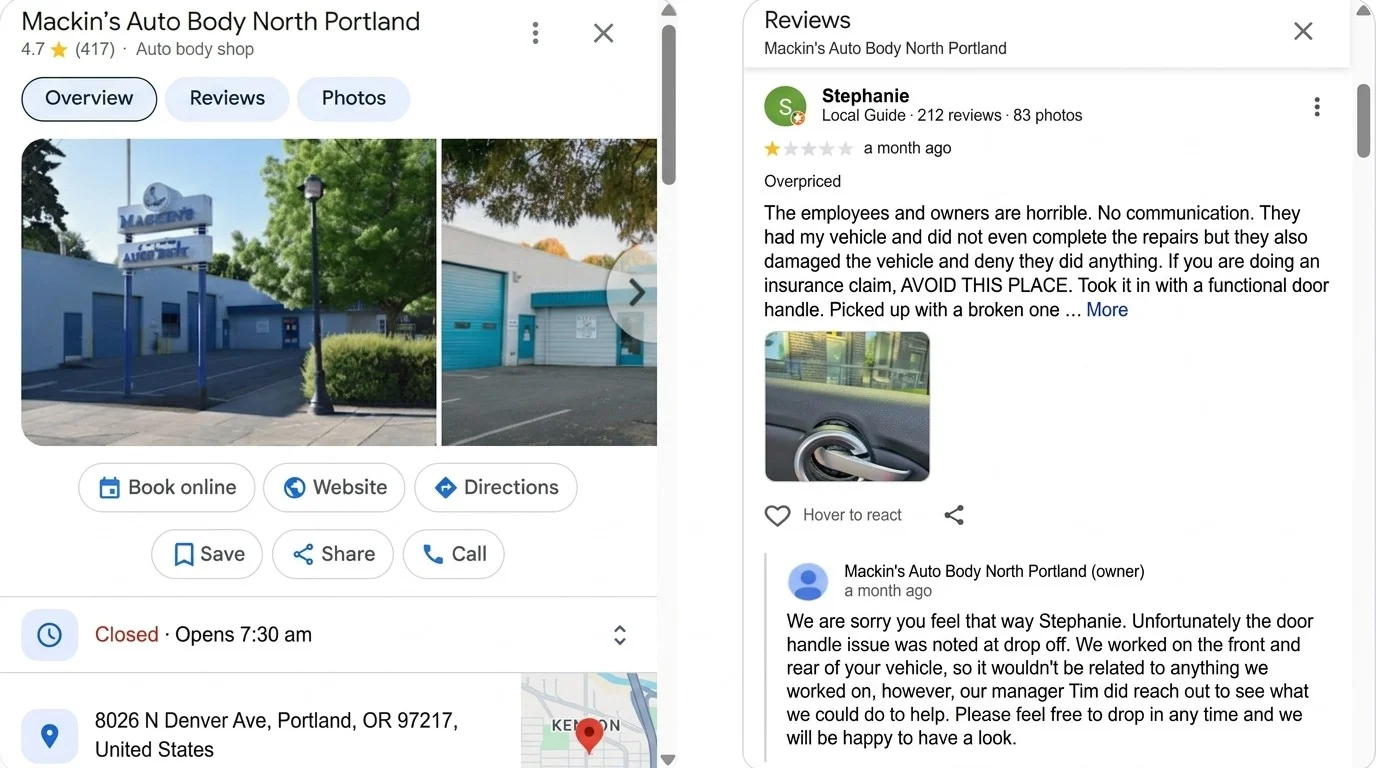
Mackin’s Auto Body is one example worth studying here. Here is how they showcase their positive reviews on their Instagram page.
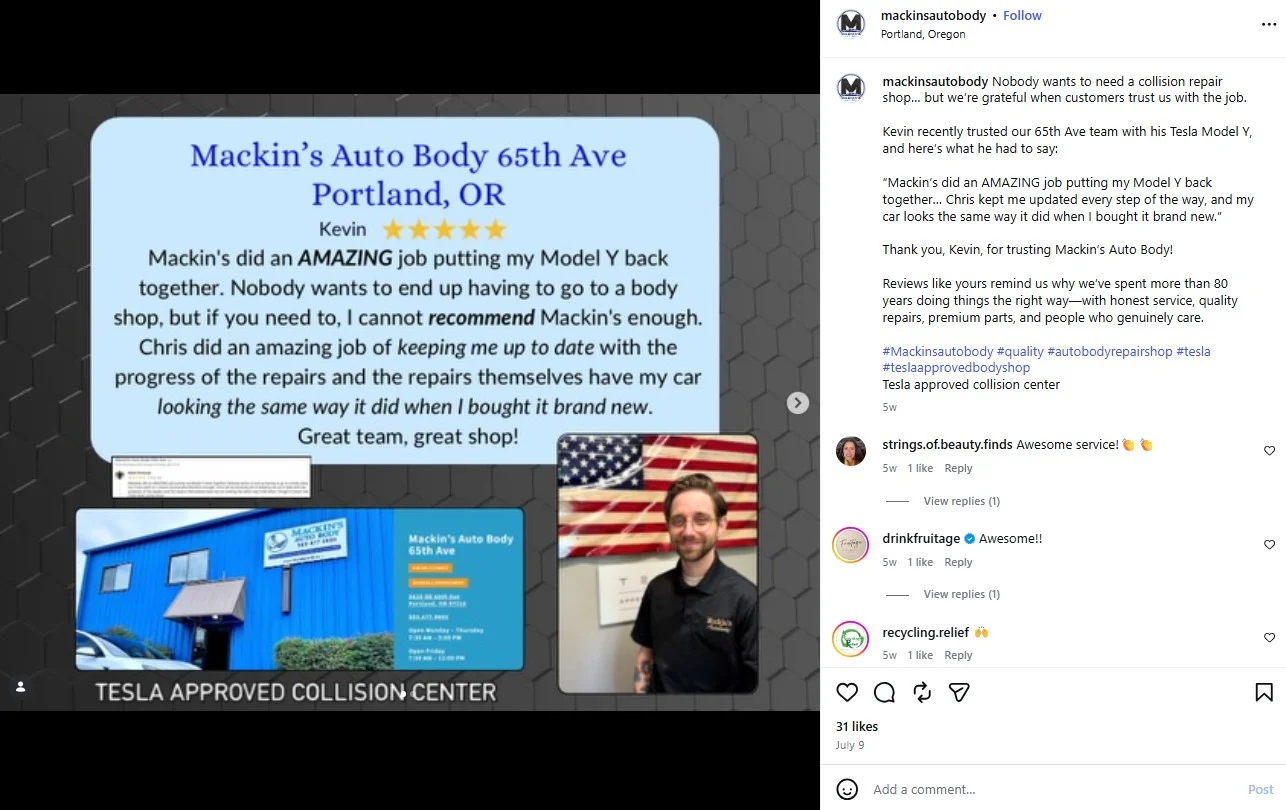
Their VP Suzanne Mackin also described their review handling process directly: they get notified the moment a negative review posts, respond as soon as possible to fix the actual problem, and track it daily. That habit is a real part of how they have maintained a 4.7 overall rating on Google.
The way you respond to reviews matters as much as the ask. Something specific, like naming the exact part that got fixed, feeds both the relationship and the platform’s local-search signals. Saurav wanted a faster templated system early on to protect the hours these take, and we settled on a handful of starting phrases personalized in under a minute instead.
What to Post: My Content Idea List for Every Week
You don’t need a content calendar full of generic ideas. You need seven or eight things you can point a phone at without thinking too hard, pulled straight from the pillars above. Most auto repair shop marketing ideas lists read the same no matter which industry got pasted on top.
Here are some engaging social media post ideas for your auto repair shop:
- A before-and-after pair from whatever repair actually happened that day
- A ninety-second technician walkthrough of one diagnosis, in their own words
- A “part of the week” post explaining what one commonly-replaced part actually does
- A specific review response, screenshotted and shared with the customer’s permission
- A seasonal reminder tied to something concrete (the week before a holiday travel weekend, the first cold snap)
- A shop-floor moment that isn’t staged: a whiteboard schedule, a parts delivery, a team lunch
- A “myth versus reality” post correcting one thing customers commonly get wrong about their car
- A quick answer to a question your front desk actually got asked that week
We keep a running folder of clean before-and-after pairs specifically so idea five and idea one never run dry at the same time. It doesn’t need to be fancy: a shelf of ready material that outlives any single week’s memory of what happened in the bay.
A Realistic Posting Cadence You Can Actually Keep Up
So, how often to post on social media? In my opinion, three posts a week, spread across two platforms, is the ceiling most independent shops can sustain. Anything past that tends to get abandoned within a month, which is worse than never starting, because an abandoned page reads worse to a new customer than no page at all.
Here’s a cadence that survives a busy Tuesday:
| Day | What Posts | Where It Comes From |
| Monday | Before-and-after pair from the prior week | Photos already on someone’s phone |
| Wednesday | Technician clip or “part of the week” | Filmed during a slow midday stretch |
| Friday | Review response or a shop-floor moment | Whatever actually happened that week |
Once your batching habit sticks, it would be better to work with some version of a scheduler, because remembering to log in and post live on Monday, Wednesday, and Friday is its own way to fail. We usually point people toward SocialPilot for this specific piece, since it lets a shop load a whole week or month in one sitting and see every platform on a single screen before anything goes out.
You can watch this walkthrough if you want to see what the actual scheduling flow on SocialPilot looks like.
Furthermore, they also have this guide on social media marketing strategies for small businesses that covers goal-setting and measurement beyond what a single-location repair shop typically needs.
How to Make this Plan Sustainable Without a Marketing Team
This is the part shop owners actually corner me about, not what to post, but how to keep posting once the novelty wears off. The honest constraint isn’t ideas, it’s hours. A two-person shop, or even a fifteen-bay one without a dedicated marketing hire, can’t treat social media like a full department. It has to fit into a week that’s already full.
The habit that actually works: once a week, someone spends twenty minutes moving that week’s photos off a phone into one folder, sorted fast into three piles (before-and-after, technician, review-worthy), then loads the whole batch into the scheduler in one sitting. The point was never the scheduling itself, every tool schedules something. It was seeing the whole week laid out before committing to it.
Whatever tool you end up using, three things are worth checking:
- Can it batch a real week of posts in one sitting,
- Does it show engagement per post so you’re not guessing what’s working, and
- Can two people share access without stepping on each other’s queue.
For us, Saurav handles most of the analytics side of things while I focus on the content and posting, which is roughly how this divides for a shop too, even when it’s the same person wearing both hats on different days.
Where You Can Start off This Week
If there’s no budget at all, my honest answer is still to start: one phone, one folder for photos, one person who is comfortable facing the camera. That system costs nothing, and it’s where I tell every shop to begin, no matter what comes next.
Once posting live every Monday, Wednesday, and Friday starts feeling like a chore, a scheduling tool is worth having. Loading a week of photos and clips into one sitting removes the excuse that kills most shops’ pages, forgetting, or not having twenty free minutes on a busy day.
I’ve seen shops with almost no budget outlast ones with a full production setup, simply because they kept showing up.
So here’s the real advice underneath everything else in this piece: pick something you can sustain, and don’t stop doing it. The platforms, the content pillars, the tools, none of it matters if the page isn’t still alive a year from now.




 Join 55,000+ social media managers


