Running out of things to post on your Facebook business page? You’re not alone.
With over 3.27 billion monthly active users, Facebook remains the largest social media platform in the world. But here’s the catch — the organic reach on this platform has plummeted to just 1.1%–2.2%, down from 16% back in 2012.
That means if you’re still posting the same type of content that you were posting in 2012, the algorithm is quietly burying your posts.
This is where coming up with a well-planned mix of Facebook post ideas can be helpful.
Because the right post ideas can keep your target audience engaged, entertained, and coming back for more.
Whether you’re managing your own brand page or handling social media for multiple clients, having a go-to list of proven content formats saves time and removes the guesswork.
In this guide, we’ve compiled 28 Facebook content ideas organized by category, complete with data-backed tips and real brand examples to draw inspiration from.
28 Best Post Ideas for Facebook in 2026
The Facebook post ideas given below are organized into seven categories so you can pick and mix based on your social media content strategy.
Let’s start with the ones that drive the most interaction.
Engagement-Driven Facebook Post Ideas
These Facebook engagement posts are designed to stop the scroll and get your audience to do something — click, comment, react, or share. They work because they lower the barrier to interaction and tap into basic human psychology.
1. Ask a question
The simplest way to spark a conversation? Just ask.
Questions work because they give your audience an easy, low-effort way to participate. You’re not asking them to write an essay — just share an opinion.
Here are some formats that work best:
- This or That questions (e.g., “Coffee or tea for Monday mornings?”)
- Open-ended questions tied to your niche (e.g., “What’s the one marketing tool you can’t live without?”)
- Controversial-but-safe takes (e.g., “Unpopular opinion: email marketing is more effective than social media. Agree or disagree?”)
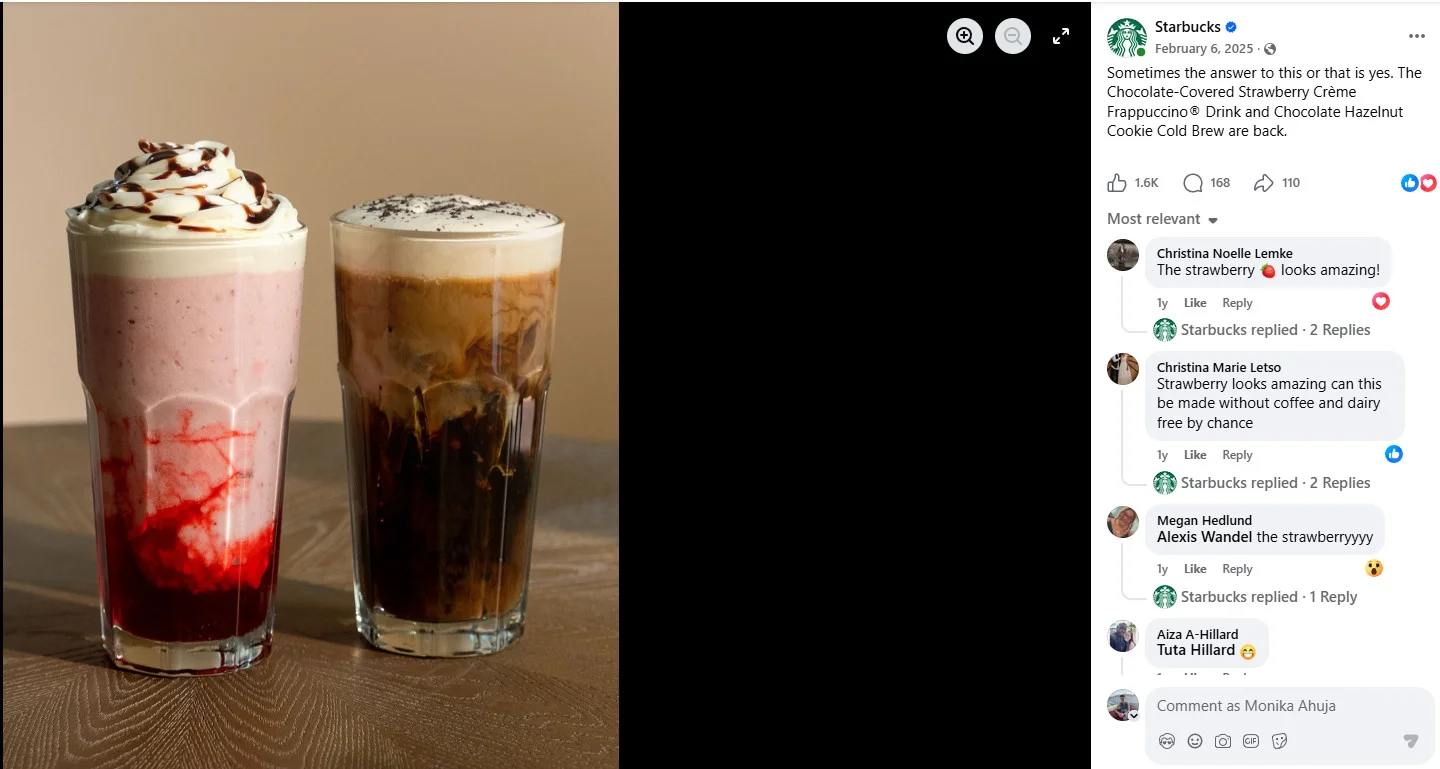
Below is a “this or that” post by Starbucks, where they are making their audience choose between the Chocolate-Covered Strawberry Crème Frappuccino and the Chocolate Hazelnut Cookie Cold Brew.
The key is to ask something your specific audience cares about — not generic questions that could apply to anyone.
2. Polls (via Facebook Stories)
Polls are one of the highest-engagement formats on social media and for good reason. They require just one tap to participate.
Facebook no longer supports native poll posts in the Page News Feed — but that doesn’t limit you much. You can run polls through Facebook Stories, inside Facebook Groups, on Event pages, and within Facebook Videos.
Stories polls in particular are a strong play: they appear before users even scroll, and the tap-to-vote format drives fast, frictionless responses.
Poll ideas that work:
- Product preference polls (“Which new flavor should we launch next?”)
- Opinion polls on industry trends
- Fun “would you rather” style polls
- Quick feedback polls (“How was your experience with us?”)
Polls and interactive content give audiences a reason to stop scrolling. According to DemandGen’s 2024 Content Preferences Survey, short-form and easily digestible content now tops what B2B audiences engage with most, making quick interactive formats like polls one of the more effective ways to capture attention without demanding too much from the reader.
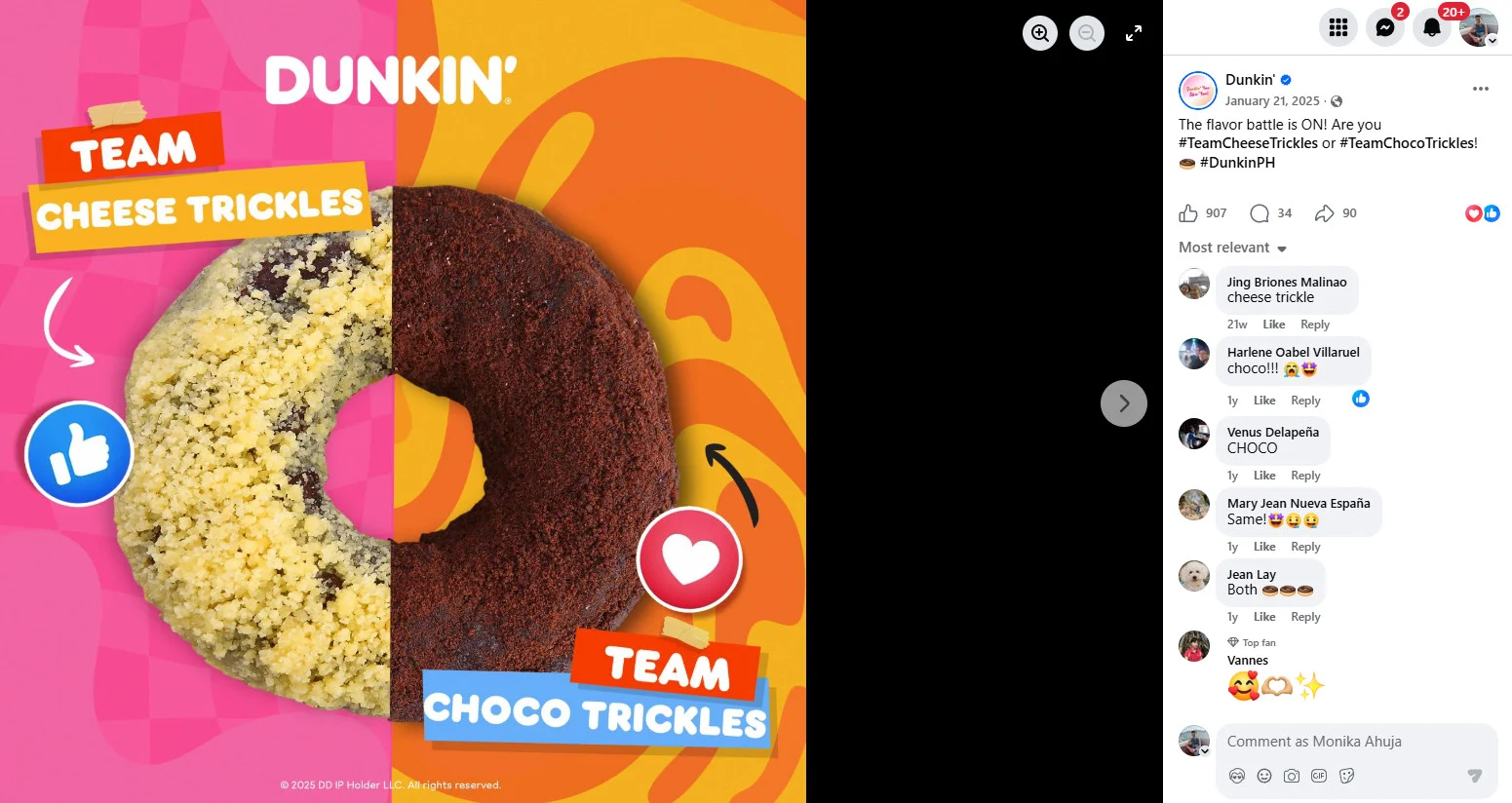
Dunkin often posts flavor battles on Facebook, asking their audience to choose between two of their products.
3. Fill-in-the-Blank Posts
Fill-in-the-blank posts consistently outperform regular text posts because they tap into something psychological — our innate desire to complete things, also called the Zeigarnik effect.
When people see an incomplete sentence, they feel a subtle urge to finish it.
Below is a “fill in the blanks” post by Oreo, where they are asking their audience about their favorite cookie and milk combination.
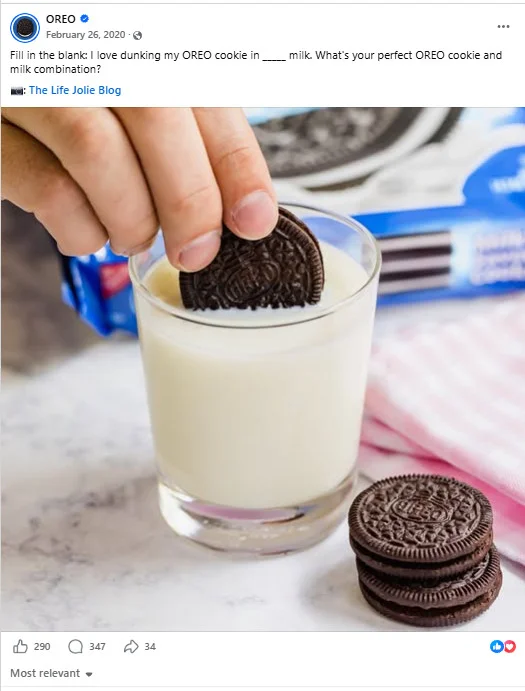
Here are some tips to make them work:
- Keep the sentence relatable to your audience.
- Leave room for creative or funny answers.
- Tie it to your brand when possible (e.g., “I use [your product] because __________”)
4. “Caption This” Photo Posts
Post an interesting, funny, or unusual image and ask your audience to come up with the best caption.
Below is one such post by The Louisa Humane Society, where they are showing a “caption this post” contest.
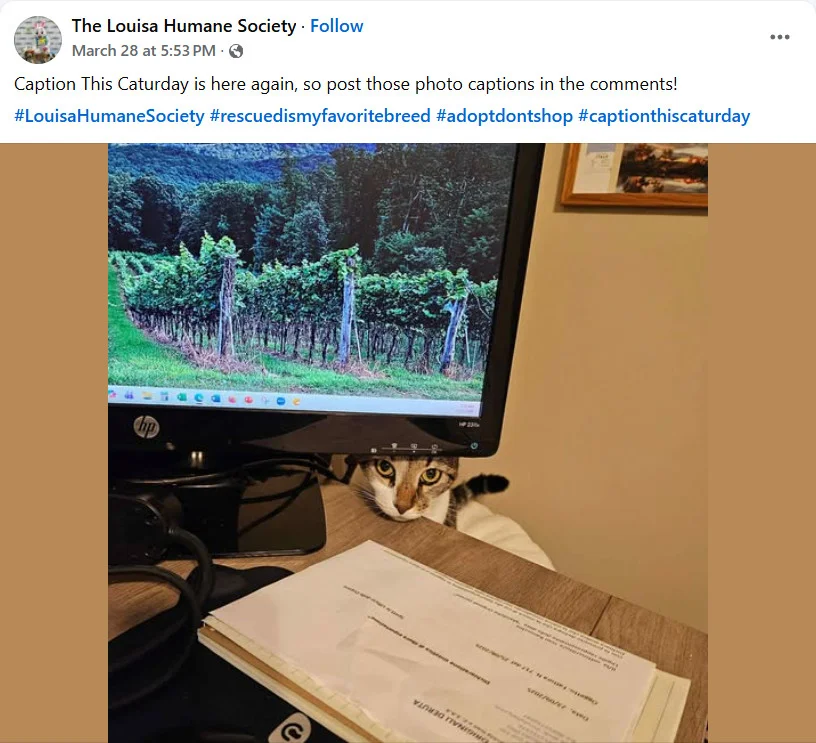
These posts generate high comment volume because they are fun. Additionally, people also love showing off their creativity and sense of humor; they also visit the comment sections to see the responses of others, thus improving your engagement.
5. Guessing Games and Quizzes
Guessing games and quizzes create a micro-commitment. Once someone takes a guess, they’ll come back to check if they were right – which means return visits and repeat engagement.
Some popular formats that work are:
- Close-up or zoomed-in product shots (“Guess the product!”)
- Industry trivia questions
- “How well do you know [your brand]?” quizzes
- Emoji puzzles related to your products or industry
Here is one such post on “Can you guess the legendary F1 car” by Lego on Facebook.
Contests, Giveaways & UGC Post Ideas
6. Run a Contest or Giveaway
Contests and giveaways remain one of the most effective and viral Facebook post ideas. The mechanics are simple: offer something valuable and ask for engagement in return.
Below is a Sephora giveaway post, where they are giving away free products worth $500 to anyone who wins the contest.
Giveaway posts usually follow a common contest format: “Like & comment/tag your friends/repost to enter.” Sometimes, giveaways are also tied to holidays or product launches.
For more inspiration, check out our guide on social media contest ideas.
7. User-Generated Content (UGC) Campaigns
Why create all the content yourself when your customers can do it for you — and that too more authentically?
UGC is social proof in its purest form and here are some ways that can help brands generate it:
- Create a branded hashtag and encourage customers to share photos using your product.
- Repost customer photos and videos (always credit the creator)
- Run a UGC contest (“Share a photo of your setup for a chance to be featured”)
Brands like GoPro have built an entire content ecosystem around UGC. Their Facebook page is filled with stunning photos and videos shot by real customers — content that costs them nothing to produce but drives massive engagement.

Learn more about building a UGC strategy in our complete guide to user-generated content.
8. Fan Spotlight / Shoutouts
Take UGC a step further by dedicating individual posts to your best customers or most loyal fans.
A fan spotlight could be:
- A “Customer of the Month” feature
- A reshare of a customer’s success story using your product.
- A shoutout to a community member who’s been particularly helpful or engaged
Here is one such customer success story by Slack, where Brian Persons from Zenni Optical shares how the tool helped them with real-time collaboration. Sharing such posts makes the featured customer feel valued and encourages others to engage more, hoping to be spotlighted next.
9. Customer Testimonials and Reviews
Showcasing testimonials or reviews is one of the most powerful business Facebook post ideas because it combines social proof with storytelling.
Instead of just posting a text quote on a plain background, try using testimonial Facebook post ideas like:
- Screenshot of a real review (Google, Trustpilot, or Facebook review)
- Short video testimonial from a happy customer
- Before/after results with the customer’s permission
- A “story format” where you narrate the customer’s journey
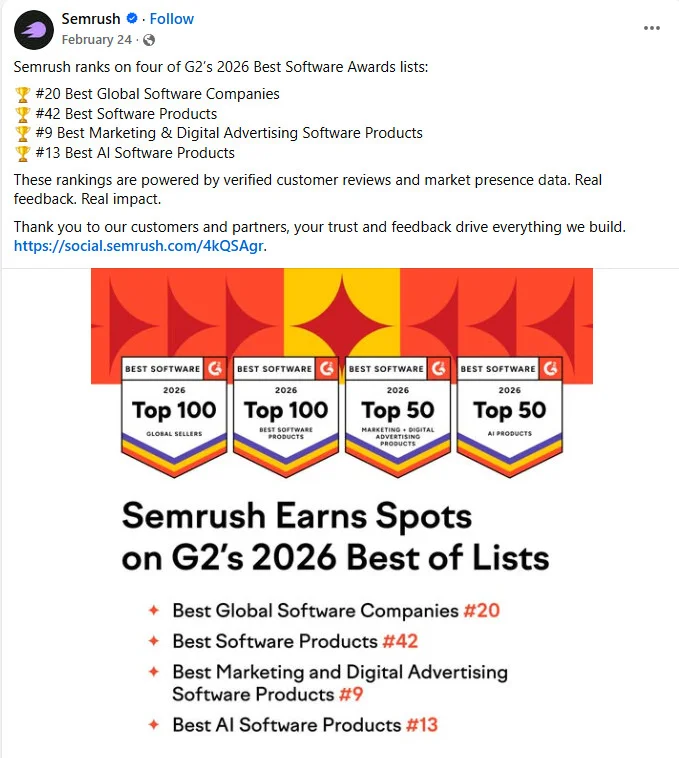
Semrush recently posted its G2 rankings from the Best Software Awards list to build social proof.
Educational & Value-Driven Post Ideas
Educational content builds authority and trust. When your audience learns something useful from your posts, they start seeing your brand as a go-to resource and not just another business trying to sell something.
10. Tips, How-To’s & Tutorials
Share your expertise in bite-sized, actionable posts. These are some of the most saved and shared Facebook post examples because they deliver immediate value.
Here are some formats that work well:
- Carousel posts with step-by-step instructions
- Short “quick tip” text posts
- Video tutorials (even 60-second ones)
- “3 things you didn’t know about [topic]” lists
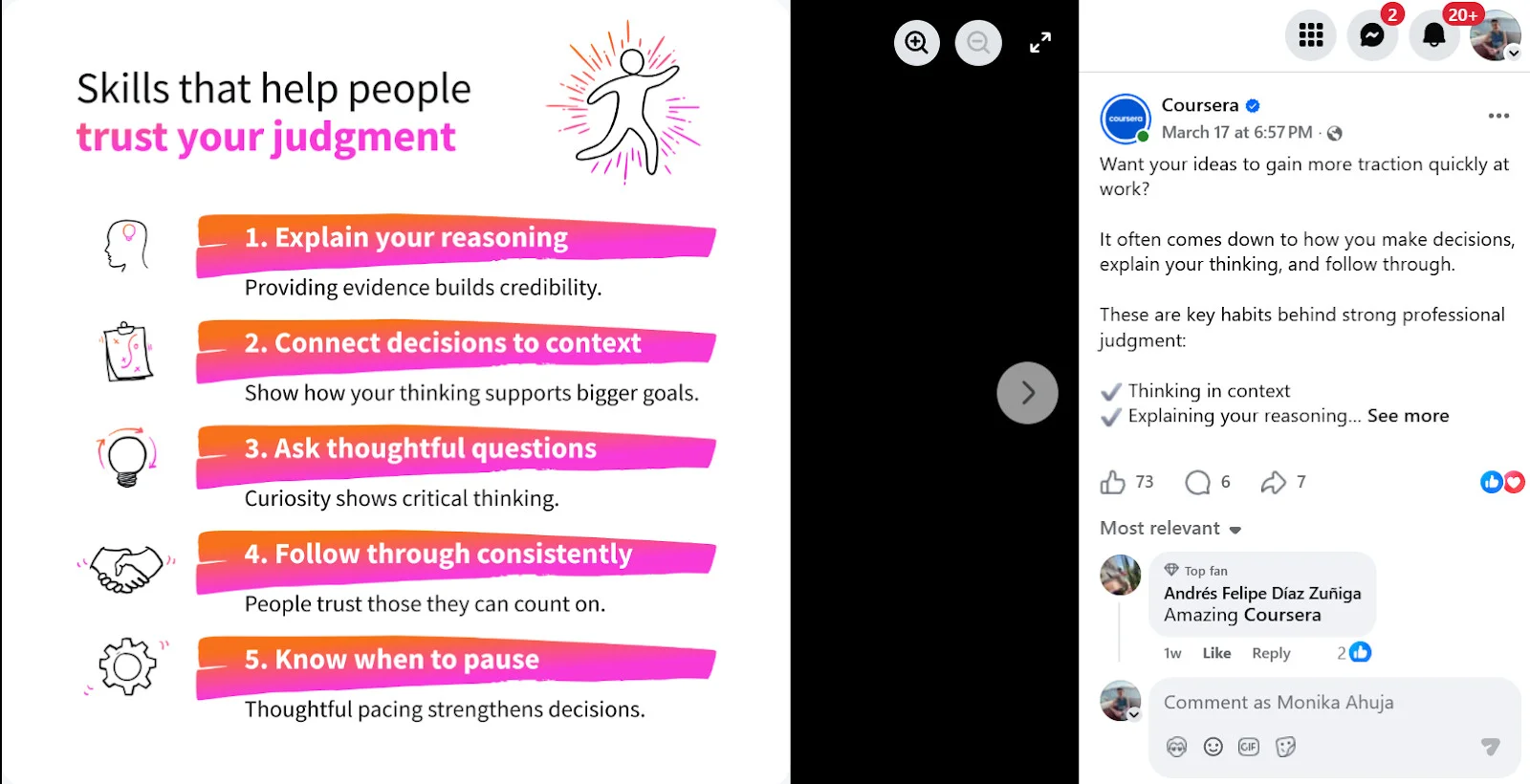
Below is a short, quick tip post by Coursera where they are talking about skills that can help people get more trust and traction at work.
11. Industry News and Insights
Position your brand as a thought leader by being the first to share and contextualize industry news.
Don’t just share the news, add your take. What does this change mean for your audience? How should they prepare?
Here are some ideas on what you can share:
- New platform features or algorithm updates
- Industry reports and survey findings
- Regulatory changes that affect your audience
- Emerging trends in your space
The video below, from Cosmoprof North America, features Social Media Correspondent Emily L. Foley sharing insights on drugstore beauty launches and emerging trends in the beauty industry.
Tip: Set up Google Alerts for key industry terms, so you’re always among the first to report changes.
12. Infographics
Infographics compress complex information into a visually digestible format and are among the most link-worthy content types available. According to DemandSage, incorporating infographics into blog posts and articles can increase inbound external links by 178%, making them a powerful tool for both audience engagement and long-term SEO value.
Here are some Infographic ideas for Facebook:
- Data from a recent industry report visualized
- Step-by-step process breakdowns
- Comparison charts (your product vs. alternatives)
- “By the numbers” posts about your industry
The infographic below by Growth Ideas shows some must-have GPTs for different categories like Productivity, writing, education, and programming.
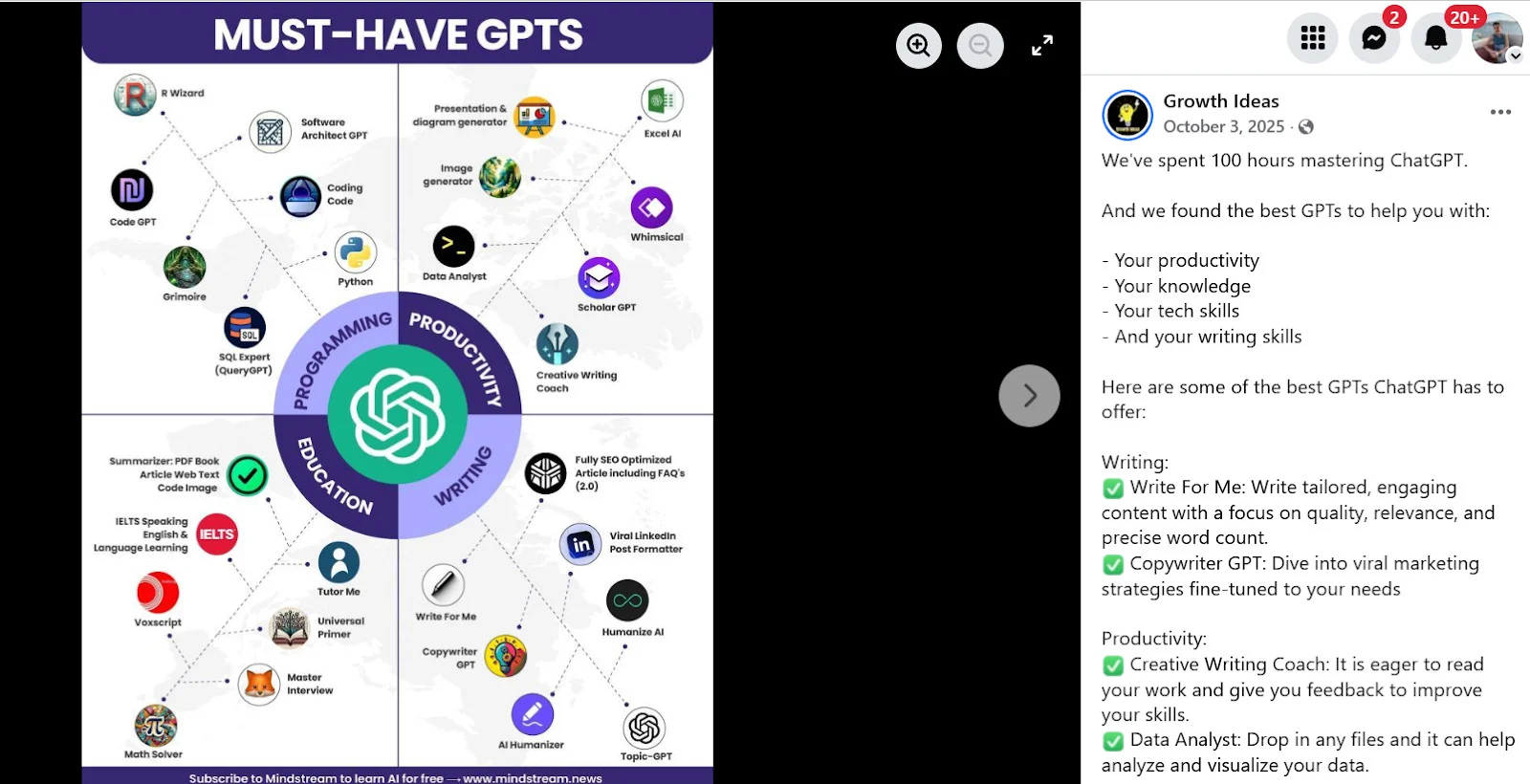
Keep in mind that most people will see your infographic on mobile, so use large fonts, minimal text, and high-contrast colors. Check our guide on different types of social media content for more visual content ideas.
13. Do’s and Don’ts Lists
Simple, scannable, and highly engaging. Do’s and don’ts lists work because they’re immediately practical and often trigger “I’ve been doing it wrong!” reactions that drive comments and shares.
Here are some examples:
- 5 Do’s and Don’ts of [industry topic]
- Common mistakes when [relevant activity] — and what to do instead
- The right way vs. the wrong way to [task]
The post below by Meraskin & Co. talks about the do’s and don’ts of using retinol.
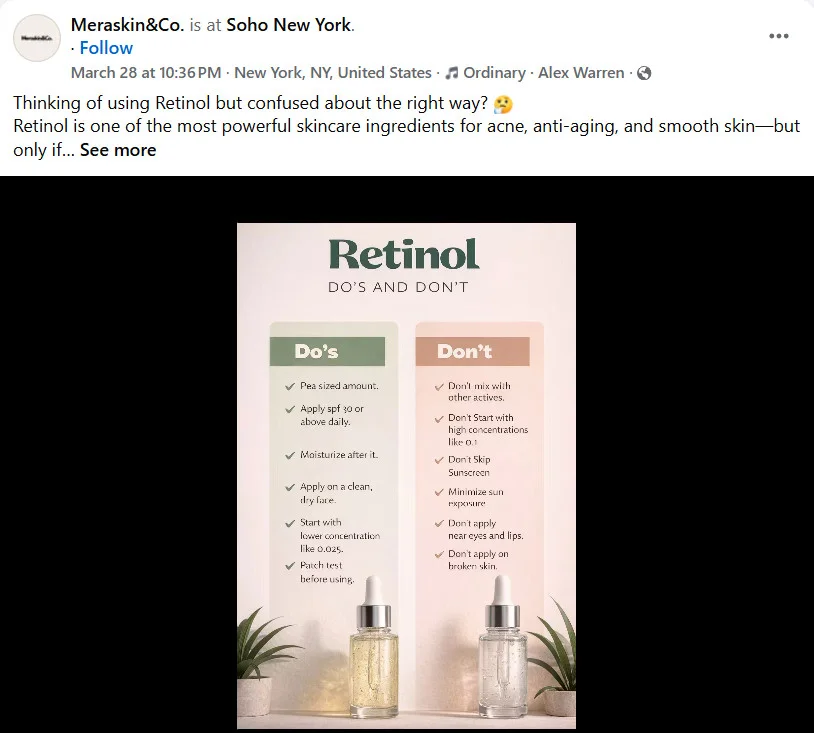
You can format these Facebook posts as carousels, single static images, or even short videos.
If you’re investing in content marketing, your Facebook page should be one of the primary distribution channels for your blog content.
But don’t just drop a link with no context. Instead:
- Write a compelling hook or catchy facebook captions that make people want to click.
- Pull out the most surprising stat or insight from the post.
- Ask a question related to the blog topic.
- Use an eye-catching blog banner image.
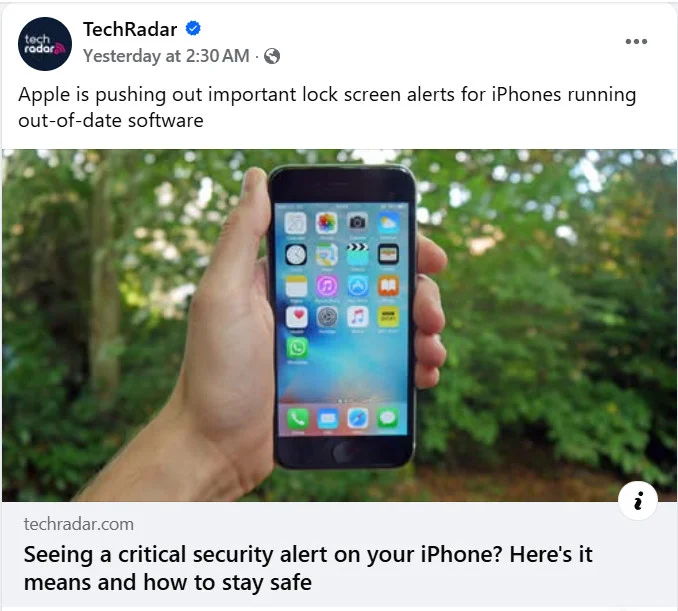
Tech Radar consistently drives traffic from Facebook by pairing blog links with strong hooks and curiosity-driven copy.
Storytelling & Brand-Building Post Ideas
People connect with people, not logos. These Facebook content ideas humanize your brand and build the kind of emotional connection that turns followers into loyal customers.
15. Tell a Brand or Personal Story
Storytelling is an engaging content format that works well on all social media platforms, including Facebook.
Also, brands don’t need hefty video production budgets; the most engaging brand stories are the ones created in simple text formats, a founder sharing why they started the company, and how far they have come.
Below is one such post by Melyssa Griffin, a solopreneur, an educator, and founder of Fable. In her text-based story, she talks about her two years of entrepreneurial journey at Fable.
16. Facebook Reels Showing BTS Content
Pull back the curtain and show your audience what happens when the cameras aren’t rolling (well, metaphorically).
Facebook reels on behind-the-scenes content satisfy curiosity and create a sense of insider access. It makes followers feel like they’re part of your inner circle.
Try the following BTS ideas on Facebook:
- Post about office or workspace tours
- How your product is made or packaged
- Team brainstorming sessions
- Event preparation and setup
- Day in the life of different team members
The below reel is by Brooki bakery Cookies House where the baker shows behind the scenes when making croissant cookies.
17. Employee Spotlights and Team Features
Employee spotlight posts humanize your company and show the world the people behind the product.
Here are some spotlight formats that work well on Facebook:
- “Meet the team” feature with a fun Q&A
- A day in the life of [team member]
- Employee achievements or work anniversaries
- Team photos from events, outings, or casual Fridays
Below is an employee highlight post by Compass Title & Escrow Ltd, where they are praising their brand manager, Jenna Faioli, for her performance.
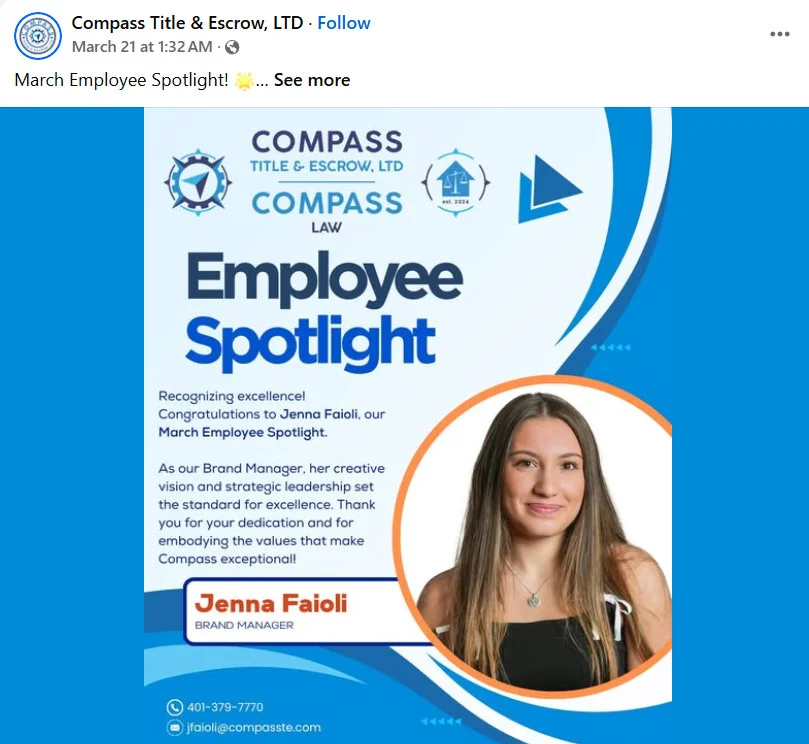
These posts also double as employer branding, because the potential hires get a glimpse of your company culture.
18. Company Milestones and Achievements
Hit 10,000 customers? Celebrate 5 years in business? Won an industry award? Share it.
Milestone posts work because they:
- Create a sense of shared achievement with your community.
- Serve as social proof of your brand’s growth and credibility.
- Give followers a reason to congratulate you (easy engagement)
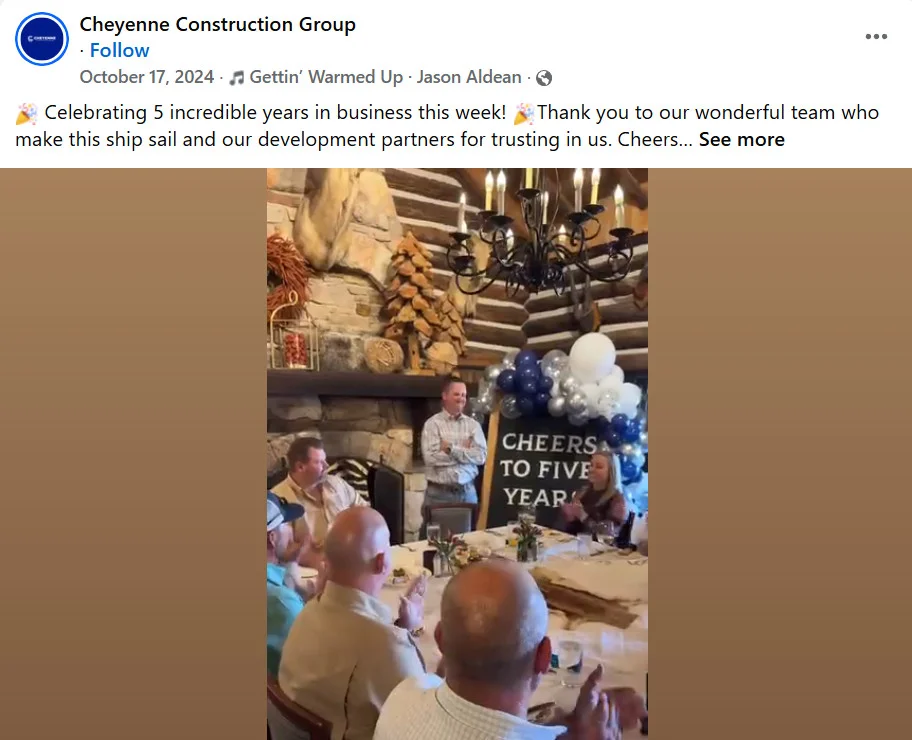
Below is a post by Cheyenne Construction Group where they are celebrating their 5 years in business.
19. Support a Charity or Cause
60% of consumers use Facebook to discover new brands and products. When a brand aligns with a cause, it adds depth and purpose that resonates beyond the product itself.
Here are some tips to do it right:
- Partner with a charity for a specific campaign
- Donate a percentage of sales and share the results.
- Highlight the volunteer work your team has done.
- Amplify causes your audience to care about.
The post below is by The Good Pour, where they talk about a charitable chain reaction every time someone buys from them. Highlighting such causes on your brand page helps your audience develop a real connection with your brand.

Just make sure to be genuine, because audiences can spot performative activism instantly.
Promotional Facebook Post Ideas
Yes, you absolutely should promote your products and services on Facebook. The key is how you do it. These business Facebook post ideas help you sell without feeling salesy.
20. Product Photos and Updates
High-quality product photography remains one of the most effective post types on Facebook. According to Socialinsider’s analysis of Facebook content, photo posts generate 35% more engagement than text-only posts, making visuals a consistent driver of performance on the platform.
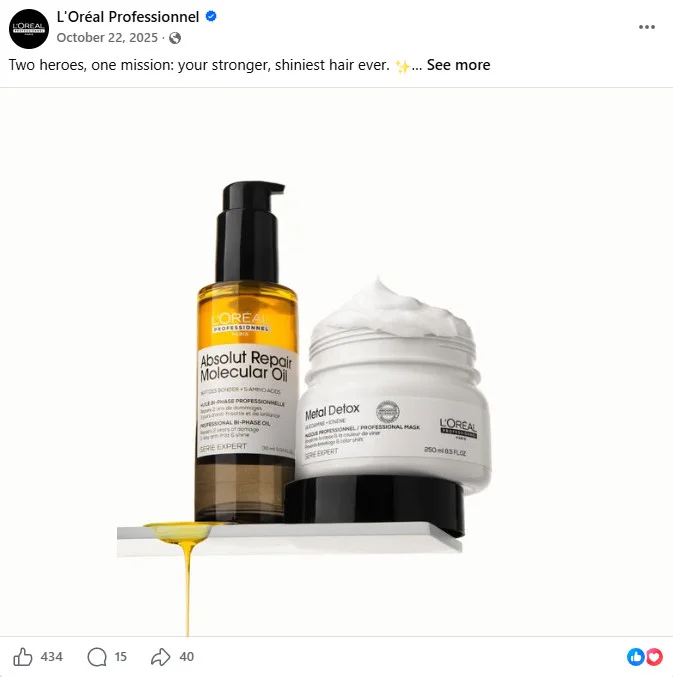
Post lifestyle shots showing the product in use or close-up detail shots that highlight quality. Below is a product shot by L’Oréal Professional showcasing stunning images of their hair care products.
21. Discounts, Sales & Limited-Time Offers
Promotional posts don’t have to be boring. The key is creating urgency and making the offer feel exclusive to your Facebook community.
You can try using promo codes or create bundle deals like “buy one, get one” offers. Pair every discount post with a clear social media call to action.
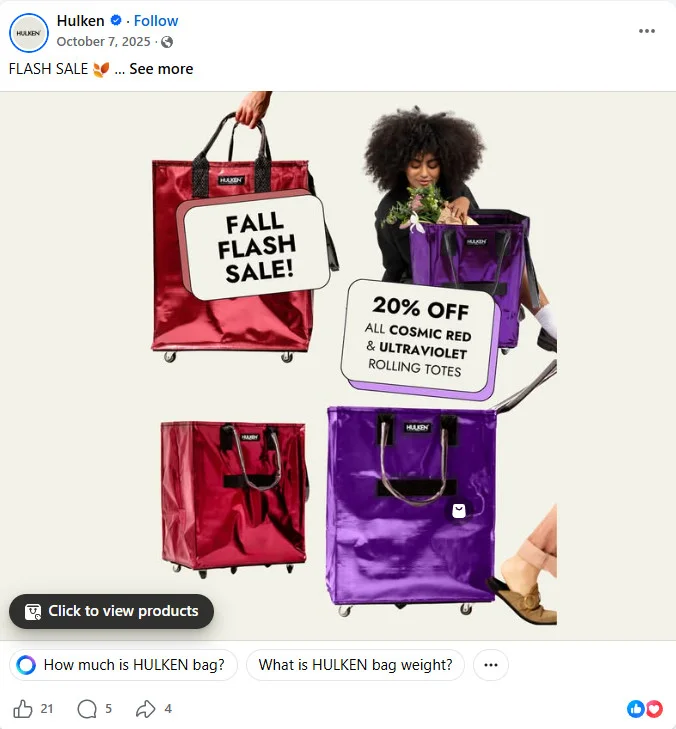
Using CTA’s like “Shop now,” “Click to view products,” or “Use code FB20 at checkout” removes friction and drives clicks. The below flash sale post by Hulken Bags uses a CTA, “Click to view products,” that will take customers to their product page.
22. Shoppable Posts and Facebook Shop
If you’re in e-commerce, Facebook Shop lets customers browse and buy without ever leaving the platform.
To make the shoppable posts work:
- Tag products directly in your post images
- Create themed collections (e.g., “Summer Essentials” or “Gift Guide Under $50”)
- Pair shoppable posts with customer reviews or UGC.
Learn more about setting up your store in our Facebook Commerce Manager guide.
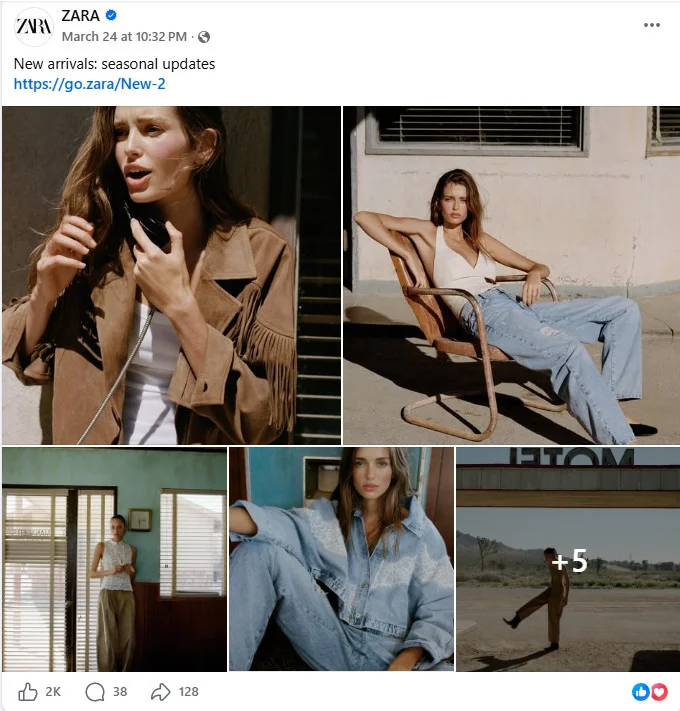
Below is a shoppable post by Zara that showcases their new arrival. They have added their Facebook Shop link, where audiences can explore and buy their collection.
23. Event Announcements and Recaps
Whether it’s a webinar, product launch, grand opening, or industry conference, events give you content for three stages: before, during, and after.
- Pre-event: Build anticipation with countdown posts, speaker reveals, or behind-the-scenes prep
- During the event: Share live updates, quotes, and real-time photos
- Post-event: Recap highlights, share key takeaways, and post attendee testimonials
This three-stage approach gives you multiple pieces of content from a single event.
Below is a pre-event post by Search Engine Journal where they are talking about their upcoming webinar on LLMs.

24. Sneak Peeks at Upcoming Launches
Tease what’s coming next. Sneak peek posts build anticipation and give your audience a reason to keep following you.
Show partially hidden product images, “Coming soon” countdown posts, or short teaser videos to create curiosity. You can also run polls asking your audience to guess what’s launching.
In the teaser video below, Apple announces the launch of its new MacBook Pro with a hidden product image.
Trending & Seasonal Post Ideas
Timeliness is a secret weapon for reach. When you tie your content to what’s already trending or what people are already celebrating, you ride a wave of existing attention.
25. Jump on Trending Topics
When a topic is already trending, the Facebook algorithm gives related content a natural boost. The brands that jump on trends quickly and creatively are the ones that go viral.
Make sure to add a unique angle or your brand’s personality to the trend to make it more relevant.
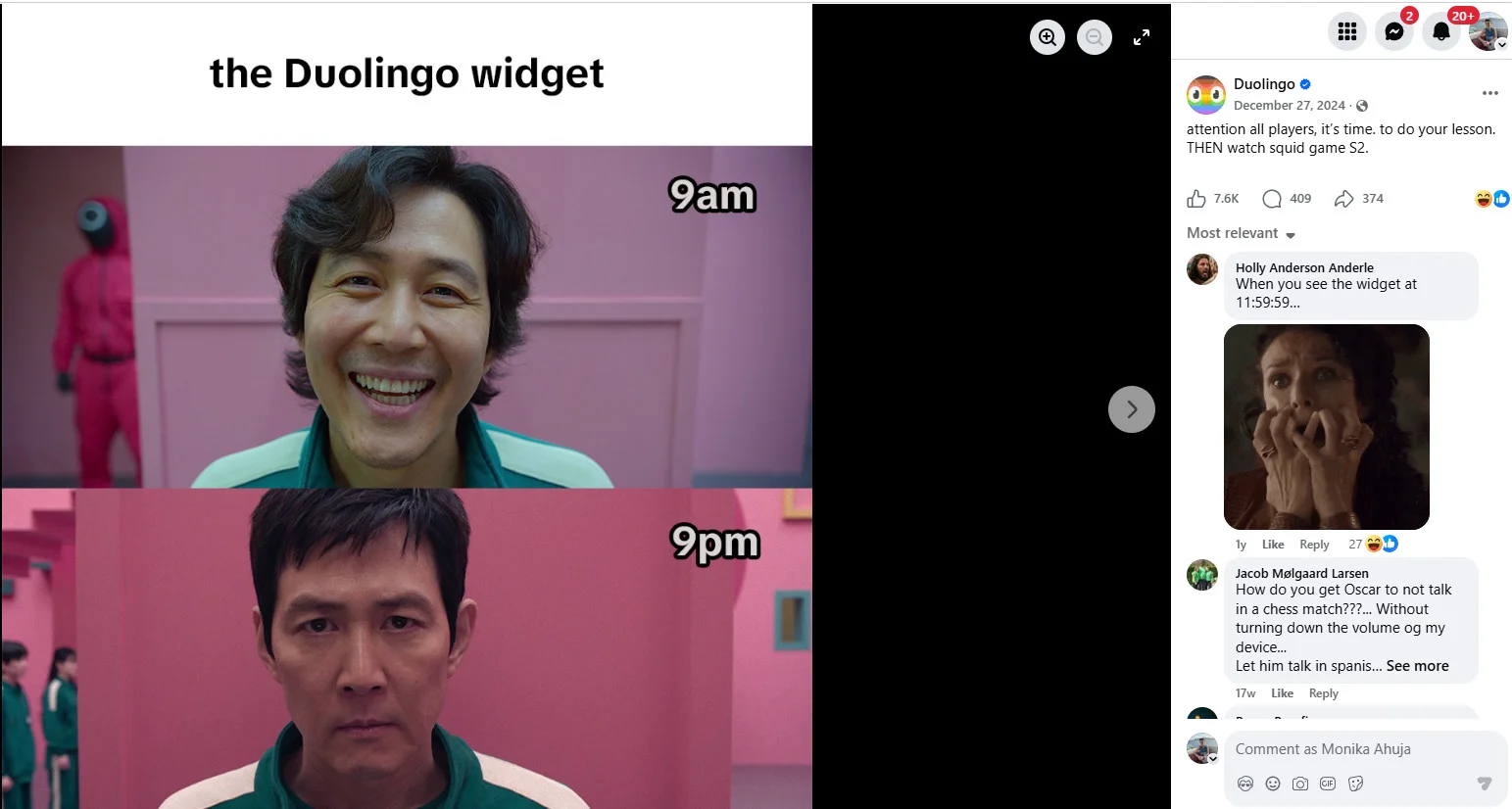
The post below shows Duolingo riding the Squid Game trend on Facebook – the post has over 7500 likes and some amazing comments from their followers.
26. Holiday and Seasonal Posts
Every holiday is a content opportunity — and we’re not just talking about Christmas and Thanksgiving.
You can create an entire social media holiday calendar with a full list of dates on which you can create posts.
Here are some often-overlooked opportunities:
- National Small Business Day
- International Coffee Day
- World Mental Health Day
- Pi Day (March 14)
- National Pet Day, etc
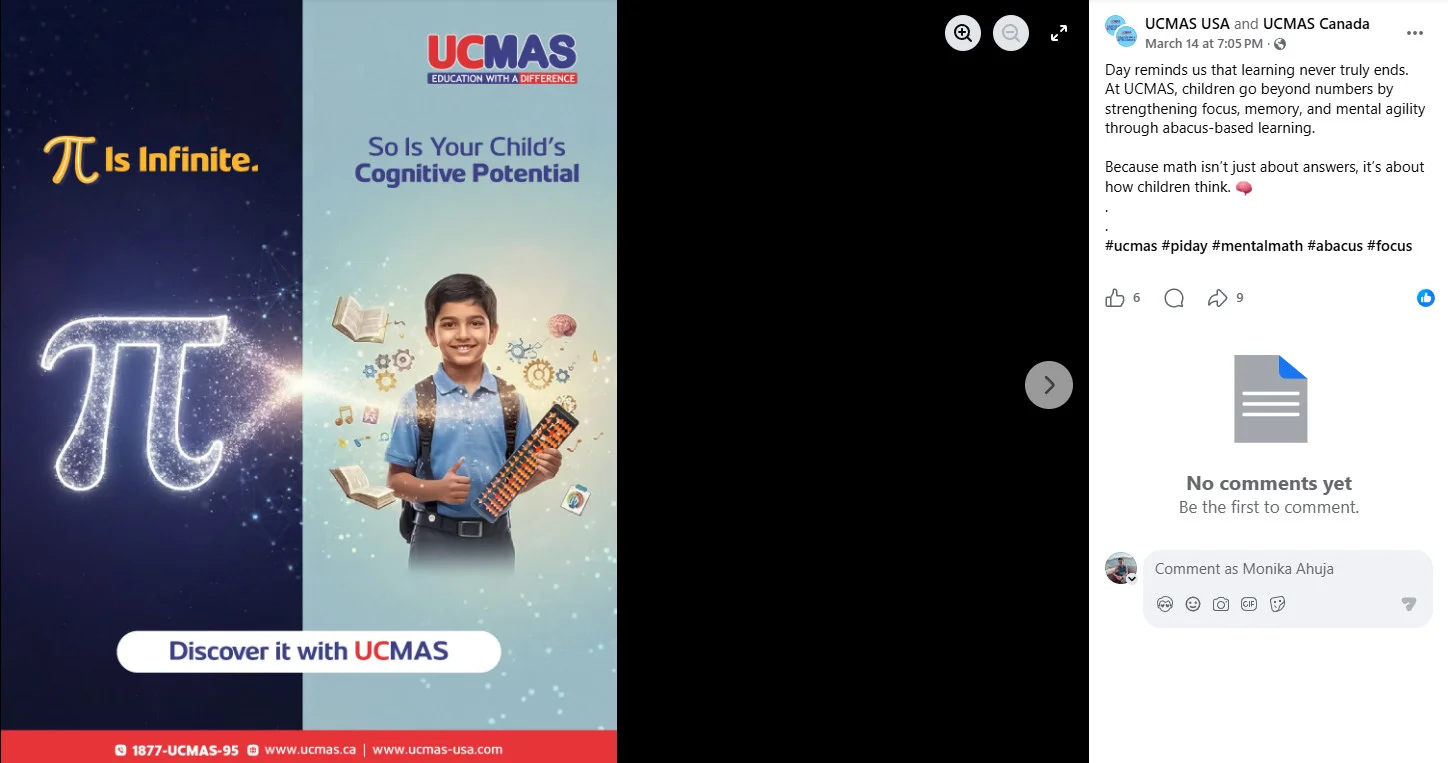
Below is a post by UCMAS celebrating Pi Day, where they talk about building infinite cognitive potential in children, just like the infinite nature of Pi.
27. Pop Culture and Current Events
Pop culture references — when done right — make your brand feel current, relatable, and in touch with what your audience is talking about.
You can create posts around popular TV shows, movie releases, or sports events like the Super Bowl, World Cup, Olympics, etc., like the below post by Disney – which talks about the Oscars.

To understand how you can use both humor and pop culture in your content, read our guide on meme marketing.
28. Create a Themed Post Series
A recurring content series gives your audience something to look forward to and come back for.
Here are some themed post ideas you can try:
- “Tip Tuesday” (weekly industry tip)
- “Feature Friday” (customer or employee spotlight)
- “Monday Motivation” (inspirational quote or story)
- “Throwback Thursday” (brand history or nostalgia content)
- Weekly product spotlight or “product of the week.”
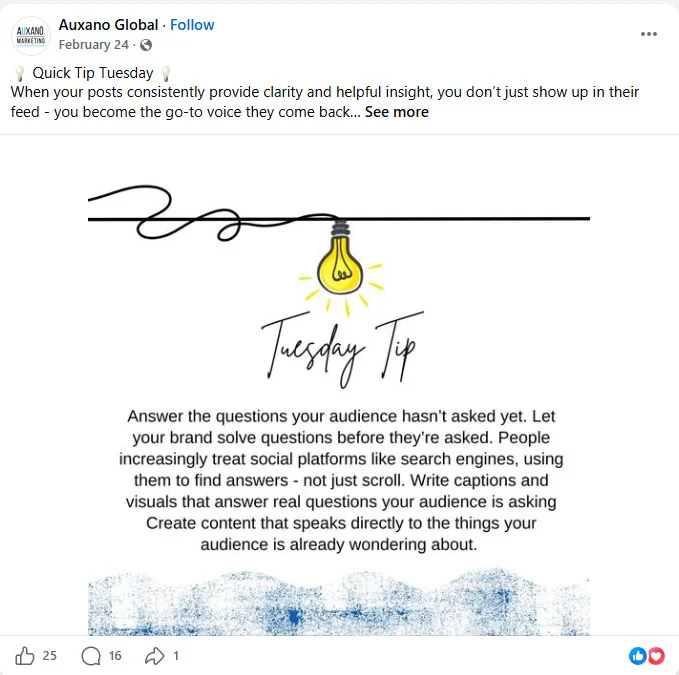
Here’s one such Facebook post example of Tuesday tip by Auxano Global, a marketing agency.
How to Balance Your Facebook Content Mix
Now that you have all the Facebook post ideas to work with, the next question is: how much of each type should you post?
This is where the 80/20 Rule comes in. This content framework suggests that 80% of your posts should deliver value — educate, entertain, inspire, or start conversations; while 20% of them should promote your products, services, or offers.
The rule of thirds is another popular framework that divides your content into three equal buckets: promotional, shared content, and personal interaction.
It suggests that 1/3 of your content should be direct product or service promotion, 1/3 should be shared content from your industry (like articles, insights, reposts), and 1/3 should be interactive, like engagement-driven posts, stories, and community building.
This framework is particularly useful for B2B brands that need to balance thought leadership with lead generation.
How to find your ideal mix:
- Start with the 80/20 rule
- Track engagement by content type using Facebook analytics.
- Identify which categories drive the most reach, comments, shares, and clicks
- Adjust your ratio based on what the data tells you
- Re-evaluate quarterly
The right ratio depends on your industry, audience, and business goals. A D2C e-commerce brand might go heavier on promotional content (70/30), while a B2B SaaS brand might lean toward educational content (85/15).
Tips to Make Your Facebook Posts More Engaging
Great Facebook post ideas are only half the battle. How you execute them matters just as much. Here are six data-backed tips to maximize the impact of every post.
Keep Captions Short (~40 Characters Is the Sweet Spot)
Facebook posts with lengths of 40-80 characters receive 66% higher user engagement than those of other lengths.
But that doesn’t mean every post needs to be short — long-form storytelling posts have their place. But for most Facebook engagement posts, brevity wins. Say what you need to say, and then stop.
For more tips on writing concise, high-impact copy, check out our Facebook captions guide.
Post at Optimal Times for Your Audience
Look for the best times to post on Facebook and post during those slots for maximum engagement. Generally, 9 a.m. and 3 p.m. on weekdays and 10 a.m. to 6 p.m. on weekends work best for most businesses.
Set the Right Posting Frequency
More posts do not always mean more engagement. Our guide on how often to post on social media shows that 2-4 posts per day is the ideal posting frequency for Facebook. But this platform’s algorithm favors consistency over volume, so make sure to be consistent.
We understand that posting 2-4 posts manually every single day can be a hassle.
That’s where SocialPilot comes in. This tool takes care of the execution, so that you can focus on the creative part.
- It helps you generate post ideas and captions using AI Pilot
- Batch-create your content and schedule it for the entire week in advance
- Visualize your entire posting schedule at a glance using its content calendar
- Manage all your Facebook comments, messages, and mentions in one Social Inbox
- And track the performance of your posts using Facebook analytics.
Posting great content is step one. Step two is showing up in the comments. A Buffer study analyzing over 2 million posts suggests that 54% of Facebook Pages performed better when they replied to comments.
The key here is to reply quickly — ideally within the first 60 minutes, because every reply signals the algorithm that your post is generating meaningful conversation.
Use Eye-Catching Visuals
Here’s a striking fact: the human brain processes images in just 13 milliseconds, according to MIT research. That’s faster than a blink.
So, posting a strong visual is your biggest competitive advantage.
When posting visuals:
- Use high-resolution, original images.
- Maintain consistent branding (colors, fonts, logo placement)
- Design for mobile-first — most Facebook browsing happens on phones
- Use video when you can
For more on video formats and specs, check our guide on Facebook video specs.
Write Compelling CTAs
Every post should have a purpose, and every purpose needs a clear call to action.
A CTA doesn’t always mean “Buy now.” It could be:
- “Tell us in the comments.”
- “Tag someone who needs to see this.”
- “Save this for later.”
- “Click the link in comments.”
- “Share if you agree.”
The goal is to tell your audience exactly what you want them to do next. Without a CTA, even the best Facebook posts can fall flat.
Putting the Best Facebook Post Ideas into Action!
The best Facebook pages don’t rely on a single type of post — they mix education, entertainment, engagement, promotion, and storytelling into a content strategy that keeps their audience coming back.
If you are a business looking for Facebook post ideas, this guide can be your playbook. Pick a few ideas from each category, add them to your content calendar, and start testing. Track what works, drop what doesn’t, and refine your mix over time.
And if you want to save hours every week on planning, scheduling, and publishing, start your free 14-day trial of SocialPilot and put your entire Facebook strategy on autopilot.