
LinkedIn marketing tools do different jobs. Some schedule posts for your company page and personal profile, others automate outreach through connection requests and message sequences, and some help you find prospects, verify contact details, or personalize your messages. Choosing the wrong type can leave a gap in your marketing workflow, even if the tool itself works well.
With more than 1.3 billion members, LinkedIn offers businesses a large audience to reach. But growing your presence, generating leads, and starting one-to-one conversations require different approaches.
We compared 13 LinkedIn marketing tools based on their features, pricing, user ratings, and limitations. Whether you want to schedule content, automate outreach, find sales prospects, or personalize your messages, each review explains what the tool does, how it works, and where it fits into your workflow.
How We Evaluated These LinkedIn Marketing Tools
“LinkedIn marketing tool” covers four quite different jobs, and a tool that is excellent at one of them can be useless for the other three. So before comparing anything, we sorted every product by the job it actually does on LinkedIn, then judged it against the questions that matter for that job.
Our Evaluation Criteria
Each tool was scored Full, Partial or None against the same four categories. Those scores appear in the comparison table, and each entry adds a feature-level LinkedIn coverage list.
| Category | What it covers | What we looked for |
| Scheduling and publishing | Planning, writing and posting content to LinkedIn profiles and company pages | Which LinkedIn account types it posts to, bulk scheduling, approvals, post analytics |
| Outreach automation | Connection requests, message sequences and follow-ups sent from a LinkedIn account | Sequence logic, daily limits and account-safety settings, email as a second channel |
| Sales prospecting and data enrichment | Finding the right people and companies, then adding emails, phone numbers or firmographic data | Where the data comes from, how credits work, CRM export |
| Communication insights | Guidance on how a specific person prefers to be written to | What the insight is based on and where it shows up while you write |
How We Fact-Checked Pricing and Features
This roundup is built from research, and we have not run these tools on live campaigns. Every price was read from the vendor’s own pricing page in October, 2026, with the billing unit stated each time, because per-seat and per-account plans in this space look alike until the invoice arrives.
Feature information comes from vendor’s help documentation and website. Ratings are G2’s or other review sites product ratings, linked so you can check it. User quotes come from public reviews on G2, TrustRadius or Trustpilot.
All 13 tools were judged against the same criteria, and each entry names a real limitation, including SocialPilot.
LinkedIn Marketing Tools at a Glance
All 13 tools are listed in review order. The four middle columns are the four LinkedIn jobs from our evaluation criteria, and the price is the cheapest published paid plan with its billing basis.
| Tool | Best for | Scheduling | Outreach | Prospecting | Comms insights | Starting price | G2 rating |
| SocialPilot | Agencies and multi-location brands |  |
 |
|
|
$25.50/mo, billed annually, per plan | 4.5/5 |
| Hootsuite | Enterprise social teams | |
|
|
|
$99/user/mo, billed annually | 4.3/5 |
| Sprout Social | Mid-to-large teams | |
|
|
|
$79/seat/mo, billed annually | 4.4/5 |
| Lemlist | Email-to-LinkedIn sequences | |
|
 |
|
$87/user/mo for LinkedIn steps, billed annually | 4.6/5 |
| PhantomBuster | LinkedIn data extraction | |
|
|
|
$56/mo, billed annually, per account | 4.4/5 |
| Expandi | Cloud-based automation | |
|
|
|
$79/seat/mo, billed annually | 4.3/5 |
| Dripify | Sales prospecting automation | |
|
|
|
$59/user/mo, billed annually | 4.5/5 |
| RocketReach | Contact and email discovery | |
|
|
|
$33/user/mo, billed annually | 4.4/5 |
| Salesloft | Sales engagement at scale | |
|
|
|
Quote only | 4.5/5 |
| LinkedIn Sales Navigator | Native LinkedIn prospecting | |
|
|
|
$119.99/license/mo, billed monthly | 4.4/5 |
| Dux-Soup (now STACKED) | Solo users and small teams | |
|
|
|
$41.25/seat/mo, billed annually | 4.4/5 |
| Leadfeeder (by Dealfront) | Website visitor companies | |
|
|
|
€79/mo, billed annually | 4.3/5 |
| Crystal | Personality-driven messaging | |
|
|
|
$49/person/mo | 4.6/5 |
Note: Vendors change plans without notice, so confirm on the pricing page before you buy.
The 13 Best LinkedIn Marketing Tools, Reviewed
1. SocialPilot
Best for Agencies, SMBs, and Multi-Location Brands
Ratings:
4.5/5 on G2
LinkedIn coverage
- LinkedIn profile and company page publishing:

- Bulk scheduling: (CSV upload, up to 500 posts)
- Carousel posts: (up to 30 images)
- Post approval workflow: (clients approve without a login)
- White-label client reports:
- Connection requests and DM sequences:
- Contact data:
SocialPilot is built for teams that publish to many LinkedIn profiles and company pages and need a client or manager to approve each post before it goes live.
What it actually looks like
You pick a LinkedIn profile or company page, write the post and choose a date and time. Before you schedule it, you can add a first comment, tag people with LinkedIn mentions, or attach a carousel of up to 30 images. For a month of posts, upload a CSV with up to 500 of them at once. Every post lands on one calendar, and you drag a post to a new day to reschedule it. All of this happens in SocialPilot’s LinkedIn scheduler.
“If you’re managing multiple social media accounts and need an efficient way to schedule content in bulk, SocialPilot is an excellent choice.” (Jessica D., G2 review)
What it does well
Approvals and reporting are built for people outside your team. A client reviews and approves posts from their phone without a login, and LinkedIn results turn into white-label PDF reports that can go out by email on a schedule.
Pricing
SocialPilot’s plans start at $30/month on the Essentials tier and scale through Standard, Premium, and Ultimate for larger agencies, with a 14-day free trial and no card required.
What running SocialPilot standalone requires
Anything one-to-one means a second tool. SocialPilot sends no connection requests, runs no DM sequences and finds no emails or phone numbers, so a sales team still needs one of the outreach or prospecting tools below.
Best for
An agency account lead or in-house social manager with a team of three to six, posting to 15 to 25 LinkedIn profiles and pages for different clients or locations, where every post needs a sign-off first.
| Ultimate | Premium | Standard | Essentials |
$170.00/mo$200
Billed annually (Save 15%)
|
$85.00/mo$100
Billed annually (Save 15%)
|
$42.50/mo$50
Billed annually (Save 15%)
|
$25.50/mo$30
Billed annually (Save 15%)
|
|
Streamline Social Media Management
|
|||
2. Hootsuite
Best for Enterprise-Level Social Media Management
Ratings: 4.3/5 on G2
LinkedIn coverage
- LinkedIn profile and company page publishing:
- Calendar/planner: (Planner)
- Bulk scheduling: (Bulk Composer, up to 350 messages)
- Post approval workflow: (Advanced plan and up)
- Social listening: (advanced listening on Enterprise)
- Connection requests and DM sequences:
Hootsuite charges for every person who uses it, not for every account you connect. That pricing model alone decides whether it fits your team.
What it actually looks like
You connect your LinkedIn profile and company pages once, then open Planner, Hootsuite’s content calendar. Click an empty time slot in the week view, and the composer opens with that date and time already filled in. To move a scheduled post, drag it to another slot. For more than a handful of posts, Bulk Composer lets you upload up to 350 at a time.
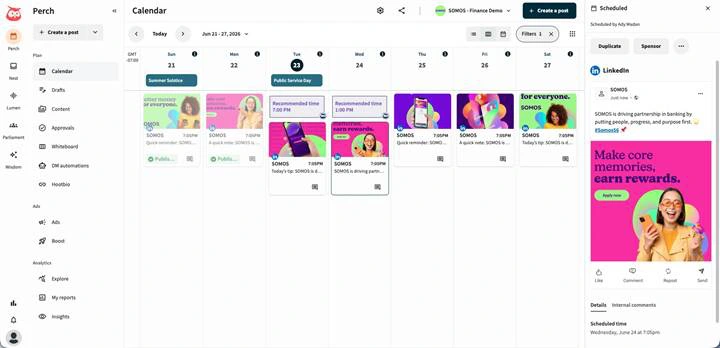
Hootsuite content calendar with scheduled posts across networks and a LinkedIn post preview open
“Not a fan of the price. It used to be more affordable, but now is more than double what it used to be.” (Verified User in Marketing and Advertising, G2 review)
What it does well
The higher plans suit large teams. Professional removes the limit on how many social accounts you can connect. Advanced adds post approvals, message routing (sending each incoming message to the right person) and team performance reports. Enterprise adds single sign-on (SSO), advanced social listening and the compliance controls a regulated company’s IT team will ask for.
Pricing
Standard costs $99 per user per month, billed annually. Professional is $199 and Advanced is $399 per user per month, and Enterprise is priced on quote. There’s a 14-day free trial but no free plan.
What running Hootsuite standalone requires
Expect the bill to grow with every person you add. Three people on Professional cost $597 a month on an annual contract, and approvals only come with Advanced plan. Hootsuite doesn’t send outreach messages either. Smaller teams that mainly need LinkedIn posting usually look at alternatives to Hootsuite first.
Best for
A social media manager at a large company whose team needs approvals, message routing and SSO, and whose software budget is set per employee rather than per channel.
3. Sprout Social
Best for Mid-to-Large Businesses and Agencies
Ratings: 4.4/5 on G2
LinkedIn coverage
- LinkedIn page publishing and scheduling:
- LinkedIn page reporting: (LinkedIn Pages Report)
- Audience demographics: (not available through LinkedIn’s API)
- Competitor reports: (Professional plan and up)
- Multi-profile management: (5 social profiles below Professional)
- Connection requests and DM sequences:
Reporting is where Sprout Social earns its price, and its LinkedIn page reports are the main reason to pick it.
What it actually looks like
Once your LinkedIn page is connected, go to the Reports tab. Under Profiles by Network, open the LinkedIn Pages Report to see results for your page. Next to it sits the Profile Performance report, which compares all your networks, with LinkedIn shown as one line on the chart. You’ll notice one gap early on. You can’t break results down by country, gender or age, because LinkedIn’s API doesn’t share that data.
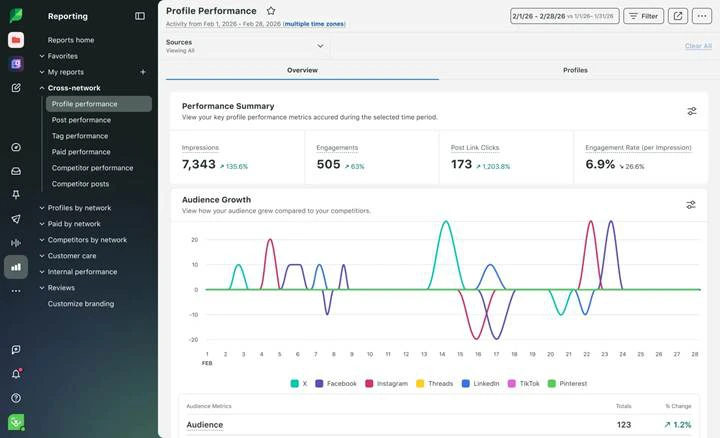
Sprout Social Profile Performance summary dashboard with LinkedIn included in the network legend
“I love that Sprout Social was easy to set up and allows for easy posting/scheduling. The tool is very user-friendly and it didn’t take long to grasp its use.” (Ashley E., G2 review)
What it does well
The higher plans add the kind of analysis a marketing lead brings to a quarterly review. Professional adds competitor reports and paid performance insights. Advanced adds API access, helpdesk integrations and spike alerts, which tell you when mentions suddenly jump.
Pricing
Essentials costs $79 per seat per month, billed annually ($99 billed monthly). Advanced, the top plan, is $399 per seat. The 30-day free trial doesn’t need a card.
What running Sprout Social standalone requires
Costs jump when you add a sixth profile. The two lower plans allow only five social profiles, so an agency that signs a sixth client has to move to Professional at $299 per seat. Four seats on Professional cost $1,196 a month, billed annually. Teams that reach that limit often compare alternatives to Sprout Social before they upgrade.
Best for
A marketing lead at a mid-size company with a team of three to ten, who reports paid and organic LinkedIn page results to leadership every month.
4. Lemlist
Best for Cold Outreach and Email-to-LinkedIn Sequences
Ratings: 4.6/5 on G2
LinkedIn coverage
- LinkedIn steps in sequences: (Multichannel plan only)
- Connection invites and chat messages: (chat reaches 1st-degree connections only)
- InMail steps: (needs LinkedIn Premium)
- Email and LinkedIn in one sequence:
- LinkedIn lead export:
- Company page publishing:
In Lemlist, a LinkedIn invitation is one more step in an email sequence, sitting between the second follow-up and the third.
What it actually looks like
In Lemlist, LinkedIn actions fit directly into your email sequences. Click Add step and choose an action such as Visit profile, Invitation, Chat message, Voice message, AI Voice message, or InMail.
You can add a Has LinkedIn URL condition to skip leads without a profile, then follow an invitation with an Accepted invite condition and a waiting period to branch the sequence based on the response. Lemlist recommends waiting three to five days before checking whether an invitation was accepted.
Keep the limits in mind: chat messages reach first-degree connections only, invitation notes are capped at 200 characters, and free LinkedIn accounts get three custom-note invitations per month.
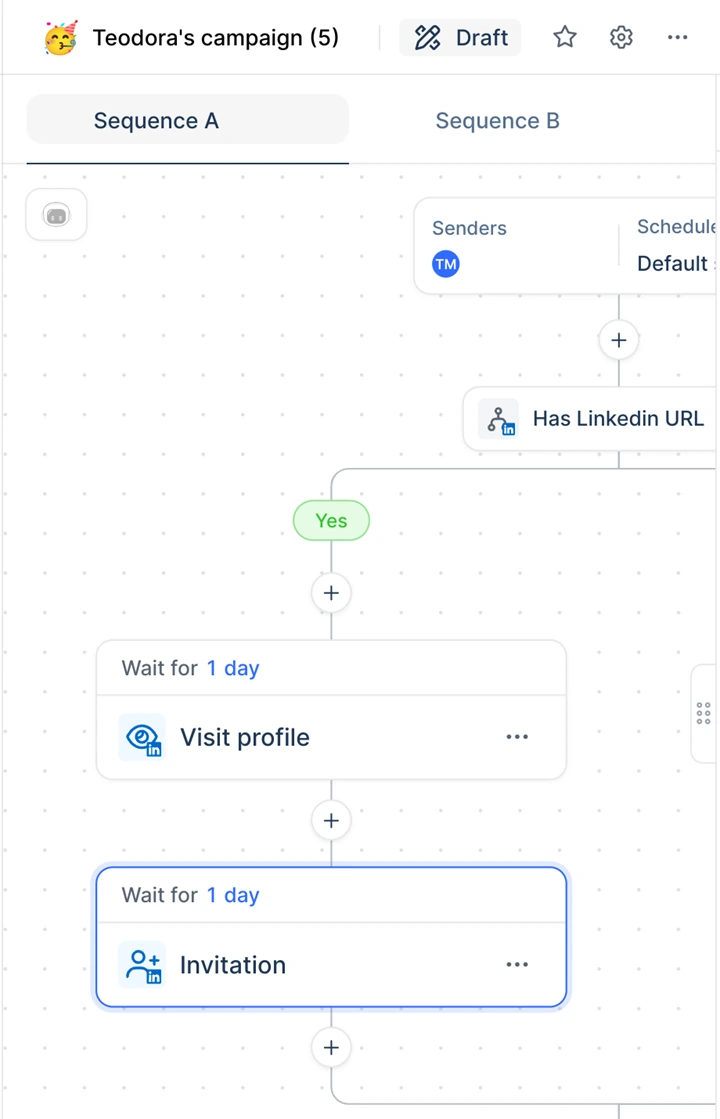
Lemlist sequence canvas with a Has LinkedIn URL condition, a Visit profile step and an Invitation step
“I successfully always booked 5 meeting a week with my Deliverability just because of LemWarm.” (Lennard Maneja, TrustRadius review)
What it does well
Email and LinkedIn run in one sequence, so nobody has to move leads around by hand. A lead who accepts your invitation gets a LinkedIn message, and a lead who ignores it keeps getting emails. Even the cheaper Email plan allows unlimited email senders, which helps if you send from several domains.
Pricing
LinkedIn steps need the Multichannel plan, at $87 per user per month billed annually ($109 billed monthly). The Email plan costs $55 but has no LinkedIn steps. Both come with a 14-day free trial.
What running Lemlist standalone requires
First, you need the Multichannel plan, because the Email plan can’t run LinkedIn steps. InMail steps also need a LinkedIn Premium account on the profile that sends them. Lemlist doesn’t post to your company page, so you still need a scheduler for your brand’s LinkedIn presence.
Best for
A founder or sales lead with one to five reps who books meetings from cold lists. If a prospect ignores two emails, they get a LinkedIn invitation on day four.
5. PhantomBuster
Best for LinkedIn Data Extraction and Automation
Ratings: 4.4/5 on G2
LinkedIn coverage
- LinkedIn search export:
- Profile scraping and email enrichment: (email credits on every plan)
- Auto Connect and messaging: (single automations chained in Workflow Builder)
- Scheduled runs: (repeat launches on a timer)
- Pipeline or CRM view: (results come as CSV files)
- Company page publishing:
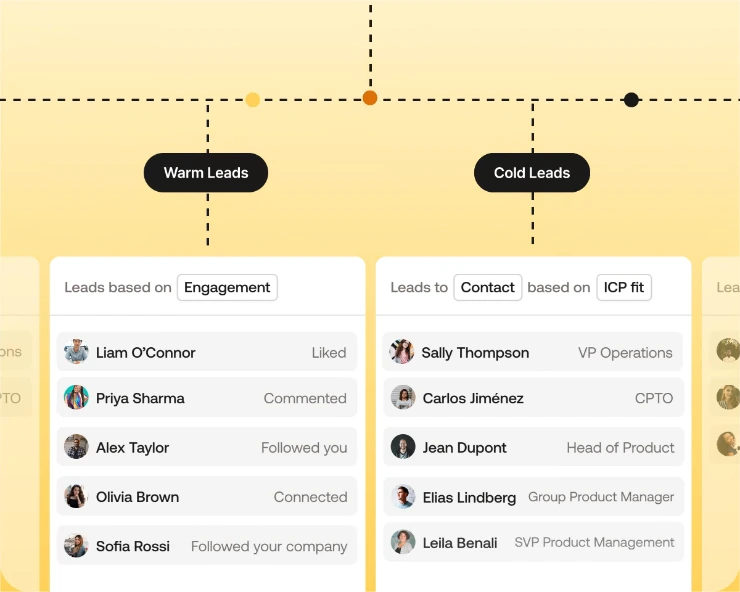
PhantomBuster is a library of small automations. Each one does a single LinkedIn job, such as exporting a search, runs on a schedule and gives you the results as a spreadsheet.
What it actually looks like
Install the browser extension, then go to Automations > LinkedIn > LinkedIn Search Export and click Use this automation. Click Connect to LinkedIn so PhantomBuster can use your logged-in session. Paste the URL of a LinkedIn search you’ve already run, and set how many results to export each time it runs. For a test, choose Run Once > Manual and click Launch, and the console shows each step as it happens. When the test works, switch the launch setting to Repeatedly. Your results wait in the Results tab, where you click Download CSV.
“We used two templates mostly, the Linkedin search scraper, and the Google Maps scraper.” (Carlos Fernando Morales, TrustRadius review)
What it does well
Every plan includes unlimited users. Your whole growth team shares the same automation slots and run time, and nobody needs a seat of their own. The automations also go well beyond LinkedIn, which is why the reviewer above runs a Google Maps scraper from the same account.
Pricing
Start costs $56 a month, billed annually, for the whole account with unlimited users. Scale, the top plan, costs $352 a month. The 14-day free trial doesn’t need a card.
What running PhantomBuster standalone requires
You decide how much to send, and LinkedIn doesn’t publish an official connection limit to guide you. A new account should send about 40 to 60 connection requests a week in its first month. If you ignore LinkedIn’s warnings, you risk a permanent ban. You also only get raw CSV files with no pipeline view, so you need a CRM or a sequencer for the follow-up.
Best for
A growth marketer or ops lead who is comfortable in spreadsheets and needs a few thousand LinkedIn profiles exported and enriched each month, for someone else to contact.
6. Expandi
Best for Cloud-Based LinkedIn Automation
Ratings: 4.3/5 on G2
LinkedIn coverage
- Connection requests and messages:
- Conditional campaign builder: (If visited, If connected, If email opened)
- Email steps: (inside the same campaign)
- Dedicated IP per account: (country-based)
- White-label workspace: (Agency plan, 10+ seats)
- Company page publishing:
Expandi sells account safety as a main feature. That tells you how real the risk of a LinkedIn restriction is for every outreach tool in this group.
What it actually looks like
You build each campaign on a visual canvas. For example, start with Visit Profile, add the condition If visited your profile, then add a Connection request. On the branch where the lead visited your profile back, add a Skill endorsement. Other conditions include If connected, If email opened, If Open InMail and If post liked, so one campaign can move between LinkedIn and email based on what the lead did last.
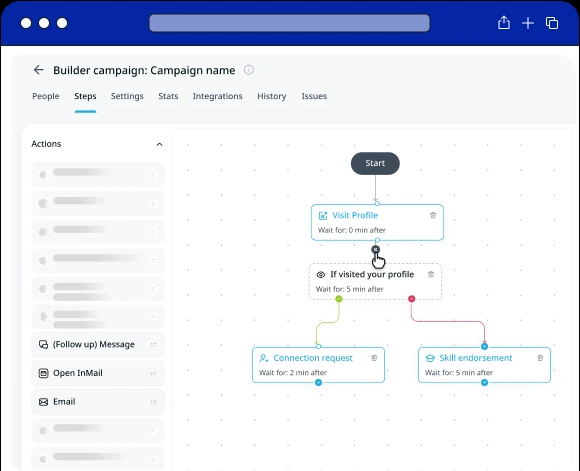
Expandi campaign builder with Visit Profile, an If visited your profile condition, a Connection request and a Skill endorsement step
“We used expandi for linkedin and we lost our account” (Sam Tabani, one-star Trustpilot review)
What it does well
Its safety features are specific. Each LinkedIn account gets its own IP address from a country you choose, new accounts are warmed up automatically, and you set daily activity limits for each account. Everything runs in the cloud, so campaigns keep going after you close your laptop.
Pricing
Business costs $79 per seat per month, billed annually ($99 billed monthly), with one LinkedIn account per seat. The Agency plan starts at 10 seats and is priced on quote. There’s a 7-day free trial.
What running Expandi standalone requires
The safety features lower your risk, but they can’t remove it. Expandi’s own terms say you use it at your own risk, and Trustpilot reviewers describe account restrictions. One says the software got them banned several times. Keep your daily volumes low, and never connect a LinkedIn profile you can’t afford to lose.
Best for
An outreach agency owner running campaigns from ten or more client LinkedIn accounts, where each account needs its own IP address and each client sees a white-labelled workspace.
7. Dripify
Best for LinkedIn Sales Prospecting Automation
Ratings: 4.5/5 on G2
LinkedIn coverage
- Connection invites and messages:
- Accepted and not-accepted branching:
- Email finding: (100 credits a month on Pro)
- Team management: (Advanced plan)
- Editing live campaigns: (add actions only, and can remove certain steps from active and paused campaigns)
- Company page publishing:
Each Dripify campaign is built around one question about every lead: did they accept your invitation or not?
What it actually looks like
Start from a template or a blank sequence, and add actions with the plus icon: View profile, Like a post, Follow, Message, Endorse or Withdraw. Two actions split the sequence into two paths, Send Invite and Find Email. After an invitation, for example, the canvas shows an accepted path and a not-accepted path, each with its own follow-ups. Two rules catch most new users. A sequence can’t start with a delay, and every path has to have an end before the campaign will launch.
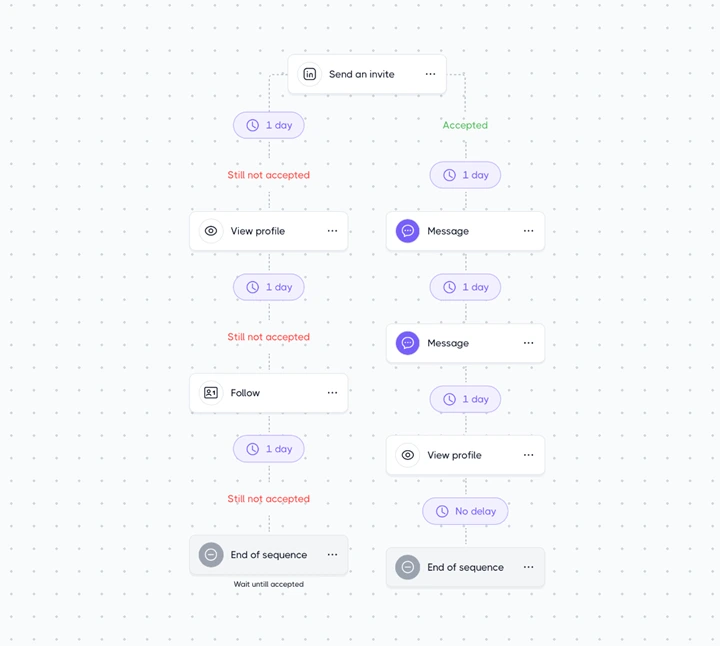
Dripify sequence canvas with a Send an invite step splitting into accepted and not accepted branches, followed by View profile, Message and Follow
“The tool is like an autopilot for linkedin reachout which focuses on automation.” (Verified User, TrustRadius review)
What it does well
Dripify is priced and organised around the individual sales rep. Each seat connects one LinkedIn account. The Advanced plan adds team management, so a sales manager can see every rep’s campaigns in one place, plus extra protection for each LinkedIn account.
Pricing
Pro costs $59 per user per month billed annually ($79 billed monthly), and Advanced costs $79 ($99 billed monthly). Each seat covers one LinkedIn account. The 7-day free trial doesn’t need a card.
What running Dripify standalone requires
Plan your sequence fully before you launch it. Once a campaign is live, you can add actions but not remove them. If a message has a mistake, leads already on that path will still get it. Dripify also doesn’t post to your company page.
Best for
A sales manager with two to five reps, each working from their own LinkedIn account, who wants every accepted invitation to move straight into a message sequence the manager can track.
8. RocketReach
Best for Contact and Email Discovery
Ratings: 4.4/5 on G2
LinkedIn coverage
- Email lookup: (every plan)
- Phone numbers: (Pro plan and up)
- Chrome extension on profiles:
- Export allowance: (1,200 a year on Essentials)
- Messaging and sequences:
- Company page publishing:
You found the right person on LinkedIn, and RocketReach fills in the email address LinkedIn keeps hidden.
What it actually looks like
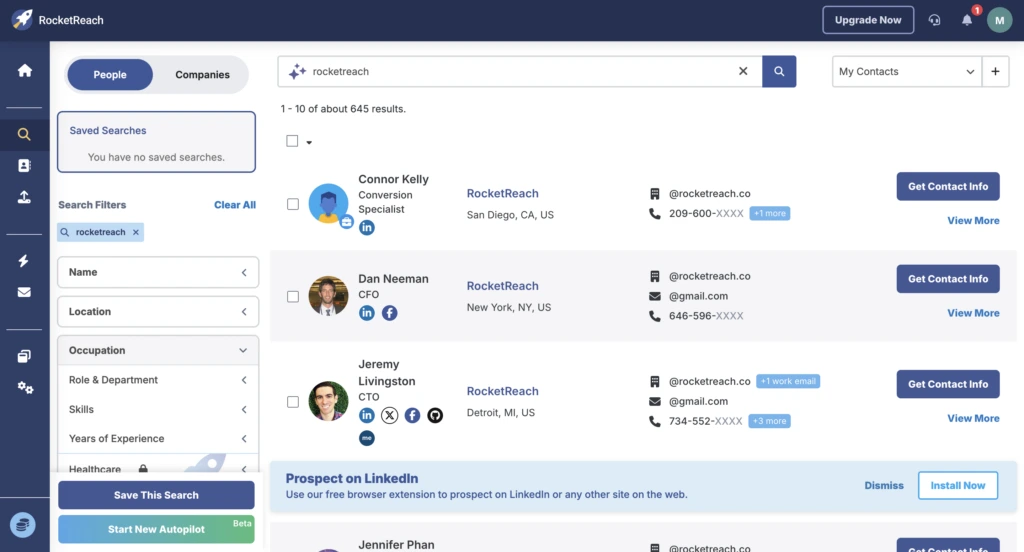
Install the RocketReach Chrome extension and keep prospecting the way you already do, on LinkedIn profiles and company websites. When you open someone’s profile, the extension shows the email address and social links RocketReach has for that person.
RocketReach says it finds contact details for 85% or more of prospects and checks each email in real time to confirm it can receive mail. Every contact you save counts as one export against a yearly limit. On Essentials, that means 1,200 contacts to spread across twelve months, and none of them include phone numbers.
“Many of the leads were either overcalled or the contact information was incorrect. I don’t like spinning my wheels.” (Carl S. on G2)
What it does well
It turns a name and a company into a usable contact record in seconds. The free account’s five lookups let you test its accuracy on your own target list before you pay.
Pricing
Essentials costs $33 per user per month, billed annually ($399 a year), and includes 1,200 exports. Phone numbers start on Pro at $75 a month. The free account includes five lookups.
What running RocketReach standalone requires
RocketReach stops once it gives you an email address. You’ll need another tool to write the message, send it, follow up and track replies. Bounced emails still use up exports, so verify addresses before a large send.
Best for
A two-person sales team that already knows its target accounts and needs about a hundred verified emails a month, not another sequencing tool.
9. Salesloft
Best for Sales Engagement at Scale
Ratings: 4.5/5 on G2
LinkedIn coverage
- LinkedIn steps in cadences: (needs a Sales Navigator license)
- InMail and connection requests: (sent through Sales Navigator)
- Email and call steps:
- Work inside Salesforce:
- Company page publishing and analytics:
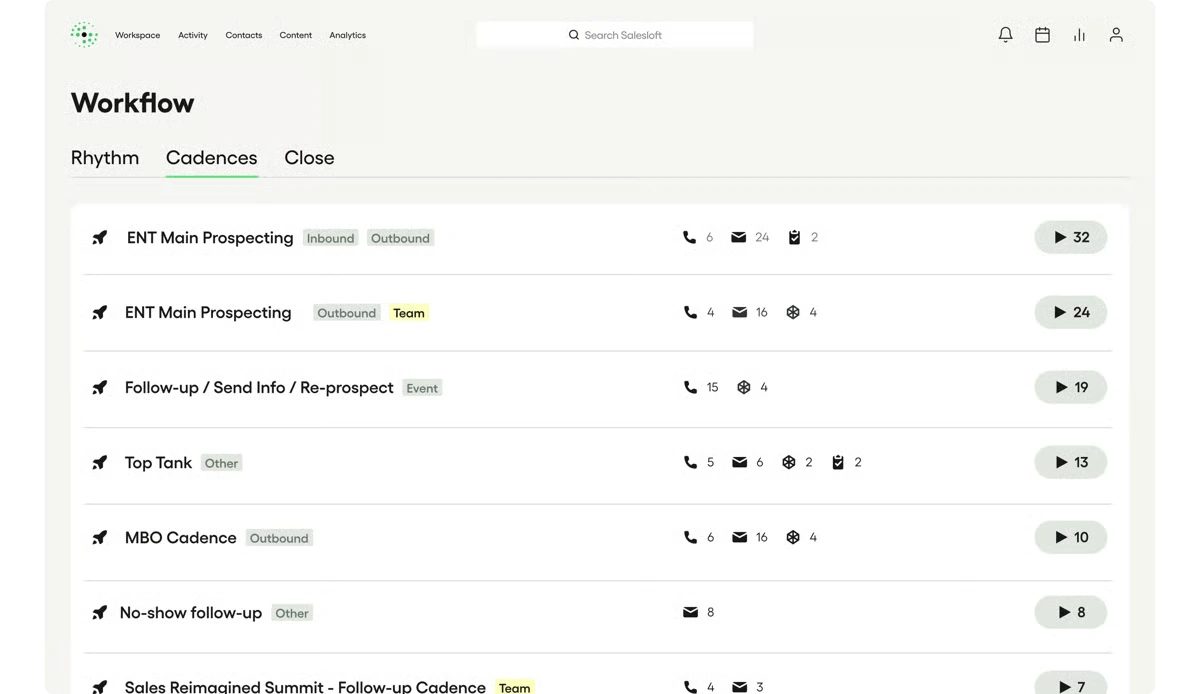
Salesloft is built for sales teams, not marketing teams. LinkedIn is one channel in a cadence (Salesloft’s word for a sequence) that also sends emails and schedules calls.
What it actually looks like
You plan the cadence day by day and add LinkedIn Sales Navigator steps between your emails and calls. There are three LinkedIn step types: research a prospect’s profile, send an InMail, or send a connection or introduction request. Reps work these steps in Salesloft or directly inside Salesforce. None of the LinkedIn steps work without a Sales Navigator account.
“I love the email tracking feature, and the calendar integration is really helpful. When prospects reschedule through the link, it automatically updates on my calendar, which saves a lot of time.” (Roselle P. on G2)
What it does well
Every touchpoint your team makes sits in one ordered cadence. A manager can see that the InMail went out on day three and that the follow-up call is due on day five.
Pricing
Salesloft doesn’t publish prices. Every plan is quoted after a demo, and the Sales Navigator license needed for LinkedIn steps costs extra.
What running Salesloft standalone requires
You’ll need two more subscriptions: a Sales Navigator license for the LinkedIn steps and a CRM to store your records. That makes three contracts in total. Salesloft also doesn’t post to your company page or report on how your posts performed.
Best for
A sales manager running eight or more SDRs on Salesforce who needs every email, call and InMail in one cadence that can be reviewed later.
10. LinkedIn Sales Navigator
Best for Native LinkedIn Prospecting
Ratings: 4.4/5 on G2
LinkedIn coverage
- Lead and account search: (more than 50 filters)
- Job change and buyer intent signals:
- Saved-search alerts:
- InMail:
- CRM integration: (Advanced Plus only)
- Automated sequences:
- Email addresses:
Sales Navigator is LinkedIn’s own prospecting tool. Every other prospecting tool on this list works around LinkedIn’s limits, while this one gives you official access to LinkedIn’s data.
What it actually looks like
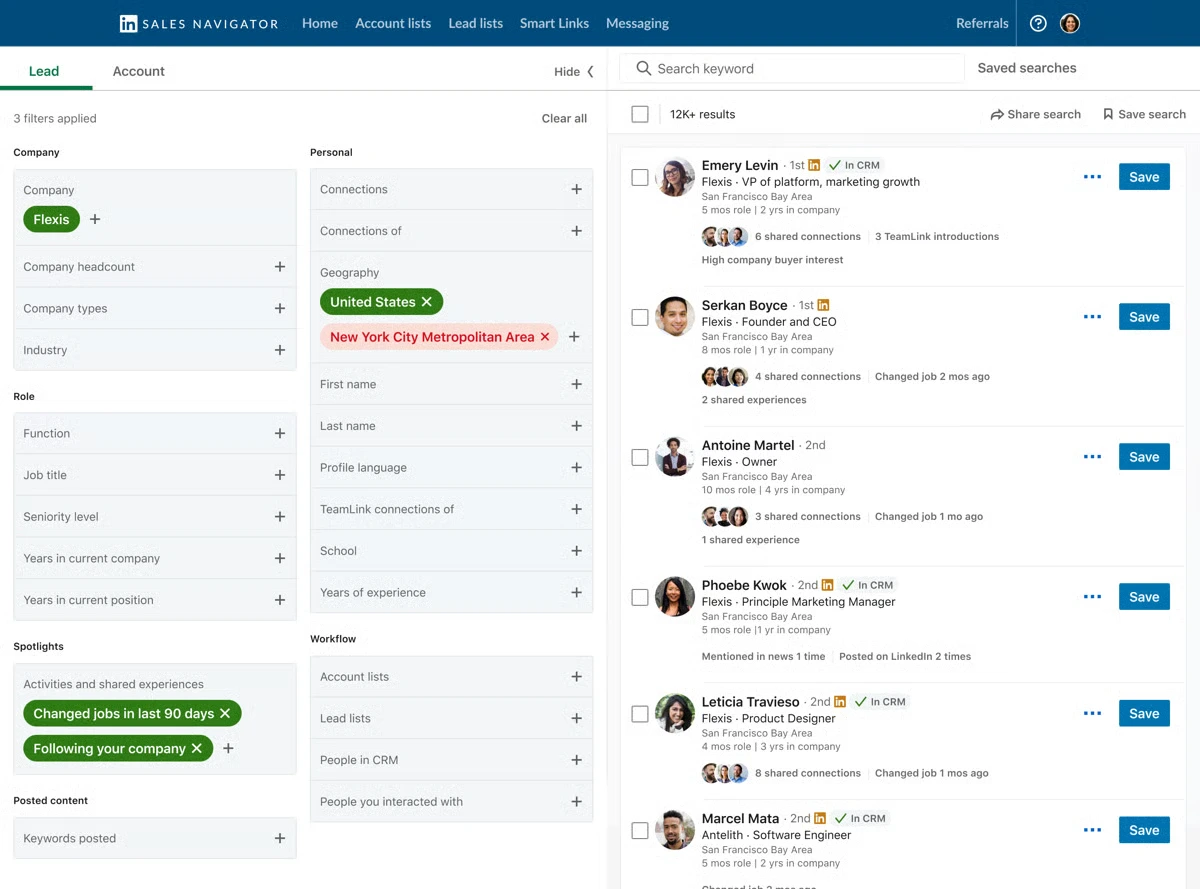
Open lead search and add filters from the panel on the left, such as Seniority Level, Function, Changed Jobs, Buyer Intent and Viewed Your Profile Recently. There are more than 50 filters in total, and a few, like People in CRM, are only on Advanced Plus. Save a search, and Sales Navigator alerts you whenever a new lead or account matches it.
“After paying USD 120, I’ve been unable to conduct effective lead search. After 5-10 different lead searches, my ability to find leads get auto-blocked by the platform.” (Rafael Sarim O. on G2)
What it does well
The data comes straight from LinkedIn. When a buyer changes jobs, the Changed Jobs filter picks it up right away, without the delay you get from third-party tools that copy LinkedIn’s data.
Pricing
Core costs $119.99 per license per month, or $1,079.88 a year billed annually. Advanced costs $159.99 a month. Eligible members can get a free trial, but a card is required.
What running Sales Navigator standalone requires
Sales Navigator finds people and lets you message them, and that’s where it stops. It gives you no email addresses, no multi-step sequences and no post publishing. Turning a saved lead into a real conversation still means doing your own outreach on LinkedIn, one message at a time.
Best for
A founder or account executive selling to a defined list of a few hundred companies, who wants to know the week a buyer changes jobs.
11. Dux-Soup (STACKED)
Best for Solo Users and Small Teams
Ratings: 4.4/5 on G2
LinkedIn coverage
- Drip campaigns: (delays you set between steps)
- Connection requests, visits and follow-ups:
- Runs with your laptop closed: (cloud plan only)
- Lead tagging and management:
- Contact database:
- Company page publishing:
Dux-Soup is now sold as STACKED, powered by Dux-Soup, the same LinkedIn automation tool under a new product name.
What it actually looks like
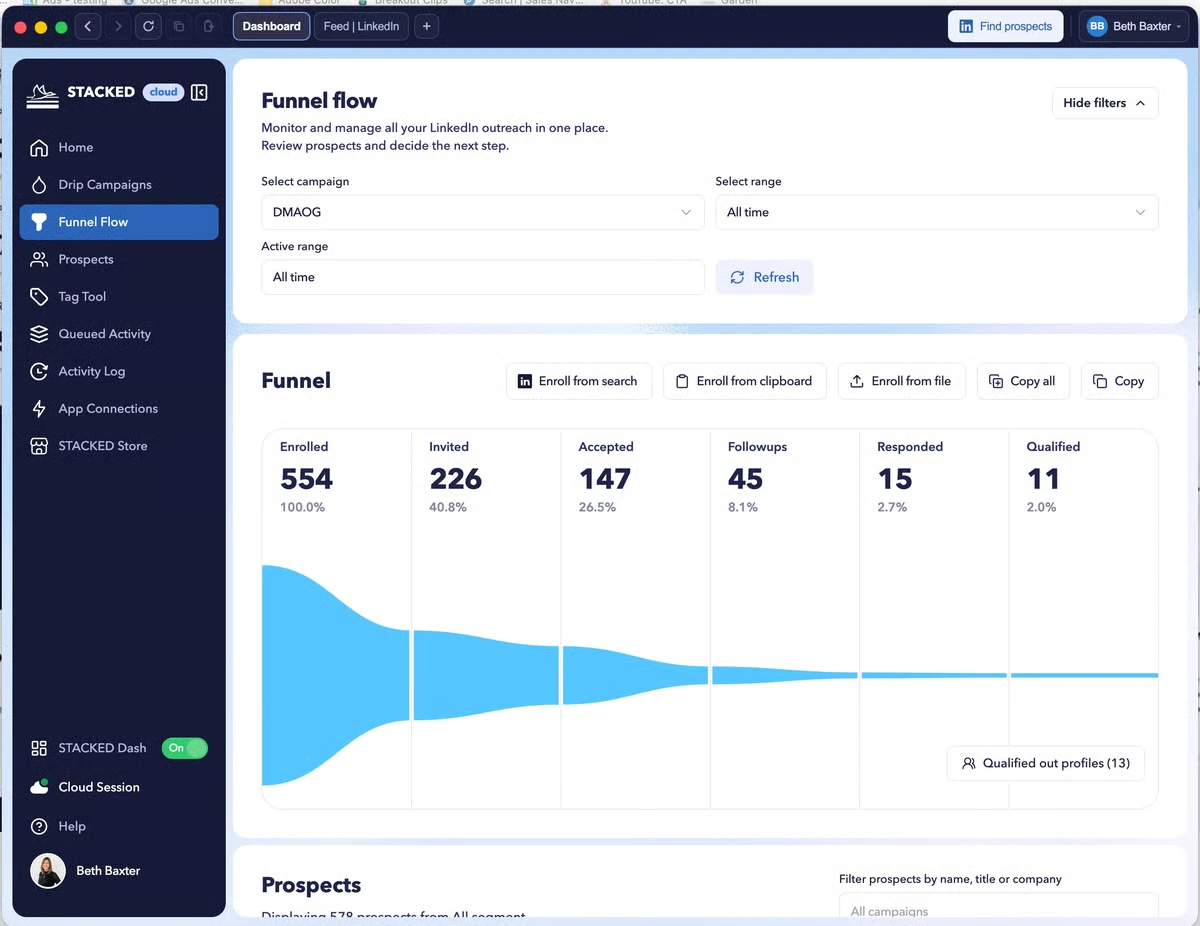
You build a drip campaign step by step. A connection request goes first, then a profile visit, then a follow-up message, and you choose how long to wait between each one. STACKED local is a desktop app for Mac or Windows that runs on your own computer. You manage campaigns from a browser dashboard. If you want campaigns to keep running when your laptop is closed, you need the cloud plan.
“I love how it models the human interaction factor as to allow you to stay within LinkedIn’s automation rules.” (Tim C. on G2)
What it does well
It’s cheap to start and easy to understand. Each seat gets unlimited drip campaigns, and you control the delay between every step.
Pricing
STACKED local costs $41.25 per seat per month billed annually ($55 billed monthly). STACKED cloud costs $74.17 ($99 billed monthly). Trial terms aren’t published.
What running Dux-Soup standalone requires
The risk falls on your own LinkedIn account. LinkedIn’s rules ban tools and extensions that automate activity on the site, and accounts that use them can be restricted or shut down. Longer delays between actions make that less likely, but they can’t rule it out.
Best for
A solo consultant or a three-person agency that sends a few dozen connection requests a day and would rather pay $55 a month than hire an outbound team.
12. Leadfeeder (by Dealfront)
Best for Identifying Website Visitor Companies
Ratings: 4.3/5 on G2
LinkedIn coverage
- Website visitor company identification:
- Saved feeds and filters:
- Verified contacts: (Activate plan and up)
- CRM sync: (Discover plan and up)
- LinkedIn messaging or posting:
Dealfront is now the parent company, and the product is still sold as Leadfeeder. Dealfront.com redirects to leadfeeder.com.
What it actually looks like
The dashboard opens with a chart of the companies visiting your website and a list of recent visitors below it. Go to Web Visitors to build saved feeds, for example companies above a certain size, or visitors who came from one Google Ads campaign. Then tag the accounts worth following up. Leadfeeder names these companies even when nobody fills in a form.
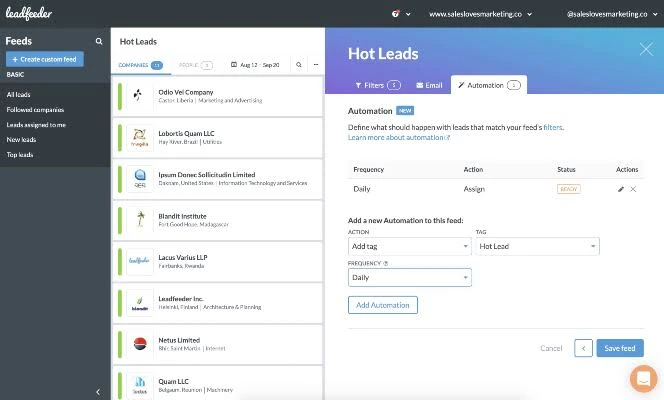
“Their so-called IP recognition service actually misidentifies many companies as the carriers they use or whatever. As a medical instrument company, it’s not a hard guess who would visit our website.” (Sherry T. on G2)
What it does well
It shows an account-based sales team which companies are interested right now, so reps can reach out this week instead of next quarter. Every plan includes unlimited users with no per-seat fees.
Pricing
Lite is free. Discover starts at €79 a month billed annually (€113 billed monthly), with unlimited users. Paid plans come with a 14-day free trial.
What running Leadfeeder standalone requires
Leadfeeder tells you the company, not the person. On plans below Activate, you find the right contact on LinkedIn yourself. The product has no messaging, posting or sequences, so you’ll still need a plan for using LinkedIn for business.
Best for
A B2B marketer whose website gets a few thousand visits a month and whose sales team keeps asking which accounts are showing interest.
13. Crystal
Best for Personality-Driven Sales Communication
Ratings: 4.6/5 on G2
LinkedIn coverage
- DISC prediction on LinkedIn profiles:
- Works in Sales Navigator and Recruiter:
- Meeting briefings and how-to guides: (Premium plan)
- Free predictions: (10 profiles on the free plan)
- Sending or scheduling:
Crystal is the odd one out here, because it does not schedule, send or find anything. It reads a LinkedIn profile and predicts the person’s DISC personality type, so you know whether to open your message with the numbers or with small talk.
What it actually looks like
With the Crystal Chrome extension installed, open a LinkedIn profile and click the View Personality tab on the right edge of the page. A side panel opens with the person’s predicted DISC type, such as “Di Driver”, a DISC wheel and a short note on how they tend to communicate. It works the same way in Sales Navigator and LinkedIn Recruiter. Each profile you check is saved in your Crystal dashboard under Sales > Customers.
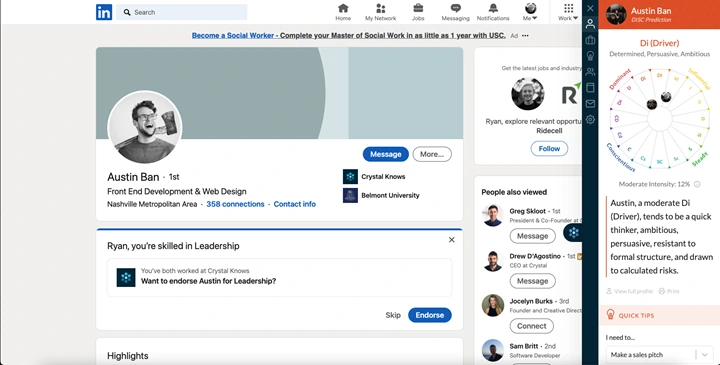
LinkedIn profile with Crystal’s side panel open, showing a Di Driver DISC type, the DISC wheel and a description
“I find it a fascinating tool for establishing much more meaningful business and working relationships based on the traits of the people we deal with. It is really easy to use and covers a lot of aspects of personality, tastes, needs, and relationships with people.” (Olga R. on G2)
What it does well
It helps your first InMail or connection note sound less generic, which is where most LinkedIn outreach, including messages sent by the tools above, falls flat.
Pricing
The free plan covers 10 profile predictions. Premium costs $49 a month or $490 a year per person, and Premium Team costs $49 per seat per month.
What running Crystal standalone requires
Crystal only gives advice, so you need other tools to find, message and follow up with people. Its read is also a prediction based on what someone wrote about themselves. Crystal says its predictions are typically 80% accurate, which means about one in five may steer you wrong.
Best for
An account executive who writes a dozen high-stakes InMails a week to senior buyers, already has a prospecting tool, and wants each message to suit the person reading it.
Additional LinkedIn Marketing Tools Worth a Look
Growfol
Growfol does less than anything in the main list. It’s an AI writing helper for LinkedIn posts and carousels, and its plans are priced by the number of company pages you manage. Creator Starter costs $19 a month, billed monthly, for one company page and 50,000 AI tokens per billing period.
Growfol Pro costs $29 a month, billed monthly, for three company pages, full analytics and a feature it calls “auto-plug comments.” Both plans start with a 7-day free trial, and there’s no free plan.
It suits a founder who posts on LinkedIn every week and wants help turning rough ideas into carousels, without paying for a full social media suite.
What to Look for in a LinkedIn Marketing Tool
Outline Your Goals
Before you open a single pricing page, write down the one LinkedIn task that takes up most of your time. That task tells you which kind of tool to buy.
- If your company page posts go out late or not at all, you need a scheduler.
- If your reps send connection requests one at a time, you need outreach automation.
- If your reps know who to contact but can’t reach them, you need a contact data tool.
Ease of Use
Look at what the tool asks you to do on day one, because setup effort varies a lot on this list. Crystal takes one click on a View Personality tab. PhantomBuster asks you to paste search URLs, set export limits and work in CSV files.
Some tools also have rules that catch new users out. Dripify lets you add actions to a live campaign but never remove them, so plan the whole sequence before you launch. Dux-Soup’s local plan only runs while your own computer is on.
Scalability
Check what happens to the price and the limits when you add your next client or rep.
- Sprout Social: the two lower plans stop at five social profiles.
- RocketReach: contacts are capped per year, from 1,200 on Essentials to 20,000 on Ultimate.
- PhantomBuster: grows by automation slots and run time, not by seats.
- Expandi: the Agency plan starts at ten seats and adds a white-labelled workspace.
- SocialPilot: each plan includes a set number of accounts and users. An extra account costs $4 a month and an extra user $5 a month.
Compatibility
Several of these tools only work if you also pay for another subscription.
- Salesloft’s LinkedIn steps need a Sales Navigator license.
- Lemlist’s InMail step needs LinkedIn Premium on the sending profile.
- Crystal works inside Sales Navigator and LinkedIn Recruiter.
For CRM sync, you need Leadfeeder on Discover or higher, Sales Navigator on Advanced Plus, or Salesloft working inside Salesforce.
Data Security
This is where outreach tools and schedulers differ most. A scheduler publishes posts to your own page. An outreach tool sends requests and messages as you, from your personal account, and that carries much more risk.
LinkedIn doesn’t publish an official limit on connection requests either, so safe volumes are a best guess based on vendor advice, such as PhantomBuster’s.
Two more things to know before you connect your account:
- Expandi says you use it at your own risk, even with a dedicated IP address for each account.
- PhantomBuster connects through your LinkedIn session cookie, the small file that keeps you logged in, so it acts as you.
Pricing and ROI
Check what you’re billed for before you compare prices. Per-user, per-seat and per-account plans look alike until the invoice arrives.
| Billing basis | Tools | What it means for you |
| Per user or seat | Hootsuite, Sprout Social, Lemlist, Expandi, Dripify, Dux-Soup, RocketReach, Sales Navigator, Crystal | Every new person adds to the bill. Three Hootsuite seats on Professional cost $597 a month. |
| Per plan, users included up to a limit | SocialPilot | Each plan includes a set number of users, and each extra user costs $5 a month. |
| Per account, unlimited users | PhantomBuster, Leadfeeder | The whole team shares one plan. |
| Quote only | Salesloft | No published price. |
Count the other subscriptions a tool needs as well. Salesloft plus Sales Navigator plus a CRM is three contracts.
Reporting and Analytics
Decide who will read the reports, because each tool reports for a different reader.
- A marketing lead presenting page results: Sprout Social’s LinkedIn Pages Report shows audience demographics, including seniority and top job functions, but not country, gender, or age breakdowns due to LinkedIn API limitations.
- Agency clients: SocialPilot sends scheduled, white-label PDF reports.
- A sales manager: Dripify’s Advanced plan provides visibility into each rep’s campaigns, while Salesloft tracks every touchpoint in a sales cadence.
If page performance is your main need, our guide to LinkedIn analytics tools covers that side in more depth.
Which LinkedIn Marketing Tool Should You Choose?
If You Need Scheduling and Publishing
- Choose SocialPilot if you’re an agency or in-house team posting to many LinkedIn profiles and company pages, and a client or manager has to approve each post first. Client approval and white-label reports start on the Premium plan, which includes six users. After that, each extra user costs $5 a month, so the bill grows slowly as your team grows.
- Choose Sprout Social if your main job is reporting LinkedIn page results to leadership every month. Its reports are the reason to pay for it, and the 30-day free trial gives you a full month to test the LinkedIn Pages Report on your own data.
- Choose Hootsuite if you work at a large company where IT will ask for SSO and compliance controls, and software budgets are set per employee. Approvals only come with Advanced, so price that plan rather than Standard.
None of these three sends outreach. If you also need to reach buyers one by one, add a tool from the next two groups.
If You Need Outreach Automation
- Choose Lemlist if you prospect by email first and want a LinkedIn invitation to go out when two emails get no reply. Budget for the Multichannel plan, because the Email plan has no LinkedIn steps.
- Choose Dripify if you run a small sales team where each rep uses their own LinkedIn account and you want to see every campaign in one place.
- Choose Expandi if you’re an agency running outreach from client accounts, because each account gets its own IP address.
- Choose Dux-Soup (now STACKED) if you’re a solo consultant on a tight budget. It costs $55 per seat billed monthly.
- Choose Salesloft if you manage a large SDR team on Salesforce and need LinkedIn, email and calls in one cadence you can review later.
Whichever tool you pick, add Crystal if you write to a small number of senior buyers. It helps you pitch each message to the person reading it.
If You Need Sales Prospecting and Data Enrichment
- Start with LinkedIn Sales Navigator if you sell to a defined list of accounts and want to know the week a buyer changes jobs. The data comes straight from LinkedIn.
- Add RocketReach when you have the right names but no email addresses. Test it on your own list with the five free lookups before you pay.
- Choose Leadfeeder if you want to know which companies are already reading your website. It names the company, not the person, so pair it with Sales Navigator to find the right contact.
- Choose PhantomBuster if you need a few thousand LinkedIn profiles exported to a spreadsheet each month for someone else to contact.
- For high-stakes InMails with any of these tools, Crystal gives you a personality read before you write.
Is RocketReach Legit?
Yes. RocketReach is a legitimate company that has sold contact data for about a decade, and many sales teams use it. However, verify contact details before relying on them and check your renewal date to avoid unexpected charges.
RocketReach was founded in 2015 and says it is trusted by over 30 million users and 95% of the S&P 500. These are company-reported figures, not independent verification. Its security page also confirms that it is SOC 2 Type II and ISO 27001 certified, addressing concerns about its security and compliance practices.
The review sites split hard. Business users rate it 4.4/5 on G2, and some of them praise the exact thing its critics attack. One G2 reviewer, Thomas C., wrote that “the thing I like most about RocketReach is the accuracy of the data.”
On Trustpilot it scores 1.2 out of 5 from about 1,115 reviews. That average hides a polarized split, with roughly 38% of reviews at five stars and 39% at one star, and Trustpilot notes that the company has not replied to its negative reviews. The one-star complaints keep coming back to two things.
- Data accuracy. “Their data is about 50% accurate,” one reviewer wrote (Matt Rice on Trustpilot).
- Auto-renewal. Annual plans renewed without the buyer expecting it. “We found no renewal reminder in the account’s mailbox, spam included,” wrote Gustavo Souza on Trustpilot.
You can test the first problem before you pay anything. The free account gives you five lookups with no card, so spend them on five people whose emails you already know and count how many come back right. If you then buy an annual plan, put the renewal date in your calendar the same day.
Start With the Job That Costs You the Most Time
Most teams end up with two LinkedIn tools, not one. None of the LinkedIn marketing tools here covers more than two of the four jobs, so start with the job that costs you the most time.
- Your company page and founder profile go quiet for weeks: fix publishing first.
- Your reps send connection requests by hand: add outreach automation.
- Your reps can’t find the right email address: add a contact data tool.
Whatever you pick, keep account risk in mind. Outreach tools act as you on LinkedIn, and LinkedIn’s rules let it restrict accounts that use them. Keep your volumes low, and only connect a profile you can afford to lose.
If publishing is the problem, SocialPilot schedules posts to your LinkedIn profiles and company pages, sends them to clients for approval and reports on the results. Start a 14-day free trial, with no credit card needed.
Frequently Asked Questions
What is the 3/2/1 rule on LinkedIn?
LinkedIn has no official rule by this name. It’s an informal posting guideline that commonly suggests sharing three value-driven posts, two engagement-focused posts, and one promotional post each week. Other versions use different ratios, so treat this as a flexible starting point for planning your content calendar.
What are the top 10 LinkedIn automation tools?
There’s no official top 10. This article covers six tools for LinkedIn outreach: Lemlist, PhantomBuster, Expandi, Dripify, Dux-Soup (now STACKED), and Salesloft. LinkedIn Sales Navigator supports InMail and saved-search alerts but not automated sequences. SocialPilot, Hootsuite, and Sprout Social focus on automating content planning and publishing.
How do I use LinkedIn as a marketing tool?
Focus on two areas: content and outreach. Publish consistently from your company page and founders’ profiles to maintain an active brand presence, then connect with potential buyers through connection requests, InMail, and follow-ups. Prospecting tools help identify relevant contacts, while website visitor data can reveal companies already showing interest in your business.
What happened to Leadfeeder?
Leadfeeder is still available under the same product name, while Dealfront is the name of its parent company. Dealfront.com redirects to leadfeeder.com, where the product offers a free Lite plan and paid plans starting at €79 per month with annual billing. It identifies companies visiting your website, including those that leave without submitting a form.
About the Author